Little Foot’s face looks like it has been through a slow-motion car crash, because it has.
For millions of years, rock pressure and shifting sediments pushed and twisted the fossil’s facial bones until the front of the skull no longer fit together in a way scientists could safely fix by hand. Now, a new digital rebuild of that face is offering a sharper view of how early hominin faces varied across Africa around 4 to 3 million years ago.
Little Foot, formally cataloged as StW 573, comes from the Sterkfontein Caves about 40 kilometers northwest of Johannesburg, inside South Africa’s Cradle of Humankind World Heritage Site. It is described as the most complete early hominin skeleton ever found. The skeleton has fueled research for years, but the face remained a stubborn problem.
An international team led by Dr. Amelie Beaudet and Professor Dominic Stratford digitally reassembled the face using high-resolution synchrotron scanning at the Diamond Light Source in the United Kingdom and virtual reconstruction methods. The work was published in Comptes Rendus Palevol.
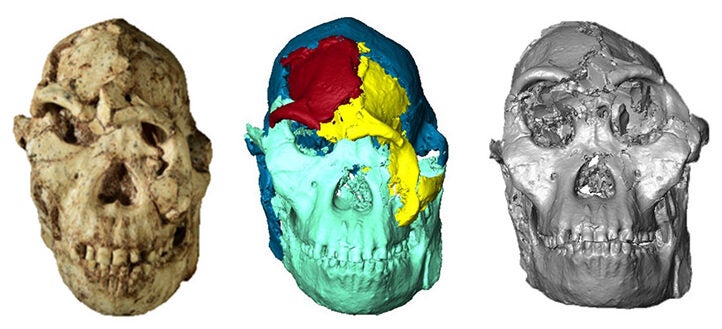
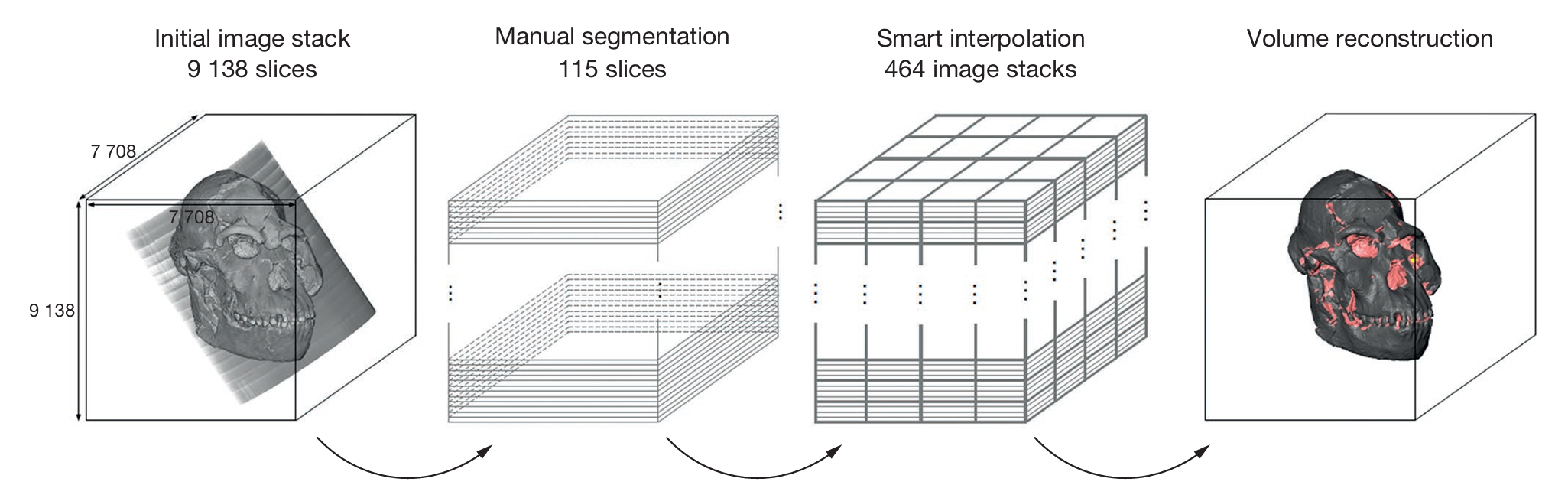
They scanned the skull in 2019 with synchrotron X-ray micro-computed tomography, then used segmentation tools to separate bone and teeth from surrounding rock. The team describes a semi-automated workflow that combined manual work on a limited set of slices with “smart interpolation” to build a full 3D volume.
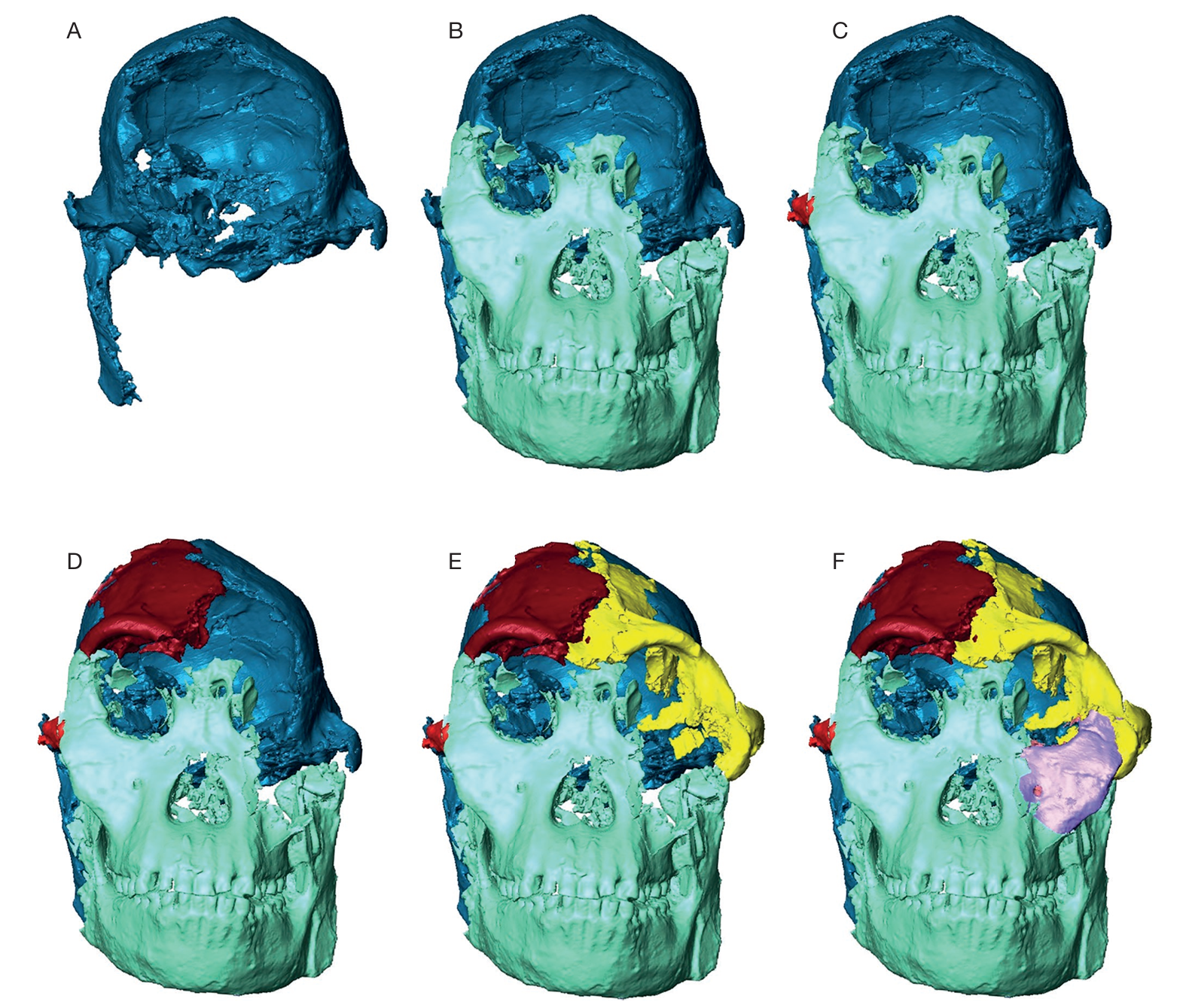
From there, they treated the skull like a broken sculpture in five big chunks. One block held the braincase and part of the jaw. Another carried most of the upper and lower face. Other blocks included parts of the zygomatic arch and the frontal bones. They aligned and rotated these pieces digitally, without correcting for plastic deformation. To rebuild the missing left maxilla, they mirrored the intact right side and trimmed overlaps.
That choice matters. The reconstruction is digital, but it is not magic. When rock pressure has bent bone, a clean fit is not always possible.
With the face reassembled, the researchers compared Little Foot to a mix of living primates and a small set of fossil faces.
Their extant sample included adult gorillas, humans, common chimpanzees, bonobos, and orangutans, with equal proportions of females and males. Those specimens came from several museums and collections, including the British Museum and Harvard’s Museum of Comparative Zoology, among others. The human crania came from the Pretoria Bone Collection and the British Museum, and the team notes ethics clearance for that work.
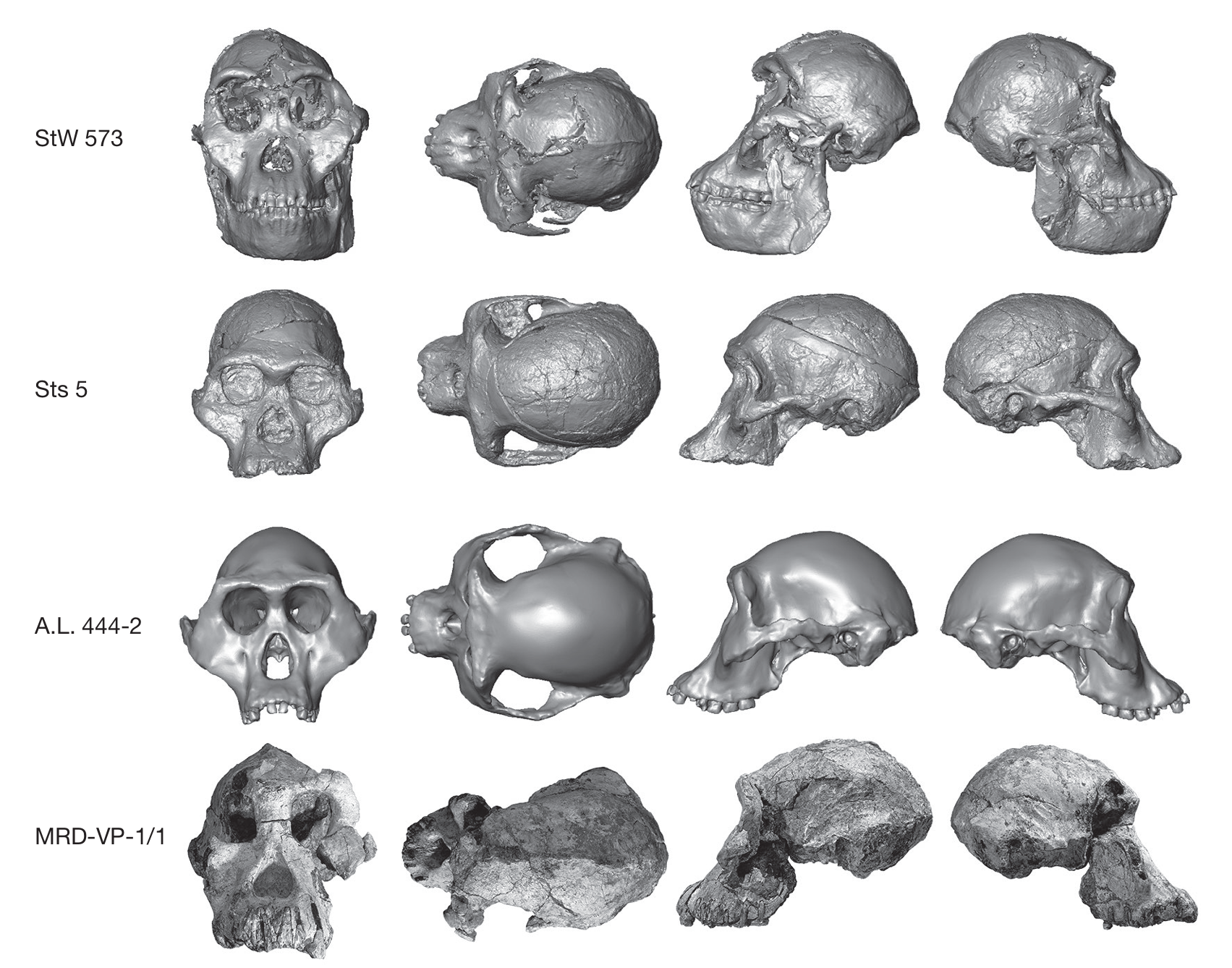
On the fossil side, they focused on three key comparators: Sts 5 (an Australopithecus africanus skull from Sterkfontein Member 4 dated to about 3.4 to 3.5 million years old), A.L. 444-2 (an Australopithecus afarensis specimen from Hadar dated to about 3.18 to 2.94 million years old), and the published description of MRD-VP-1/1 (an Australopithecus anamensis specimen from Woranso-Mille dated to 3.8 million years).
They analyzed nine linear facial measurements and also ran a three-dimensional geometric morphometrics analysis using 34 landmarks. In plain terms, that let them compare facial shape and proportions across the sample.
Here is the unexpected pattern they emphasize: Little Foot, a South African fossil, lines up more closely with the East African fossils than with the younger South African specimen used for comparison. The team points to similarities in overall facial size, the dimensions and shape of the eye sockets, and broader facial architecture.
“This pattern is unexpected, given the geographic origin of Little Foot and suggests a more dynamic evolutionary history than previously assumed,” says Beaudet, identified as a previous post-doctoral fellow and current honorary researcher at Wits University.
The paper frames a possible scenario: Little Foot may represent a lineage closely related to East African populations, while later South African hominins developed more distinct facial features through local evolutionary processes.
Stratford, who is also Director of Research at the Wits Sterkfontein Caves, puts the bigger idea this way: “Rather than viewing early hominin evolution as occurring in isolated regions, the study supports the idea of Africa as a connected evolutionary landscape, with populations adapting to ecological pressures while remaining linked through shared ancestry.”
One part of the face keeps pulling the researchers’ attention back: the orbital region.
Their shape analysis suggests that variation in the orbits plays an outsized role in how these fossils cluster. Little Foot’s orbits are described as tall and wide with an oval shape, closer to MRD-VP-1/1 and, to a lesser extent, A.L. 444-2, and different from the more rectangular orbits of Sts 5. The study also notes a wider interorbital region in Little Foot than in A.L. 444-2, and a nasal ridge feature that is absent in the comparative hominins but present in gorillas.
The team argues that selective pressures may have acted on the orbital region at this time, potentially tying the face to changes in visual capacity and ecological behavior.
“Besides the fact that our study, limited to one anatomical region and a couple of comparative fossil specimens, provides additional data on the affinities between Australopithecus populations across Africa, we demonstrate that the orbital part of the face has possibly been under evolutionary pressure at that time,” Beaudet says.
They also step back from any neat story about a straight-line march toward modern faces. “While we know that the hominin face evolved through time to become less projected and more gracile, we still ignore when such changes occur, and the nature of the evolutionary mechanisms involved.”
The face matters because it is not just a display. The researchers point out that it sits at the crossroads of breathing, feeding, smelling, seeing, and non-verbal communication. In that sense, facial bones preserve clues about how early hominins lived in their environments and among each other.
“Only a handful of Australopithecus fossils preserve an almost complete face, making Little Foot a rare and valuable reference point. Little Foot’s face preserves key anatomical regions involved in vision, breathing and feeding, and its skull will offer further key elements for understanding our evolutionary history,” Beaudet says.
One sentence keeps the work grounded.
The reconstruction is preliminary.
The team is explicit about limits, and they stack up quickly.
The analysis focuses on one anatomical region, the face. Fossil comparisons rely on very few specimens, because complete faces are rare. Sexual dimorphism could complicate interpretations, and the degree of variation in traits like the orbits is unknown within southern African Australopithecus groups.
Taxonomic questions also hover over the result. Little Foot has been attributed by Clarke and Kuman (2019) to Australopithecus prometheus, which the authors note differs from Australopithecus africanus by several craniodental characters. If that attribution holds, comparisons to Sts 5 carry added baggage.
Then there is the rock itself. The reconstruction did not adjust for plastic deformation, and the paper says deformation in the neurocranium will need correction. Beaudet notes that other parts of the skull, especially the braincase, remain distorted and will require similar digital reconstruction to better understand brain size and organization.
As additional reconstructions are completed, the researchers hope to refine how early hominins moved, interacted, and diversified across Africa, but the face alone cannot carry the whole load.
Digital reconstruction can turn damaged fossils into usable datasets without further risking the specimen. That matters when a skull is this rare.
The work also gives researchers a better reference point for comparing other fragmentary faces, especially around the eye sockets and nasal region.
Over time, this kind of reconstruction could sharpen debates about how many Australopithecus species existed, how populations across Africa related to one another, and which traits reflect local adaptation versus shared ancestry.
Research findings are available online in the journal Comptes Rendus Palevol.
The original story “Giant dark matter ‘sheet’ may shape galactic motion in the Milky Way” is published in The Brighter Side of News.
Like these kind of feel good stories? Get The Brighter Side of News’ newsletter.
The post 3.67 million year old fossil provides new insight into the evolution of the human face appeared first on The Brighter Side of News.

