For centuries, scientific progress has depended on more precise tools for measuring the world around us. Galileo’s telescope revealed Jupiter’s moons and shook the geocentric universe. Thomas Young’s double-slit experiment showed that light is a wave.
The detection of gravitational waves a few years ago opened an entirely new window into the universe. Now physicists say they have reached another tipping point. They’ve shown how to measure multiple quantum properties at the same time with a single system and with levels of precision previously off-limits.
The development was achieved by Christophe H. Valahu and Ting Rei Tan and an international team of co-authors. Their work takes a direct attack on one of the most famous obstacles of physics—the Heisenberg uncertainty principle.
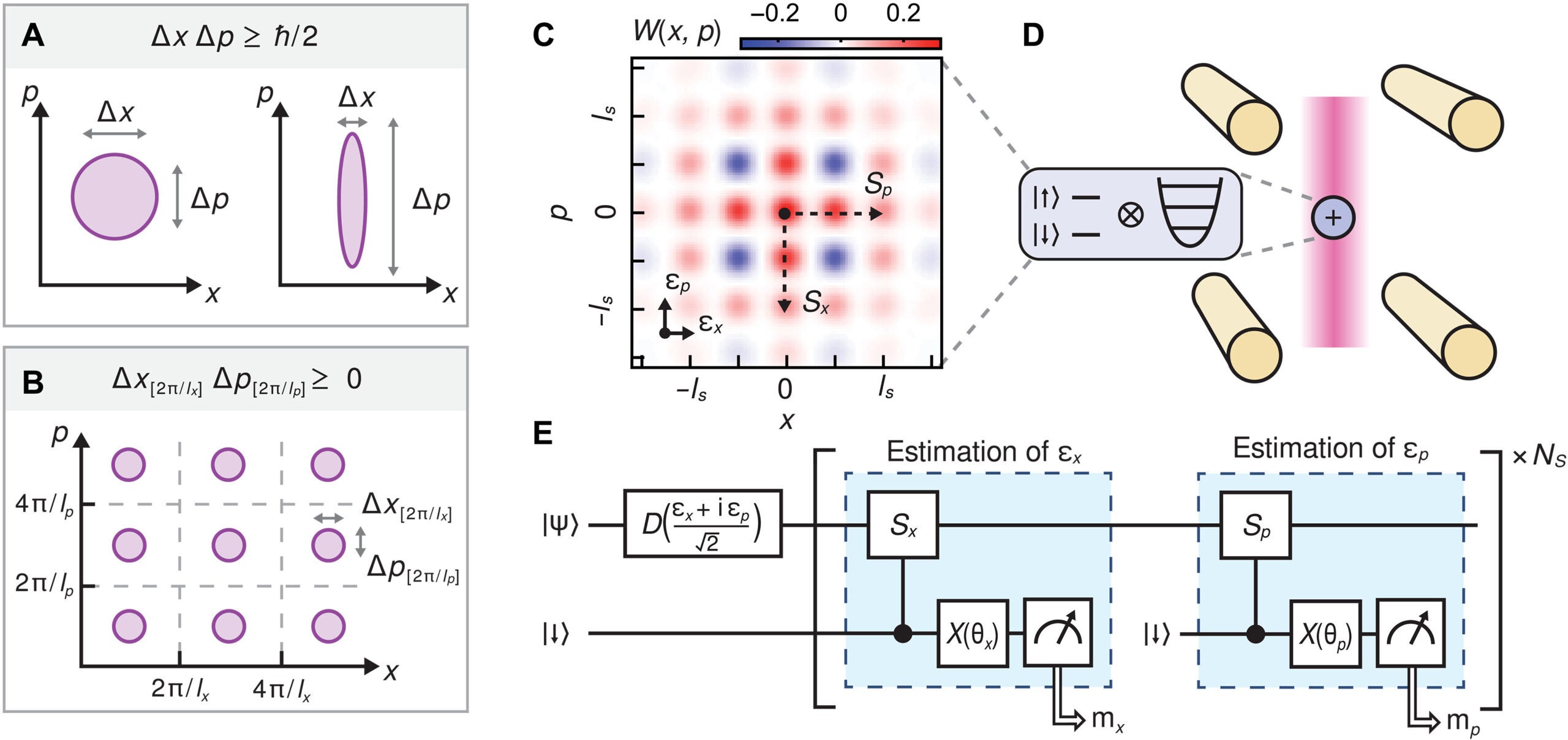
It’s a principle that has guided scientists since 1927: you can’t nail down certain pairs of properties, such as position and momentum, with infinite precision at the same time. Sharpen one measurement, and the other one inevitably blurs. But the researchers have found a clever loophole for this limit without breaking the laws of quantum mechanics.
University of Sydney‘s Dr. Tan explained the idea using a simple analogy. “Think of uncertainty as air in a balloon,” he said. “You can’t get rid of it without popping the balloon, but you can push it around to shift it.” The method the team has created compresses uncertainty into areas of a quantum system that don’t matter, creating space for accuracy where it does.
Instead of attempting to directly measure position and momentum, the researchers examined modular observables. These are variables so defined that they “commute” with each other, avoiding the conflict that would otherwise make such measurements incompatible.
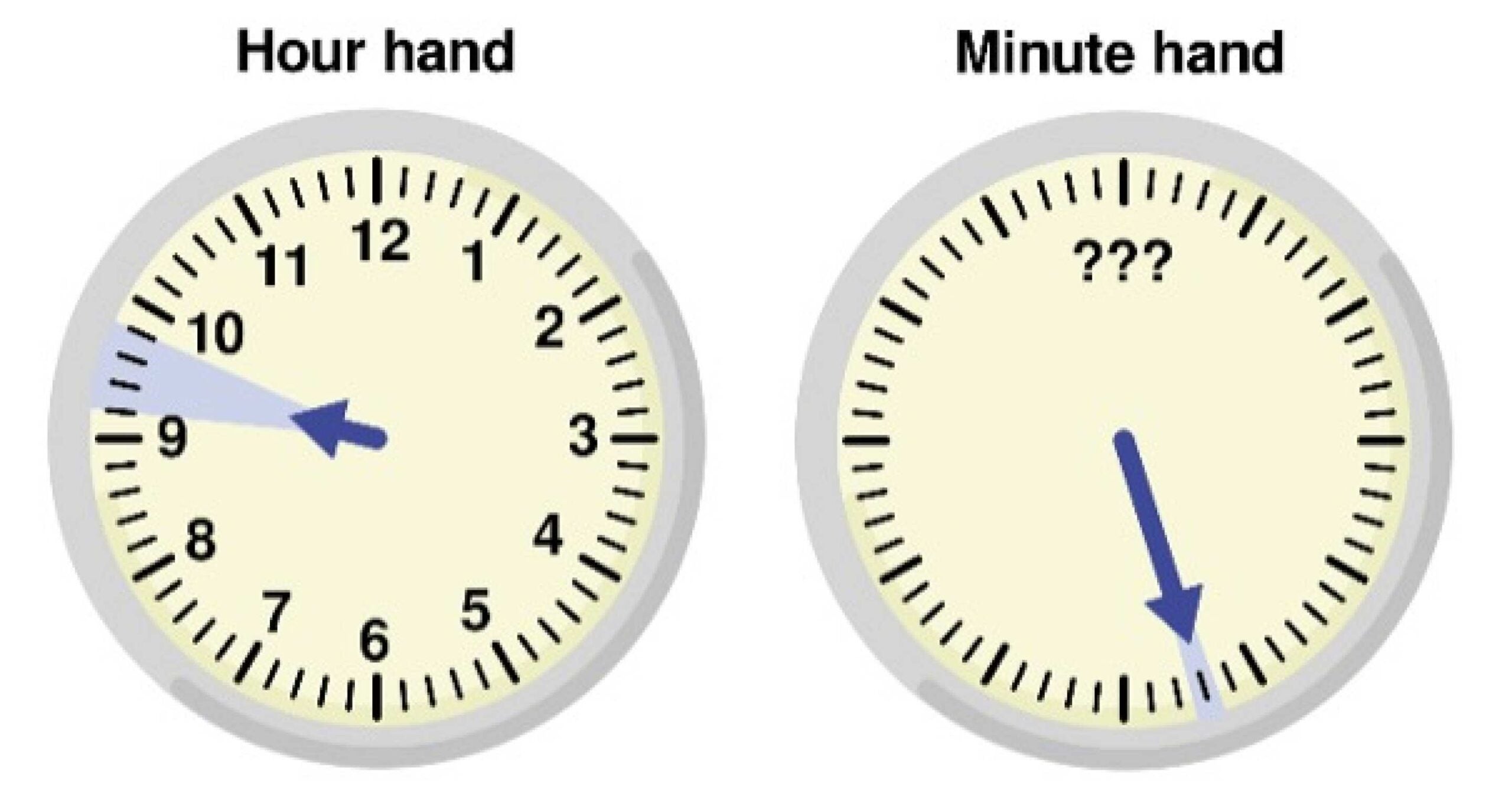
Essentially, it means discarding some global information in exchange for far better local accuracy. Christophe Valahu compared it to reading the time on a clock with only one hand. If you only notate the small, repeating information—like the minutes—you forfeit the hours but gain sharper accuracy where it matters most.
To prove that the idea is sound in practice, the team used a single trapped ion, a single atom held in place by electric fields. With carefully calibrated lasers, they place the ion in a “grid state,” a quantum pattern originally designed for error-corrected quantum computing.
In this state, the ion’s wave function looks like equally spaced peaks, somewhat like the lines on a ruler. When the ion is pushed by a small force, the whole pattern shifts. A horizontal displacement looks like a shift, and a tilt as a momentum change.
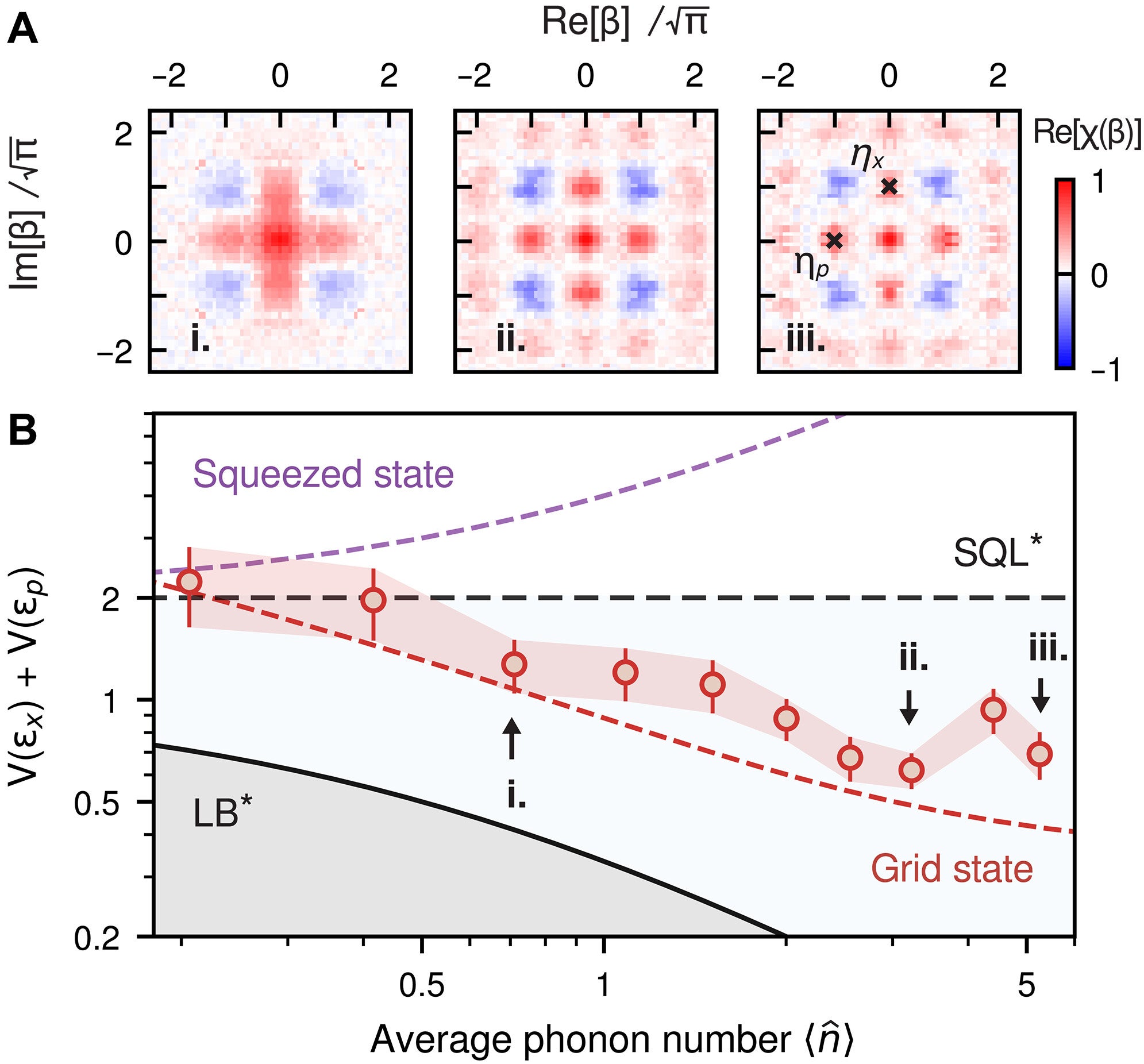
Because the measurements are sensitive only to these tiny changes, both position and momentum can be tracked at the same time with an accuracy that exceeds the so-called “standard quantum limit,” the best that can be achieved with classical methods alone. The researchers realized more than 5 decibels below this limit with their grid states—a clear demonstration of quantum advantage.
The researchers didn’t stop there. The group also explored another notoriously troublesome pair of variables: number and phase. These determine how many quanta are present in a mode and how their wave function is oriented. Number and phase, like position and momentum, are ordinarily mutually exclusive.
But by creating special “number-phase states,” the group showed that uncertainties in both could be driven below the classical limit. This was the first time such states had been realized and controlled in the lab.
Their measurements achieved more than 3 decibels of gain above the simultaneous standard quantum limit for number and phase. Although the improvement was smaller than for the grid states, it proved that the same technique could be applied to entirely different pairs of quantum properties.
To squeeze out even more precision, the group used an adaptive quantum phase estimation protocol. By dynamically changing controllable phases in the course of the experiment, they reduced errors even more. The adaptive method demonstrated how feedback and control can push quantum sensing into ranges it was previously thought unable to approach.
Valahu explained the practical use in simple terms. “In quantum sensing, we’re typically trying to measure the smallest possible changes caused by weak forces or fields,” he said. “We throw away the information that we don’t need, so we can measure what we do want to know with much greater precision.”
The implications extend far beyond individual experiments with a single ion. Extremely precise measurements underlie science and technology. Just as atomic clocks transformed navigation and telecommunications, quantum sensors can transform fields that depend on ultimate sensitivity. Potential applications include navigation in submersibles and spacecraft where GPS is inapplicable, to medical and biological imaging, to probing materials and fundamental physics.
RMIT University Professor Nicolas Menicucci, a theorist working on the project, pointed out how the research crosses disciplines. “Ideas originally conceived for fault-tolerant quantum computers can be repurposed so that sensors can measure fainter signals without being swamped by quantum noise,” he said. The crossover shows how advancement in one area of quantum science can lead to breakthroughs in another.
The project involved physicists from Australia, Britain, the United States, and Europe. Researchers were from universities including the University of Sydney, RMIT, the University of Melbourne, Macquarie University, and the University of Bristol.
The work was funded by the U.S. Office of Naval Research Global, the U.S. Army Research Office, the Air Force Office of Scientific Research, the Australian Research Council, and Lockheed Martin. Dr. Tan said that this partnership is an example of the strength of international collaboration and the ties that propel discovery forward.
The central message of the paper is that quantum constraints previously seen as hindrances can be turned into tools. By appropriately choosing what to measure and what to define, physicists can make incompatible quantities compatible. The team summarized their paper by saying that they had reported on “previously unidentified measurement capabilities unavailable to classical systems.”.
The results do not defy Heisenberg’s principle, but they redefine its boundaries in a way that can lead to new generations of sensors. While the forces measured in this experiment were not record breakers, the fact that such sensitivity emanated from a single atom in a relatively straightforward experiment is remarkable in itself. It suggests that exquisite sensitivity need not be the domain of enormous, costly machines.
The study offers a path to ultra-sensitive equipment that would improve daily life as well as fundamental science. In medicine, quantum sensors would allow doctors to track changes in the body with much greater precision.
In navigation, they could guide submarines or spacecraft through the environment where GPS doesn’t work. In physics, they could reveal hidden forces or test theories about the universe.
By pushing measurement beyond the classical limits, this research adds a powerful new tool to the quantum sensing toolkit—one that could eventually yield benefits across a wide range of society’s sectors.
Research findings are available online in the journal Science Advances.
Like these kind of feel good stories? Get The Brighter Side of News’ newsletter.
The post New quantum discovery challenges Heisenberg’s uncertainty principle appeared first on The Brighter Side of News.

