Plastic waste has haunted the world’s oceans for decades. What you may not realize is that the most dangerous pieces are often the ones you never see. Far below the ocean’s glittering surface, trillions of tiny plastic shards are quietly spreading through deep waters, drifting for decades and sinking into places once thought to be untouched.
A new study published in Environmental Science & Technology shows how these “small microplastics” move through the sea in complex ways. The findings come from researchers at Kyushu University, who tracked plastic particles smaller than the width of a grain of sand and discovered they do not simply float or sink. They linger, travel, and settle in secret patterns that could reshape marine life for generations.
“When these microplastics degrade further to 10–300 µm, we call them small microplastics. Many researchers are investigating the distribution and movement of microplastics in the ocean. However, when they reach that size, they become harder to collect and analyze,” said Professor Atsuhiko Isobe of Kyushu University’s Research Institute for Applied Mechanics. “There was no standardized protocol to evaluate the presence of small microplastics in the ocean that could minimize contamination, particle loss, and potential fragmentation.”
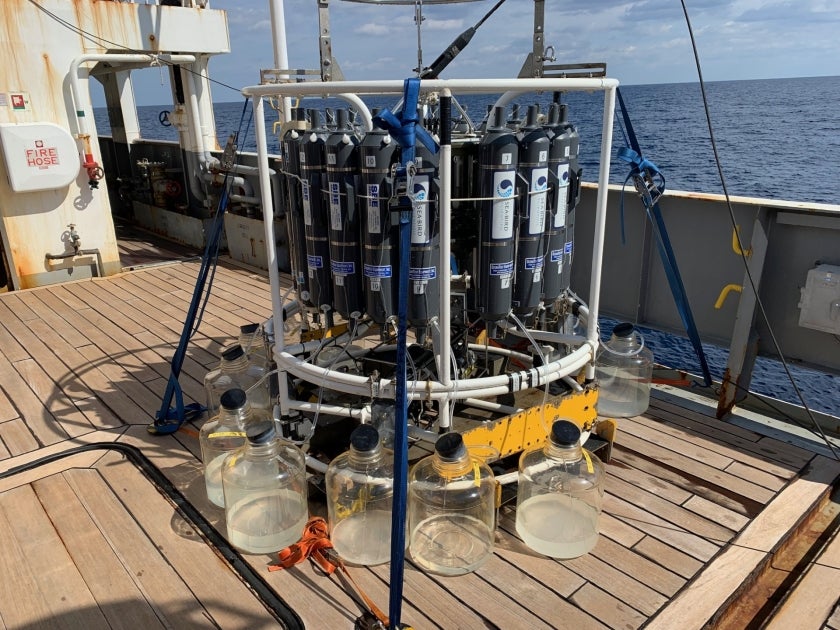
To find out where these tiny plastics go, scientists boarded the research vessel Umitaka-maru and set sail across the western North Pacific in late 2022. They sampled water at 12 depths, from the ocean surface down to about 3,300 feet. Each stop brought samples from calm tropical waters and swirling currents alike.
Collecting plastic this small is tricky. Airborne fibers can sneak into samples. Plastics can break apart during testing. Even tools used on deck can introduce stray particles. To avoid this, the team built a clean booth on board the ship and filtered seawater using plastic-free equipment. Every step was closely monitored to stop contamination.
Back on land, filters holding these particles were treated gently to remove natural matter while leaving plastic intact. The scientists then used infrared tools to identify the type of plastic in each particle. Common materials like polyethylene, polypropylene, and polyester revealed what everyday items had quietly traveled thousands of miles to reach the deep.
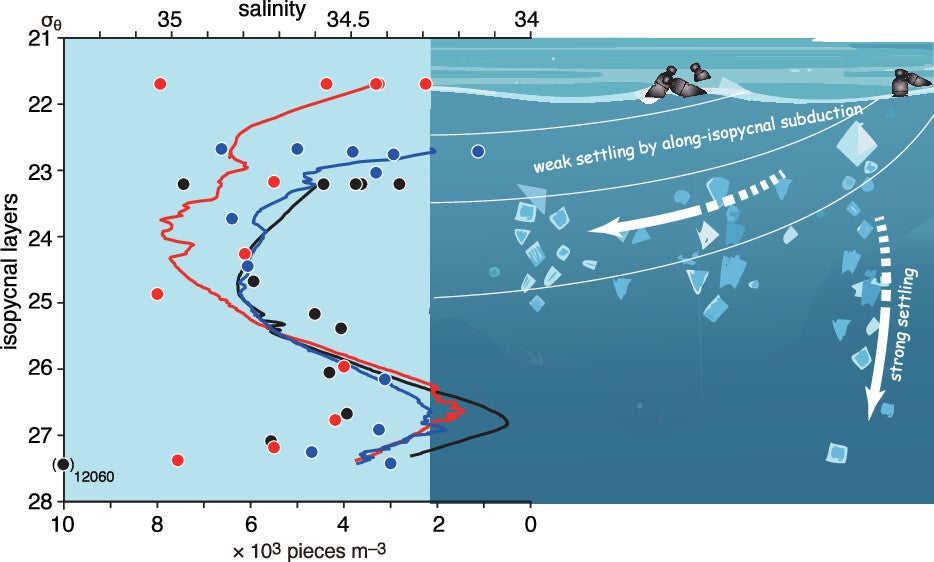
The results were unsettling. At nearly every depth, from the surface to dark waters far below, plastic was present. The average concentration reached nearly 7,000 particles per cubic meter of seawater, with some layers holding more than 14,000 particles.
Most of the plastics were smaller than 100 micrometers. That is thinner than a human hair. Nearly all were jagged fragments rather than threads. While lighter plastics should float, they were found deep underwater too. Heavier materials were common there as well.
The pattern was not simple. Plastic levels did not fade with depth as many expected. Instead, researchers found hidden “clouds” of plastic drifting below the surface, trapped in underwater layers that stretch across oceans like invisible roads.
Researchers discovered that these plastics sink in two distinct ways.
Some quickly become heavy as algae and bacteria stick to their surfaces, making them fall straight toward the seafloor. These pieces settle in waters that may not mix back to the surface for hundreds of years.
Other plastics turn almost weightless in seawater. These pieces slip into deep layers where water density matches their own. There, they drift sideways for decades, carried by slow-moving currents across vast distances.
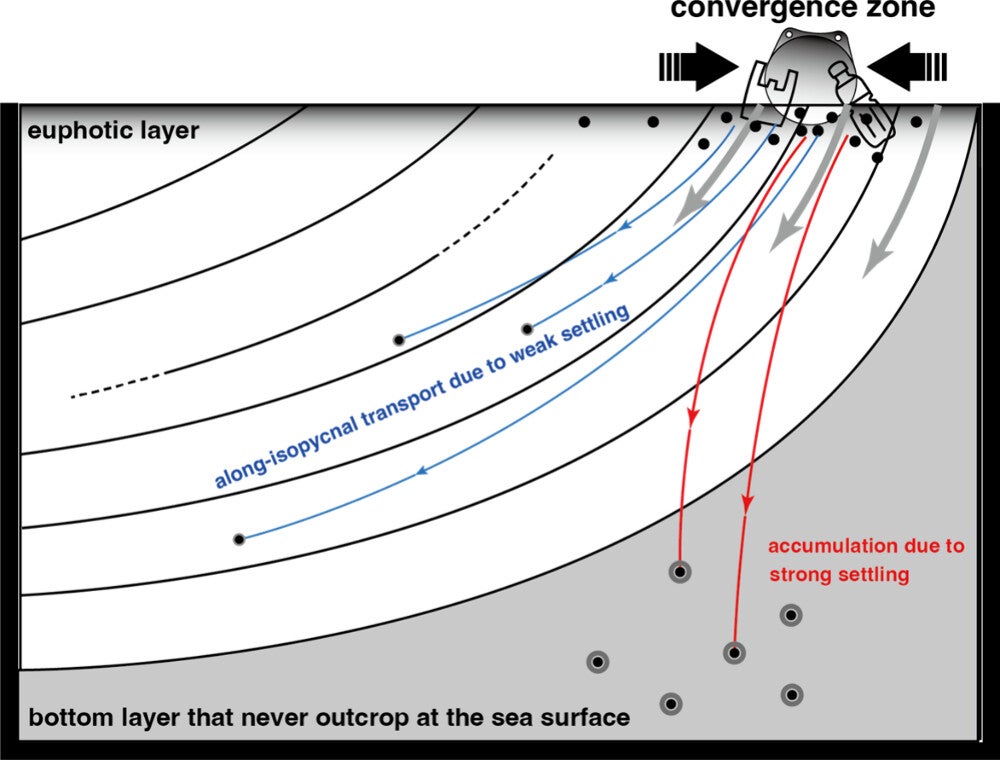
“Our findings revealed that small microplastics reach sea depths via two distinct pathways: drifting and sinking,” Isobe said. “In the first pathway, small microplastics reach neutral buoyancy with the seawater. They then drift in an area of the ocean where water density is between 1,023 and 1,025 kilograms per cubic meter at depths of about 100 to 300 meters. These small microplastics will drift through this layer for approximately 20 to 40 years.”
This slow movement turns the deep ocean into a plastic storage zone. Once inside, many particles may never return to the surface. Some sink even further, locked away in waters that have no direct contact with the air or sunlight above.
Plastic production continues to rise worldwide, and these tiny fragments are piling up beneath the waves. Scientists say the hidden buildup could threaten deep-sea animals that ingest plastics while feeding. Long-term effects are still unclear, but concerns include chemical exposure, tissue damage, and food chain contamination.
“Moving forward, we want to collect more data to clarify how widely microplastics are distributed throughout the ocean. We also intend to investigate their impact on the marine environment,” Isobe said. “Understanding the environmental impact of microplastics will require more time, but our findings show that the marine environment is becoming irreversibly polluted and necessitates urgent countermeasures.”
The ocean may look endless. It is not immune.
Research findings are available online in the journal Environmental Science & Technology.
Like these kind of feel good stories? Get The Brighter Side of News’ newsletter.
The post Microplastics are filling the deep ocean faster than scientists feared appeared first on The Brighter Side of News.

