In a patch of sky about 1.2 billion light-years from Earth, astronomers have found a cosmic rarity: three galaxies caught in a merger, and all three of their central supermassive black holes are actively feeding and shining in radio waves. The system, known as J1218/J1219+1035, gives researchers a rare chance to watch how galaxy collisions can switch on black hole growth.
The work was led by Dr. Emma Schwartzman at the U.S. Naval Research Laboratory and published in The Astrophysical Journal Letters. Using high-resolution radio telescopes, the team confirmed compact radio “cores” in each galaxy. Those cores signal active galactic nuclei, or AGN, which are powered by black holes pulling in gas.
This makes J1218/J1219+1035 the first confirmed “triple radio AGN,” meaning three active black holes in one interacting group that are all detectable in radio observations. It is also only the third confirmed triple AGN system in the nearby universe.
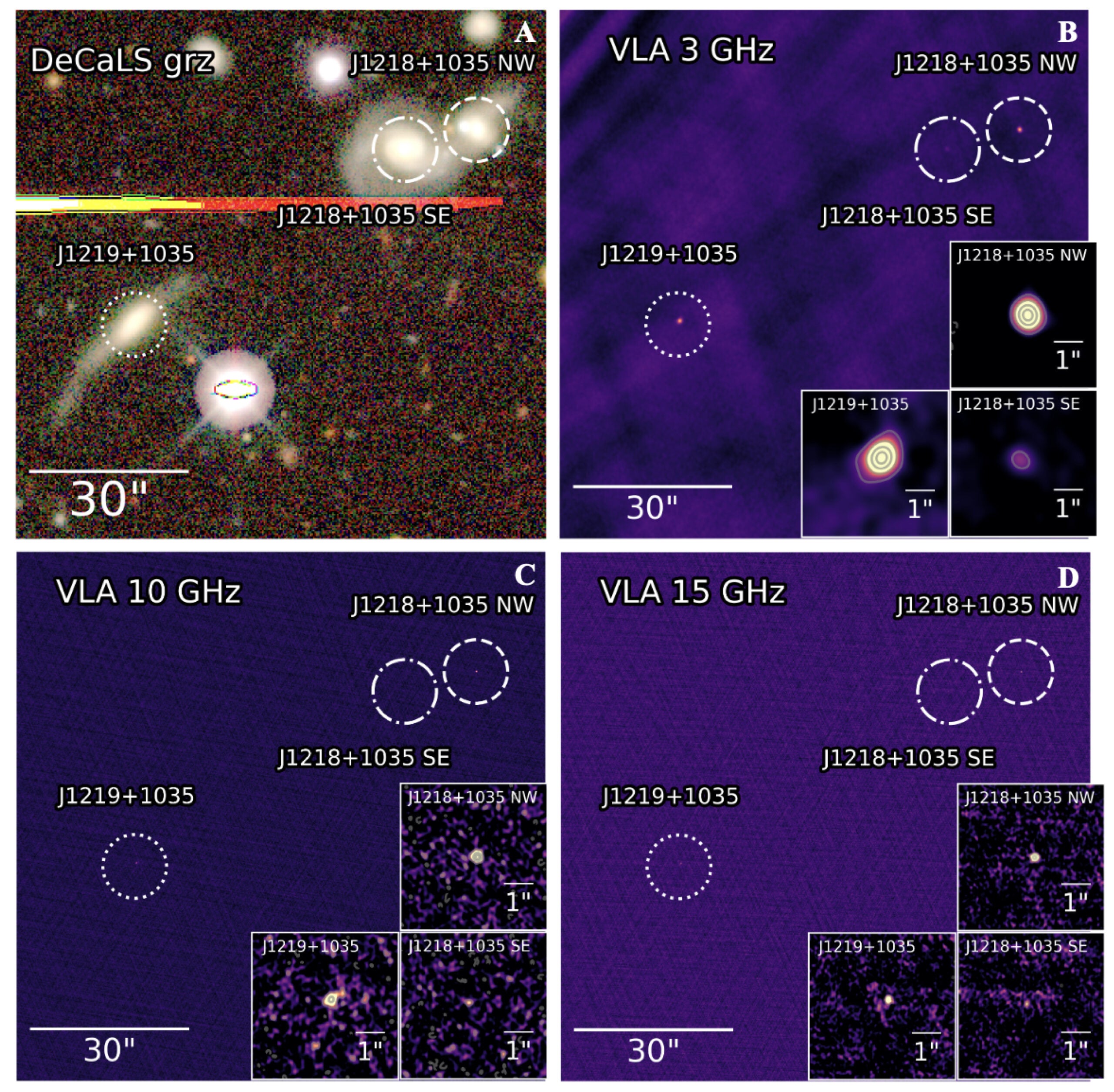
The three galaxies sit close enough to be a bound group. Two nuclei are separated by about 22.6 kiloparsecs, and the third lies about 97 kiloparsecs from the pair. The galaxies also show tidal features that trace their mutual pull. Those structures are the visual clues of an ongoing merger.
“The trail began with NASA’s Wide-field Infrared Survey Explorer, or WISE. Mid-infrared colors can flag dusty, hidden AGN that do not stand out in visible light. Our team built a parent sample of 133 candidate dual-AGN pairs from the AllWISE Bright Source Catalog using a color cut designed to pick likely AGN. We required W1 minus W2 to be at least 0.8 and used a brightness cut in W2. We also demanded strong signal-to-noise and clean photometry,” Schwartzman told The Brighter Side of News.
That search pointed to a promising pair inside J1218/J1219+1035. Two galaxies, labeled J1218+1035 NW and J1218+1035 SE, met the WISE color criteria. Their spectroscopic redshifts closely matched, and optical images showed disturbed shapes that often appear in interacting galaxies.
A third galaxy, J1219+1035, sat farther away. It also matched the pair in redshift and appeared tied to the system by tidal structure, including a long tail. But unlike the close pair, J1219+1035 did not have mid-infrared colors that clearly signaled an AGN. That raised a key question. Was the third galaxy powered by a black hole, or were other processes driving its glow?

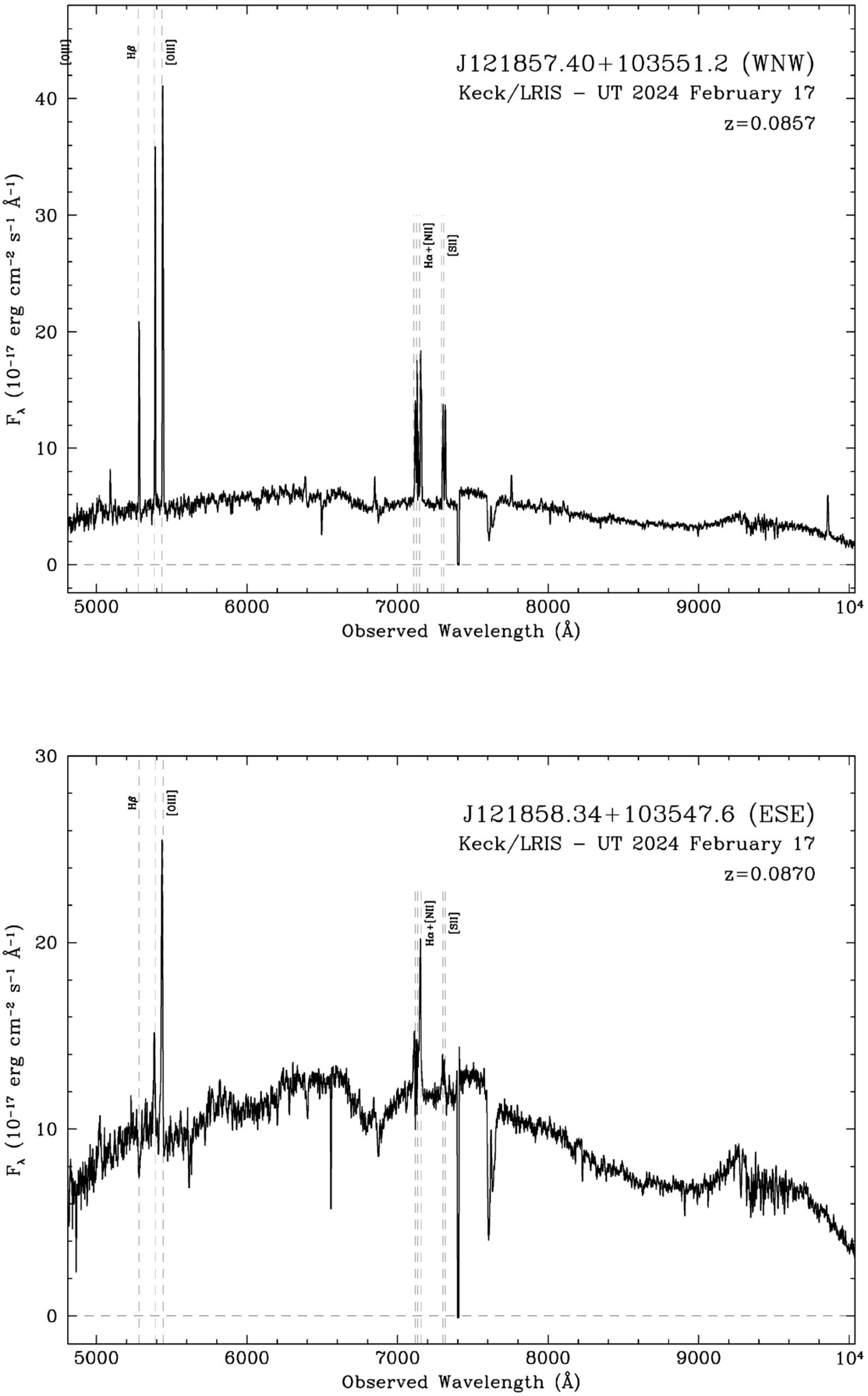
Optical spectra had already suggested activity in parts of the system. J1218+1035 SE had been classified as a narrow-line Seyfert II, which is a strong AGN sign. J1219+1035 showed a “composite” signature, meaning its emission could reflect both star formation and an AGN.
The problem is that composite line ratios can come from more than one source. Star formation, shock heating, or even older stellar populations can mimic some AGN-like signals. The team also obtained follow-up optical spectra for the close pair using the Keck Observatory’s Low-Resolution Imaging Spectrometer. Those observations confirmed a shared redshift for the pair, but the NW nucleus still did not produce a clean optical label.
So, the case for three active black holes needed a sharper tool.
That tool was high-resolution radio imaging with the U.S. National Science Foundation’s Karl G. Jansky Very Large Array, or VLA. Observing in its highest-resolution A configuration, the VLA mapped the system at 3, 10, and 15 GHz. At each frequency, the team detected compact, unresolved radio sources aligned with each galaxy’s center. That tight alignment matters, because it points to nuclear activity rather than random star-forming regions.
The radio signals also behaved like AGN emission. Two cores showed typical “steep” spectra, and the third showed an even steeper spectrum. In plain terms, their radio brightness dropped in a way expected for synchrotron radiation, the kind produced by fast particles in magnetic fields near black holes and their small jets.
The team also used the U.S. National Science Foundation’s Very Long Baseline Array, or VLBA, to test how compact one core was at even finer resolution. The VLBA did not directly detect J1218+1035 SE, but it still helped. The non-detection set an upper limit that implied a brightness temperature above what star formation alone would usually produce. That result supported the AGN explanation.
Together, the VLA and VLBA evidence confirmed that all three galaxies host active nuclei and that all three are radio-bright in a compact way. The team notes that none of the sources meet standard thresholds for “radio loud” galaxies. Still, their radio cores and spectral behavior match what researchers expect from AGN.
“Triple active galaxies like this are incredibly rare, and catching one in the middle of a merger gives us a front-row seat to how massive galaxies and their black holes grow together,” Schwartzman said.
“By observing that all three black holes in this system are radio-bright and actively launching jets, we’ve moved triple radio AGN from theory into reality and opened a new window into the life cycle of supermassive black holes.”
Astronomers expect galaxies to grow through repeated mergers. In that picture, large galaxies form by absorbing smaller ones. When galaxies merge, their central black holes do not merge right away. Over long periods, gravity and friction within the combined galaxy bring those black holes toward one another.
Most confirmed systems involve two active black holes. Triple systems are far rarer, especially in nearby space, and they can test how often multiple black holes switch on during a merger. They also help researchers study how gas flows inward during chaotic interactions.
Before this discovery, only two triple AGN systems were confirmed in the local universe within ongoing mergers: HCG 16 and J0849+1114. Each required evidence across several wavelengths. Even then, radio data did not show clear activity in all three nuclei in J0849+1114. That contrast makes J1218/J1219+1035 stand out.
Research findings are available online in The Astrophysical Journal Letters.
Like these kind of feel good stories? Get The Brighter Side of News’ newsletter.
The post Three black holes light up at once in rare three-galaxy collision appeared first on The Brighter Side of News.

