Astronomers have long chased a hard question: how did black holes grow so huge so fast. Researchers at Maynooth University in Ireland say they now have a clearer answer. Their work; led by PhD candidate Daxal Mehta in Maynooth University’s Department of Physics; was reported in Nature Astronomy.
“We found that the chaotic conditions that existed in the early Universe triggered early, smaller black holes to grow into the super-massive black holes we see later following a feeding frenzy which devoured material all around them,” says Daxal Mehta, a PhD candidate in Maynooth University’s Department of Physics, who led the research.
“We revealed, using state-of-the-art computer simulations, that the first generation of black holes – those born just a few hundred million years after the Big Bang – grew incredibly fast, into tens of thousands of times the size of our Sun.”
The team included postdoctoral fellow Dr Lewis Prole and research group leader Dr John Regan, both at MU’s Physics Department. They focused on an era when young galaxies were dense, gas-rich, and turbulent. Those conditions can let a black hole feed at extreme rates, at least for short stretches.
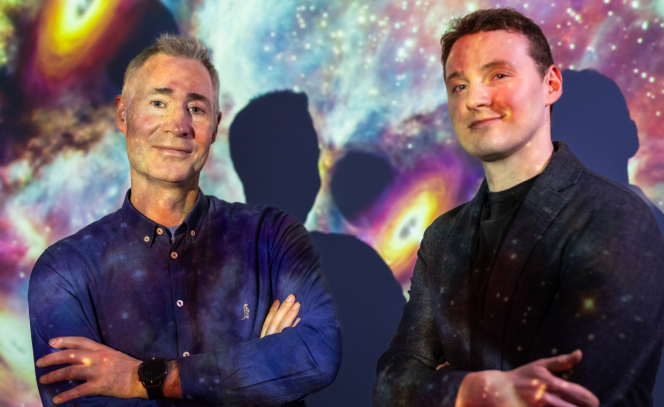
“This breakthrough unlocks one of astronomy’s big puzzles,” says Dr Lewis Prole, a postdoctoral fellow at MU and research team member. “That being how black holes born in the early Universe, as observed by the James Webb Space Telescope, managed to reach such super-massive sizes so quickly.”
Black holes do not all start the same way. Some are “heavy seed” black holes; born unusually large. Others are “light seed” black holes; formed when the first stars die. Light seeds can begin at only about ten to a few hundred times the mass of the Sun. To explain giant black holes early in cosmic history, many astronomers leaned on heavy seeds.
“Now we’re not so sure,” says Dr John Regan of MU’s Physics Department and research group leader. “Heavy seeds are somewhat more exotic and may need rare conditions to form. Our simulations show that your ‘garden variety’ stellar mass black holes can grow at extreme rates in the early Universe.”
The new simulations suggest light seeds can sometimes “win the lottery.” Most stay small. A small fraction hit the right neighborhood in a young galaxy and bulk up quickly. That matters because the early universe likely made many light seeds. If only a few grow fast, that could still explain the rare supermassive black holes telescopes spot far away.
The growth mechanism hinges on brief episodes of “super Eddington accretion.” In simple terms, the black hole swallows gas faster than the usual limit. In theory, intense light from the hot inflow should push gas away. Yet the simulations show that, in the densest and most chaotic regions, gas can keep pouring in anyway.
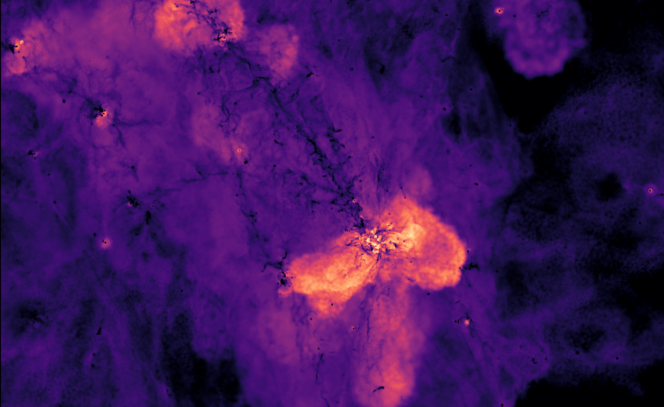
“These tiny black holes were previously thought to be too small to grow into the behemoth black holes observed at the centre of early galaxies,” says Daxal Mehta. “What we have shown here is that these early black holes, while small, are capable of growing spectacularly fast, given the right conditions,” he adds.
To test the idea, the researchers ran extremely detailed cosmological simulations of early galaxy formation. They used a moving-mesh code called Arepo. The key was resolution; how finely the simulation can track gas flows near a black hole.
At the highest settings, the simulation could capture gas behavior on scales of about a tenth of a parsec. That let the team resolve the region where a small black hole’s gravity can pull in nearby gas. When that region is not resolved, black holes often look starved in the model. When it is resolved, more of them show short, intense growth spurts.
“The story starts with Population III stars, the first stars, forming from metal-free gas in small dark matter haloes. Those stars lived fast and died young, often in only a couple million years. Some collapsed into black holes directly. Others exploded as supernovas first,” Daxal Mehta shared with The Brighter Side of News.
“Our simulations found a strong pattern: fast-growing black holes usually formed by direct collapse. That path avoids a supernova blast that can blow away nearby gas. If the gas stays put, a newborn black hole can start feeding almost right away,” he added.
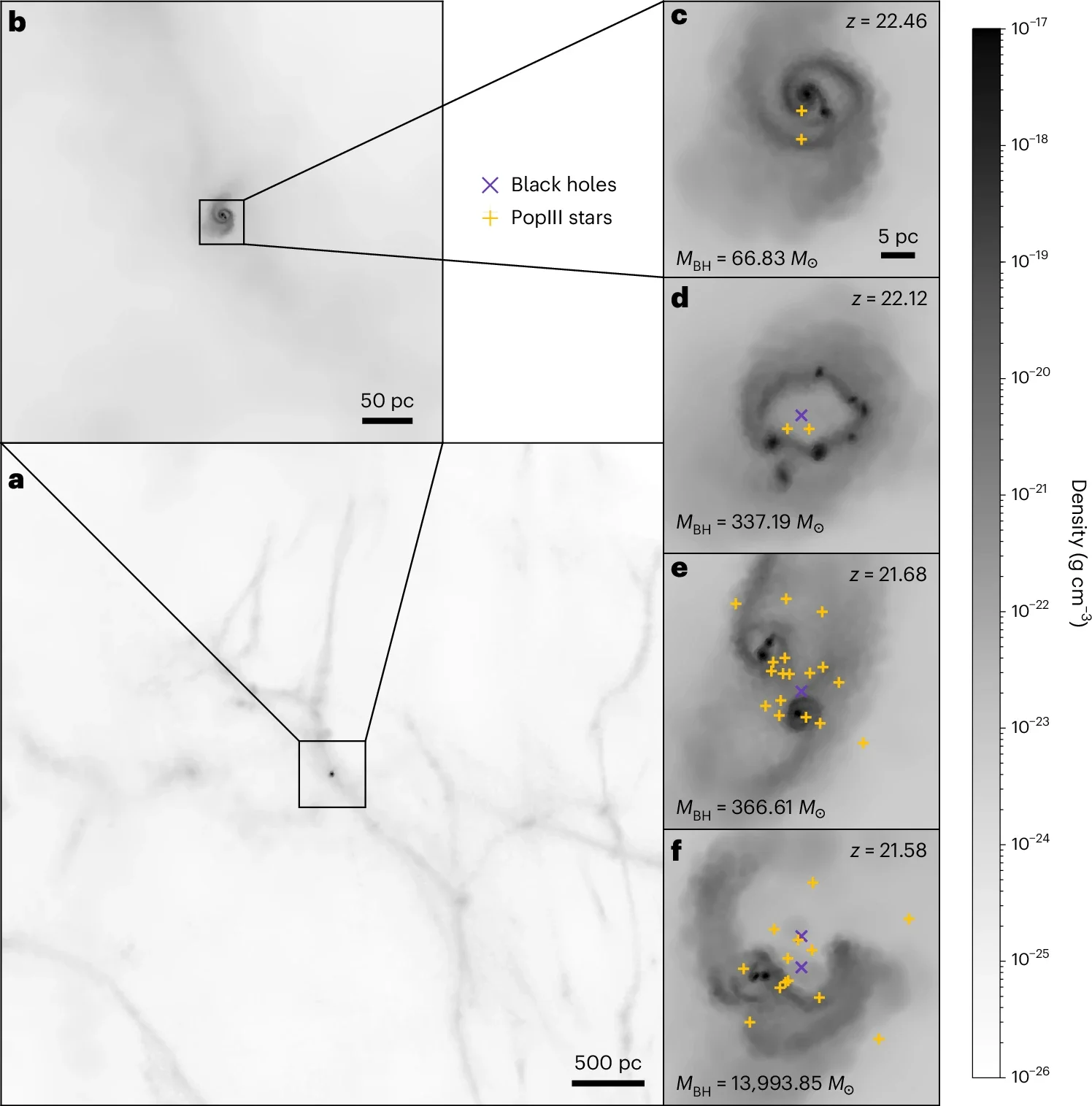
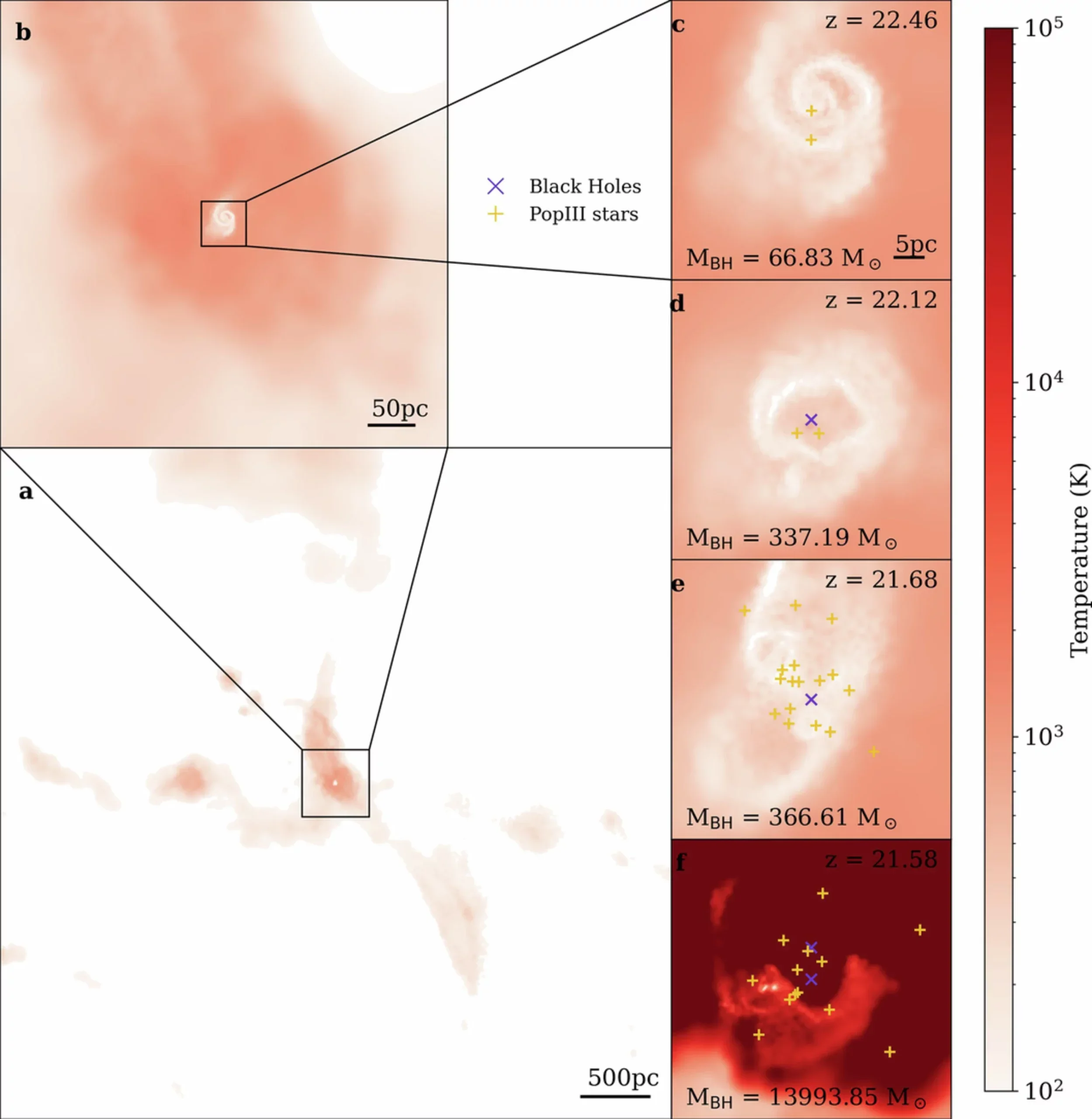
Even in the best conditions, rapid growth did not last long. The simulations showed feeding bursts that often lasted only a few million years. During those spurts, some black holes reached more than 10,000 times the mass of the Sun. That is big enough to enter the “intermediate-mass” range.
But the odds stayed low. Only a small percentage of the light seeds grew dramatically. Most never found the cold, dense gas they needed. Others began feeding and then got cut off when the environment changed.
The biggest “kill switches” were feedback and gas loss. Supernovas from nearby stars can shove gas out of the center of a young galaxy. Heating tied to black hole feeding can also clear a cavity around the black hole. Once the gas is gone, the growth phase ends quickly.
That stop-and-go behavior is central to the team’s conclusion. Early black hole growth looks less like a smooth climb and more like a series of short sprints. The winners are rare, but they can climb into the mass range that later simulations often assume as starting points for the first supermassive black holes.
“The early Universe is much more chaotic and turbulent than we expected, with a much larger population of massive black holes than we anticipated too,” says Dr Regan.
This work changes what you can reasonably expect from the universe’s first black holes. It strengthens the case that many supermassive black holes could begin as ordinary remnants of the first stars, rather than only from rarer heavy-seed events. That shift can guide how researchers interpret early James Webb Space Telescope discoveries and how they design future simulations, since the results suggest that resolving tiny gas scales can change the outcome.
The study also points to possible targets for future gravitational-wave astronomy. The researchers say the findings matter for the European Space Agency and NASA’s Laser Interferometer Space Antenna mission, scheduled to launch in 2035.
“Future gravitational wave observations from that mission may be able to detect the mergers of these tiny, early, rapidly growing baby black holes,” says Dr Regan. If those signals appear, they could offer a new way to test how quickly black holes grew in the universe’s first few hundred million years.
Research findings are available online in the journal Nature Astronomy.
Like these kind of feel good stories? Get The Brighter Side of News’ newsletter.
The post Computer models reveal how early black holes grew so quickly after the Big Bang appeared first on The Brighter Side of News.

