A strange form of matter called a time crystal has fascinated physicists for about a decade. These systems move in repeating cycles, even without a steady external push. Now, researchers at New York University have uncovered a new and surprisingly simple version that you can see with the naked eye.
The work comes from physicists at NYU, led by David Grier, director of the university’s Center for Soft Matter Research. He worked with graduate student Mia Morrell and undergraduate Leela Elliott. Their findings appear in the journal Physical Review Letters. The team showed that small foam beads, held in midair by sound waves, can fall into steady rhythmic motion on their own.
What makes the result stand out is how basic the setup looks. The entire device is about a foot tall and light enough to hold. Yet it reveals physics that bends some of the most familiar rules taught in school.
“Time crystals are fascinating not only because of the possibilities, but also because they seem so exotic and complicated,” Grier says. “Our system is remarkable because it’s incredibly simple.”
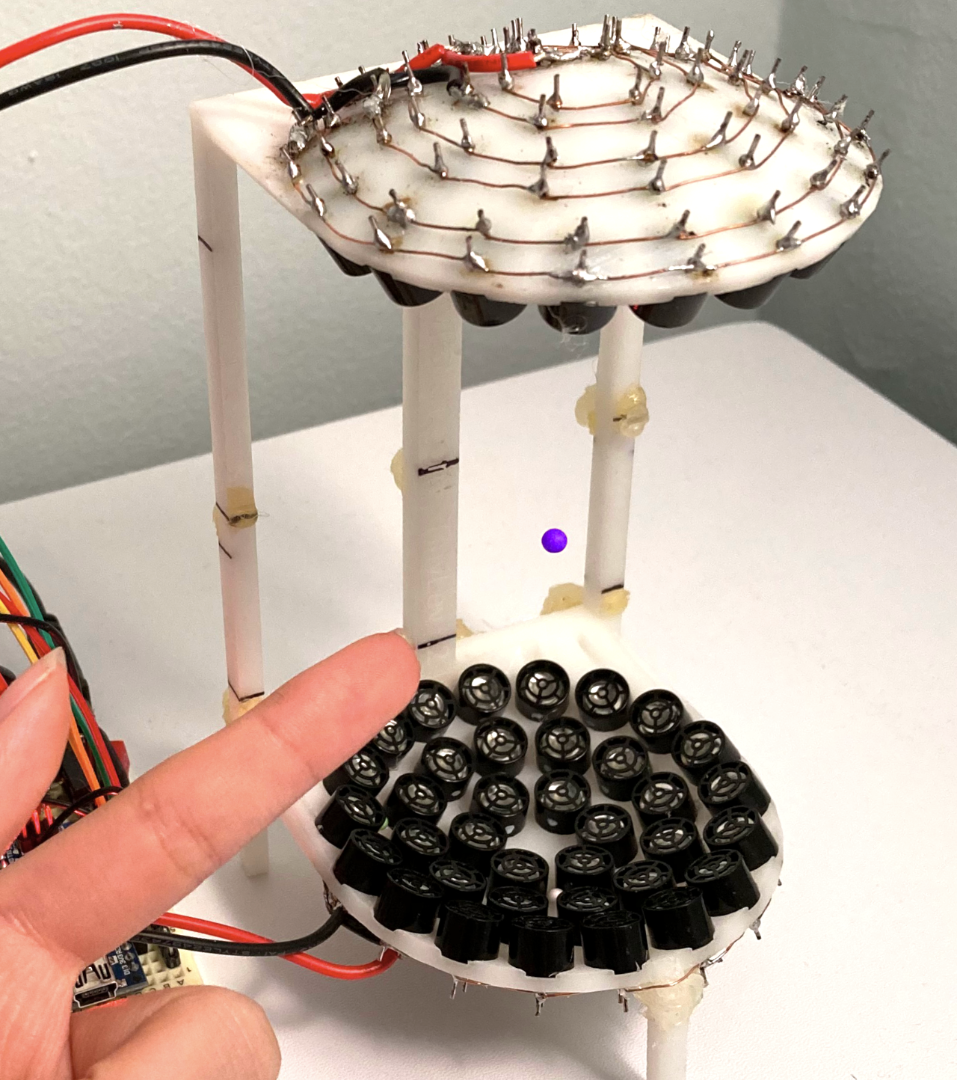
The experiment uses an acoustic levitator, a tool that traps objects using sound instead of strings or magnets. In this case, high-frequency sound waves form a standing pattern in air. At certain points, the sound pressure balances gravity and holds tiny objects in place.
The beads are made of expanded polystyrene, similar to packing foam. When placed inside the sound field, they float motionless at first, suspended at precise spots.
“Sound waves exert forces on particles, just like waves on the surface of a pond can exert forces on a floating leaf,” Morrell says. “We can levitate objects against gravity by immersing them in a sound field called a standing wave.”
The real surprise comes when more than one bead is present. Each bead scatters the sound waves around it. Those scattered waves then push on nearby beads. This creates interactions that are very different from the pushes and pulls you expect from ordinary objects.
In everyday physics, forces come in matched pairs. If one object pushes another, it feels an equal push back. That idea is known as Newton’s Third Law.
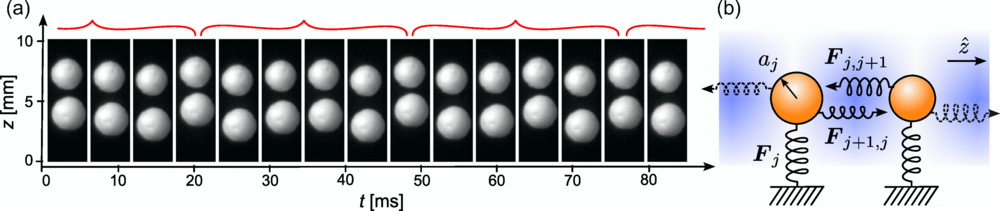
In the levitated system, that balance can break down. Larger beads scatter more sound than smaller ones. As a result, a large bead can push a small one harder than the small one pushes back. Momentum is carried away by the sound waves themselves, so the forces no longer have to cancel.
“Think of two ferries of different sizes approaching a dock,” Morrell says. “Each one makes water waves that pushes the other one around, but to different degrees, depending on their size.”
Because of this imbalance, the beads can begin to move on their own. Pairs of beads start to sway back and forth in steady patterns, even though no external rhythm is driving them. Energy flows quietly from the sound field into their shared motion.
The team focused on the simplest case, just two beads floating side by side. Air resistance should normally slow any movement and bring it to a stop. Instead, certain pairs settle into stable oscillations that last for hours.
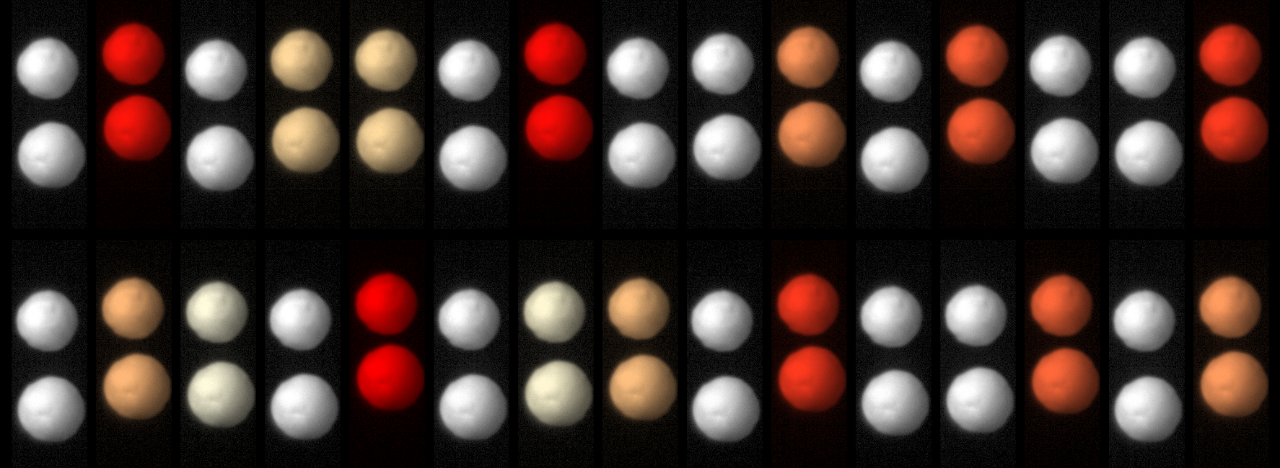
High-speed video captured these motions clearly. In one setup, two millimeter-sized beads oscillated at about 61 cycles per second, matching predictions from theory. The motion stayed smooth and regular, not random or chaotic.
In some cases, the pair moved together. In others, they moved in opposite directions, like two lungs expanding and shrinking. That second pattern is especially important. It shows a continuous time crystal, a system that breaks time symmetry by choosing its own rhythm.
The oscillations are not imposed by the sound source. The sound field itself stays steady. The ticking emerges from how the beads interact.
Most random bead pairs do nothing at all. They simply hang in place. The researchers found that only certain size combinations allow motion to grow instead of fade away. If the beads are identical, the strange effects vanish and forces become balanced again.
This explains why time crystal behavior is rare in the system. It depends on slight differences and imperfections. In physics terms, the disorder is frozen in, and that frozen disorder allows new behavior to appear.
The study also shows that even this tiny system can shift between different states. It can be still, gently active, or locked into a precise ticking pattern. Nothing about the beads themselves changes. Only their interaction does.
Although the clearest examples involve just two beads, the same physics should extend to larger groups. Arrays of levitated particles could show waves of motion, localized vibrations, or other collective effects.
The researchers point out that similar ideas may apply beyond sound. Any system where objects interact by scattering waves could show related behavior. That includes light, water waves, or even some biological systems.
Nonreciprocal interactions also appear in living chemistry. Some biochemical networks, including those involved in metabolism, do not follow equal give-and-take rules. That makes this simple experiment a useful model for understanding how rhythms arise in nature.
This work opens new paths for designing oscillators and sensors that rely on structure rather than built-in motors. Because the motion emerges from interactions, devices could be simpler, smaller, and more stable.
Time crystals like this could help with timing, signal processing, and data storage, especially in future quantum technologies. They may also inspire new ways to study biological clocks and other natural rhythms.
At a deeper level, the study shows how complex behavior can arise from plain materials and steady conditions. That insight can guide researchers as they look for order in systems that once seemed quiet and inert.
Research findings are available online in the journal Physical Review Letters.
The original story “NYU physicists create visible time crystals levitated by sound” is published on The Brighter Side of News.
Like these kind of feel good stories? Get The Brighter Side of News’ newsletter.
The post NYU physicists create visible time crystals levitated by sound appeared first on The Brighter Side of News.

