Morning routines can add up over decades. A new study suggests your daily coffee or tea habit may also connect to how well your brain holds up with age.
Researchers from Mass General Brigham, Harvard T.H. Chan School of Public Health and the Broad Institute of MIT and Harvard tracked 131,821 adults for up to 43 years. They reported that two to three cups of coffee a day, or one to two cups of tea, lined up with lower dementia risk and slower mental decline. The research appeared in JAMA.
“When searching for possible dementia prevention tools, we thought something as prevalent as coffee may be a promising dietary intervention — and our unique access to high-quality data through studies that have been going on for more than 40 years allowed us to follow through on that idea,” said senior author Daniel Wang, an associate scientist with the Channing Division of Network Medicine in the Mass General Brigham Department of Medicine and an assistant professor at Harvard Medical School.

“While our results are encouraging, it’s important to remember that the effect size is small and there are lots of important ways to protect cognitive function as we age. Our study suggests that caffeinated coffee or tea consumption can be one piece of that puzzle.”
Dementia is not one sudden moment. Often, the first sign is personal. You may feel your memory slip, even if tests look normal. Scientists call that stage subjective cognitive decline. For some people, problems later show up on testing as mild cognitive impairment. Some then progress to clinical dementia.
That long timeline makes prevention important. Current dementia treatments remain limited. They usually offer modest help once symptoms appear. So researchers keep looking at daily habits that might nudge risk earlier.
Coffee and tea stand out because they include caffeine and plant compounds called polyphenols. Lab studies suggest these chemicals may cut inflammation and protect cells from damage. Scientists also suspect caffeine could affect brain processes linked to Alzheimer disease, including amyloid and tau pathways. Still, human studies have disagreed, partly because many tracked diet only once or followed people for shorter periods.
This new work used two well-known U.S. cohorts. The Nurses’ Health Study began in 1976 and enrolled 121,700 female registered nurses. The Health Professionals Follow-up Study started in 1986 and enrolled 51,529 male health professionals.
For this analysis, diet tracking started in 1980 for the nurses and 1986 for the health professionals. Researchers excluded people with certain illnesses, missing data or implausible calorie reports. After those steps, the dementia analysis included 86,606 women and 45,215 men.
Participants filled out food questionnaires at the start and then every two to four years. They reported how often they drank set portion sizes. A cup meant 8 ounces. Researchers also estimated total caffeine from coffee, tea, soda and chocolate, and updated each person’s long-term average over time.
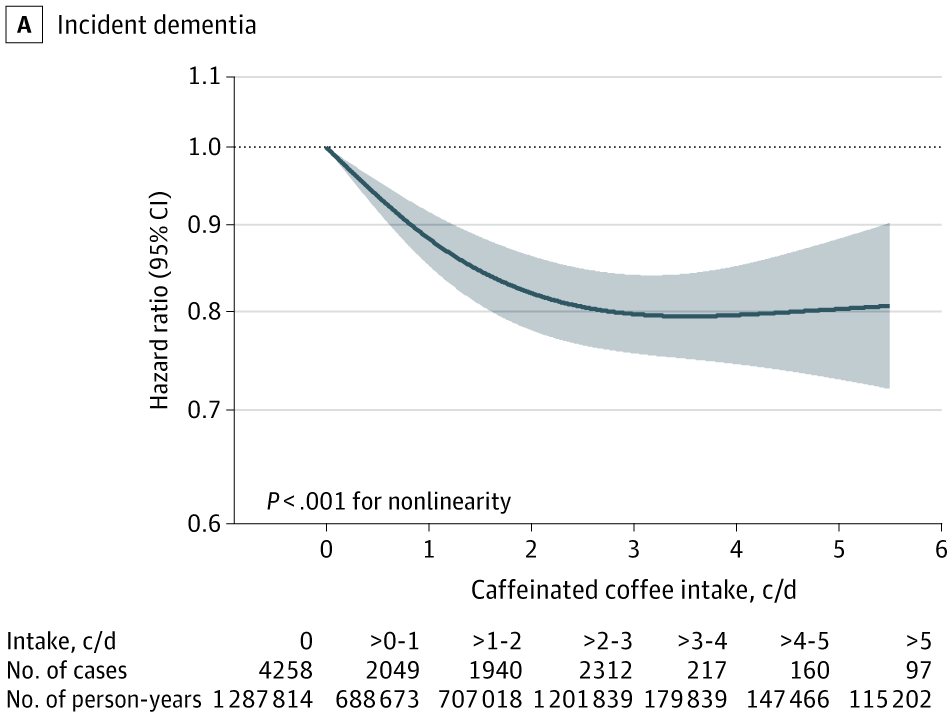
Over 4.3 million person-years of follow-up, 11,033 participants developed dementia. When researchers compared people by how much caffeinated coffee they drank, they saw a pattern. Higher intake lined up with lower dementia rates.
In the full analysis, people with the highest caffeinated coffee intake had an 18% lower dementia risk than those who drank little or none. People who drank more caffeinated coffee also reported fewer early worries. Subjective cognitive decline showed up in 7.8% of high coffee drinkers versus 9.5% among those with low intake.
Tea showed a similar connection. Higher tea intake lined up with lower dementia risk and fewer reports of perceived decline. Decaffeinated coffee did not show the same benefit. That result points to caffeine as a likely factor, though the study did not prove cause and effect.
The strongest links appeared at moderate levels. Dementia risk was lowest around two to three cups of caffeinated coffee a day or one to two cups of tea a day. More caffeine did not seem to add extra protection, but it also did not show clear harm in this study.
“We also compared people with different genetic predispositions to developing dementia and saw the same results — meaning coffee or caffeine is likely equally beneficial for people with high and low genetic risk of developing dementia,” said lead author Yu Zhang, a student at Harvard Chan School and a research trainee at Mass General Brigham.
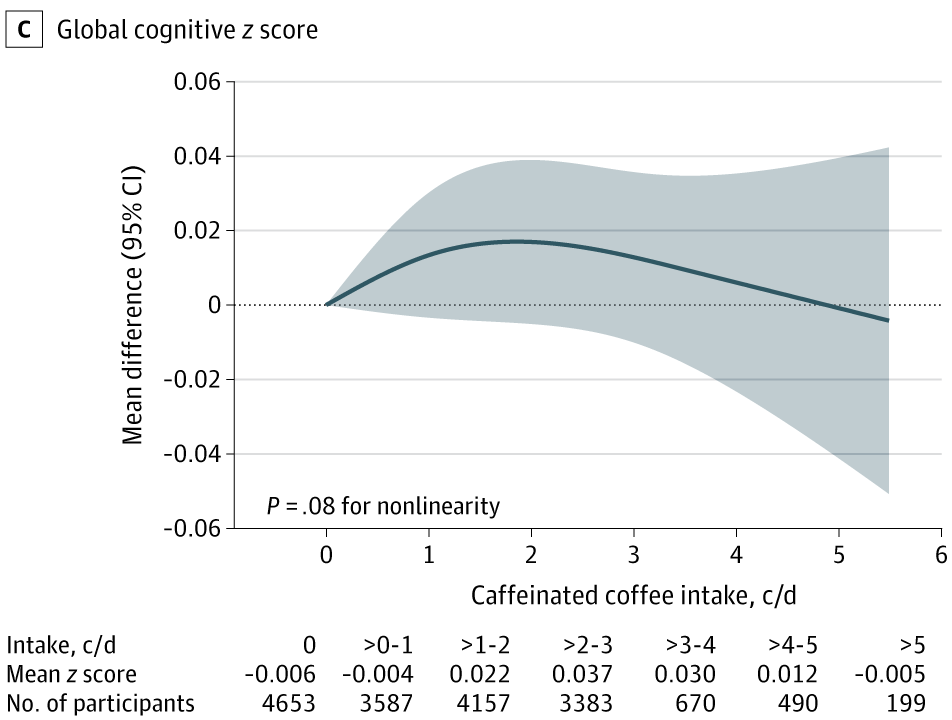
Objective cognitive testing was available in one group, older nurses who took phone-based tests. Those tests included the Telephone Interview for Cognitive Status, or TICS, plus memory and word tasks. Higher caffeinated coffee intake linked to slightly better TICS scores. Tea linked to slightly stronger results across several measures, including verbal memory.
The differences were modest. Researchers noted that a 0.11-point TICS gap lines up with about 0.6 years of average decline in that cohort. That kind of shift may not feel dramatic for one person. Still, across a population, small changes can matter.
The study also flagged key limits. It was observational, so it cannot prove caffeinated drinks prevent dementia. Diet surveys did not capture tea type or coffee brewing methods. Dementia reports relied on death records and self-reported diagnoses, with physician review when records existed. The participants were mostly health professionals, which may limit how well results apply to every community.
Even with those caveats, the results offer a simple take-away. If you already enjoy caffeinated coffee or tea, moderate intake may fit into a brain-healthy lifestyle.
This study strengthens the case for testing caffeine and related compounds more directly in future trials. Researchers can now target specific “sweet spot” doses, such as two to three cups of coffee daily, rather than guessing.
For public health, the findings support practical guidance that feels realistic. Coffee and tea are common, affordable and familiar. If later research confirms cause and effect, moderate caffeine intake could become one small tool in broader dementia risk reduction plans.
The work also highlights a bigger message for aging. Dementia risk likely shifts through many small choices over time. Caffeinated coffee or tea may be one piece, alongside sleep, exercise, blood pressure control, social connection and healthy eating.
Research findings are available online in the journal JAMA.
The original story “2-3 cups of coffee a day can lower dementia risk and slow cognitive decline” is published in The Brighter Side of News.
Like these kind of feel good stories? Get The Brighter Side of News’ newsletter.
The post 2-3 cups of coffee a day can lower dementia risk and slow cognitive decline appeared first on The Brighter Side of News.

