A blade of bone lay half-buried in Saharan sand, shaped like a scimitar and tall enough to confuse the people who picked it up.
In November 2019, a 20-person team working in Niger collected that crest and a few jaw fragments from the desert surface. They did not grasp what they had at first. When they returned in 2022 and found two more crests, the pieces clicked into place. The fossils belonged to a new species of spinosaurid: Spinosaurus mirabilis, described in a paper in Science.
The team was led by Paul Sereno, a professor of Organismal Biology and Anatomy at the University of Chicago. The discovery, the authors argue, adds a late chapter to spinosaurid evolution, and it comes from an inland basin rather than the nearshore settings that usually produce Spinosaurus fossils.
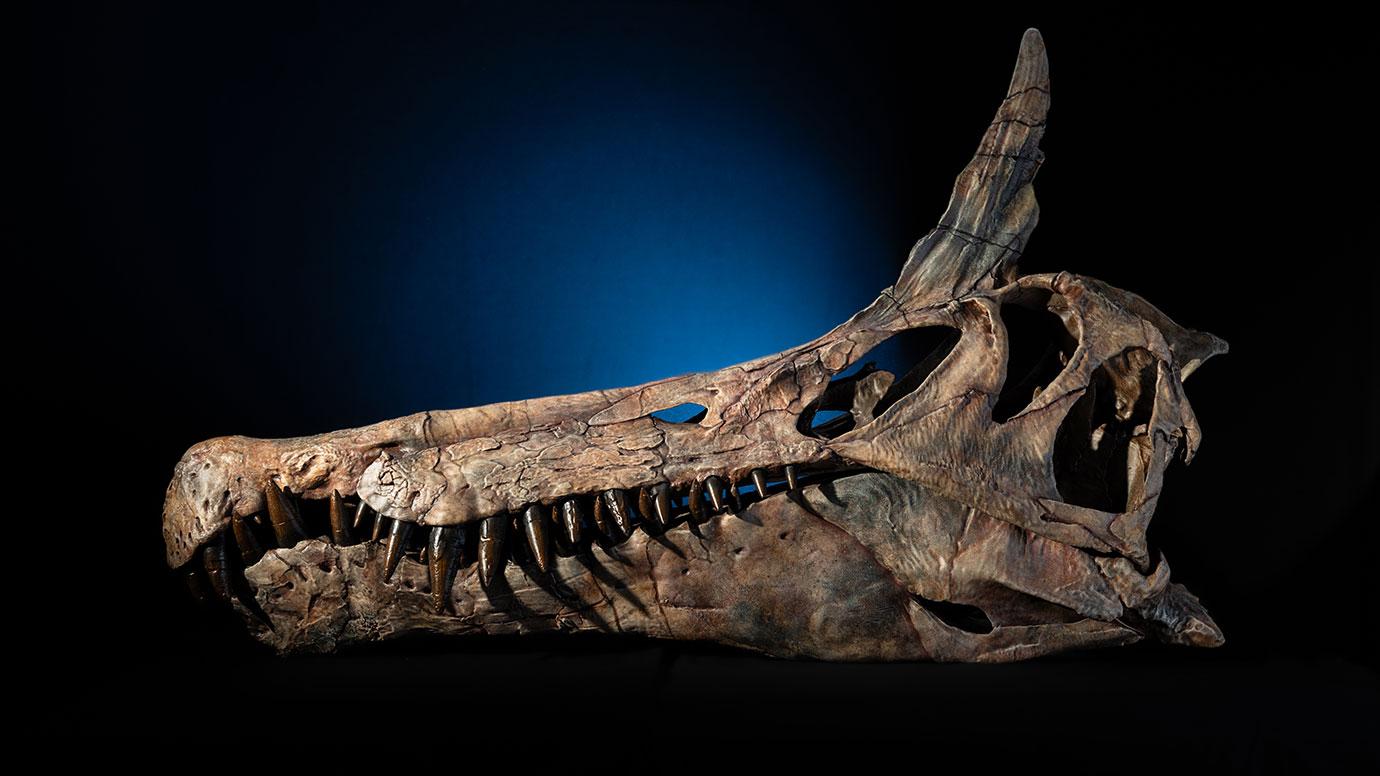
The new dinosaur’s signature feature is a nasal-prefrontal crest that arches upward and backward, rising over the orbit. The paper describes it as scimitar-shaped, with a thickened ridge along its length and thinning margins at the front and back. It also lacks the raised vertical fluting seen in the crest of Spinosaurus aegyptiacus.
Texture and internal canals in the crest matter here. CT-based digital work shows paired vessels feeding the dense bone, with branching at midlength and few openings to the outside. The surface carries fine striations, sometimes crisscrossing, plus deeper grooves. Those details led the authors to infer a keratinous sheath that covered, and likely extended, the bony core, drawing on comparisons to modern birds with keratinous crest sheaths.
Sereno captured the team’s reaction to the first full digital assembly of the skull. “This find was so sudden and amazing, it was really emotional for our team,” he said. “I’ll forever cherish the moment in camp when we crowded around a laptop to look at the new species for the first time, after one member of our team generated 3D digital models of the bones we found to assemble the skull, on solar power in the middle of the Sahara. That’s when the significance of the discovery really registered.”
The skull reconstruction shows a second striking trait: interdigitating tooth rows. In this arrangement, lower-jaw teeth protrude outward and fit between the upper teeth. The paper notes that this “interdigitating” design appears in other fish-eating animals across the fossil record, including ichthyosaurs, some crocodiles, and pterosaurs. Among dinosaurs, the authors treat it as a distinguishing feature of Spinosaurus and close relatives.
In S. mirabilis, the upper jaw includes a broad diastema with fossae that accommodate three large lower-jaw teeth. The jaw margins also show festooning that helps make room for the interlocking crowns. The snout profile differs from S. aegyptiacus in a few ways, including a slightly arched premaxilla and a lower posterior snout profile with more parallel margins toward the orbit. The paper also reports wider spacing among teeth in the back half of the snout.
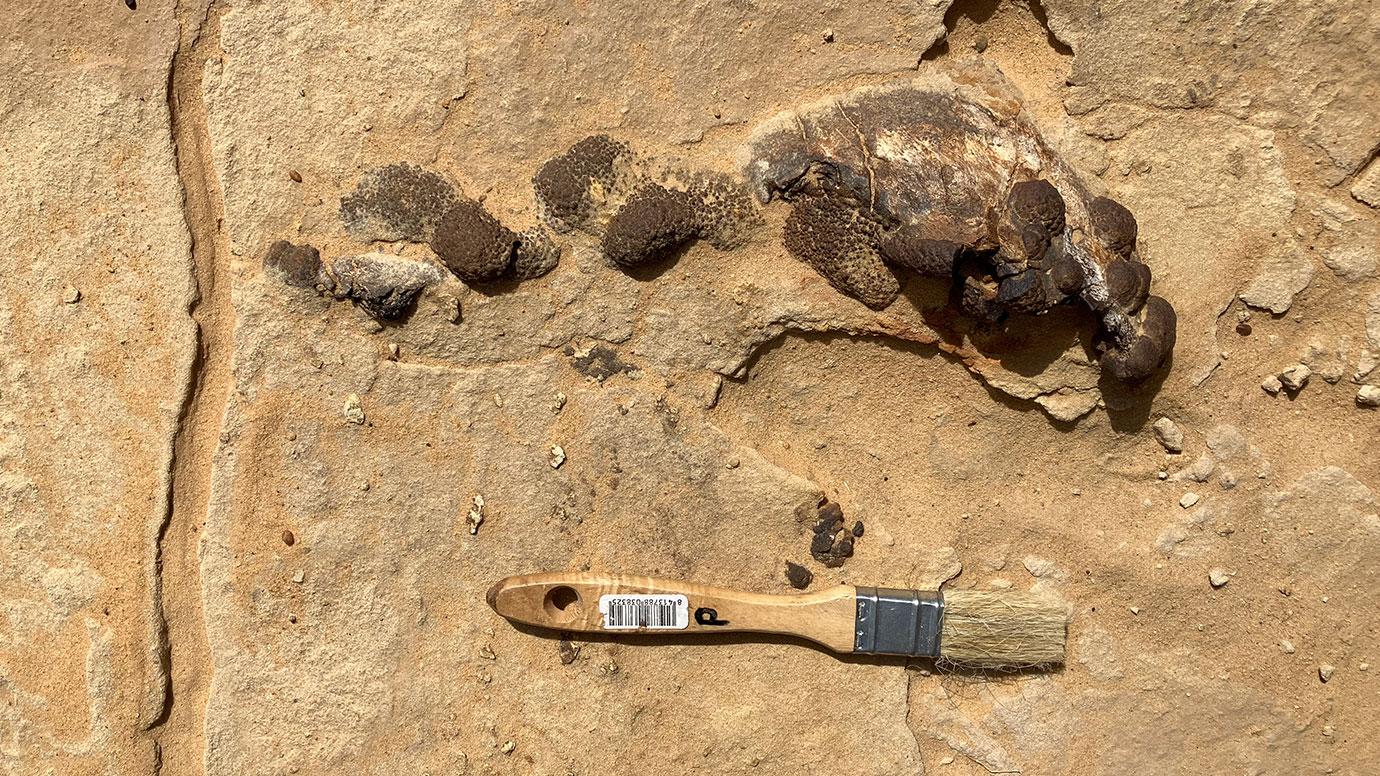
The holotype, cataloged as MNBH JEN1 at the Musée National Boubou Hama in Niamey, includes an associated right premaxilla, both maxillae, the base and lower half of the fused crest with parts of both prefrontals, the alveolar edge of the right dentary, and five maxillary teeth found with the maxillae. Referred specimens come from the Jenguebi and Iguidi fossil areas.
For years, Spinosaurus fossils were known only from nearshore deposits along Africa’s margin of the Tethys Sea. That pattern helped fuel debate over whether these theropods were shoreline waders or fully aquatic divers. The new species shifts the map.
The fossils come from the Farak Formation at Sirig Taghat in the Jenguebi area of Niger. The paper places the fauna in the Early to Middle Cenomanian, roughly 100 to 95 million years ago, and emphasizes the inland setting. The Jenguebi and Iguidi localities sat about 500 to 1000 kilometers from the closest marine margin at the time.
At the site, multiple S. mirabilis specimens occur in fluvial sediments near skeletons of rebbachisaurid and titanosaurian sauropods. The authors argue that the association and articulation of remains, plus their proximity in the section, leave “no doubt” that these animals coexisted in the same riparian habitat.
That context feeds into behavior. Sereno offered a vivid picture: “I envision this dinosaur as a kind of ‘hell heron’ that had no problem wading on its sturdy legs into two meters of water but probably spent most of its time stalking shallower traps for the many large fish of the day.”
The paper and accompanying narrative trace the expedition’s roots to a brief mention in a 1950s monograph, when French geologist H. Faure reported sabre-shaped teeth from a small Cenomanian locale called Akarazeras. Those teeth were later lost, and no one returned to the site for decades.
Nearly 70 years later, the team rediscovered Akarazeras, then pushed deeper into the sand sea and found a fossil-rich area called Jenguebi. Sereno described the gap in attention plainly: “No one had been back to that tooth site in over 70 years,” he said. “It was an adventure and a half wandering into the sand seas to search for this locale and then find an even more remote fossil area with the new species. Now all of the young scholars who joined me are co-authors on the report gracing the cover of Science.”
The narrative includes a key moment: the team met a local Tuareg man who led them by motorbike deep into the Sahara, to a field where he had seen large fossil bones. There, the team found teeth and jaw bones of the new Spinosaurus.
Back in Chicago, Sereno’s group cleaned and CT scanned the fossils and assembled a digital rendering of the skull. Sereno also worked with paleoartist Dani Navarro to create a reconstruction scene, and other artists animated the model. The team prepared replicas of the skull and the crest, too. On March 1, the replicas are set to join Sereno’s Dinosaur Expedition exhibit at the Chicago Children’s Museum.
The paper also flags limits. All known individuals of S. mirabilis are immature, and adult size remains uncertain. The authors report only three crests, from differently aged individuals, which is too few to assess crest dimorphism. Asymmetry appears in all three crests, and the holotype shows the strongest lateral deflection.
Research findings are available online in the journal Science.
The original story “‘Hell-heron’ dinosaur fossils uncovered in the central Sahara” is published in The Brighter Side of News.
Like these kind of feel good stories? Get The Brighter Side of News’ newsletter.
The post ‘Hell-heron’ dinosaur fossils uncovered in the central Sahara appeared first on The Brighter Side of News.

