A monkey descending a tree trunk often keeps its head up, moving almost like a cautious climber backing down a ladder. Squirrels and many other mammals, by contrast, tend to go headfirst. That difference turns out to carry clues about how primates evolved their distinctive upright postures.
A new comparative analysis of tree-dwelling mammals, published in eLife, examined how animals move down vertical supports such as trunks and vines. The research compared 21 arboreal species, from primates to rodents and marsupials, making it the first broad study to analyze both upward and downward climbing across many mammal groups.
The results point to a pattern shaped not just by body size, but by evolutionary history and anatomy.
“While not all arboreal mammals traverse narrow terminal branches, they all rely on vertical supports to reach tree canopies,” said lead author Séverine Toussaint of the Center for Research on Paleontology in Paris. “Their ability to safely descend sloping and vertical supports remains important, yet largely understudied.”
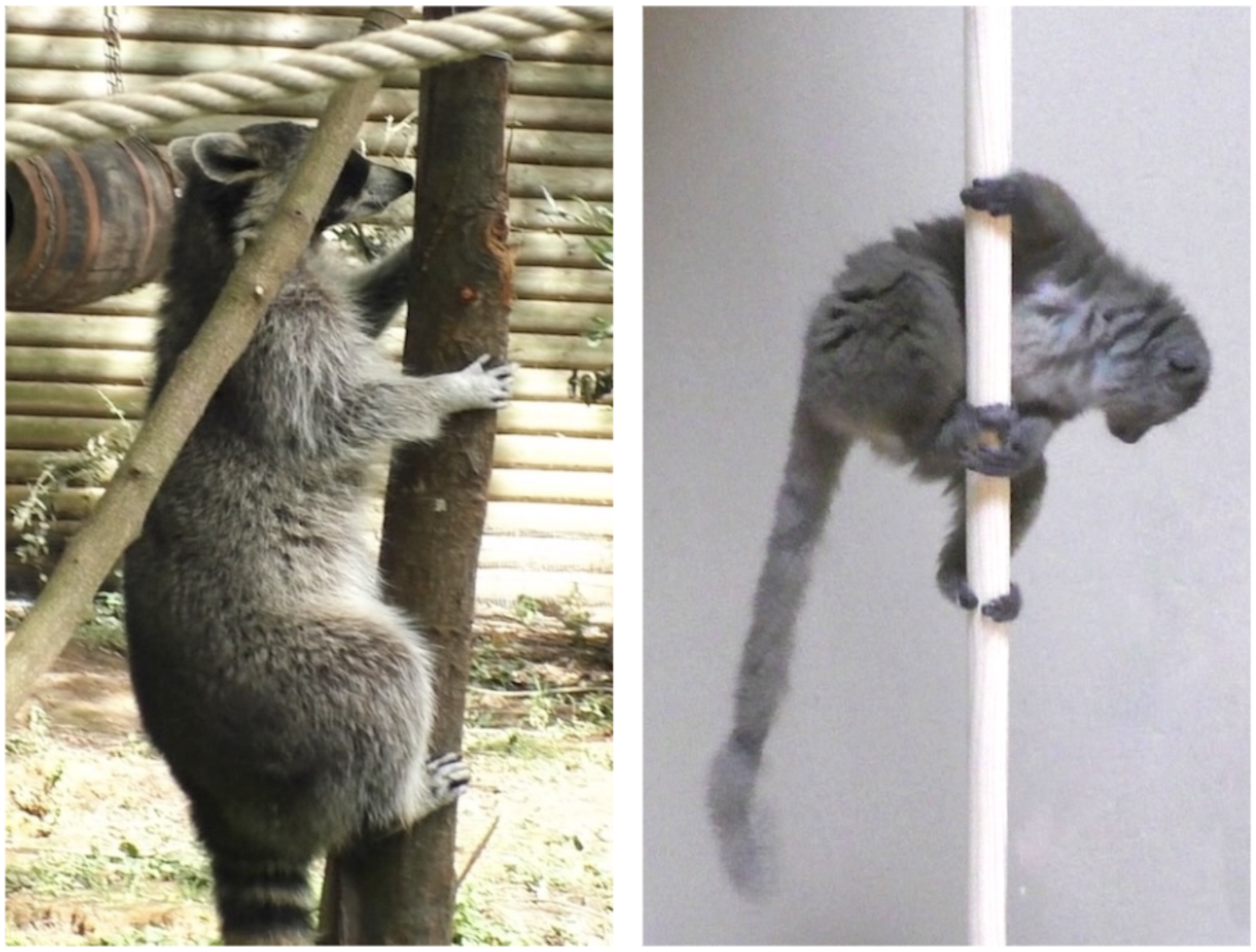
The team analyzed 57 animals representing 21 species and recorded 1,390 descents and 1,400 ascents using high-speed video. Supports were grouped by size relative to the animals’ hands and feet, from twig-like to large trunk-like surfaces.
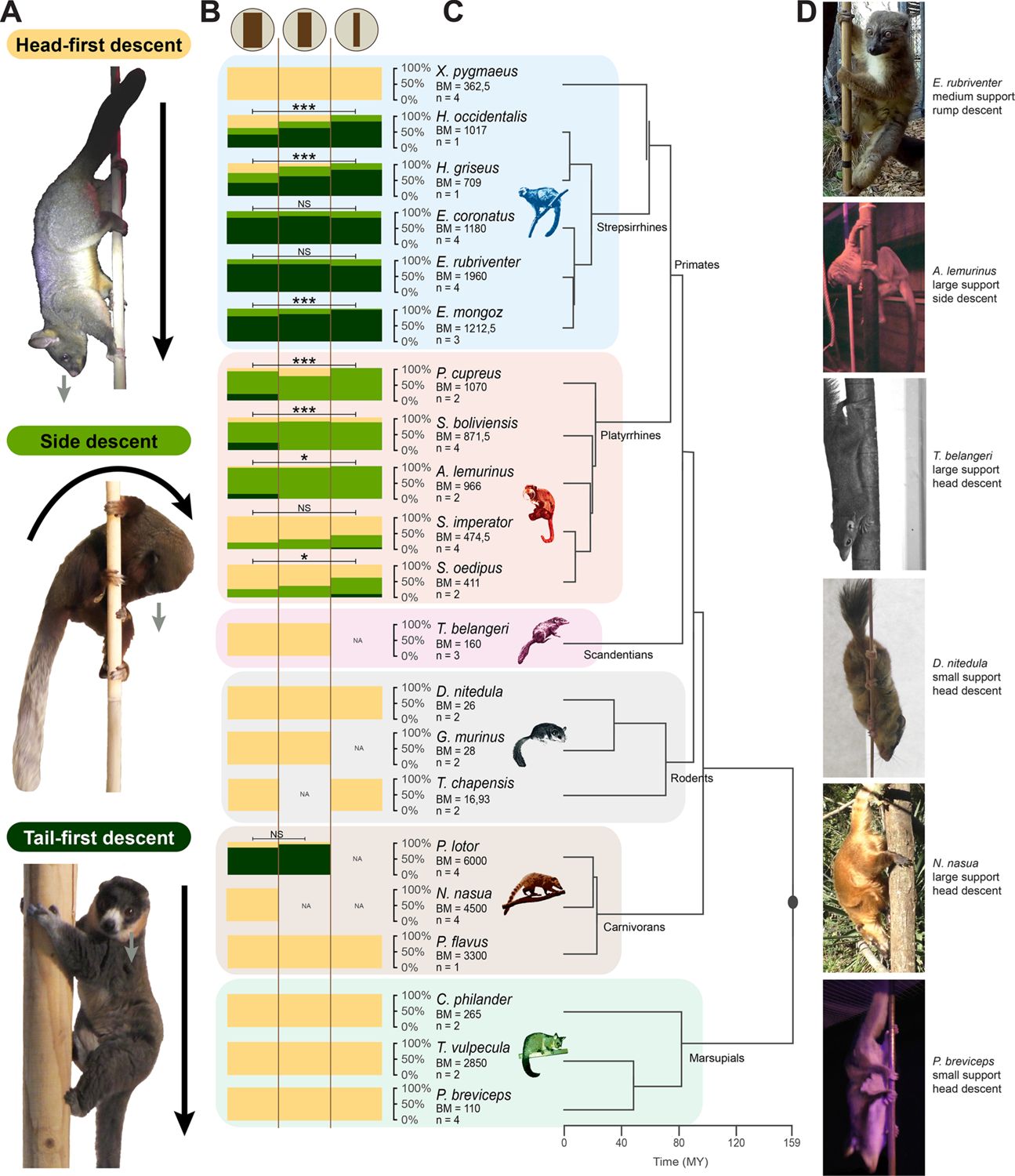
Researchers identified three main descent styles: head-first, side-on, and tail-first. Head-first movement kept the body parallel to the trunk with the face downward. Tail-first resembled climbing up, with the head pointing upward. Side descents involved rotating the body sideways against the support.
Clear differences emerged between primates and other mammals.
Most non-primates descended headfirst regardless of surface size. Rodents, marsupials, and treeshrews followed this pattern consistently. Primates behaved differently, showing much more variety. Lemurs often moved tail-first, while many New World monkeys used sideways descents, especially on narrow supports.
“Primates generally used tail-first and side descents on small vertical supports, suggesting that narrower supports impose constraints that call for more upright postures,” said co-author Dionisios Youlatos of Aristotle University of Thessaloniki.
Smaller primates such as lorises and tamarins behaved more like non-primates, relying mainly on head-first descent.
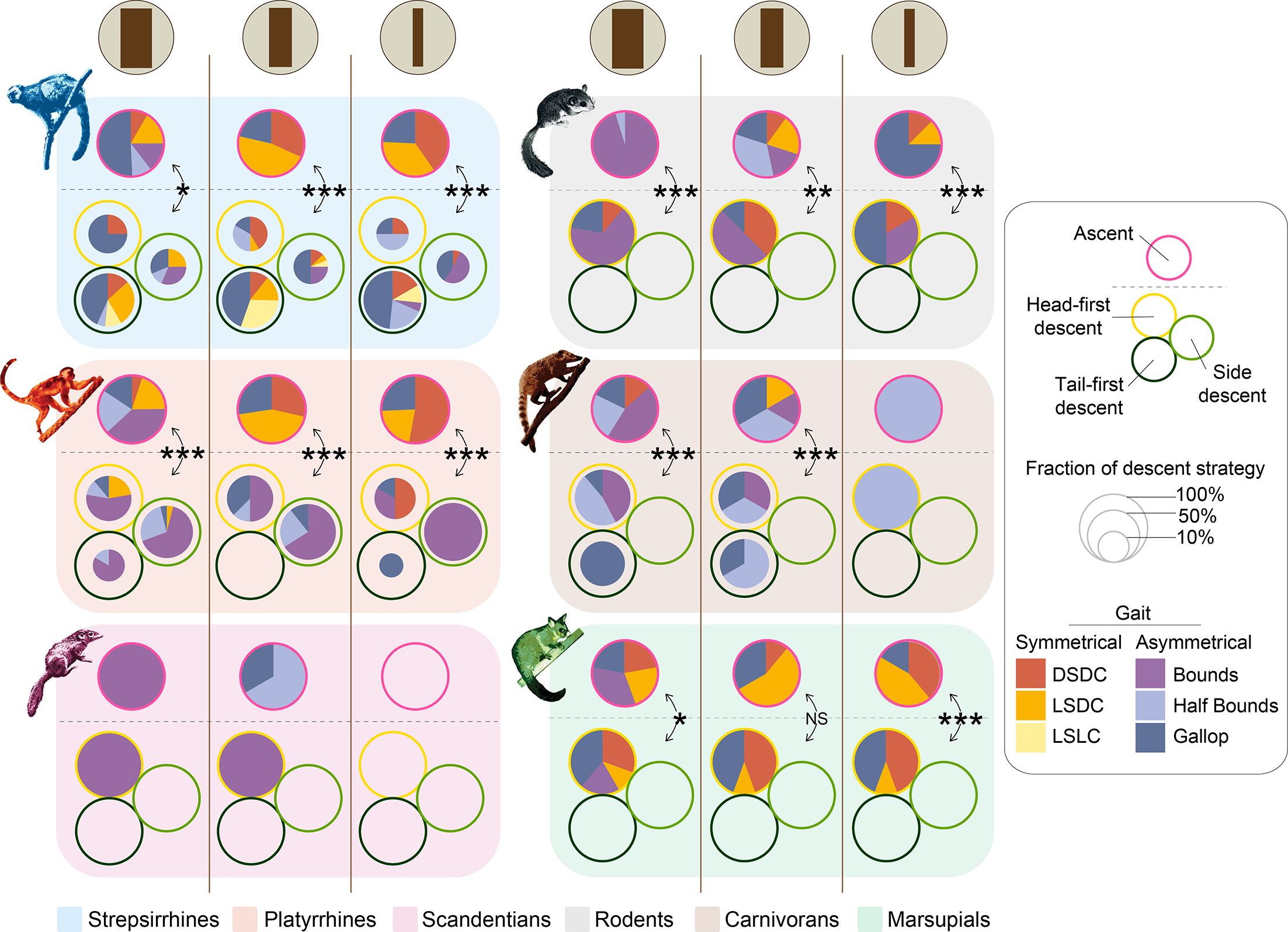
Animals adjusted their movement mechanics when climbing down compared with climbing up.
Across species, head-first descents were 30 to 43 percent slower than ascents. Animals also increased the time their limbs stayed in contact with the surface, which likely improves stability. Many species shifted toward more asymmetrical gaits during descents, using movements similar to bounding or galloping patterns.
Primates using tail-first or side-on strategies showed a different pattern. Their absolute speeds changed little compared with climbing up, suggesting those postures may help maintain efficiency while reducing risk.
The smallest species, including rodents and treeshrews under 200 grams, moved the fastest relative to body size.
The study also examined how body proportions influence descent behavior. Several factors were linked to posture choice, including limb length, tail length, body mass, and relative head size.
Animals with longer limbs and tails, larger bodies, and heavier heads were more likely to descend tail-first rather than head-first. Shorter-limbed species with more balanced fore- and hindlimb lengths tended to go headfirst.
Head size may matter more than expected. Primates generally have larger brains relative to body size than other mammals, which increases head mass and shifts the body’s center of gravity. That change could make head-first descent less stable, encouraging more upright strategies.
The researchers say this is the first study to examine how relative head mass might affect arboreal movement.
Using relationships between anatomy and movement in living species, the team built a model to estimate how extinct mammals may have climbed. They applied it to 13 fossil species related to early primates.
Most were predicted to descend primarily headfirst. Two early primates, Darwinius masillae and Europolemur kelleri, showed signs of more varied strategies, possibly reflecting longer limbs and tails.
The findings suggest that upright descent behaviors evolved gradually as primates developed longer limbs, stronger grasping abilities, and larger brains.
“Considering that early euarchontoglires were probably small to very small… it is plausible that they used mostly head-first descents,” said co-author John Nyakatura of Humboldt University of Berlin. “As euprimates evolved better grasping abilities… they likely began to adopt side and upright vertical descent postures.”
The authors note several limitations. Not all animals readily used the experimental supports, which may have influenced behavior measurements. The study also focused on small- to medium-sized species, leaving questions about larger primates and carnivores.
Future research including heavier animals such as apes could improve models for interpreting fossil species.
Research findings are available online in the journal eLife.
The original story “The odd ways mammals descend trees and what it means for primate evolution” is published in The Brighter Side of News.
Like these kind of feel good stories? Get The Brighter Side of News’ newsletter.
The post The odd ways mammals descend trees and what it means for primate evolution appeared first on The Brighter Side of News.

