The desert doesn’t look like it has anything to give. Then night falls, the air cools, and a quiet trickle of water begins to gather.
That is the basic promise behind a new hand-held atmospheric water harvester built at UC Berkeley. It is a device that captures water molecules from air at night, then uses only ambient sunlight during the day to release that moisture and condense it into drinkable water. In tests in Death Valley National Park, one of the hottest and driest places in North America, the system kept working through wide temperature swings. It also functioned well with very low humidity.
“Almost one-third of the world’s population lives in water-stressed regions. The UN projects in the year 2050 that almost 5 billion people on our planet will experience some kind of water stress for a significant part of the year,” said Omar Yaghi, a Berkeley chemistry professor who leads the work and is known for inventing metal-organic frameworks, or MOFs. “This is quite relevant to harnessing a new source for water.”
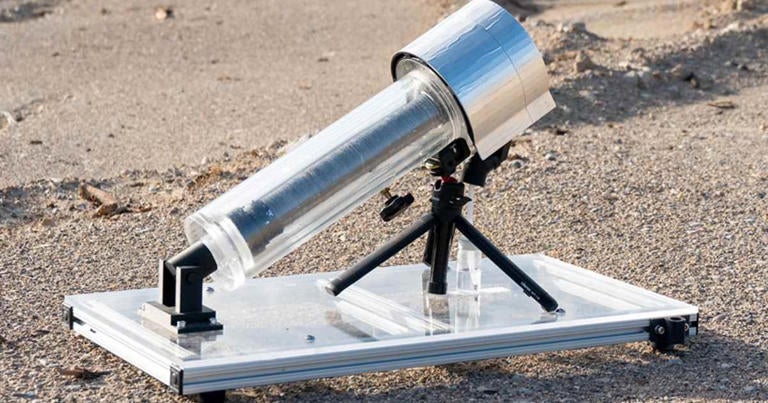
The device leans on MOFs, ultra-porous materials that can selectively pull water vapor out of the air. The research team argues that other candidates such as hydrogels, zeolites, or salts struggle to combine three things at once. These things are operating at low humidity, doing so efficiently, and holding a lot of water.
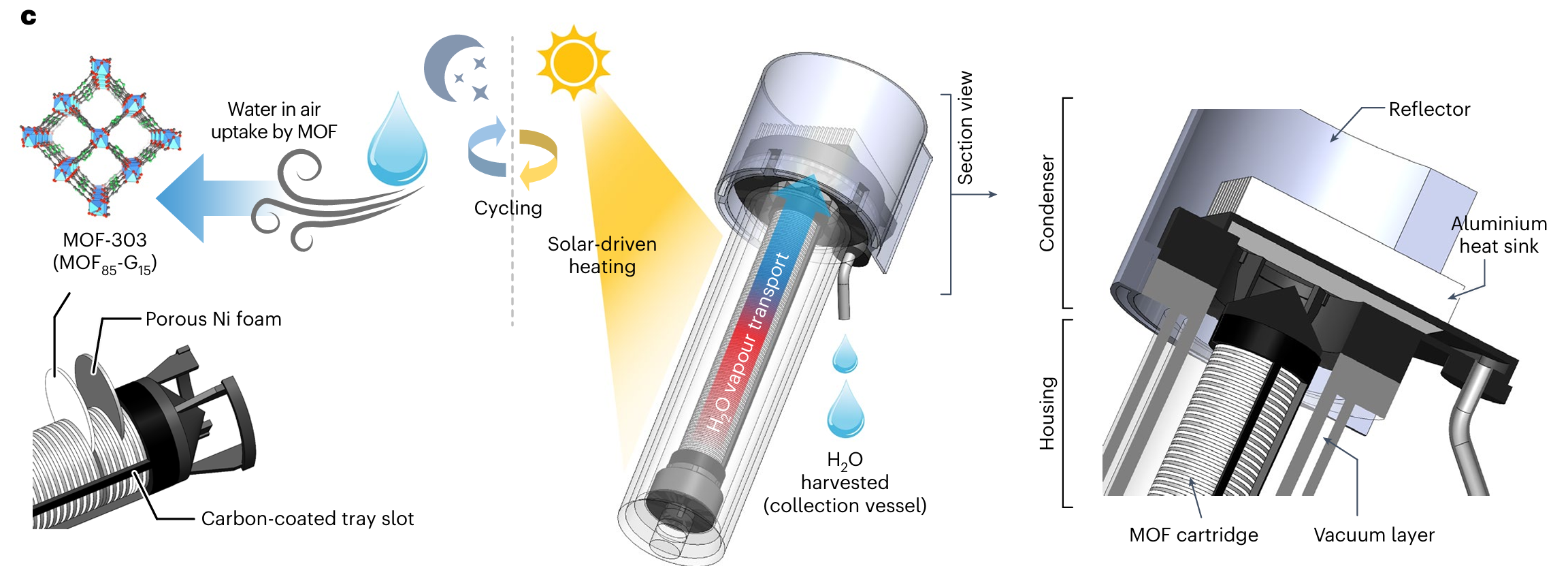
In this work, the team integrated a particular MOF, called MOF-303, into a cartridge designed to expose as much surface area to air as possible. Instead of packing the material into a thick bed, they pressed it into thin disc-shaped pellets and stacked those pellets with porous nickel foam. The foam lets air move through the stack and also spreads heat. This is important because MOFs tend to insulate rather than conduct warmth.
The device itself separates two jobs that pull in opposite thermal directions. The MOF cartridge needs heat so it can release water. The condenser works better when it stays cooler. This allows water to form droplets instead of drifting away. Berkeley’s design places the condenser above the cartridge and uses a vacuum-insulated, cylinder-shaped housing meant to reduce heat loss. Yet, it still takes in sunlight across the day.
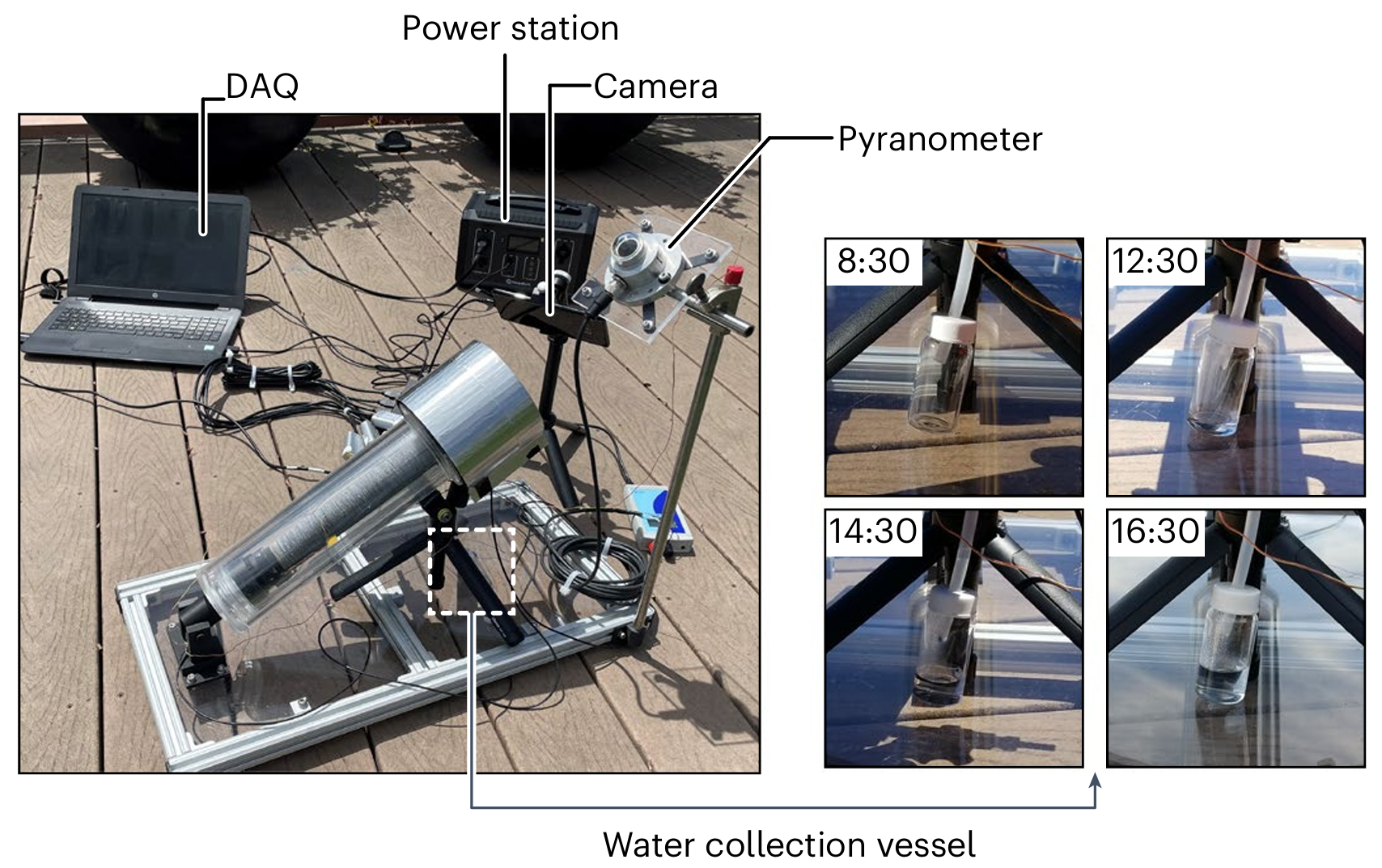
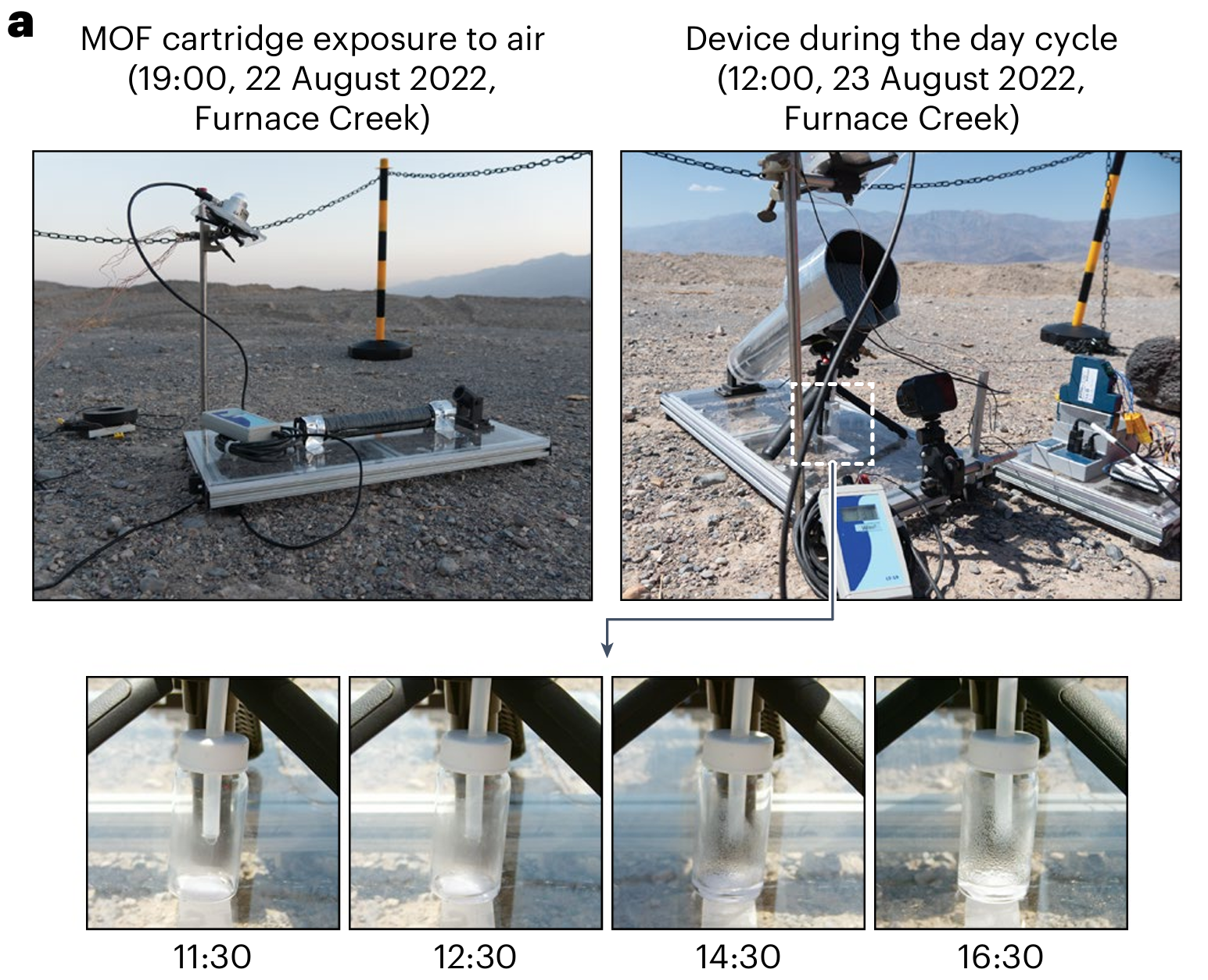
Field tests ran in Berkeley and in the Death Valley region in August 2022, including a cycle at Furnace Creek. In the Death Valley trials, the team reported ambient conditions that ranged from very dry nights to brutally hot days. There was an ambient temperature swing of 21.9 to 60.7 degrees Celsius. In addition, relative humidity ranged from 9.4% to 36% during the tests described in the paper.
Even then, the harvester produced water. At Furnace Creek, the team reported an average nighttime relative humidity of 14% and a condenser temperature that reached 65 degrees Celsius. Under those conditions, the system collected 114 grams of water per kilogram of MOF-303 per day. Across all Death Valley tests, the highest daily yield reached 210 grams per kilogram.
In Berkeley, yields climbed higher, averaging 245 grams per kilogram. The researchers attributed their higher results to better condensation when the ambient temperature stayed lower. This helped the device shed heat.
The paper also reports calculated device efficiency values of about 41% to 66% across the field tests. This is based on a thermodynamic analysis comparing actual water collection to a maximum specific yield under the test conditions.
If the MOF is the sponge, the condenser is where the water actually becomes water you can pour. In the lab, the team explored ways to speed that last step.
They modified aluminum condenser surfaces using hydrophobic coatings and then tried a strip-patterned surface. The idea: help water droplets nucleate and grow in specific channels, then let gravity pull merged droplets away so the surface doesn’t stay wet and resist further condensation. In laboratory tests, the patterned condenser reached a water-harvesting capacity of 248 grams per kilogram of MOF-303.
The paper also emphasizes scale and geometry. The cartridge design keeps a constant ratio between MOF volume and exposed surface area, even as MOF quantity changes. The authors describe this as important for scaling the approach beyond small batches of material.
Outside the paper itself, Yaghi points to another thread feeding into the work: computational design. He is co-director and chief scientist of the Bakar Institute of Digital Materials for the Planet (BIDMaP) at Berkeley’s College of Computing, Data Science, and Society. This institute uses data science and machine learning to speed the design of molecules, materials, and devices.
“What we’re doing at BIDMaP is creating what I call the ‘digital innovation cycle’ to connect the molecule, the material and how the material is configured and fits into the device including the actual device design, its efficiency and performance,” Yaghi said. “All of these are connected, and each part has to be optimized to get the highest performance.”
The study’s authors are Woochul Song, Zhiling Zheng, Ali Alawadhi and Yaghi, affiliated with Berkeley’s Department of Chemistry, the Kavli Energy NanoScience Institute and BIDMaP. Song left Berkeley this year to join Pohang University of Science and Technology.
The work arrives as drought pressure grows in many regions. The team frames the harvester as one potential way to pull water from a source that exists almost everywhere, even if it’s thinly spread.
The researchers also underline what still needs scrutiny. Their summary notes that the prototype’s real-world impact depends on economic and environmental assessments that account for device fabrication and MOF synthesis. This includes the preparation of starting materials and the solvents used to activate the MOF. They also call for long-term cycling performance data at larger scales, so cost-benefit comparisons can be made against existing water systems.
For now, the device offers a specific demonstration: water from desert air, collected passively with sunlight, under conditions where the authors say no other reported system has operated without energy input beyond ambient sunlight.
Research findings are available online in the journal Nature Water.
The original story “Nobel prize winner invents machine that pulls water from dry air” is published in The Brighter Side of News.
The post Nobel prize winner invents machine that pulls water from dry air appeared first on The Brighter Side of News.

