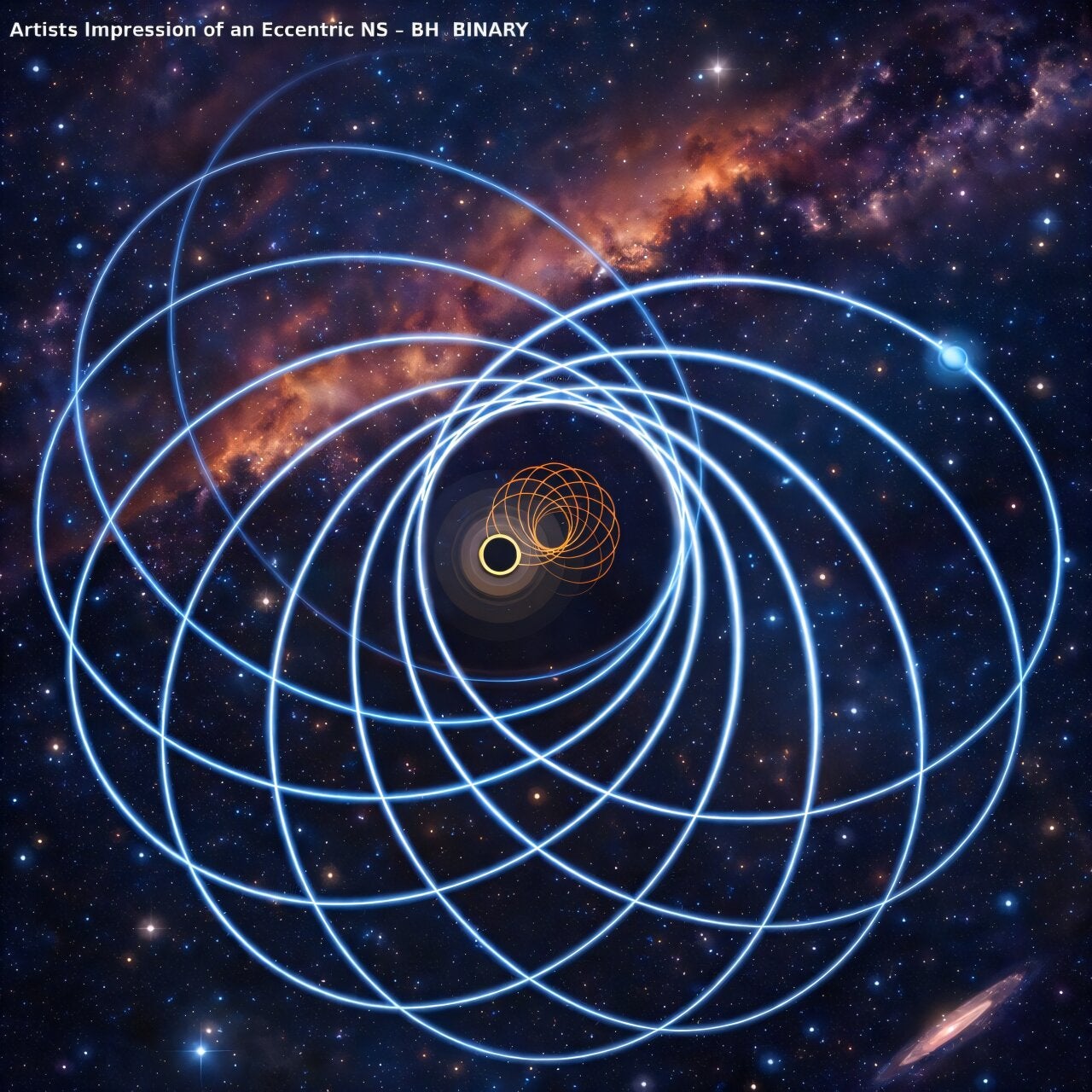
In 2020, astronomers discovered a violent cosmic event that has led them to rethink how extreme pairs of astronomical objects form. These pairs are capable of producing powerful cosmic collisions. The event, referred to as GW200105, involved two of the most extreme objects in the universe: a neutron star and a black hole.
The two objects were locked in a spiraling path toward one another until they finally merged. For a long time, scientists had assumed that any system consisting of a black hole and a neutron star would have merged along an almost perfectly circular path by the time the two objects collided. However, this discovery shows that GW200105 followed an elliptical path.
This elliptical orbit indicates that the two objects that created this signal likely had a much more chaotic history than previously thought.
The results of this investigation were presented in The Astrophysical Journal Letters. The study involved researchers from the University of Birmingham, Universidad Autónoma de Madrid, and the Max Planck Institute for Gravitational Physics.
The work was carried out through a reanalysis of gravitational-wave data from the Laser Interferometer Gravitational-Wave Observatory (LIGO) and the Virgo observatory.
“This discovery provides incredibly important new evidence on how these extreme types of cosmic objects come to form and provides us with an entirely new set of questions as to where in the Universe these types of systems may have originated,” said Dr. Patricia Schmidt from the University of Birmingham.
Signals that were initially hidden in the GW200105 data were used to detect the unusual characteristics of the event.
GW200105 was first detected on January 5, 2020, during the third observing run of Advanced LIGO and Virgo. Early in the analysis, it appeared to be a relatively typical merger between a neutron star and a black hole.
After completing that initial analysis, scientists returned to the data for a deeper investigation. Following this new examination, researchers reanalyzed and updated the GW200105 data using a newly developed model of gravitational-wave detection.
This model took into account two unique characteristics in the data: eccentricity and precession, which refers to the wobbling motion of a spinning object.
Researchers analyzed thousands of different theoretical waveforms using the pyEFPE model and Bayesian statistics. This process allowed them to identify the waveform that best matched the signal detected by LIGO.
The results were surprising.
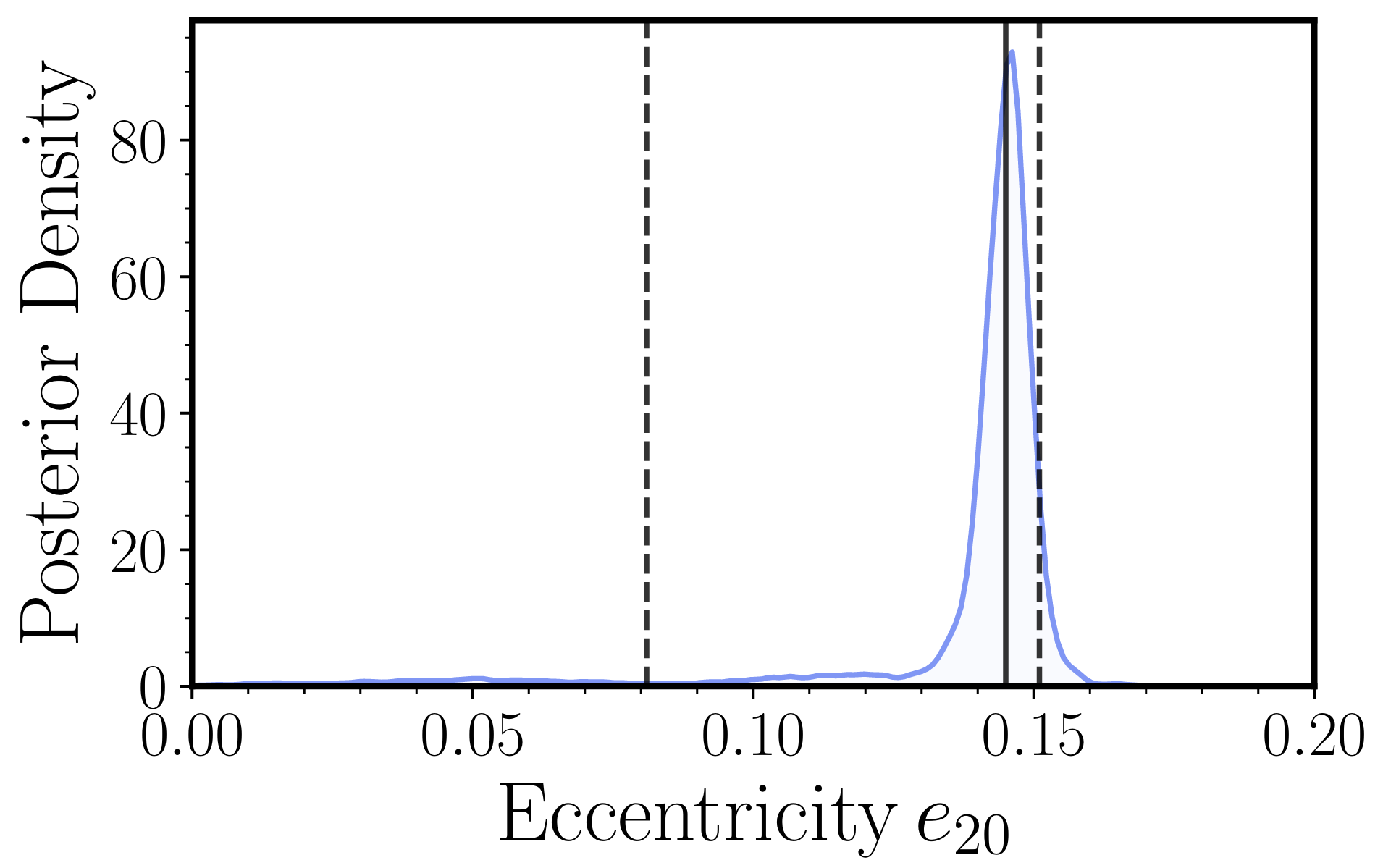
Instead of circular orbits, the researchers found clear evidence of eccentricity in the orbital motion of the two objects.
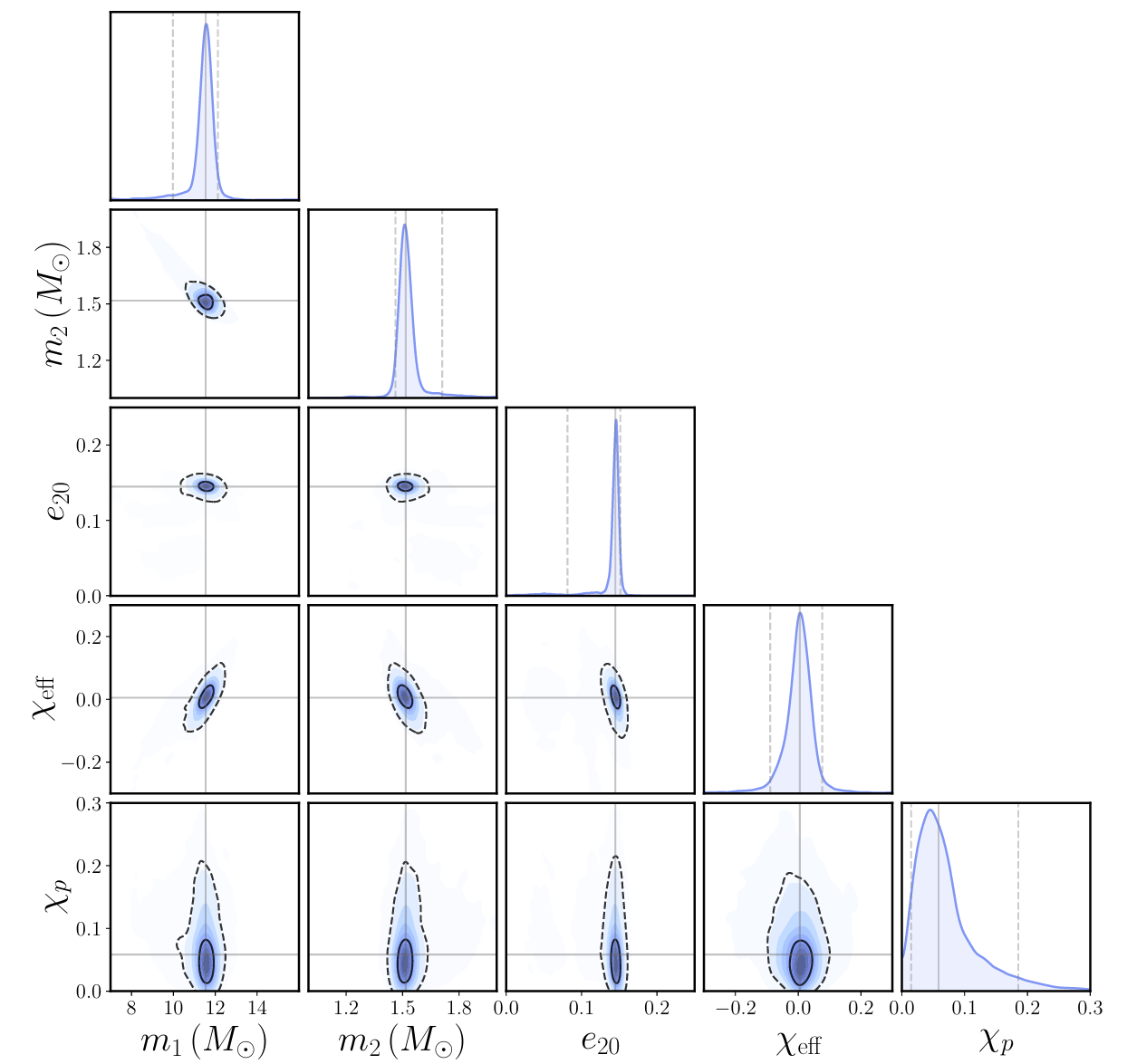
This eccentricity was determined to have a median value of approximately 0.14 at a gravitational-wave frequency of 20 Hz. The lower end of the 99 percent confidence interval for the measurement also remained above zero, demonstrating that a circular orbit could be ruled out with a high degree of confidence.
The conclusion was striking.
Assuming the presence of circular motion in this binary system appeared extremely unlikely.
The eccentric motion of the objects also affected estimates of the masses of the black hole and the neutron star.
Using the eccentric orbit model, the black hole’s mass is estimated to be around 11.5 times the mass of the Sun. The neutron star’s mass is estimated to be about 1.5 times the mass of the Sun.
Earlier estimates, which assumed circular motion, produced different results. Those earlier calculations suggested a black hole mass of approximately 8.9 solar masses and a neutron star mass of about 1.9 solar masses.
These discrepancies arose because eccentric orbital motion causes subtle changes in the gravitational-wave signal. Those changes can bias the estimated masses of the objects if circular motion is assumed.
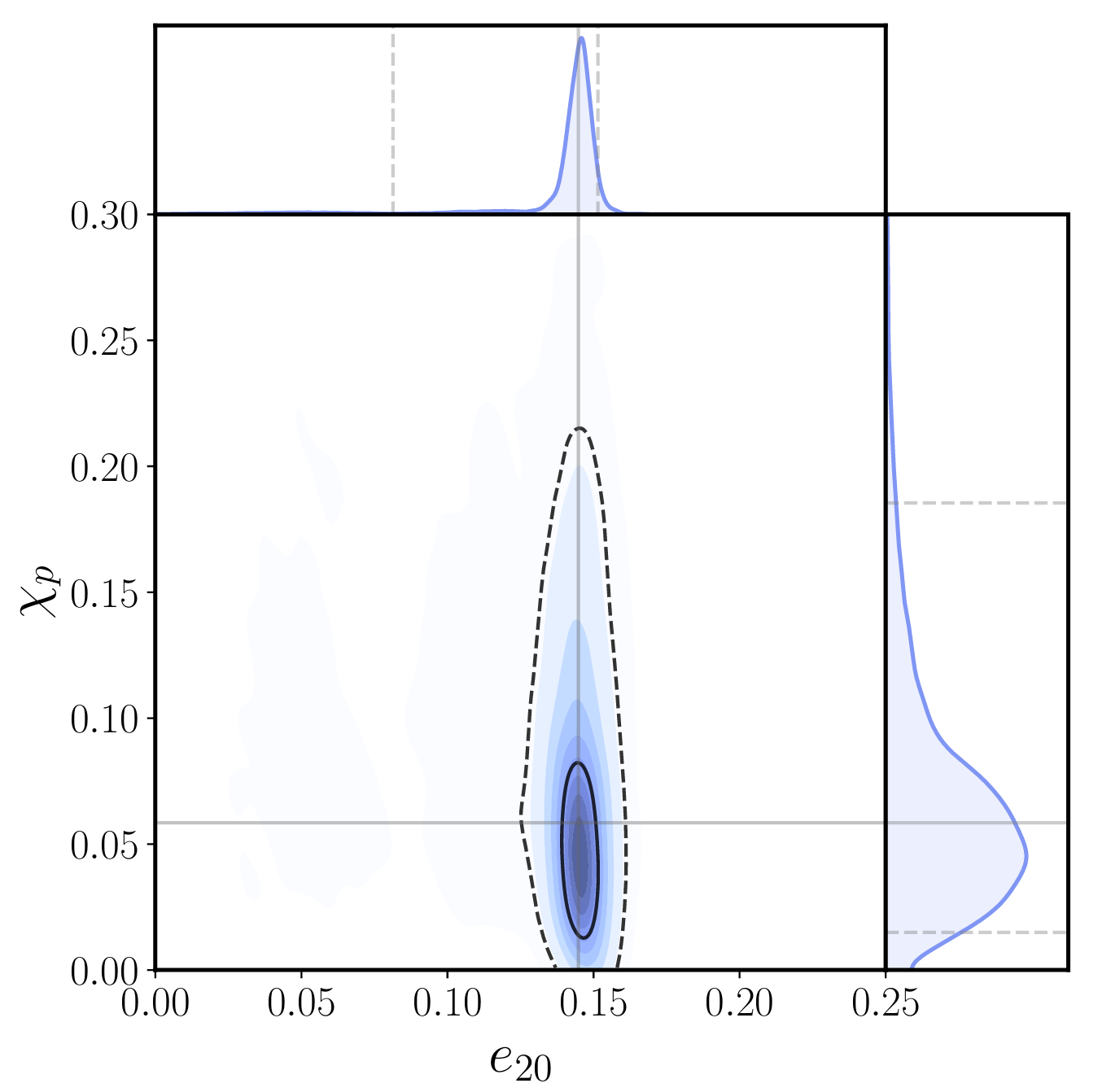
Researchers also found very little evidence that the objects were spinning in a way that would produce large amounts of orbital precession.
Therefore, it is unlikely that the eccentric nature of the orbit resulted from the spin of the objects during their inspiral phase. Instead, the eccentricity likely reflects the way the two objects originally formed.
One of the researchers involved in investigating the origin of GW200105 is Dr. Geraint Pratten, a Royal Society University Research Fellow at the University of Birmingham.
According to Dr. Pratten, the shape of the merged pair’s orbit offers important clues about how the system formed.
“The orbital shape provides a lot of insight about the history of the system,” Dr. Pratten said.
“The strong elliptical shape prior to the merger indicates that this system did not develop quietly and independently. It was likely influenced by gravitational interactions with nearby stars, or perhaps a third companion.”
Most theoretical models of neutron star–black hole binary systems suggest that they begin as two massive stars orbiting each other relatively independently.
Over millions of years, gravitational radiation gradually removes energy from the orbit. As this happens, the orbit becomes increasingly circular while the two objects slowly spiral closer together.
If this scenario were correct in this case, the orbit should have been nearly circular by the time gravitational-wave detectors observed the system.
However, GW200105 shows strong evidence of orbital eccentricity. This suggests that significant gravitational interactions occurred during the system’s history.
Several possible explanations have been proposed to account for the eccentricity.
One possibility is that the system formed within a densely packed star cluster. In such environments, close gravitational encounters between nearby stars can disrupt binary systems and alter their orbits.
Another possibility is that the system formed within a hierarchical triple-star configuration. In this scenario, a third object could have exerted gravitational forces that maintained an elongated orbit while the two compact objects spiraled toward each other.
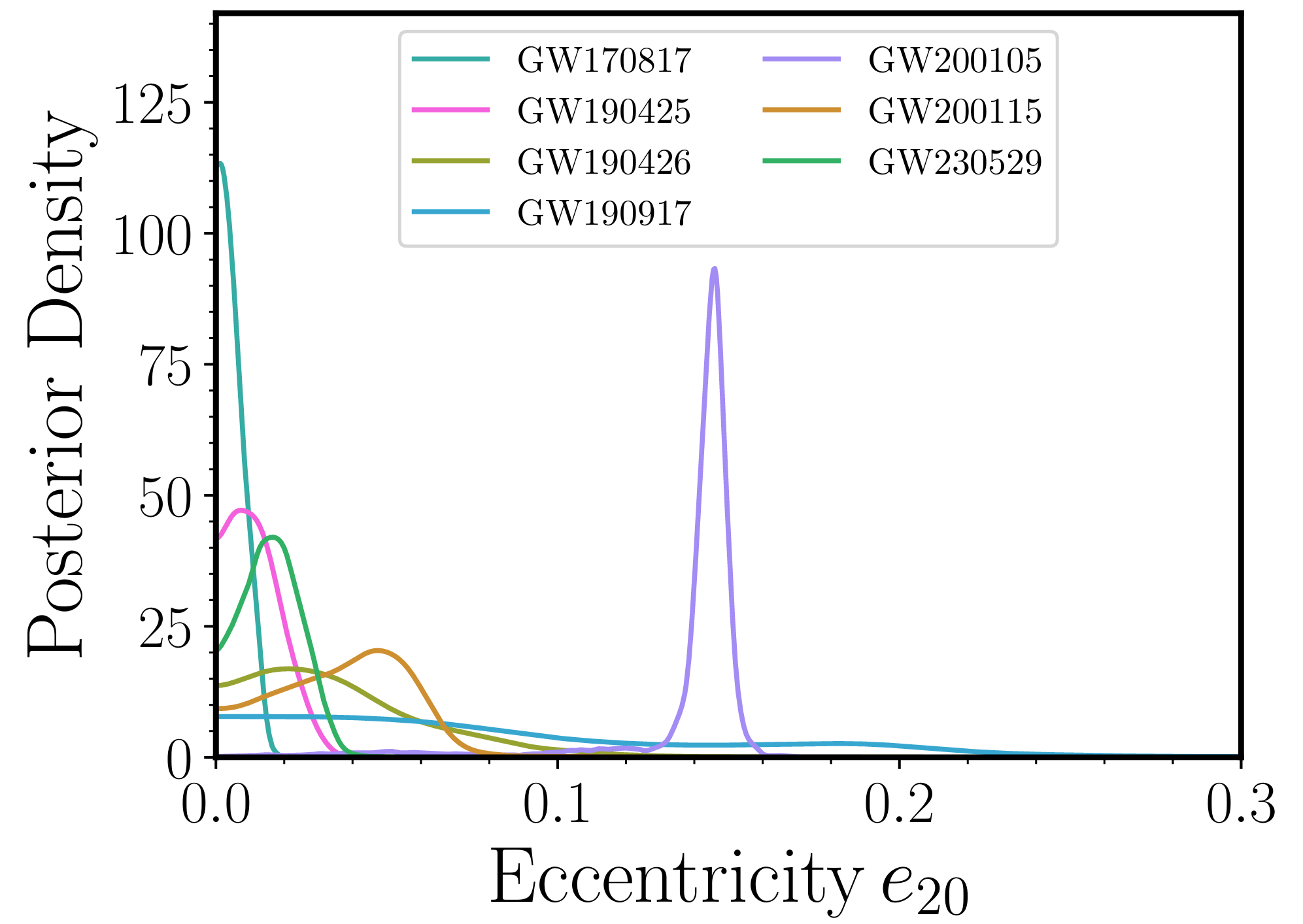
Researchers also examined several other neutron star–black hole and neutron star–neutron star mergers for similar signatures of enhanced eccentric motion.
None of the additional mergers showed convincing evidence of eccentric orbits.
GW200105 therefore appears to be unusual among currently observed gravitational-wave events.
Extensive testing also showed that the signal was unlikely to be a coincidence.
Simulations indicate that random noise would produce a signal exhibiting the same level of eccentricity as GW200105 only 0.023 percent of the time.
Further analysis also showed that errors in the models or sampling strategies could not account for the findings.
According to Dr. Gonzalo Morales of Universidad Autónoma de Madrid and the Max Planck Institute for Gravitational Physics, “the identification of the origin of masses greater than the mass of the Sun has been a challenge. The evidence of eccentric orbital activity in GW200105 clearly indicates that these two sources formed in an area of space containing multiple gravitationally interacting stars.”
The results of this study provide new insight into how extremely dense objects form and evolve.
By offering a method to distinguish different evolutionary pathways for black hole–neutron star binary systems, the findings help scientists better understand how often chaotic formation processes produce these systems.
Gravitational-wave observatories continue to detect an increasing number of mergers. As these observations accumulate, researchers expect to gain a clearer picture of the environments in which such chaotic origins occur.
Future instruments will further expand these discoveries.
Next-generation ground-based gravitational-wave observatories, along with the proposed space mission LISA, are expected to detect many additional eccentric binary systems. These discoveries may reveal even more about the environments and processes that create some of the universe’s most extreme cosmic pairs.
Research findings are available online in The Astrophysical Journal Letters.
The original story “Astronomers discover the first neutron star–black hole merger with an eccentric orbit” is published in The Brighter Side of News.
Like these kind of feel good stories? Get The Brighter Side of News’ newsletter.
The post Astronomers discover the first neutron star–black hole merger with an eccentric orbit appeared first on The Brighter Side of News.

