Magnetic fields that stretch across thousands of light-years should take a very long time to organize. Standard dynamo theory puts that timeline at roughly 5 to 10 billion years in galaxies. Yet astronomers have spotted coherent magnetic fields in galactic and protogalactic environments at high redshifts, including reports up to redshift 2.6 and even 5.6.
That mismatch has been a stubborn problem.
A new study in Physical Review Letters argues that part of the answer may lie in the chaos of galaxy formation itself. Instead of treating magnetic growth as something that unfolds in a settled system, the researchers looked at what happens while a galaxy is still assembling from a collapsing cloud of ionized gas.
“However, dynamo theory has its limitations”, says Pallavi Bhat, an assistant professor at the International Centre for Theoretical Sciences and an author of the study. “In particular, it struggles to explain observations of young galaxies with robust magnetic fields across thousands of light-years”.
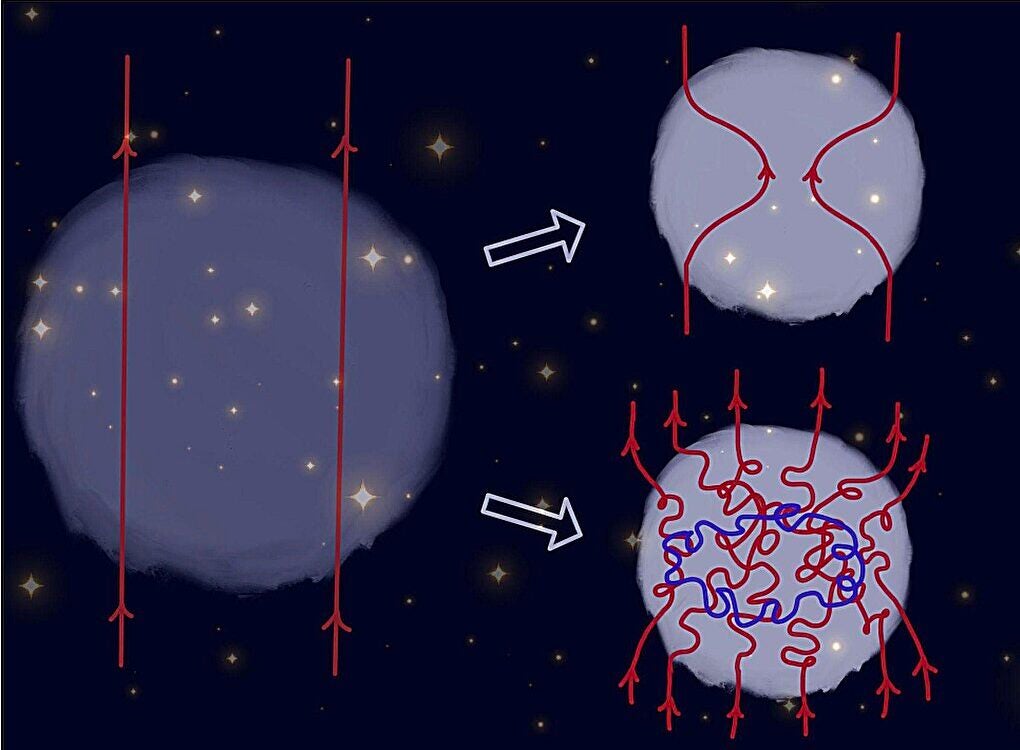
Almost all visible matter in the universe exists as plasma. When that plasma moves turbulently, magnetic fields can grow through the dynamo process. In galaxies, the theory already allows quick amplification of small-scale magnetic fluctuations, on timescales around 10 million years. Large-scale fields are another matter. Those usually take much longer.
The new work asks what changes when the gas cloud itself is collapsing under gravity.
“When the galaxy is forming, gravity itself can stir the plasma, which can amplify magnetic fields”, says Irshad, a graduate student at ICTS and the study’s lead author.
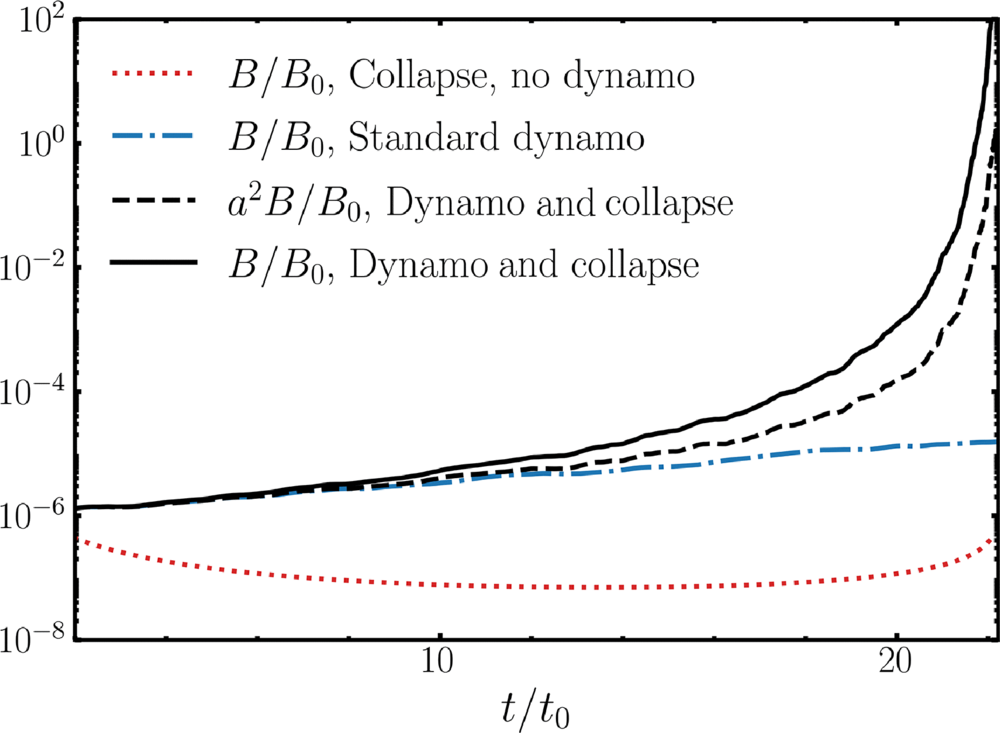
The team used analytical calculations to examine a turbulent cloud undergoing collapse. Their core result is that the magnetic field does not just grow exponentially, as in the standard picture. It grows “superexponentially.” In plain terms, the growth rate itself speeds up as collapse proceeds.
That happens because turbulence changes during contraction. The plasma contains eddies, swirling motions like the ones seen in a stream. Magnetic amplification depends on how fast those eddies turn over. As the cloud shrinks, the researchers found, that turnover rate rises. Faster eddies mean faster field growth.
One single effect would not have been enough. The collapse also compresses the magnetic field through flux freezing, but the paper argues the dynamo boost goes beyond that simple compression. Even after factoring out the baseline effect of collapse, the dynamo contribution still accelerates.
To make the problem manageable, the researchers used a mathematical setup called supercomoving coordinates. In cosmology, that framework is used to absorb the expansion of the universe.
“These coordinates essentially make the equations of a collapsing galaxy the same as a static galaxy, making the calculations very straightforward”, says Irshad.
That simplification let the team adapt standard magnetohydrodynamic equations to a collapsing background. They then backed up the analytical work with numerical simulations, using the publicly available Dedalus code in a periodic cubic box at a resolution of 1283. Those simulations tracked both small-scale and large-scale dynamos.
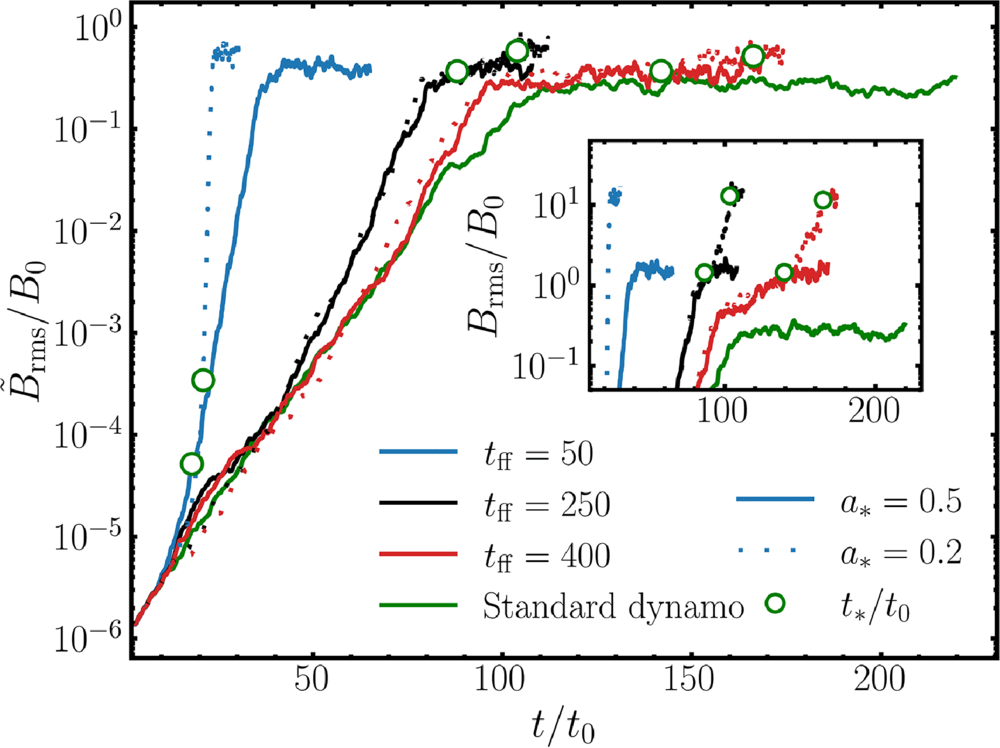
The numerical results supported the main idea. In a collapsing turbulent flow, both kinds of dynamos showed faster magnetic amplification than they did in a stationary background. The paper also found that the saturated magnetic field can end up stronger than expected from standard dynamo theory or from flux freezing alone. For a spherically symmetric collapse, a frozen-in field scales with gas density as B ∝ ρ2/3, while the dynamo-assisted case in this study scales as B ∝ ρ5/6.
The paper gives a striking example of what that speed-up could mean. In one case discussed by the authors, superexponential growth over 15 orders of magnitude cuts the saturation time of the standard dynamo by a factor of 10.
Still, the authors do not present this as the final word. Their analysis focuses on a homogeneous cloud, incompressible supercomoving turbulence, and a uniformly collapsing spherical system. The study also notes that gas pressure stops collapse before any true singular state is reached, and that real galaxies break spherical symmetry and become inhomogeneous. Density inhomogeneities, compressible flows, and more realistic collapse modes remain to be explored.
The timing matters because magnetic fields can influence far more than radio observations. The study notes that early magnetic fields can affect the stellar mass spectrum by suppressing fragmentation and enabling jets and outflows from accretion disks. They also help shape galaxy evolution and feedback through winds and fountains.
Although magnetism is usually much weaker than gravity in setting the largest cosmic structures, appearing earlier gives it more time to matter.
“There’s still much to learn in this ‘zeroth-order question you ask about the timescale’ too, says Pallavi. For example, there have been efforts to create computational models for the structure formation in the universe. This study can predict how fast the magnetic fields are set up in the universe, enabling scientists to test and refine their models accordingly, she says.”
The same framework may also apply beyond galaxies. The authors say their results are relevant to primordial star formation, where strong compression and efficient coupling between gas and magnetic fields could also amplify fields more quickly than expected.
This study gives modelers a new timescale to test. If collapse really accelerates magnetic growth, simulations of galaxy and star formation may need to build that effect in from the start.
That could change estimates for when young galaxies first developed observable magnetic structure, and it may help explain why ordered fields appear earlier in the universe than older theories predict.
Research findings are available online in the journal Physical Review Letters.
The original story “Scientists are rethinking how young galaxies formed their magnetic fields” is published in The Brighter Side of News.
Like these kind of feel good stories? Get The Brighter Side of News’ newsletter.
The post Scientists are rethinking how young galaxies formed their magnetic fields appeared first on The Brighter Side of News.

