A new study published in Personality and Social Psychology Bulletin suggests that liberals and conservatives actually share a common foundation for morality based on preventing harm. The research indicates that political disagreements arise because people on the left and right hold different “assumptions of vulnerability.” In other words, they make different assumptions about which groups or entities are most susceptible to being harmed.
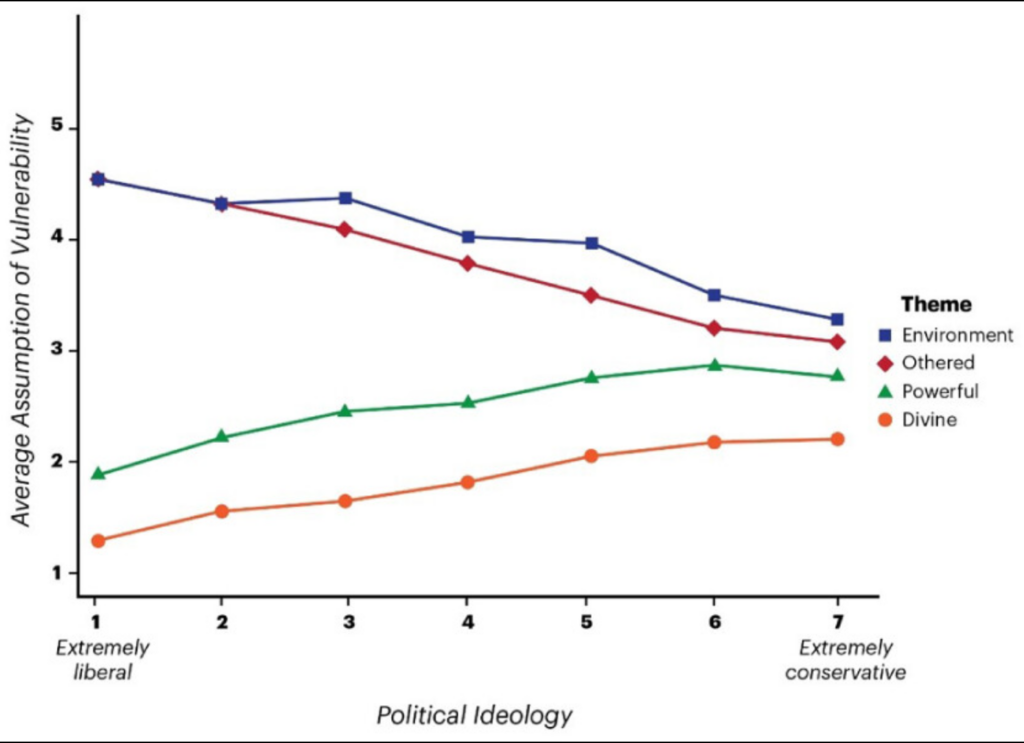
While both sides actually agree that marginalized groups and the environment face the highest risk of harm, they disagree on the size of the gap between different groups. Liberals see a massive divide in vulnerability between the marginalized and those in power. Conservatives, on the other hand, view vulnerability as a more universal human trait, rating the powerful and the divine as significantly more susceptible to harm than liberals do.
These findings challenge a popular idea known as Moral Foundations Theory. This older framework proposes that conservatives and liberals rely on entirely different mental mechanisms to make moral judgments, suggesting liberals care mostly about harm and fairness, while conservatives uniquely value loyalty, authority, and purity.
However, recent scientific advances point to harm as the universal core of all moral judgments. This shift in understanding presented a puzzle for scientists. The researchers wanted to better understand how “moral disagreements about politics arise when everyone makes moral judgements based on whether someone was perceived to harm someone else,” explained Jake Womick, an assistant professor at California State University, Bakersfield, and co-first author of the study.
“People tend to think that liberals and conservatives are fundamentally morally different, that they hold different foundational moral values about what is fundamentally right and wrong and that this explains why the left and right disagree on things like abortion, immigration and guns,” explained Emily Kubin, a postdoctoral research fellow at the University of Oxford and co-first author.
“However, recent advancements in morality research point to people across the ideological spectrum caring about the same moral concern — harm,” Kubin continued. “But how can everyone care about harm but still disagree on so many issues? This work attempted to address that tension by showing how liberals and conservatives care about harm (or vulnerability), but just see it in different places.”
To solve this puzzle, the researchers proposed that everyone bases their morality on protecting victims, but individuals simply disagree on who exactly qualifies as a victim. By measuring these underlying assumptions of vulnerability, they hoped to explain why the left and right diverge on issues ranging from climate change to policing.
In preliminary work, the scientists conducted a pilot study and two supplemental studies to establish that assumptions of vulnerability predict general moral judgments. They confirmed that people who perceived entities like children or the American flag as highly vulnerable also granted them higher moral status. These early tests revealed systematic differences across the political spectrum, with conservatives seeing fetuses as especially vulnerable to harm.
In the first primary study, the researchers recruited 400 participants to examine how vulnerability assumptions explain moral judgments on divisive topics. Participants read six moral scenarios, such as college students burning an American flag or illegal immigrants being detained at the border. The participants then rated the immorality of each scenario on a scale from one to five. The participants also rated the perceived vulnerability of the targets at the center of each scenario, such as the American flag or illegal immigrants.
The researchers found that political orientation predicted moral judgments, with liberals condemning left-leaning issues and conservatives condemning right-leaning issues. More importantly, individual perceptions of vulnerability predicted these moral judgments better than political orientation alone.
The scientists then focused on four specific themes of vulnerability to better understand contemporary political debates. These four themes included the environment, marginalized groups known as the “othered,” powerful people like police officers, and the divine. In the second study, 932 participants rated the vulnerability of three targets within each of the four themes. They also evaluated the immorality of real-world scenarios in which these targets were victimized.
The data revealed that liberals rated the environment and marginalized groups as more vulnerable than conservatives did. On the other hand, conservatives rated the powerful and the divine as more vulnerable than liberals did. The scientists also noted that liberals tended to view vulnerability as group-based, while conservatives viewed vulnerability as more evenly distributed across all individuals.
To ensure these findings were robust, the scientists replicated the experiment with a quasi-representative national sample of 1,832 religious Americans. These participants completed the same vulnerability ratings and reported their political orientations. The researchers observed the same ideological patterns in this highly religious sample.
Liberals again amplified the differences in vulnerability between groups, while conservatives minimized those differences. Because the sample was highly religious, the overall ratings for the vulnerability of the divine were significantly higher than in the previous study.
“Perhaps the most interesting and important finding comes from looking at the rank order of these four categories on the extreme political left and right,” Womick told PsyPost. “Two big takeaways here.”
“First, Across the political spectrum, people tend to agree on the relative vulnerability of groups (i.e., the rank order of each category of vulnerability). Both extreme liberals and conservatives viewed transgender people and immigrants as more vulnerable than police officers and CEOs. I think the unifying framework of perceived harm and these similar rankings across the political spectrum offer some common ground that might be useful for bridging political divides.”
“Second, where they differed here was in the degree of these distinctions. On the extreme left, people really split vulnerability into extremes (e.g., transgender people are highly vulnerable, while CEOs are almost completely invulnerable), whereas those on the extreme right the capacity for harm, victimization, and mistreatment as more evenly distributed across groups.”
The researchers conducted a third study to see how these vulnerability perceptions related to other personal values and whether they remained stable over time. They recruited 920 participants who completed the vulnerability surveys twice, with a one-week gap between the sessions. During the first session, the participants also completed surveys measuring their moral foundations, basic values, authoritarian beliefs, and supernatural beliefs.
The scientists found that the participants’ vulnerability ratings were highly stable over the one-week period. The vulnerability perceptions also aligned with other psychological traits in expected ways. For instance, believing the environment is vulnerable predicted a strong moral concern for plants and animals, while perceiving the powerful as vulnerable predicted higher levels of right-wing authoritarianism.
In the fourth study, the scientists directly compared their vulnerability framework against Moral Foundations Theory. They recruited 484 participants to rate their stances on eight hot-button issues, such as transgender rights and health insurance regulations. Participants also completed assessments of their political ideology, their assumptions of vulnerability, and their moral foundations.
The data showed that assumptions of vulnerability explained unique variances in the participants’ political stances beyond what moral foundations could explain. For issues related to the environment and marginalized groups, vulnerability assumptions were much stronger predictors of political stances than moral foundations. This provides evidence that beliefs about who can be harmed are uniquely powerful in explaining social and economic debates.
The scientists wanted to ensure these ideological patterns were not just reactions to specific, highly politicized words like immigrants or police. In a fifth study involving 403 participants, they measured vulnerability perceptions using only abstract definitions of the four themes. Participants read definitions for the environment, marginalized groups, the powerful, and the divine, without seeing any specific examples.
They then rated how vulnerable these broad categories were to harm and mistreatment. Even without specific examples, the ideological divides persisted exactly as before. Liberals rated the abstract concepts of the environment and marginalized groups as highly vulnerable, while conservatives extended more vulnerability to the powerful and the divine.
The researchers then investigated whether these perceptions of vulnerability operate on an unconscious level. They recruited 278 participants to complete a reaction-time task designed to measure implicit associations. Participants quickly viewed words related to the four vulnerability themes followed by ambiguous visual symbols, and they had to guess if the symbol represented something vulnerable.
Because the initial words appear so quickly, people tend to unconsciously project their feelings about the word onto the ambiguous symbol. The scientists found that these unconscious measures of vulnerability highly correlated with the participants’ explicit, self-reported survey answers. Political orientation also predicted these implicit scores, suggesting that our assumptions about victimhood are deeply ingrained in our unconscious minds.
In the seventh study, the scientists tested whether these vulnerability beliefs actually influence real-world behavior. They asked 186 participants to make forced-choice decisions between pairs of real charities. Each charity represented one of the four vulnerability themes, such as a climate action fund for the environment or a police survivor fund for the powerful.
The researchers promised to donate real money to the charities based on the participants’ choices. The scientists found that participants’ vulnerability ratings predicted their donation choices. People who perceived a specific group as highly vulnerable were significantly more likely to direct financial resources to a charity supporting that group.
To test whether vulnerability perceptions actively cause changes in moral judgments, the researchers conducted an experimental manipulation. They recruited 506 participants to read a story about a wealthy corporate executive who refused to give money to a homeless person. The participants were randomly assigned to one of three groups.
One group wrote about how the executive might be vulnerable to harm, another group wrote about how the homeless person might be vulnerable, and a control group simply read the story. The researchers found that focusing on a specific person’s vulnerability changed how participants judged the situation. When participants focused on the executive’s vulnerability, they judged the executive’s refusal to donate as less immoral. Focusing on the homeless person’s vulnerability made the executive’s actions seem significantly more wrong.
“Everyone views morality as a matter of harm, but those on the political left and right disagree about what groups are particularly vulnerable to harm,” Womick said. “Those on the left view the marginalized and the environment as more vulnerable to harm, victimization, and mistreatment. Those on the right view the powerful and the divine as more vulnerable.”
But the study, like all research, includes some limitations. The United States has a unique political landscape, and it remains unclear how these trends might apply to political dynamics in other countries. Future research will need to test these vulnerability frameworks across different cultures to see if the same patterns emerge globally.
Additionally, the demographic makeup of the study samples was predominantly White and not fully representative of the general population. Because political ideology and racial identity are closely connected, the researchers recommend testing these ideas in more diverse groups. The four themes explored in these studies also represent just a starting point, as there are many other groups people might view as vulnerable.
Looking ahead, the researchers plan to expand their focus beyond the victims of harm to study the people who cause harm. They want to investigate whether there are dispositional differences in how liberals and conservatives perceive moral agents.
“This research was inspired by Dyadic Morality Theory, which tells us acts are viewed immoral when one person (an agent) intentionally harms another person (a patient),” Womick explained. “Assumptions of vulnerability focus on dispositional differences in the person being harmed (how much a target has patiency). We’re now working on looking at dispositional differences in what kinds of groups are especially likely to do harm (dispositional differences in perceptions of moral agents).”
The study, “Liberals and Conservatives See Different Victims: Moral Disagreement Is Explained by Different Assumptions of Vulnerability,” was authored by Jake Womick, Emily Kubin, Daniela Goya-Tocchetto, Nicolas Restrepo Ochoa, Carlos Rebollar, Kyra Kapsaskis, Samuel Pratt, Helen Devine, B. Keith Payne, Stephen Vaisey, and Kurt Gray.

