Light moving through a tiny silicon structure does not look dramatic. It slips down narrow waveguides etched onto a chip, guided by geometry too small to see with the naked eye. Yet in those channels, researchers at the University of Central Florida say they have found a way to build more complex quantum states of light without making the system itself more cumbersome.
Their study, published in Science, centers on a problem that has lingered in quantum photonics. Entangled states of light can help power quantum computing and quantum sensing, but making those states both scalable and resistant to imperfections has been difficult.
Andrea Blanco-Redondo, an optics and photonics professor at CREOL, the College of Optics and Photonics, said her group has now shown a method for entangling multiple topologically protected modes of light in silicon photonic superlattices.
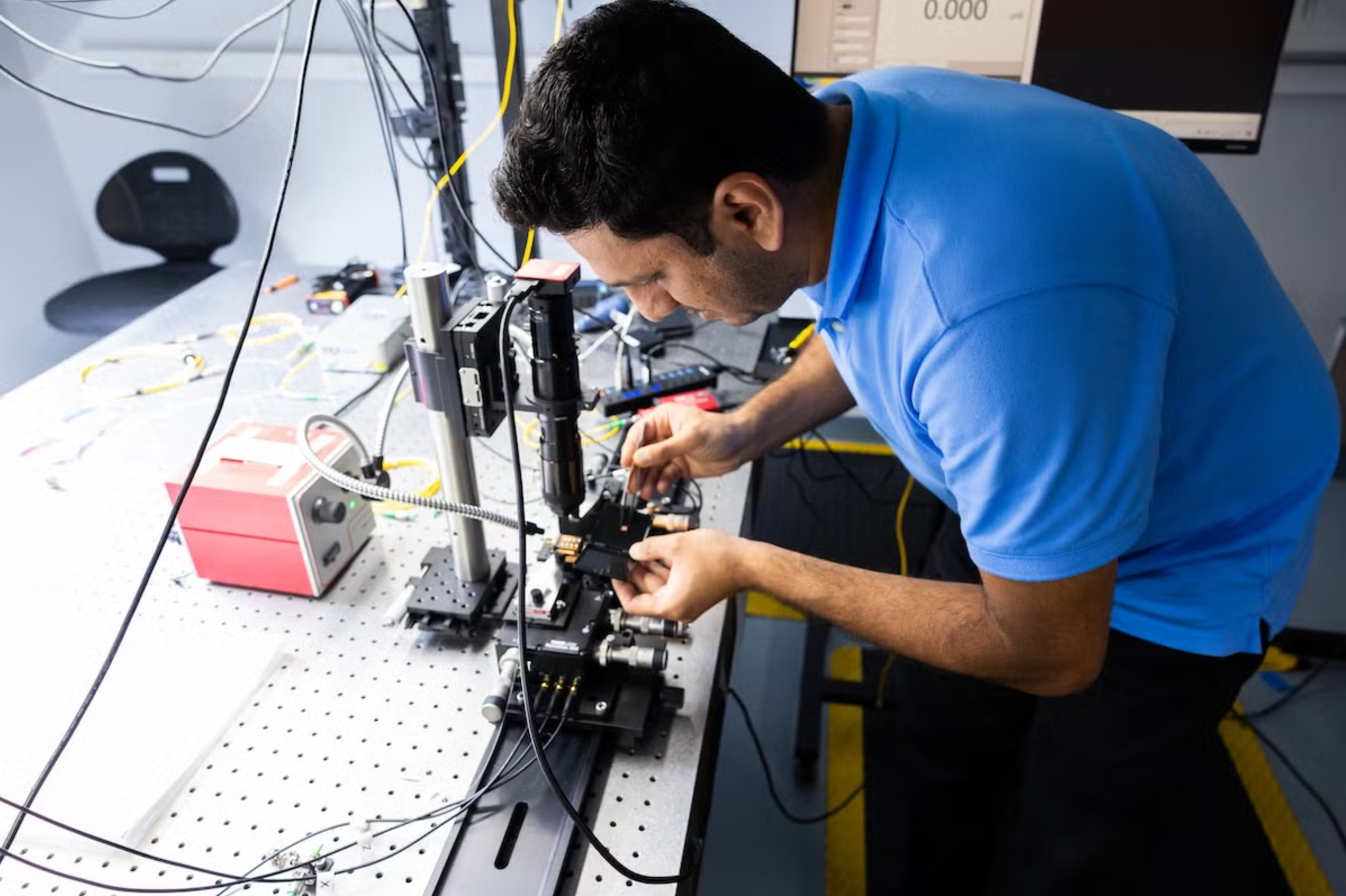
Topological modes are unusual because they depend on the overall structure of a system, not just local details. That gives them a kind of built-in protection. In this case, the researchers used superlattices, structures known to support these protected modes, and found a way to entangle them in higher dimensions. Blanco-Redondo put it plainly: the team figured out how to entangle the protected modes of those superlattices.
That matters because quantum entanglement is fragile. A single photon can exist in a superposition of states, and when two photons are entangled, measuring one determines the state of the other. Earlier work had shown pieces of this idea, but scaling beyond two topological modes had remained out of reach. The new work tackles that limit directly, offering what the researchers describe as a scalable route to more complex entangled states while preserving topological protection.
The promise is not just elegance. More complex entangled states can carry more quantum information, and topological protection can help them resist disorder. Both are important if quantum systems are ever going to move from careful lab demonstrations to devices that work reliably at larger scales.
The team’s method relied on silicon photonic waveguide arrays, which Blanco-Redondo compared to rearranging the furniture in a room. Instead of making the system more elaborate, the researchers displaced the waveguides into a configuration that supports many co-localized protected modes rather than one. The result was a bigger capacity to encode quantum information in a resilient way.
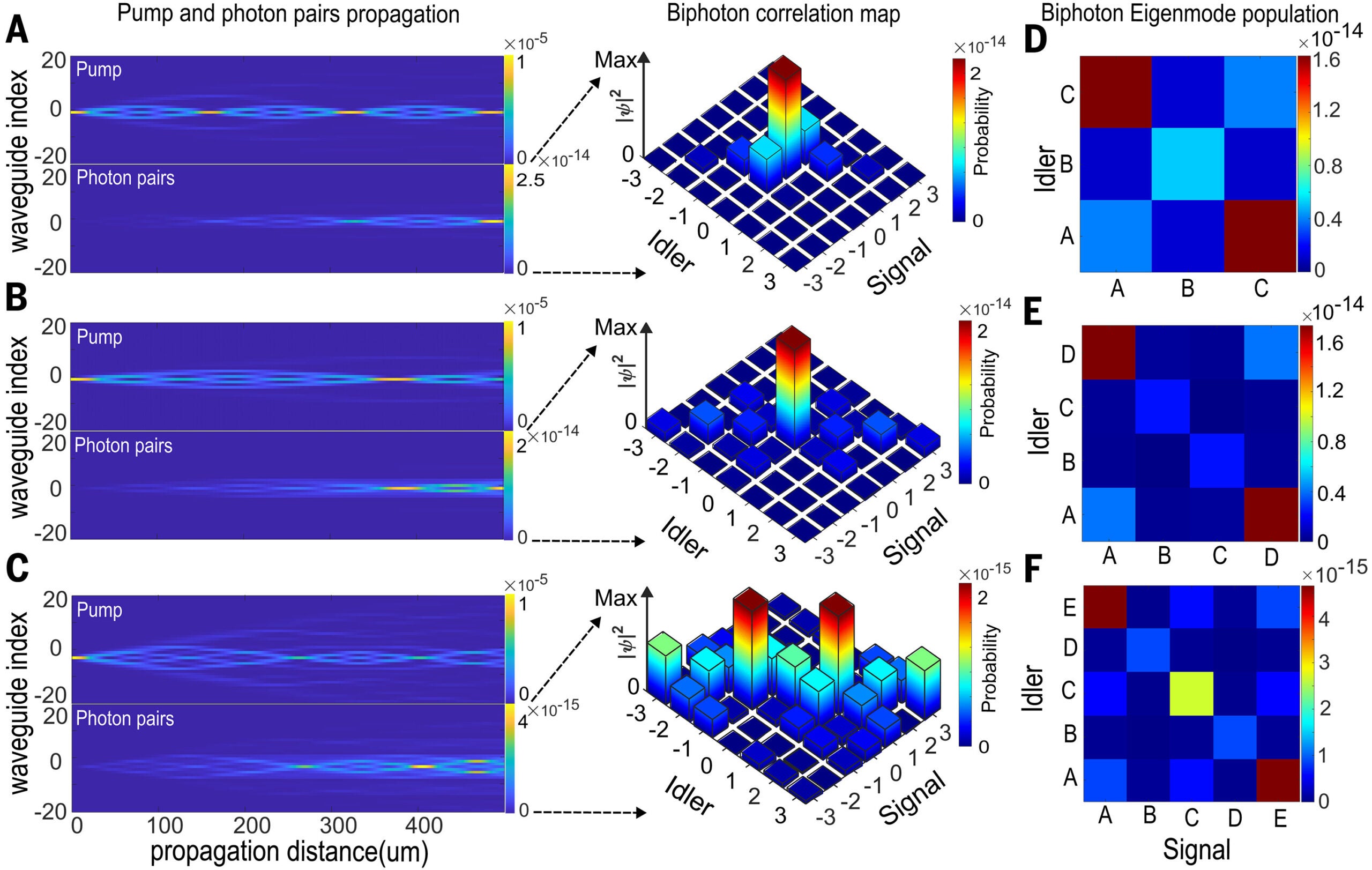
In the technical part of the study, the group built three kinds of superlattices with unit cells made of four, five, or six waveguides. Those designs supported three, four, and five topological interface states, respectively. By exciting a linear superposition of those interface modes in carefully engineered silicon superlattices, the team used the waveguides’ optical nonlinearity to generate biphotons entangled across three, four, and five topological modes.
The experiments used subpicosecond pump pulses at 1550 nanometers, sent into the center of the superlattice through a grating coupler. At the output, photons were separated into signal and idler channels, detected with superconducting nanowire single-photon detectors, and recorded through coincidence measurements. The resulting correlation maps matched the theoretical predictions across the different superlattice types.
One small paragraph in the paper carries a lot of weight.
Because the measurements did not include phase information, the close agreement between measured and predicted joint spatial intensity was especially important for identifying high-dimensional entanglement.
To test robustness, the team fabricated four copies of each superlattice design. Even with unavoidable nanofabrication tolerances of about plus or minus 5 nanometers, the measured biphoton correlation maps looked notably similar from device to device. The researchers also used the Schmidt number, a measure tied to entanglement dimensionality, and fidelity relative to an ideal theoretical state. As expected, the Schmidt number increased as the number of supported modes increased.
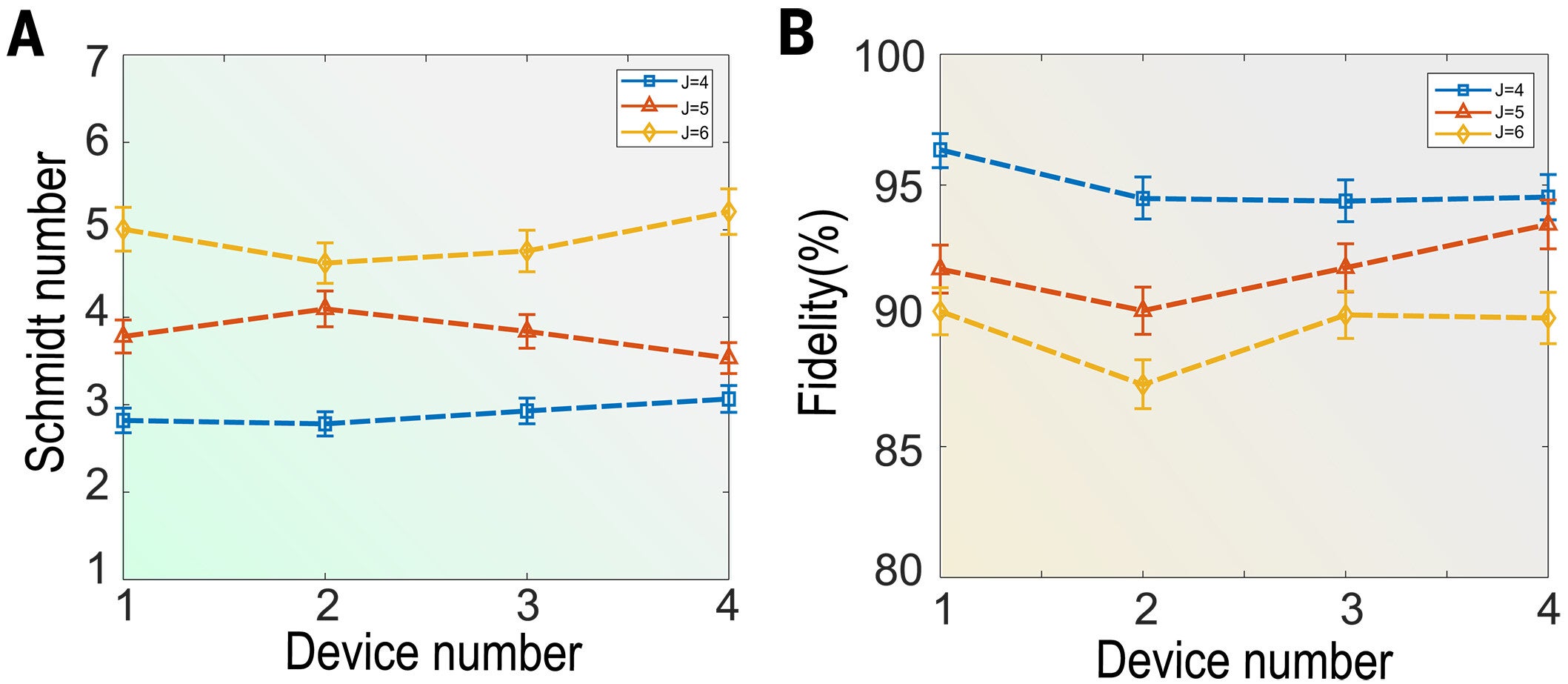
Still, the paper does not pretend the system is perfect. The average fidelity dropped slightly as the number of modes rose, suggesting that the highest-dimensional entangled states were less robust to disorder. The authors linked that weakness to smaller bandgaps in the more complex systems and said bandgap engineering might compensate for it.
The work was led by Blanco-Redondo, CREOL doctoral student Javad Zakery, and former CREOL research scientist Armando Perez-Leija, now at Saint Louis University. It arrives as CREOL and the Florida Alliance for Quantum Technology push to expand Florida’s role in quantum research and infrastructure. Blanco-Redondo said the result gives the group momentum as it builds shared facilities and broader collaborations in quantum optical science.
This work points to a way of building quantum light states that are both richer in information capacity and tougher against fabrication flaws.
That could matter for future quantum computing and sensing systems, where scalability and error resistance remain major obstacles.
The study also suggests that fairly conventional silicon photonic waveguides can serve as a practical platform for exploring larger, more complex quantum states of light.
Research findings are available online in the journal Science.
The original story “Scientists unlock scalable entanglement for next-generation quantum computing” is published in The Brighter Side of News.
Like these kind of feel good stories? Get The Brighter Side of News’ newsletter.
The post Scientists unlock scalable entanglement for next-generation quantum computing appeared first on The Brighter Side of News.

