A dim red giant just out of reach of the Milky Way is providing astronomers with an incredibly rare glimpse into the earliest days of our universe, at a time when it was not possible for a telescope to observe these objects directly.
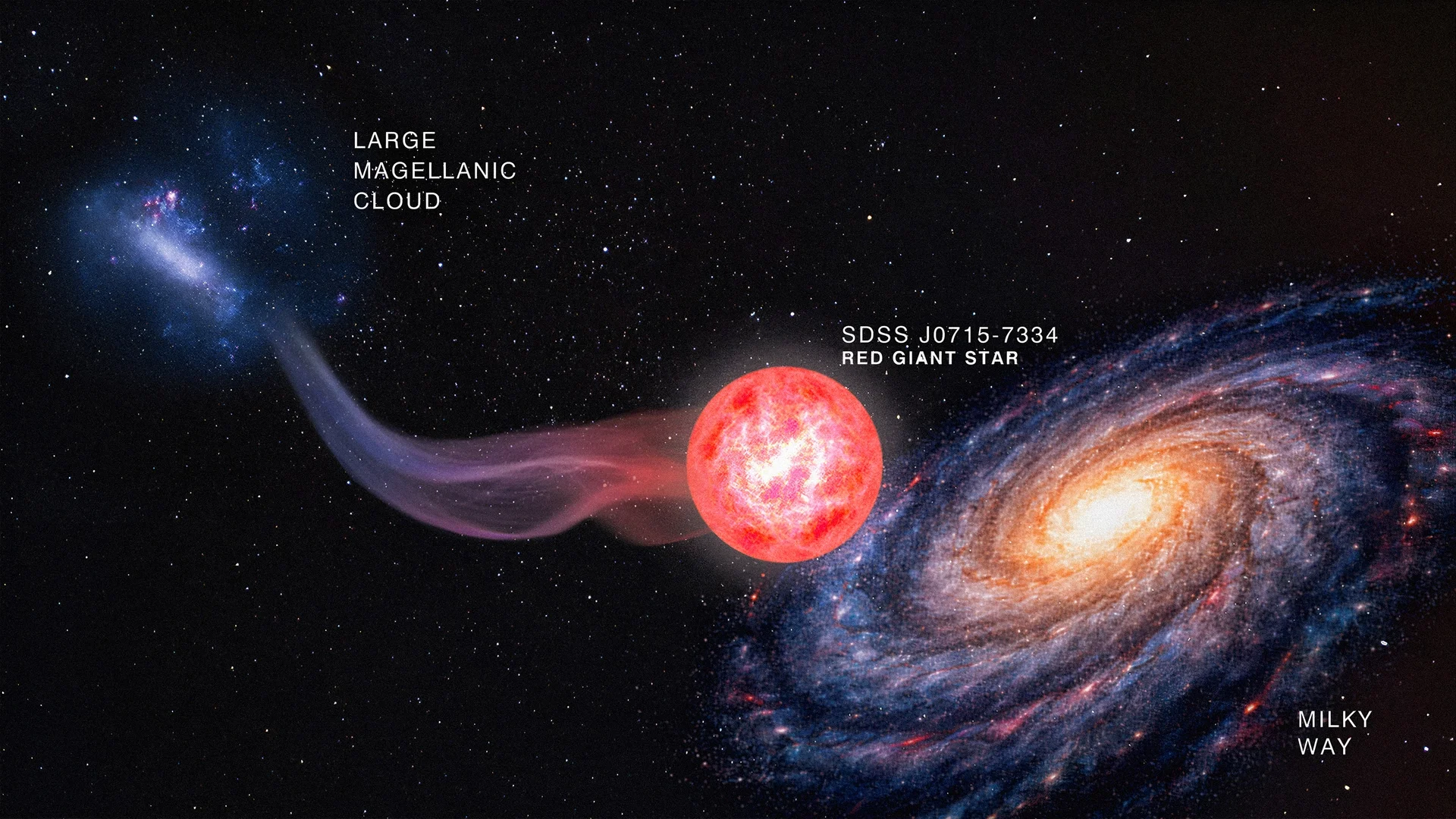
The star SDSS J0715-7334 is located about 80,000 light-years away, and it resides near the Large Magellanic Cloud, a satellite galaxy of the Milky Way. Unlike most red giants, which are known for their large sizes and brilliant brightness, SDSS J0715-7334 is notable for being one of the most chemically primitive (metal-poor) stars discovered. In addition to being composed of nearly entirely hydrogen and helium, with traces of other elements, it contains less than 0.005 percent of the total metallic content of our sun.
This star is significant because it has long been theorized that the first stars to form in our universe (Population III stars) were composed almost entirely of hydrogen and helium. Population III stars have never been directly observed, as it is believed that these were very massive stars that burned out rapidly. They left behind only the chemical remnants of their explosive deaths. The chemical makeup of SDSS J0715-7334 appears to contain some of the information about early Population III stars.
“No Population III stars have ever been observed due to their rapid life cycles and early deaths, or because the remaining Population III stars, of the lowest mass that might survive to the present time, will be exceedingly rare,” said co-author Kevin Schlaufman, a physics and astronomy associate professor at Johns Hopkins University. “The properties of the first generation of stars are some of the most important unknowns in modern astrophysics, regardless of which direction we take with them.”
Published in Nature Astronomy, the results of this study were made possible by the Sloan Digital Sky Survey (SDSS). Schlaufman, who first noted this star in 2014, ultimately determined that it warranted further investigation. This followed analysis performed with the high-resolution Magellan Clay Telescope, outfitted with a MIKE spectrograph, which revealed its unique characteristics.
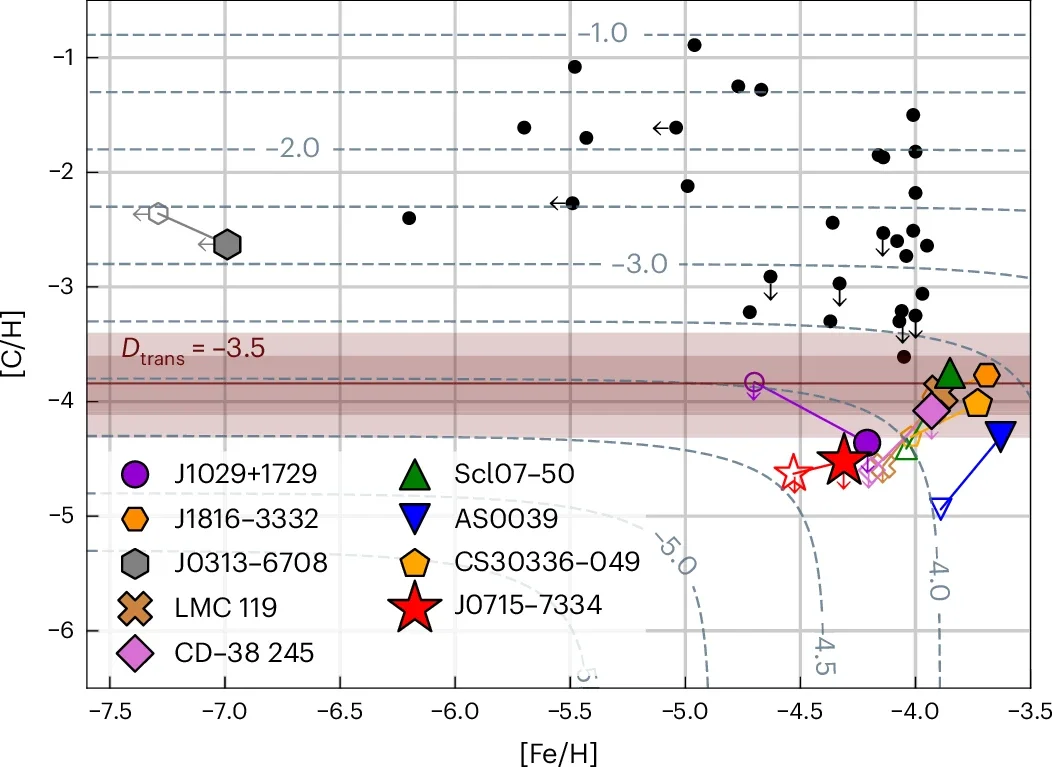
The research indicates that this star contains nearly pure hydrogen and helium, with trace quantities of iron and carbon. The metallicity upper limit of this star is less than log Z/Z⊙ < -4.3, which translates into approximately 7.8 × 10⁻⁷. This value is approximately twice as low as that of the next lowest metallicity star prior to this discovery. The previous lowest metallicity star on record was J1029+1729.
Because the previous lowest metallicity star is not always the most chemically primitive star, the comparison with this newly discovered star is significant. Some stars can be very metal-poor but still have a large quantity of carbon. This results in a greater amount of metal compared with their level of iron. However, in the case of SDSS J0715-7334, it has an extremely low level of iron and, simultaneously, a very strict upper limit for carbon content. This results in it being the first record holder for a star with both low iron and a declared, strict upper limit for carbon.
Schlaufman states, “This star is not itself a primordial star, but it is the closest we’ve come to measuring the Population III generation of stars on this specific metric.”
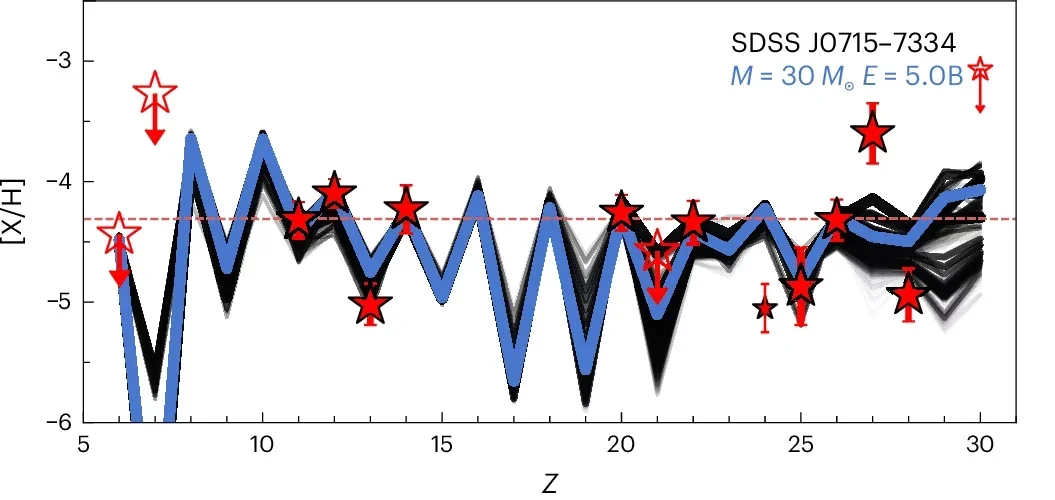
Researchers theorize that SDSS J0715-7334 was formed from a gas cloud that had been previously enriched with the metals ejected during a supernova event associated with Population III stars during their formation of the galaxy. This star serves as a kind of chemical “ghost” left over from one of those supernova explosions. Using the ratios of elements currently contained within the star, the research team estimated which type of stellar progenitor gave rise to this star. They did this by working backwards.
Based on their best-fit models, they determined that the progenitor star had a mass of approximately 27 times that of our sun, with an uncertainty of 3.9 solar masses. The energy output from the explosion was measured to be approximately 6.0 ± 2.6 × 10⁵¹ ergs. This indicates that it was a more powerful explosion than what is considered typical for this type of progenitor star.
The elemental abundance signatures of this star also provide additional evidence for the creation of early low-mass stars in the universe. Since the beginning of modern astrophysics, astronomers have debated what conditions allowed the gas in the early universe to cool and break apart into fragments. This allowed low-mass stars to form and survive into the present epoch. Researchers have proposed two primary options: one being carbon and oxygen cooling, and another being that the presence of dust played a critical role.
This star is below the threshold for atomic fine-structure cooling. This indicates that it is only the second known example of a star that likely did not form via this process. The authors of this work argue that dust cooling was also necessary for this star. Consequently, they state that more than 1 percent of the metals in this star had to be in the form of dust.
While it does not definitively solve the issue for all ancient stars, it demonstrates that dust cooling was likely a factor in star formation beyond the Milky Way as well. SDSS J0715-7334’s unusual chemical properties also tell us something about its origin.
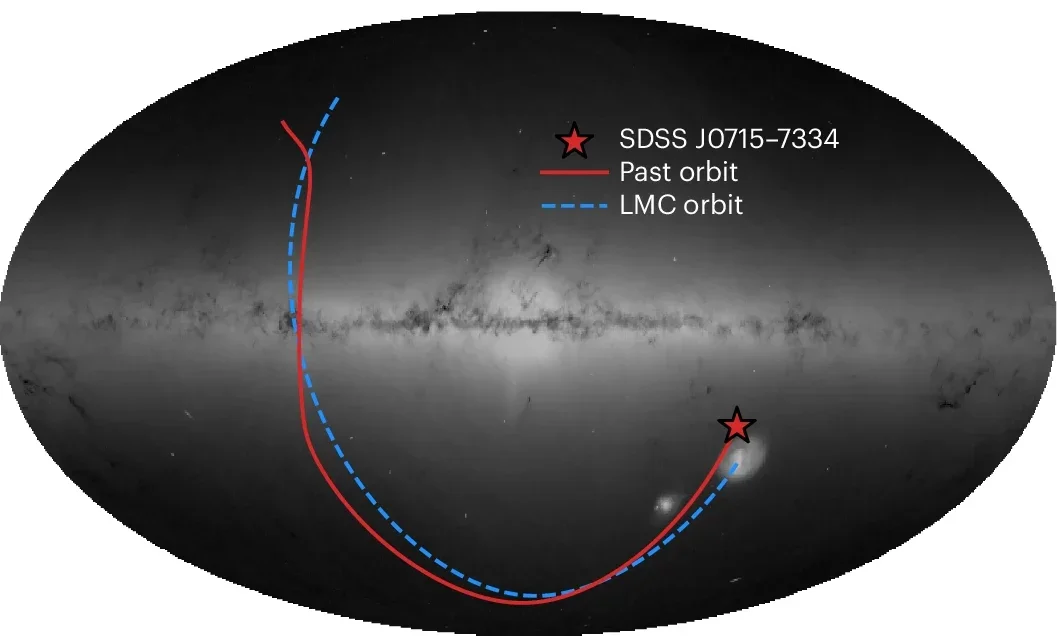
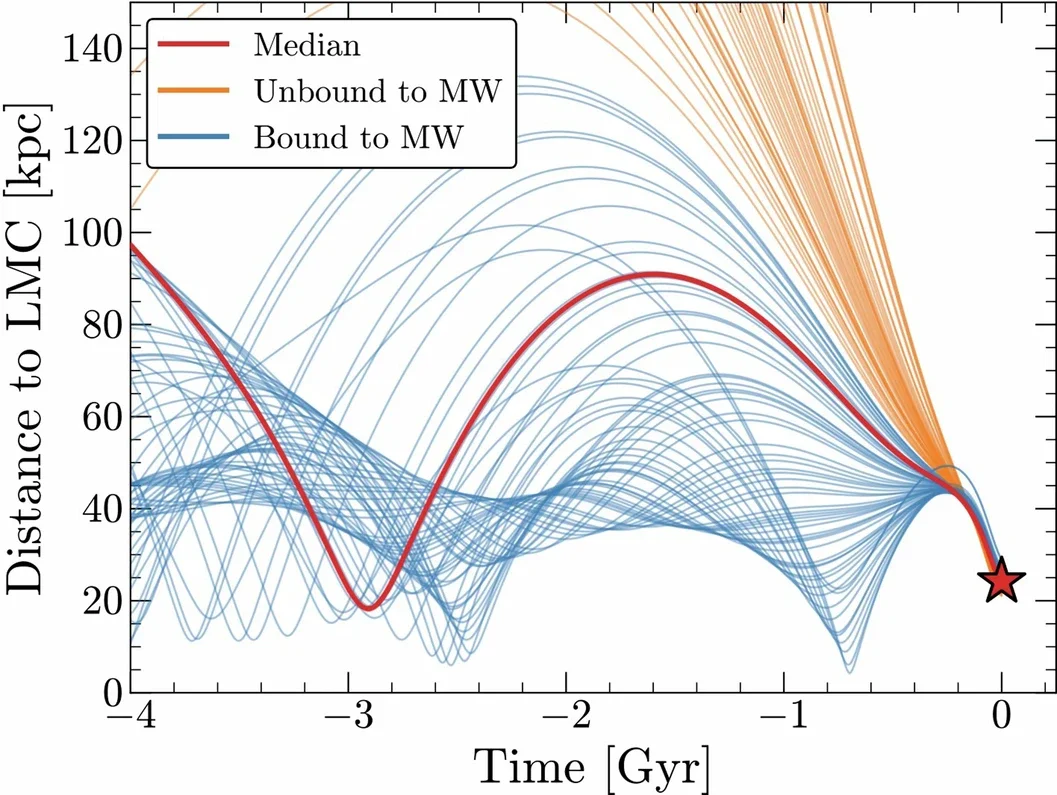
SDSS J0715-7334 is observed to have +427.2 ± 0.9 km/s radial velocity. At first glance, this appears too high for orbital stability, leading to an initial assumption that it belonged to an extragalactic system, such as a galaxy group. However, the velocity modeling done by the team showed that both the Milky Way and the Large Magellanic Cloud exert gravitational forces on SDSS J0715-7334. As a result, SDSS J0715-7334 has been shown to have an orbital path and an angular momentum consistent with that of the Magellanic system.
It has been suggested that SDSS J0715-7334 was formed in or near the Large Magellanic Cloud and has only recently entered the Milky Way. The authors of the article have referred to SDSS J0715-7334 as a galactic immigrant.
The fact that SDSS J0715-7334 appears so different from other old stars found in the Milky Way may be another indicator of its ancestry. The star that previously held the title of the oldest star found in the Milky Way, J1029+1729, is thought to have been born within the thick disk of the Milky Way. It shows evidence of being formed from a lower-mass, lower-energy Population III progenitor. However, SDSS J0715-7334 appears to have formed from a higher-mass progenitor. It also appears to have been explosively formed.
“The pristine stars are windows into the beginning of stars and galaxies in the universe,” explained first author Alexander Ji, assistant professor of astronomy and astrophysics at the University of Chicago.
This stark contrast could indicate that the environment played a role in the earliest star formation.
Although SDSS J0715-7334 is a significant example of star formation, it cannot be considered a direct example of a Population III star. It is not a Population III star, but a star formed later than Population III stars. However, it appears to retain a chemical composition similar to that of a Population III star.
The data from the research does have limits in terms of what can be concluded. Specifically, how much total metallicity the star has is dependent upon the assumptions made about unmeasured elements, such as oxygen and nitrogen. Therefore, depending on the assumptions made about elements that are not measured, the metallicity estimates may vary widely. The orbit of the star is not fully defined in all details. There are several model uncertainties that remain based upon the history and mass of the Large Magellanic Cloud.
The analysis of the star itself provided challenges to the researchers in regard to the models for extremely metal-poor red giants. SDSS J0715-7334 is found at the edge of the grid for cool, extremely metal-poor red giants. The researchers also note that there are still issues with measuring the ionization balance of the star based upon measurements of iron. This indicates broader problems associated with understanding stars that are this extreme.
Based upon nearly every reasonable assumption concerning the data available, SDSS J0715-7334 represents the most metal-poor star ever discovered.
The discovery of this star provides context for claims made about very metal-poor galaxies that were discovered using the James Webb Space Telescope (JWST). The JWST galaxies are considered exciting by the authors of the article because the constraints of their metallicity values are approximately ten times less than those needed to make a definitive claim that Population III stars have been discovered.
Thus, the quest to discover such stars is far from over.
For astronomers, SDSS J0715-7334 provides a more rigorous real-world test for theories used to understand the earliest stars, the earliest supernovae, and the role of stellar dust in the formation of the earliest low-mass stars. “The finding is indicative of much greater potential to find more extremely metal-poor stars in locations such as the Magellanic Clouds compared to ‘normal’ areas.
Finding more objects with characteristics similar to SDSS J0715-7334 will allow astronomers to compare and understand how the earliest stellar explosions occurred in different locations and ultimately allow for greater refinement in how the first stars formed.”
Research findings are available online in the journal Nature Astronomy.
The original story “Astronomers discovered the most primitive star ever” is published in The Brighter Side of News.
Like these kind of feel good stories? Get The Brighter Side of News’ newsletter.
The post Astronomers discovered the most primitive star ever appeared first on The Brighter Side of News.

