Clay, oil, and deep time do not usually leave much behind. Skin disappears. Cartilage collapses. Proteins break apart. Yet a small reptile that lived about 289 million years ago has done something rare enough to reset expectations in paleontology.
The fossil, identified as Captorhinus and described in Nature, preserves not just bone but skin, cartilage, and protein remnants. It is, according to the study, the oldest known mummified remains of a terrestrial vertebrate. More than that, it preserves the cartilage framework of the animal’s respiratory system, giving researchers an unusually clear look at how some of the earliest reptiles may have breathed and moved on land.
“This is an exciting discovery in paleontology with great evolutionary significance,” said University of Toronto Mississauga researcher and lead author Robert Reisz. “This unprecedented preservation of a respiratory system showcases the oldest known complete rib cage for muscle powered inhalation and exhalation.”
That matters because one of the biggest turning points in vertebrate history was the move from aquatic and semi-aquatic life to life fully on land. Early anamniotes, which included early-diverging tetrapods, stem lissamphibians, and stem amniotes, are generally thought to have relied on buccal pumping and cutaneous respiration, much like some living amphibians and lungfishes. But amniotes, with their more water-tight skin and more active terrestrial lifestyles, needed a more efficient way to move air through the lungs.
The new fossil points to a rib-assisted breathing system already in place in an early Permian reptile.
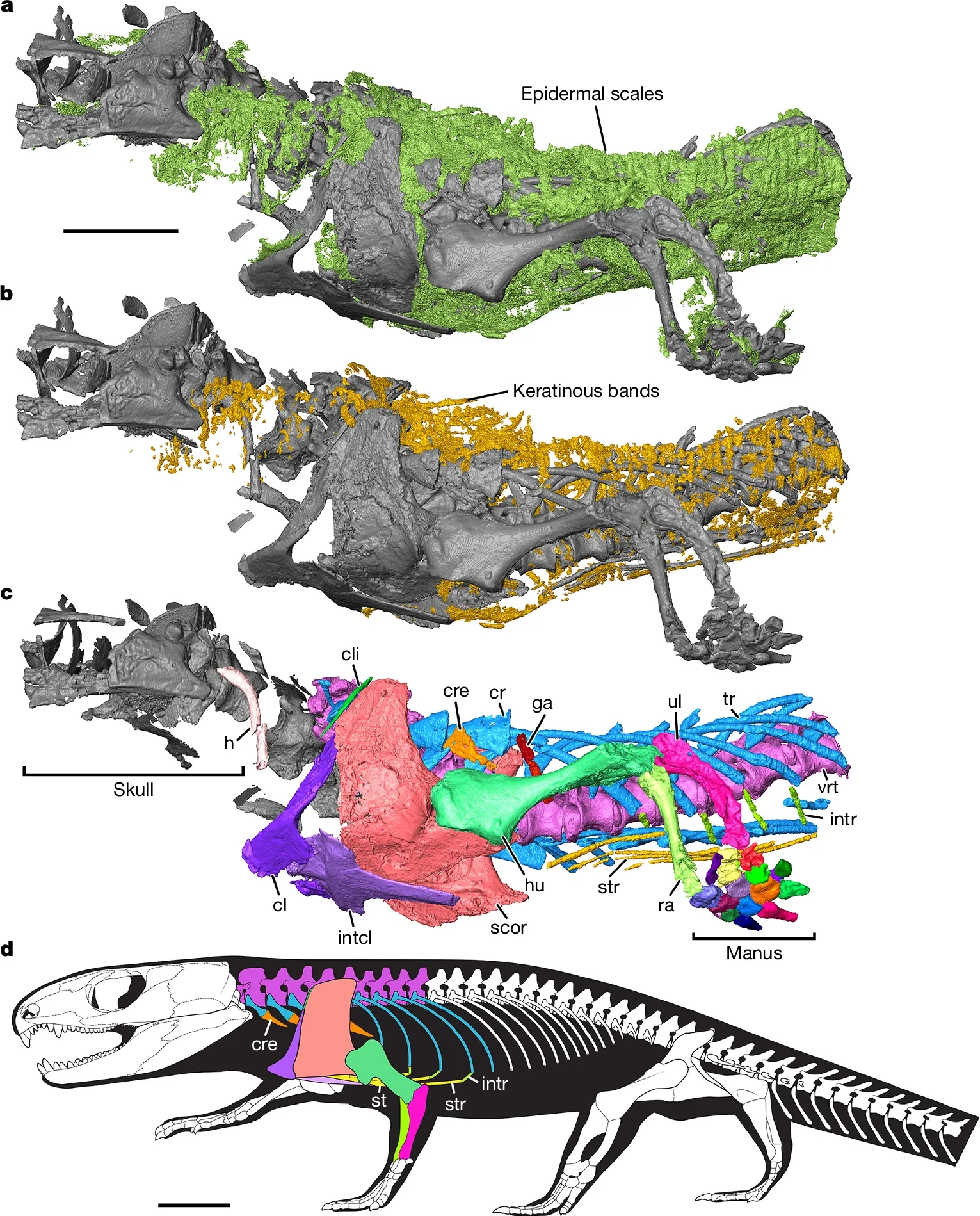
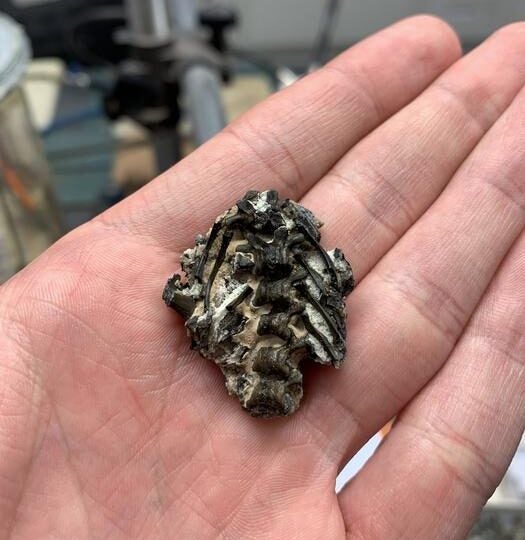
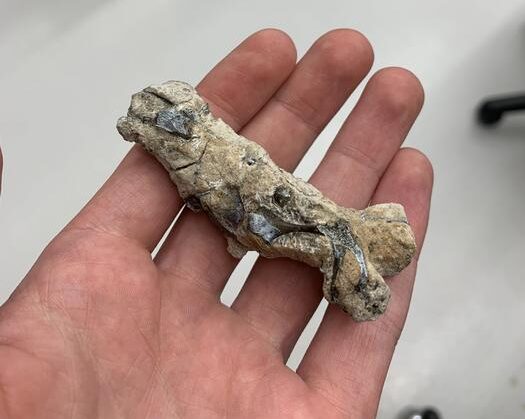
The two key specimens come from caves near Richards Spur in Oklahoma. One, cataloged as ROMVP 88565, preserves a near-perfectly articulated skeleton with a nearly complete covering of three-dimensionally preserved skin, along with cartilaginous elements in the neck and rib cage. The other, ROMVP 88300, preserves the thoracic region, including shoulder girdle cartilages, cervical ribs, a segmented sternum, and the front portions of sternal ribs.
Together, the fossils show how the bones and cartilages fit into a complete rib cage linked to the shoulder girdle. The preserved sternum is paired and segmented, with features comparable to those of reptiles and also similar to structures in the mammalian branch of amniote evolution. Four pairs of cartilaginous sternal ribs were present in one specimen, and short intermediate ribs linked these elements to the thoracic system. The arrangement resembles that seen in living lizards.
The scans also revealed cervical rib extensions, thin cartilaginous structures attached to the ends of the neck ribs. Some were nearly as long as the bony cervical ribs themselves. In living amniotes, similar extensions occur in several lizards and in Sphenodon.
Researchers argue that this whole arrangement supports the idea that Captorhinus could perform costal aspiration breathing, using rib movements to expand and contract the chest for inhalation and exhalation.
“We propose that this system found in Captorhinus represents the ancestral condition for the kind of rib-assisted respiration present in living reptiles, birds, and mammals,” Reisz said. “This efficient respiratory apparatus is important for their more active, energetic, and competitive lifestyles compared to their amphibian counterparts.”
The fossil’s preservation appears to have depended on a very unusual set of circumstances. The animal likely died in a cave system, where its body became encased in fine carbonaceous mud or silt. It was then permeated by hydrocarbons from an oil seep and affected by mineral-rich groundwater. The environment was also low in oxygen.
Those conditions seem to have helped preserve tissues that almost never survive from the Paleozoic.
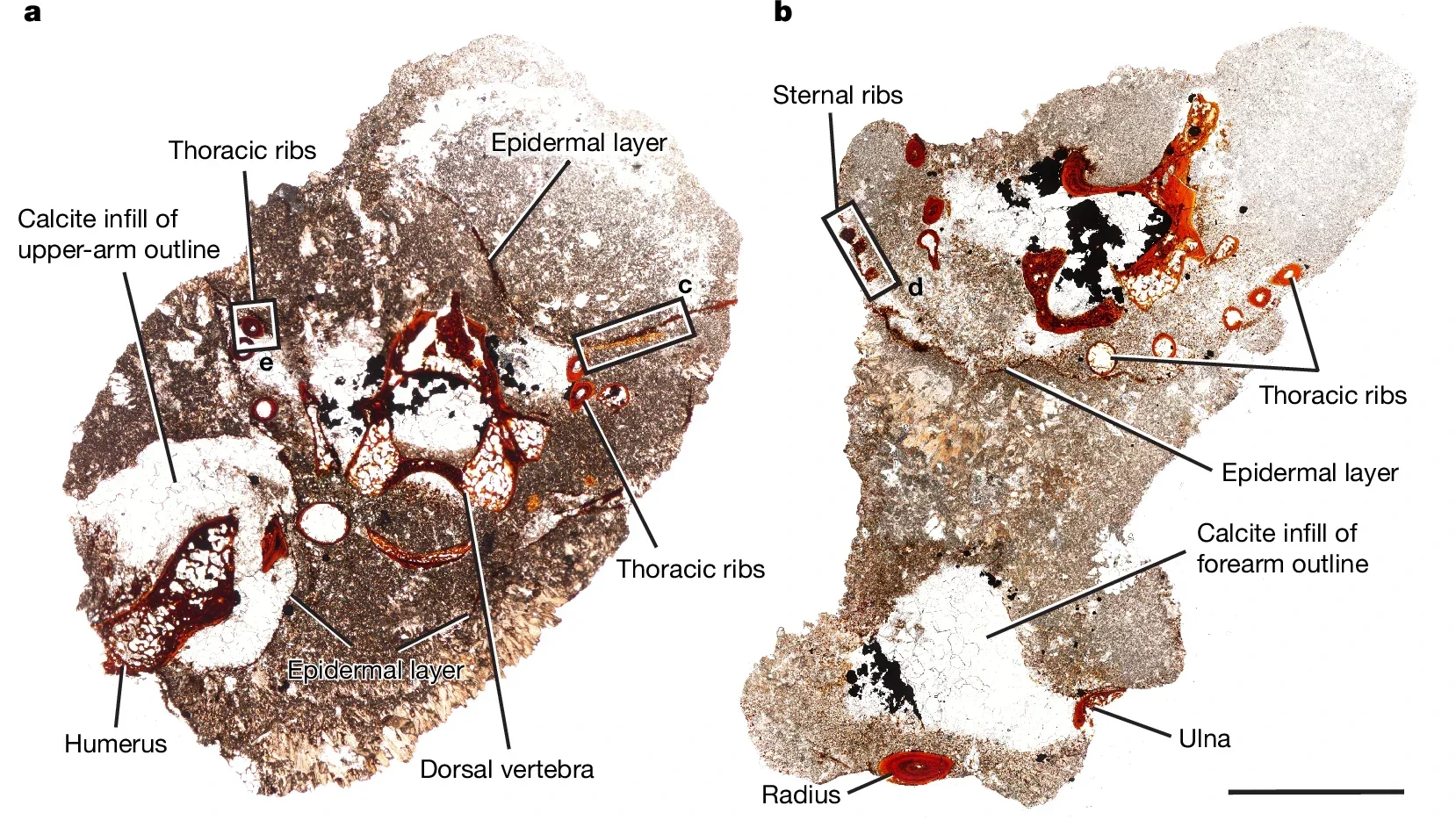
Because the fossils were extremely delicate, the team avoided standard manual preparation. Instead, co-authors Joseph Bevitt and Ethan Mooney used neutron computed tomography, or nCT, to image the specimens. Researchers at three centers also used X-ray fluorescence, electron probe microanalysis, and synchrotron radiation Fourier-transform infrared spectroscopy to sort out the chemistry of the tissues. Tea Maho of the University of Toronto Mississauga conducted histological sampling, which indicated that the cartilages were calcified, as they are in living lizards.
The chemical work helped distinguish bone from calcified cartilage and skin. It also found proteinaceous signatures in several tissues. According to the paper, preserved amide-bearing biomolecules in these fossils push the record for such material back by nearly 100 million years.
The skin itself adds another layer of detail. One specimen preserves a nearly complete covering of desiccated skin, folded close to the body and partly attached to the rib cage. The fossil even preserves what the authors describe as possible outlines of individual epidermal cells in the outermost layer. Beneath that lay corneous bands arranged in repeating transverse patterns along the trunk.
The fossil does not only speak to breathing. It also offers clues about locomotion.
The shoulder girdle preserves epicoracoidal cartilages, thin overlapping structures also found in living squamates. In Captorhinus, these appear to have allowed some mobility between the left and right sides of the shoulder girdle. The authors say that may have let the coracoid plates slide past each other during movement.
That makes this reptile the earliest known example of potential coracosternal mobility during locomotion, a feature also seen in other living reptiles, including the crocodilian Alligator.
The fossils also preserve spatulated cervical ribs and their cartilaginous extensions, which the researchers think probably supported muscle attachment and helped connect the neck and shoulder girdle. The study suggests these structures may have played roles in both support and breathing.
“The mummified Captorhinus is among the most significant early amniote fossils in the world,” said Mooney. “It has offered an unparalleled window into the appearance, lifestyles, and evolution of the earliest reptiles, expanding dramatically our understanding of this pivotal episode of amniote evolution. As more work continues on this time period, more incredible discoveries are sure to be unearthed.”
One of the broader implications is that costal aspiration breathing may have opened evolutionary doors beyond respiration itself. The paper notes that fossil and living amphibians tend to have broader snout-to-head length ratios than amniotes, likely because buccal ventilation places different functional demands on the skull. If early amniotes relied less on that system, their heads may have been freer to diversify.
That would help explain why amniotes later spread into such a wide range of ecological roles.
This fossil sharpens the picture of how early reptiles made life on land work. It suggests that a complete rib-assisted breathing system, linked closely to the shoulder girdle, was already present in a very early amniote. It also shows that movement and breathing may have evolved together more tightly than once thought.
Just as important, the discovery expands what scientists think deep-time fossils can preserve. If skin, calcified cartilage, and protein remnants can survive under the right conditions in a 289-million-year-old reptile, other Paleozoic fossils may hold more biological detail than researchers once expected.
That could change how scientists search for evidence about the origins of breathing, movement, and other major vertebrate innovations.
Research findings are available online in the journal Nature.
The original story “289-million-year-old mummified reptile reveals how bodies evolved to breath and move” is published in The Brighter Side of News.
Like these kind of feel good stories? Get The Brighter Side of News’ newsletter.
The post 289-million-year-old mummified reptile reveals how bodies evolved to breath and move appeared first on The Brighter Side of News.

