For a brief stretch on April 13, 2029, a giant space rock will slip closer to Earth than some of the satellites parked high above the planet. That object is Apophis, an asteroid once treated as a serious threat. Now it is viewed as one of the most unusual scientific opportunities in modern astronomy.
Apophis is not headed for impact. That part is settled. But the asteroid’s close flyby is still extraordinary because of what Earth itself may do to it on the way past.
The asteroid, officially known as 99942 Apophis, is expected to pass about 20,000 miles, or 32,000 kilometers, above Earth’s surface. At roughly 375 meters across on average, it is large enough to command attention and close enough to become visible to the naked eye in parts of Europe, Africa, and Asia, weather permitting. In fact, space agencies say it will be the closest approach of an asteroid this size that scientists have known about in advance.
That makes the 2029 event more than a sky show. It turns Earth into part of the experiment.
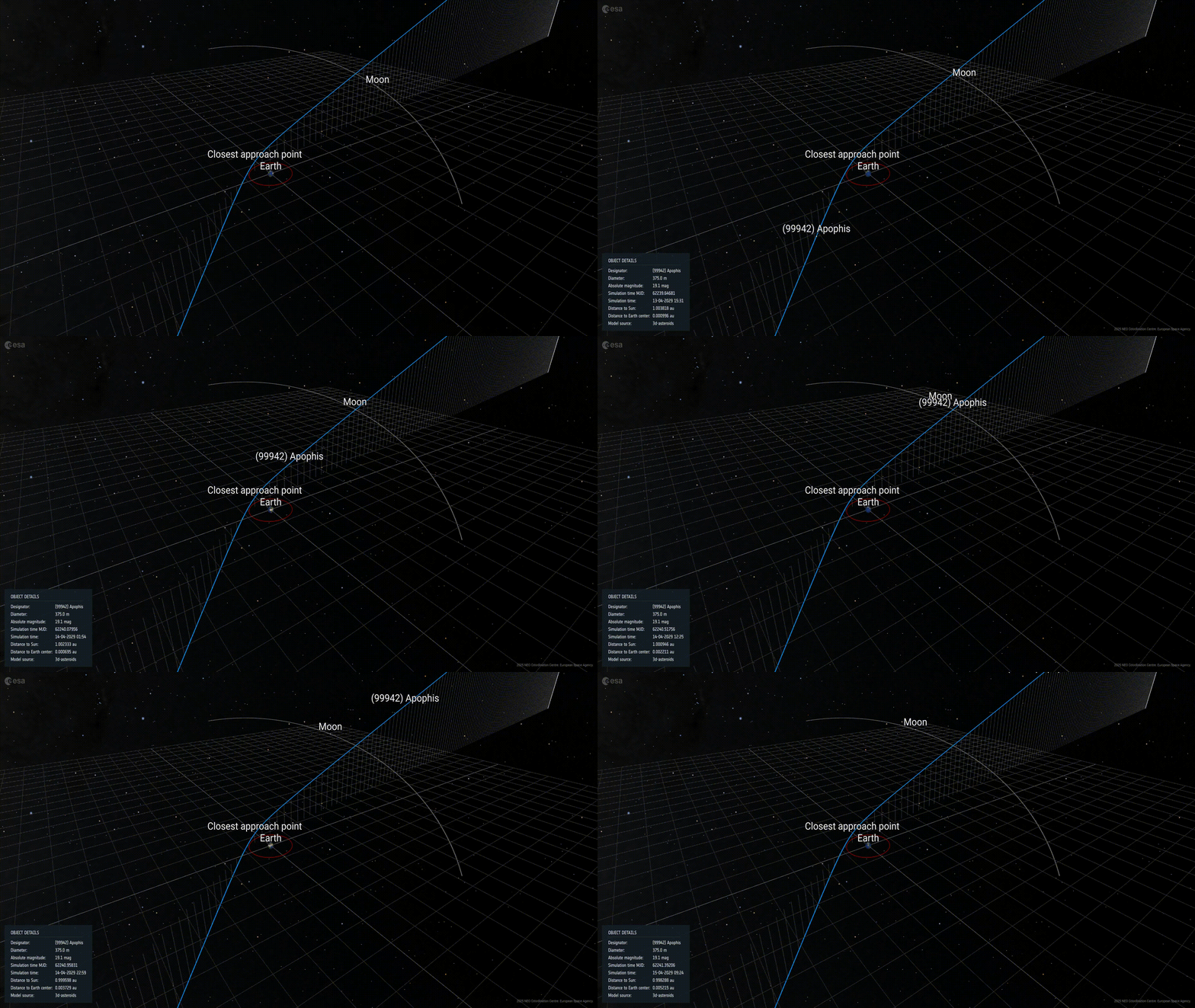
When Apophis was discovered in 2004 at Kitt Peak National Observatory, early observations suggested a small but real chance that it could strike Earth in 2029. Later concern extended to 2036 and 2068. At one point, the estimated risk for 2029 climbed as high as 2.7%, making Apophis one of the most closely watched asteroids ever found.
More observations changed the picture. Radar work in March 2021 sharpened the asteroid’s known path enough for astronomers to rule out any impact with Earth for at least the next 100 years. Thus, what had once been treated as a danger is now being treated as a rare field opportunity.
The real fascination lies in the flyby itself. As Apophis sweeps past Earth, the planet’s gravity is expected to pull unevenly on the asteroid. That difference in force across its body, often described as a tidal effect, could stretch and squeeze it. It might alter its spin, and possibly trigger quakes, landslides, or other surface shifts as well.
Scientists are especially interested in whether the encounter could disturb the asteroid enough to expose fresher material beneath its weathered outer layer. Over long periods, asteroid surfaces are altered by solar wind and cosmic rays. That process, known as space weathering, changes how the surface reflects light. A fresh surface reflects differently from an older, weathered one.
Researchers at MIT have been watching for that clue for years. Their work has focused on measuring the sunlight reflected from Apophis across a full rotation to build a clear before-and-after record. As a result, if the asteroid’s surface changes after the 2029 pass, the difference could stand out clearly in its spectral signature.
That kind of change would matter because it could help explain why some asteroids look weathered while others appear surprisingly fresh. One idea is that close planetary encounters can shake up the surface enough to expose newer grains. Another possibility is that some asteroids lose surface material when changes in rotation fling loose particles away. Apophis may help sort out which process matters more.
There is still uncertainty here. Scientists expect its spin to change, but they cannot say exactly how. The asteroid’s response will depend on details that are not fully known, including its internal structure, density, and the way its surface material is arranged.
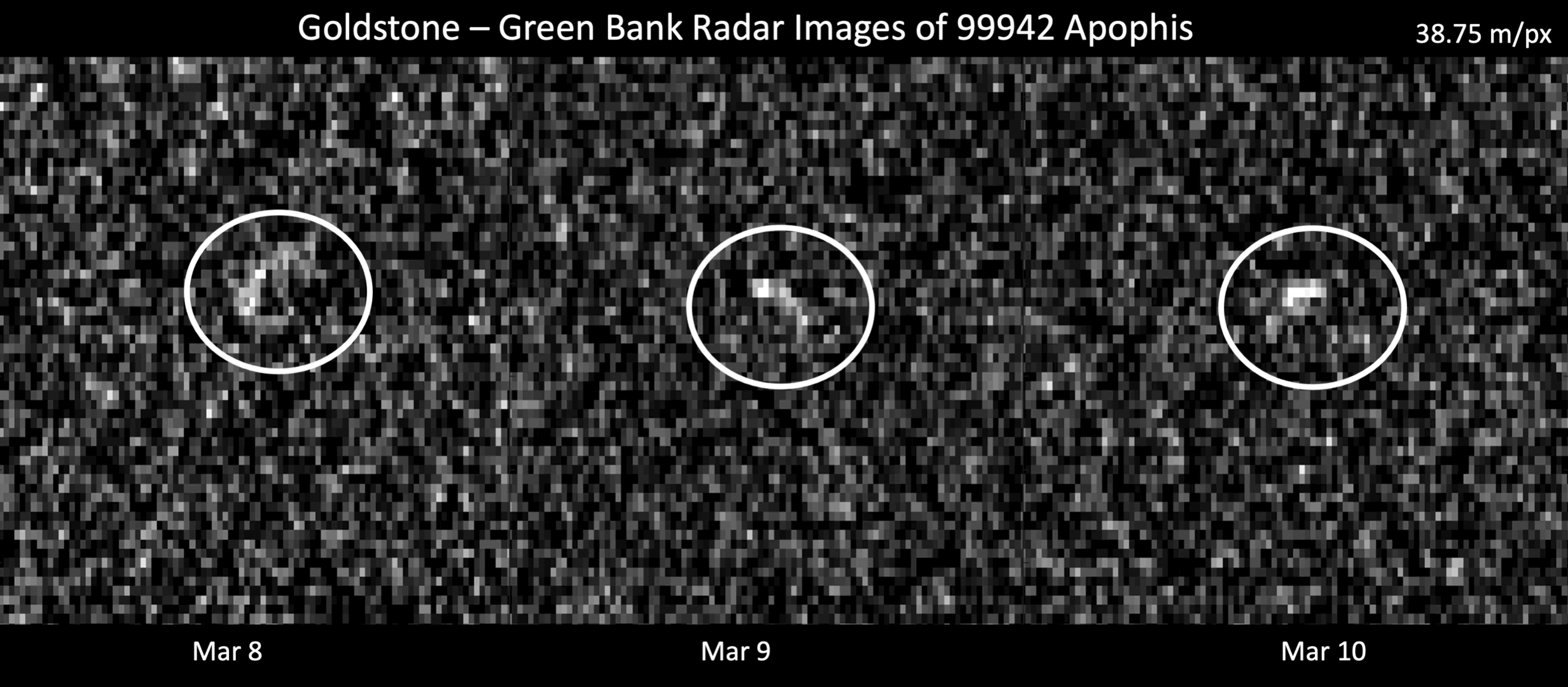
Apophis is thought to be an S-type, or stony, asteroid made mainly of silicate materials with some metallic nickel and iron. Radar observations suggest it is elongated and may even have two lobes. Its mean diameter is about 1,115 feet. Its long axis is at least 1,480 feet long.
In other words, it is not a small object quietly drifting by. It is a major near-Earth body. Scientists believe it likely formed in the main asteroid belt between Mars and Jupiter about 4.6 billion years ago. Then, it was gradually nudged into its current orbit by gravitational interactions with planets, especially Jupiter.
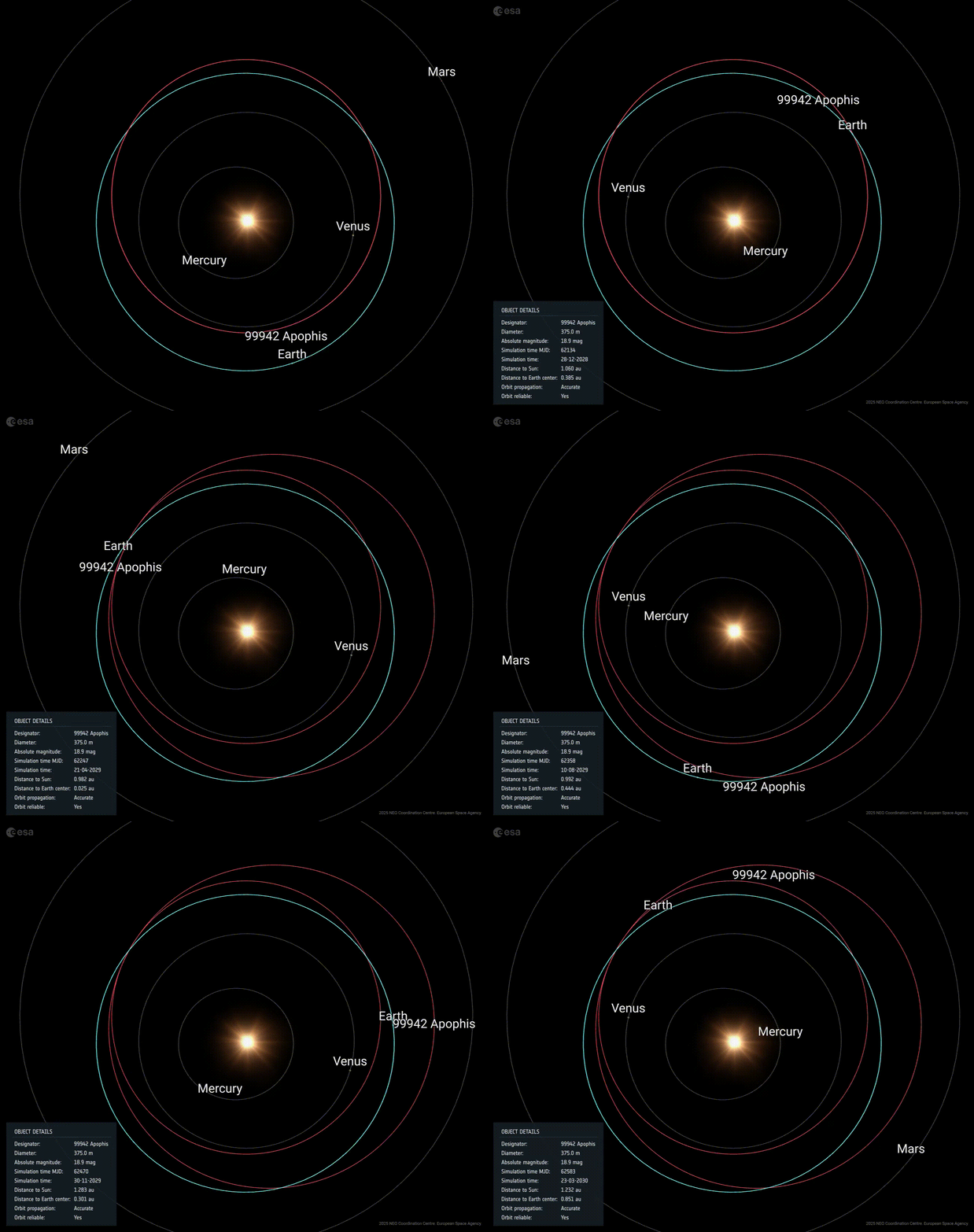
Right now, Apophis belongs to the Aten group of asteroids, which cross Earth’s orbit and circle the sun in less than a year. That will change after the flyby. Earth’s gravity is expected to widen its path around the sun and lengthen its orbital period from about 0.9 years to about 1.2 years. As a result, Apophis will shift into the Apollo group.
So the 2029 flyby will not just be close. It will reshape the asteroid’s future motion through the solar system.
Astronomers also expect a global observing effort. Telescopes on Earth and in space will track its path, measure changes in brightness, and collect radar data to pin down its shape and orientation. Meanwhile, NASA’s OSIRIS-APEX mission, repurposed from the spacecraft once known as OSIRIS-REx, is on its way to meet Apophis after the flyby. The European Space Agency is preparing its Ramses mission to rendezvous with the asteroid and watch how it changes through the encounter.
That pairing could be unusually powerful. One mission is expected to capture the before-and-after story around the flyby itself, while the other will examine material near the surface after Earth’s pull has done its work.
Part of what makes Apophis so compelling is its history. Its name comes from the Greek form of Apep, the Egyptian god associated with chaos and destruction. That label fit the mood in the early days, when scientists were still racing to understand whether the asteroid might one day hit Earth.
Now the fear is gone, but the drama remains.
This is a case where a former threat has become a scientific gift. An asteroid of this size passes this close to Earth only every few thousand years on average, according to NASA. Therefore, scientists have never had a chance like this to watch a large near-Earth asteroid respond in real time to a close pass by our planet.
And not every answer will arrive neatly. If Apophis shows a clear color change, researchers may gain strong evidence that Earth’s gravity can freshen an asteroid’s surface. If no change appears, that matters too. It could mean the flyby was not enough to disturb the surface in the way scientists expect, or that another process is doing the work instead.
Either outcome would sharpen the science.
The original story “‘God of chaos’ asteroid Apophis will pass very close to Earth in 2029” is published in The Brighter Side of News.
Like these kind of feel good stories? Get The Brighter Side of News’ newsletter.
The post ‘God of chaos’ asteroid Apophis will pass very close to Earth in 2029 appeared first on The Brighter Side of News.

