Light crossed the gap between two machines in an Oxford laboratory, and with it came a result that pushes quantum computing into new territory.
Researchers built a system in which two separate quantum computers worked together as a single device, even though the modules sat about two meters apart. They did not rely on a direct wired transfer of quantum information. Instead, the machines shared it through photons, using a method known as quantum gate teleportation.
That distinction matters. For years, one of the biggest problems in quantum computing has been scale. It is hard enough to control a small number of qubits, the quantum version of bits. Trying to pack huge numbers of them into one processor only makes the system more fragile, more noisy, and harder to run accurately.
The Oxford team took a different route. Rather than chase one giant machine, they linked smaller modules that could cooperate. In effect, they showed that quantum computing may grow the way some classical supercomputers did, by connecting smaller units that act together.
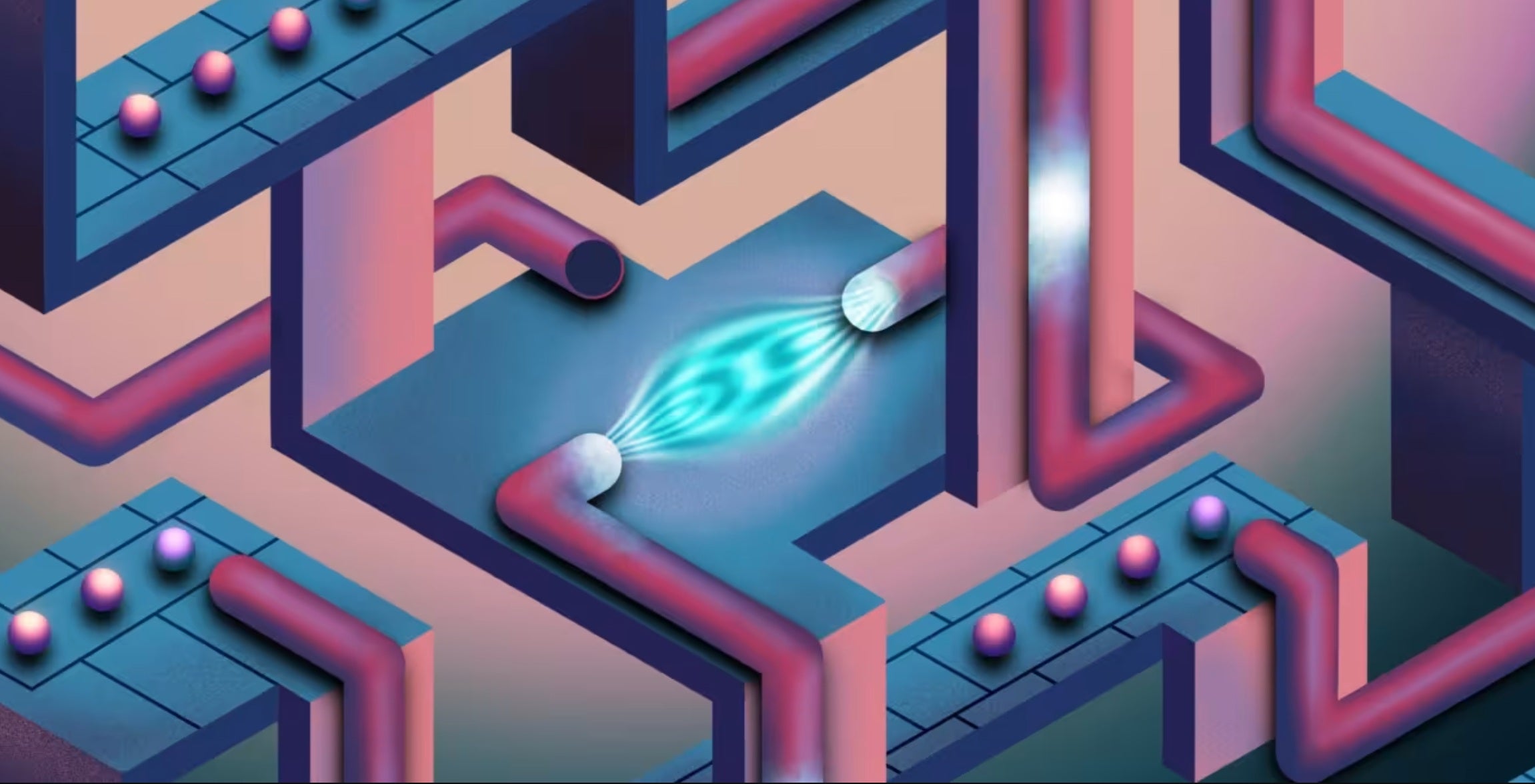
Dougal Main, a researcher at Oxford Physics, put it this way: “By interconnecting the modules using photonic links, the system gains flexibility, allowing modules to be upgraded or swapped without disrupting the entire architecture.”
Quantum computers do not process information the way ordinary computers do. Classical machines use bits that are either 0 or 1. Quantum systems use qubits, which can exist in combinations of states at once. That unusual behavior is what gives quantum computing its promise in fields such as cryptography, materials design, and drug discovery.
Yet that promise comes with a stubborn engineering problem. The larger a single processor becomes, the tougher it is to maintain precise control over every qubit and every interaction between them.
Distributed quantum computing tries to ease that burden. The idea is simple in outline, even if it is difficult in practice: break a computation across smaller quantum processors, then connect those processors through quantum and classical links. If the network works well enough, the modules can behave like one larger computer.
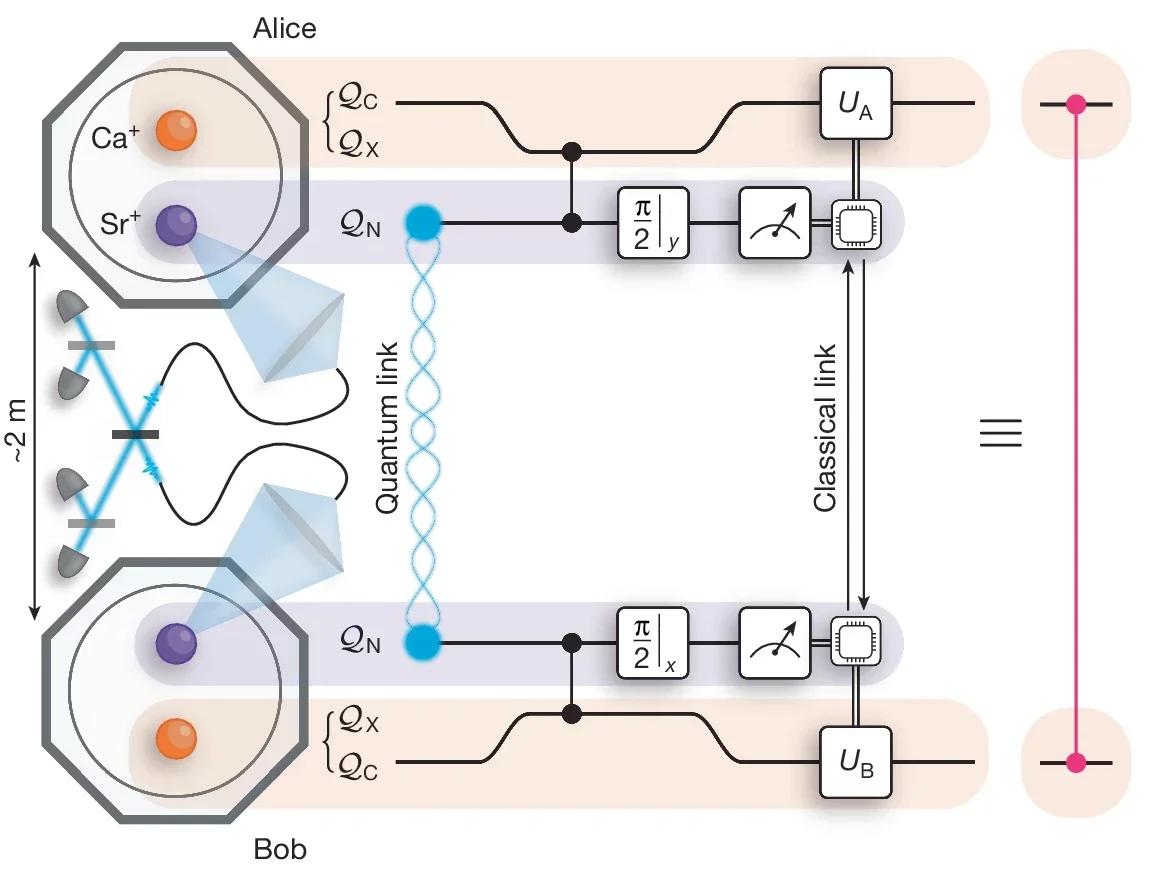
In Oxford’s experiment, each module contained two trapped ions held in place by electric fields inside a vacuum chamber. One was a strontium ion that served as the network qubit, the part that could interact with light and communicate across the network. The other was a calcium ion that acted as the circuit qubit, storing and processing the quantum information used for computation.
The two modules were nicknamed Alice and Bob.
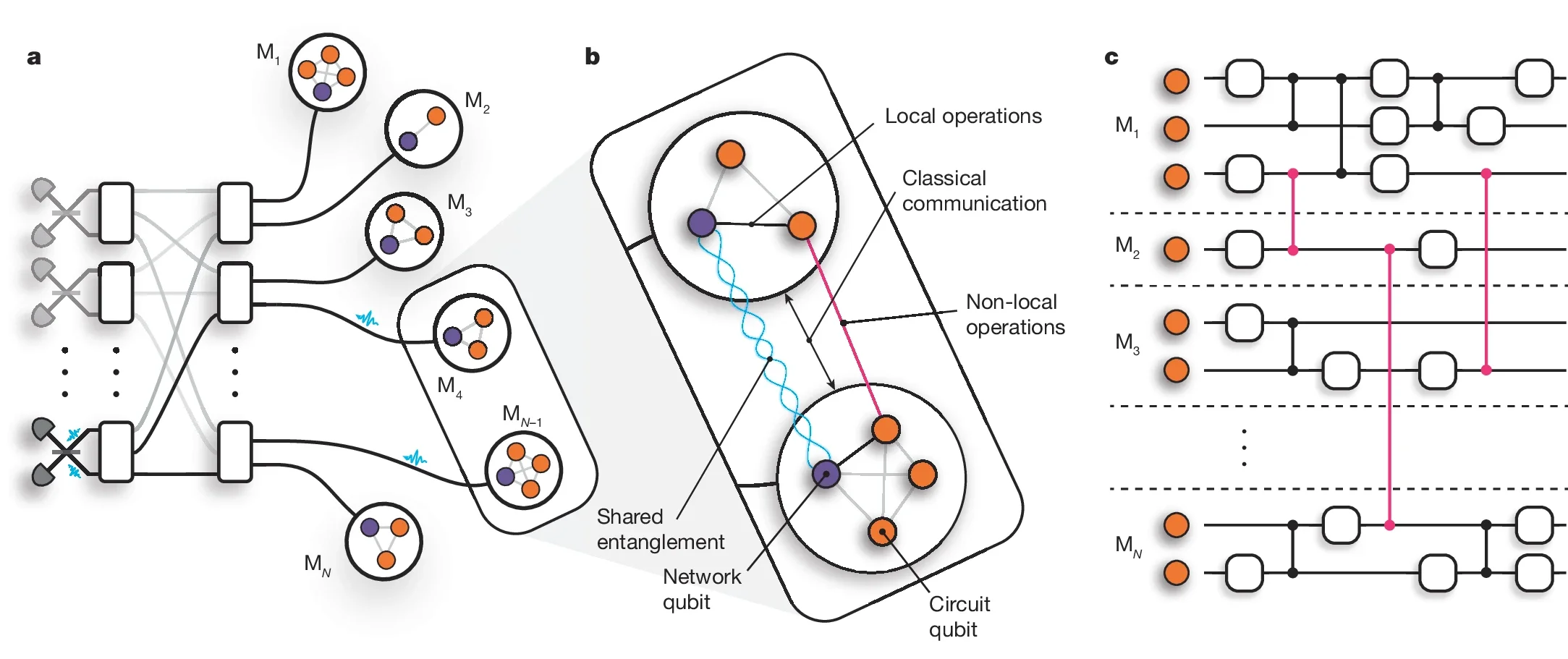
To link them, each module emitted a photon toward a central Bell-state analyzer. There, the photons interfered in a way that created entanglement between the distant network qubits. Once that shared entangled state existed, the researchers could use local operations and classical communication to teleport a controlled-Z, or CZ, gate between the circuit qubits.
Nothing physical carrying the stored data had to travel from one quantum processor to the other. The system instead used the entangled connection as a kind of quantum bridge.
The team measured the fidelity of the remotely entangled link at 96.89%. The teleported CZ gate itself reached an average fidelity of 86.2%.
That single result already marked a major step. But useful quantum computing needs more than one successful remote gate. It needs a sequence of them.
So the researchers pushed further. They chained together multiple rounds of quantum gate teleportation to build more complex operations, including distributed versions of the iSWAP and SWAP gates. Those circuits used two and three teleported CZ gates, respectively.
The iSWAP gate reached an average fidelity of 70%, while the SWAP gate came in at 64%.
Those numbers are not yet where a practical fault-tolerant machine would need them to be. Still, they showed that the approach can support real circuits, not just isolated demonstrations. The researchers also took one more step that made the result harder to dismiss as a laboratory curiosity.
They ran Grover’s algorithm on the distributed system.
Grover’s algorithm is a standard test in quantum computing because it lets a quantum machine search an unsorted set more efficiently than a classical one. In this two-qubit version, the computer had to identify one marked item out of four possible choices. The distributed machine used two teleported gates, one for the oracle and one for the diffusion step.
Across 500 repetitions for each marked state, the linked modules returned the correct answer with an average success rate of 71%.
That is far from perfect. It is also the first deterministic execution of an algorithm on a distributed quantum computer, according to the team.
The experiment’s success came with clear limitations, and the researchers did not hide them.
Most of the leading errors came from local operations inside each module rather than from the basic idea of networking the modules together. The measured teleported-gate fidelity was also slightly lower than the error budget predicted, which the team attributed to calibration drift during the long data collection period.
There were other technical bottlenecks. Remote entanglement did not happen instantly. Each attempt took 1,168 nanoseconds, but successful entanglement only appeared on average after 7,084 tries. That translated to a success probability of 1.41 × 10⁻⁴ per attempt and an average entanglement generation time of about 103 milliseconds. The overall entanglement generation rate was 9.7 per second.
Those numbers help explain why the system is not ready for broad use. Speed, stability, and fidelity still need work.
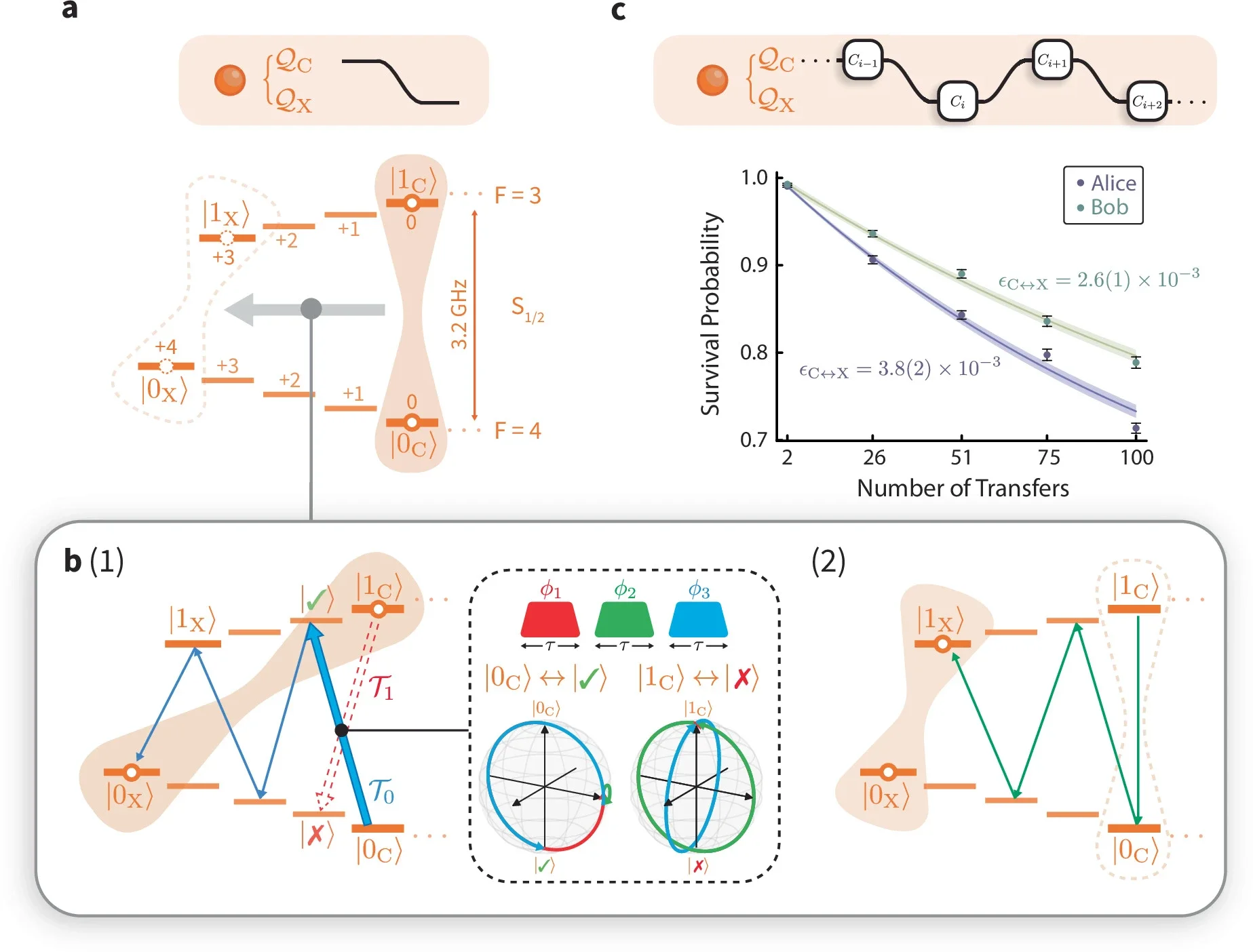
Even so, the result suggests the core architecture can improve. The circuit qubits preserved stored quantum information during the entanglement process with fidelities of 98.1% and 98.2% in the two modules. Local mixed-species entangling gates reached 97.6% and 98.0%. The researchers argue those local performance limits are technical, not fundamental.
Professor David Lucas, the study’s principal investigator, said, “Our experiment demonstrates that network-distributed quantum information processing is feasible with current technology. Scaling up quantum computers remains a formidable technical challenge, but this shows the path forward.”
Main added: “By carefully tailoring interactions between distant systems, we can perform logical quantum gates between qubits housed in separate quantum computers. This breakthrough enables us to effectively wire together distinct processors into a single machine.”
What makes this work stand out is not just the possibility of a larger quantum processor. It is the flexibility of the design.
Photons are natural carriers of quantum information over long distances, and the teleportation-based setup does not depend on one specific hardware platform. In principle, it could connect different kinds of quantum systems, including trapped ions, neutral atoms, and diamond-based devices. With quantum repeaters and other networking tools, such links could one day stretch far beyond one room.
That points toward something broader than distributed computing alone. It points toward a quantum internet, where distant processors exchange entangled quantum information across extended networks.
This work strengthens the case for modular quantum computing, a strategy that could make large-scale machines easier to build, maintain, and upgrade. Instead of forcing millions of qubits into one fragile processor, engineers may be able to connect smaller units that specialize in different tasks.
That matters for secure communications, advanced simulation, and future computing infrastructure. Distributed quantum systems could support more robust encryption methods, model complex molecules for drug research, and handle scientific calculations that overwhelm today’s machines.
The road ahead is still difficult, but this experiment shifts the conversation from whether linked quantum processors can work to how far the approach can be taken.
Research findings are available online in the journal Nature.
The original story “Oxford scientists achieve quantum gate teleportation between two quantum supercomputers” is published in The Brighter Side of News.
Like these kind of feel good stories? Get The Brighter Side of News’ newsletter.
The post Oxford scientists achieve quantum gate teleportation between two quantum supercomputers appeared first on The Brighter Side of News.

