Dark matter is supposed to be everywhere, threaded through the Milky Way and outnumbering ordinary matter by a wide margin. Yet after decades of effort, nobody has caught it directly. That gap between certainty and absence has helped turn modern cosmology into a field of giant machines, giant budgets and giant collaborations.
So there is something striking about a recent axion search that went in the opposite direction.
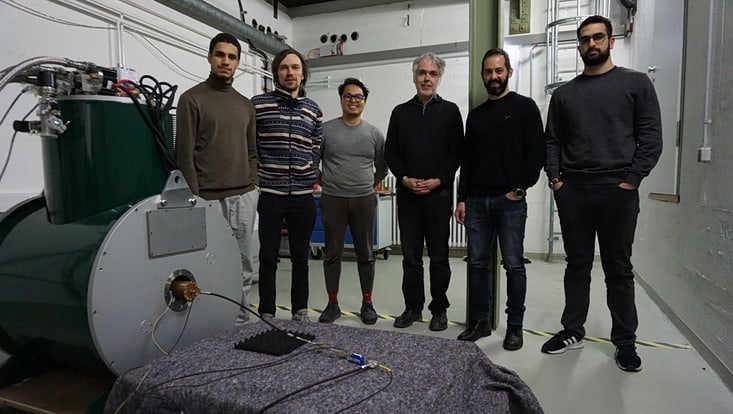
A team of then-undergraduate students at the University of Hamburg built a compact cavity detector. They ran it inside a powerful magnet and used it to probe one narrow slice of the dark matter problem. They did not find a signal. However, what they did find was a way to rule out axions with certain properties in that range. This tightened the map for future searches and showed that careful, smaller-scale physics can still leave a mark on one of science’s biggest mysteries.
The work, now published in the Journal of Cosmology and Astroparticle Physics, focused on axions, hypothetical particles long considered one of the strongest candidates for dark matter. If axions exist and make up dark matter, they should be passing through our region of the galaxy all the time. In the right conditions, researchers think those particles can convert into photons in a magnetic field. This can produce an extremely faint signal.
That possibility gave the student team a target.
The project was supported by a student research grant from the University of Hamburg through the Hub for Crossdisciplinary Learning, which backs independent research efforts. The team also worked with support from scientists connected to the MADMAX dark matter experiment. This is a much larger and more complex effort searching for similar particles.
“We were kind of embedded in the research group of the MADMAX dark matter experiment,” said Nabil Salama, one of the study’s authors, now an M.Sc. student in physics at the University of Hamburg. “MADMAX carries out a similar experiment on a much larger and more complex scale, and we benefited from their expertise and support.”
He added, “We are very grateful for this help, and also to the University of Hamburg and the Quantum Universe Cluster of Excellence, which provided funding, access to key equipment such as the magnet, and invaluable support from researchers.”
The team used that support to assemble a stripped-down resonant cavity detector, built from highly conductive copper and paired with electronics, cables, a receiver chain and measurement instruments. The setup was simple by the standards of major dark matter experiments. But it was designed to do the same basic job: listen for a faint electromagnetic signature that could appear if axions converted into photons inside the cavity while exposed to a strong magnetic field.
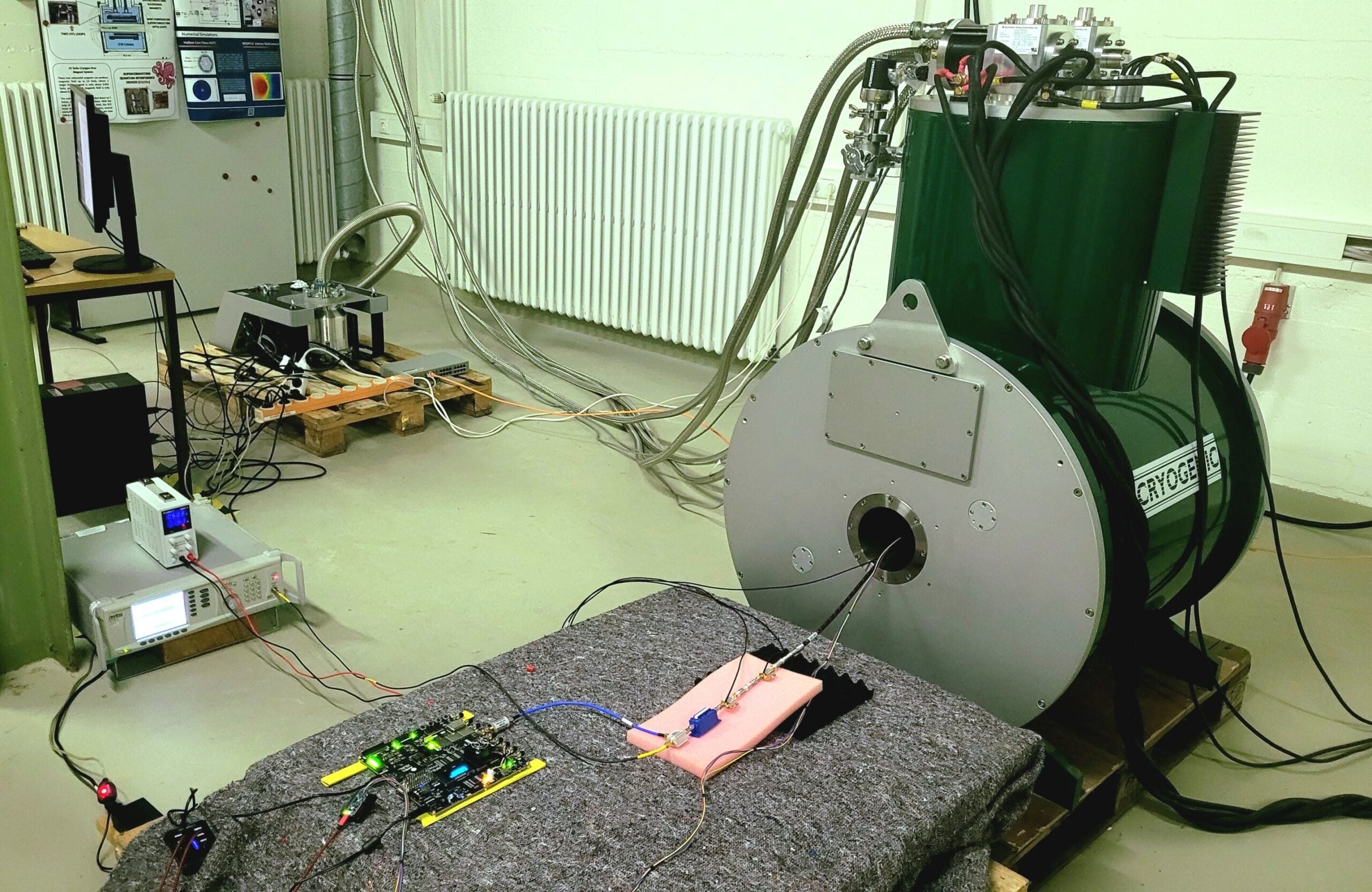
“The detector we built is essentially the simplest version of a cavity detector for dark matter,” Salama said.
It was not a garage project. The students relied on university infrastructure, existing equipment and technical advice from nearby research groups. But they also deliberately reduced a complicated class of experiments to its essentials.
“We reduced very complex experiments to their essential components,” Salama said. “The result is a less sensitive setup, limited to a small search window, but still capable of producing new scientific data.”
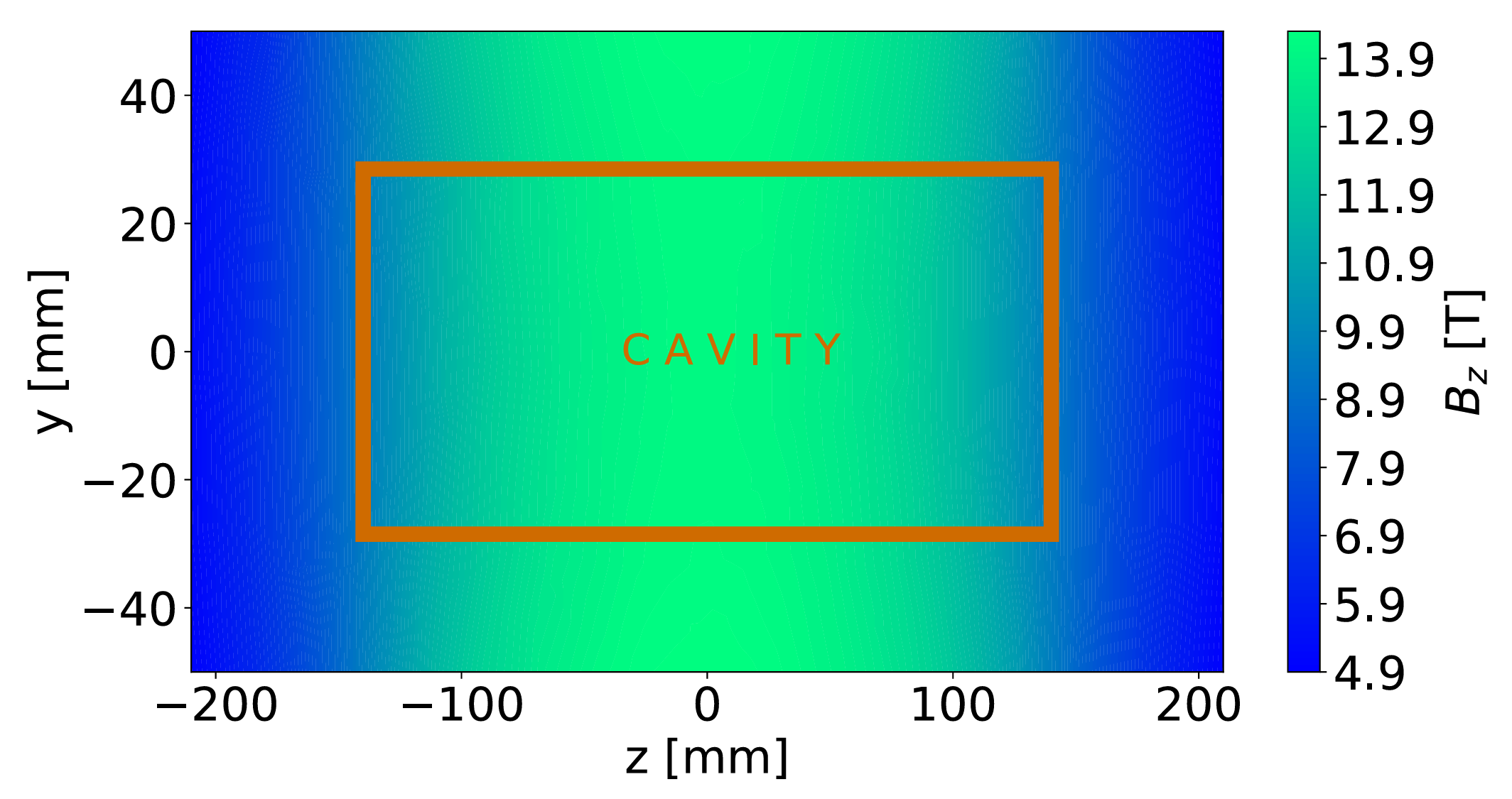
The experiment centered on a cylindrical cavity placed inside a superconducting solenoid magnet. The cavity measured about 28.5 millimeters in inner radius and 280 millimeters in length. It was tuned to resonate at 4.023 gigahertz, a frequency corresponding to an axion mass near 16.6 microelectronvolts.
That is only a tiny region in the much broader landscape of possible axion masses.
“The search for axions involves exploring a wide range of possible parameters,” said Agit Akgümüs, the study’s first author, now an M.Sc. student in mathematical physics at the University of Hamburg. “Our experiment covers only a small region, with limited sensitivity, but it still helps narrow down the possibilities. To actually find the particle, we need either much larger experiments or many different ones. Each experiment must probe a specific region.”
The magnet reached a peak field strength of 14 tesla, and the receiver chain amplified any possible signal coming out of the cavity. Before collecting data, the team calibrated the system and measured its performance. During the run itself, they had to account for drifting conditions. These included shifts in resonance frequency and cavity quality caused by environmental changes and the magnet’s low operating temperature.
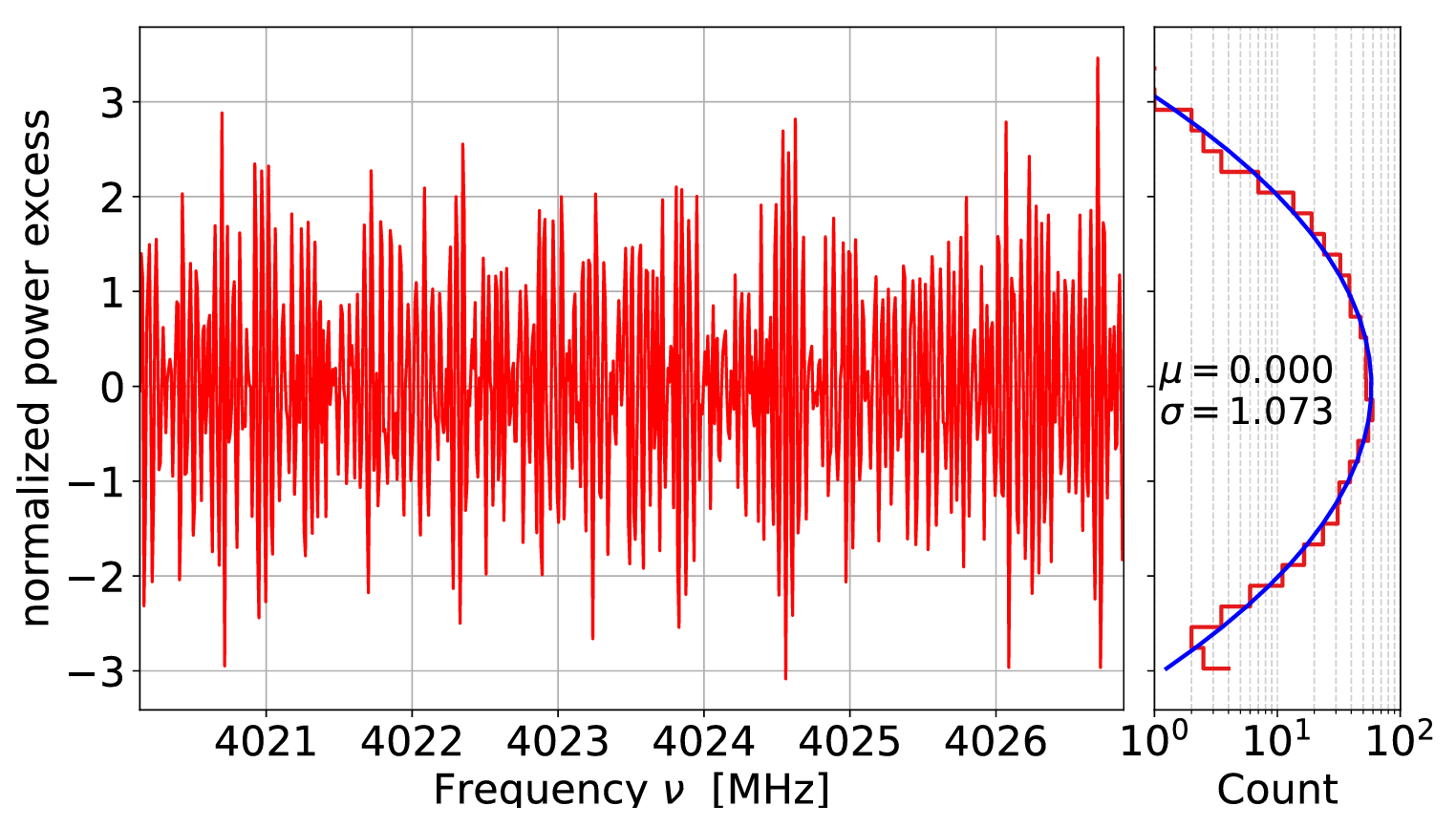
The data-taking period lasted 71 hours, from April 19 to April 22, 2024. Over that span, the team recorded 1.82 billion power spectra. Because of the way the system was sampled, that translated into an effective measurement time of 54.4 hours.
Then came the hard part, analysis.
The researchers processed each spectrum to remove the smooth background, combined the results with weighted averaging and searched for any excess power matching the expected shape of an axion signal. The largest excess they found was 3.24 sigma in the raw scan. However, after accounting for the full search, that dropped to a global significance of 0.84 sigma. This corresponded to a 20.1 percent chance of such an excess appearing from random fluctuations alone.
In plain terms, there was no convincing signal.
For dark matter searches, that kind of outcome is common. It also matters.
Because the team saw no statistically meaningful excess, they could set a 95 percent confidence limit excluding axion dark matter with coupling strengths larger than 14.6 × 10⁻¹³ GeV⁻¹ across the mass range from 16.626 to 16.653 microelectronvolts. At peak sensitivity, they excluded couplings above 2.8 × 10⁻¹³ GeV⁻¹.
That performance beat previous constraints in the same mass range, including the CAST limit, by more than two orders of magnitude. It also brought the experiment within a factor of 44 of the KSVZ benchmark sensitivity. This is a commonly cited target in axion physics.
For a student-led setup with limited resources, that is a serious result.
“The benefit of working with dark matter, or axions, is that we expect it to be present everywhere in our galaxy,” Akgümüs said. “So essentially, no matter where you perform the experiment, you have some dark matter on your hand you can do experiments with.”
He also stressed the obvious tradeoff. “Our results are naturally more limited than those of larger experiments. Performance scales with resources and complexity. However, we have shown that it is possible to reduce these setups to a much smaller scale, even to projects developed almost independently by students, while still producing real scientific data.”
One comment from peer review stayed with the team. Salama said a referee suggested that once axions are finally discovered and their mass is known, experiments like this could become much easier to build and might even fit into teaching labs.
“We were told that setups like ours could one day become standard student lab experiments,” Salama said. “In a way, we may have anticipated that future, showing that it is already possible to build and operate such an experiment on a small scale.”
This result does not solve dark matter. It does something more incremental and more useful. It trims away another part of the axion parameter space and helps other groups decide where to look next.
The result offers a working example of how smaller, lower-cost experiments can contribute to frontier physics when they are well designed and tightly focused.
That matters for universities, student researchers and labs that do not have access to the largest instruments. It suggests the search for dark matter is not reserved only for the biggest projects.
Research findings are available online in the Journal of Cosmology and Astroparticle Physics.
The original story “Undergraduate students built a cavity detector to search for axion dark matter” is published in The Brighter Side of News.
Like these kind of feel good stories? Get The Brighter Side of News’ newsletter.
The post Undergraduate students built a cavity detector to search for axion dark matter appeared first on The Brighter Side of News.

