The water coming off comet 3I/ATLAS is not just unusual. It is extreme.
Astronomers studying the interstellar comet found that its water is packed with an unusually heavy form of hydrogen called deuterium. The levels are far beyond anything measured in comets from our own solar system. That chemical fingerprint points to a birthplace much colder than the one that produced Earth. It is also colder than the places that formed the planets and the icy bodies that still circle the Sun.
The result gives researchers one of their clearest looks yet at how different other planetary systems can be.
“Our new observations show that the conditions that led to the formation of our solar system are much different from how planetary systems evolved in different parts of our galaxy,” said Luis Salazar Manzano, lead author of the study and a doctoral student in the University of Michigan’s Department of Astronomy.
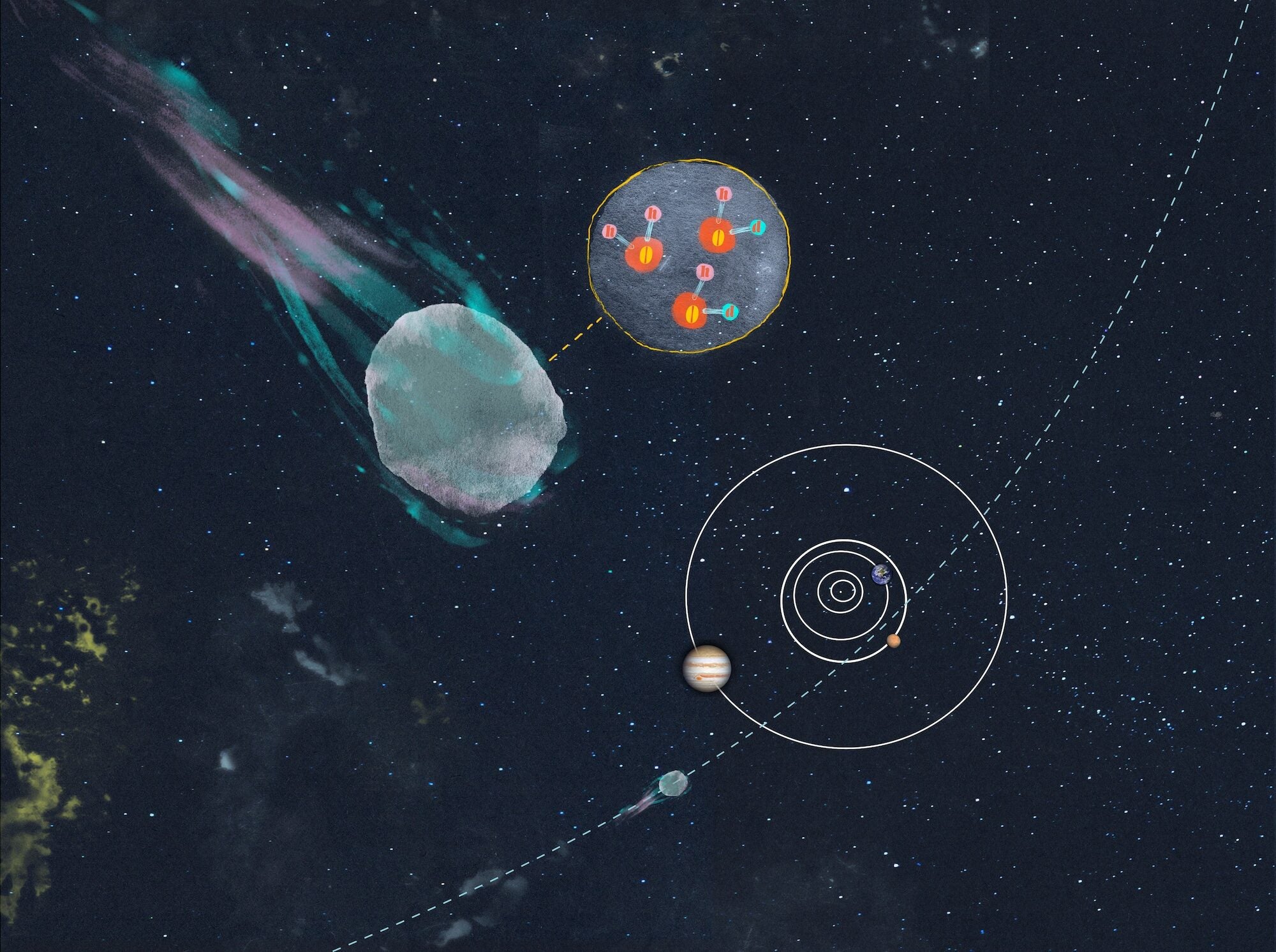
The work, published in Nature Astronomy, focuses on 3I/ATLAS, only the third interstellar object ever detected. It is also the second one known to show a clear cloud of gas, or coma, as it passed through the inner solar system.
Ordinary water is made from oxygen and hydrogen. In deuterated water, one of those hydrogen atoms is replaced by deuterium, which carries an extra neutron. That small difference matters. The balance between deuterium and ordinary hydrogen acts like a record of the environment where the water formed.
Cold conditions favor the chemical reactions that enrich water with deuterium. Warmer settings tend to blur or erase that signal.
That is why 3I/ATLAS stands out.
Salazar Manzano said the amount of deuterium relative to ordinary hydrogen in the comet’s water is higher than anything seen before in planetary systems or in planetary comets. According to the team, the ratio is at least 30 times higher than in any comet measured in our solar system. Additionally, it is about 40 times higher than the value in Earth’s oceans.
“This is proof that whatever the conditions were that led to the creation of our solar system are not ubiquitous throughout space,” said Teresa Paneque-Carreño, a co-leader of the study and assistant professor of astronomy at the University of Michigan. “That may sound obvious, but it’s one of those things that you need to prove.”


The study depended on timing.
Astronomers detected 3I/ATLAS early enough for follow-up observations. This gave researchers a brief chance to study the gases released as sunlight heated the comet. Salazar Manzano and collaborators first used the MDM Observatory in Arizona, where they saw some of the earliest signs of gas emission. He then contacted Paneque-Carreño, who brought in the Atacama Large Millimeter/submillimeter Array, or ALMA, in Chile.
ALMA turned out to be crucial because it is sensitive enough to separate the faint signal of deuterated water from ordinary water.
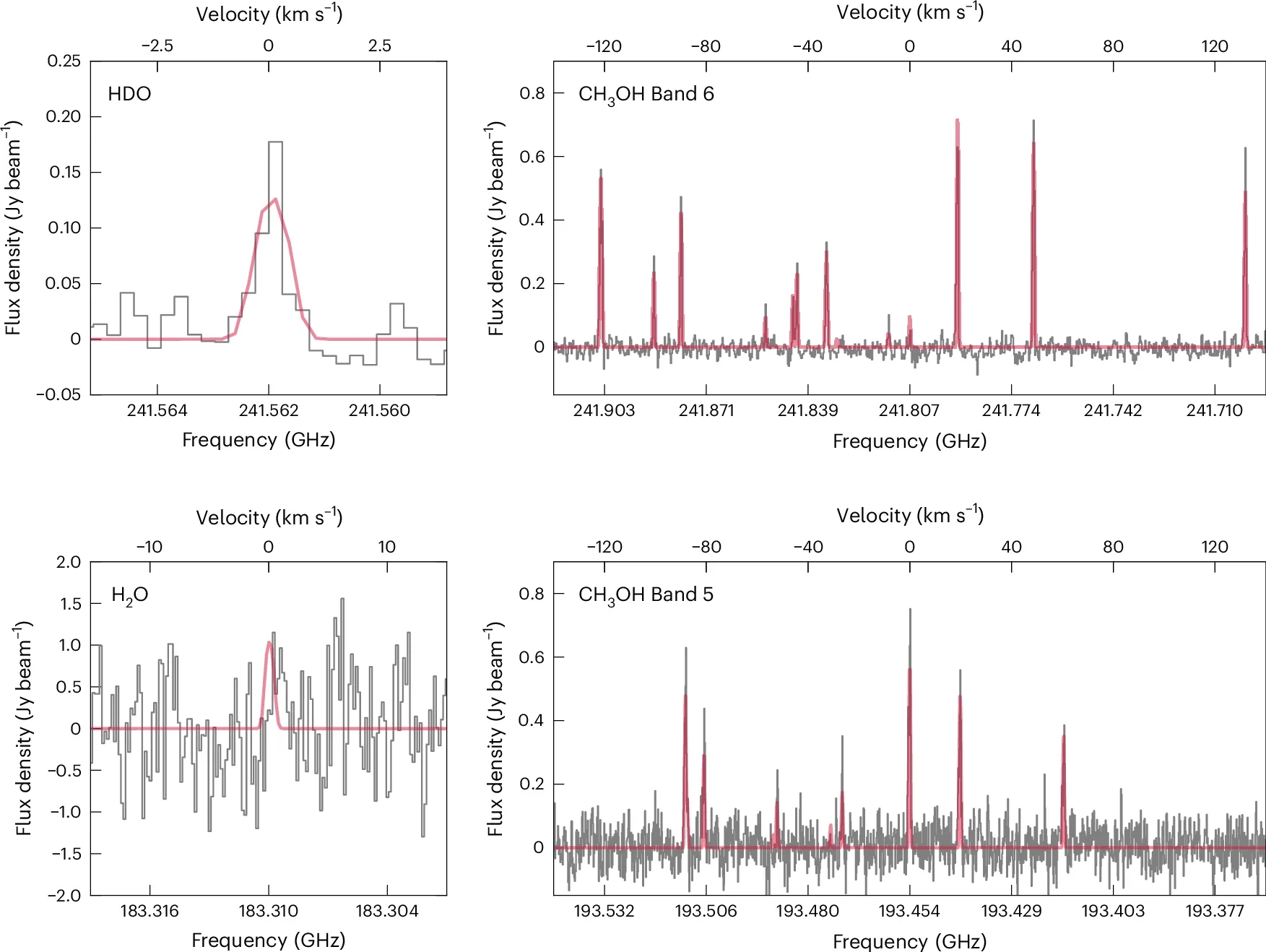
The observations were made on Nov. 4, 2025, six days after the comet’s closest approach to the Sun. At that point, 3I/ATLAS lay 1.37 astronomical units from the Sun and 2.24 astronomical units from Earth. The team observed spectral signatures from HDO, a form of water containing deuterium, along with methanol. Ordinary water itself stayed below the direct detection threshold.
That could have been a problem. Instead, the researchers used a model of the coma and a Bayesian retrieval method to estimate the comet’s water production rate from the way methanol lines behaved. Then they compared that with the HDO signal. Even in a more conservative scenario that relied only on the water-related data, the deuterium result stayed extraordinarily high.
This is the first time scientists have carried out this kind of isotopic analysis on an interstellar object.
“Being at the University of Michigan and having access to these facilities was the key to making this work possible,” Salazar Manzano said. “We were part of a team that was very talented and very experienced in multiple areas, all of us complemented each other and that’s what allowed us to analyze and interpret these data sets.”

Since its discovery, 3I/ATLAS has looked odd in more ways than one.
The source material notes that its estimated kinematic age is between 3 billion and 11 billion years. This may make it the oldest interstellar object yet found. Other studies had already reported unusual chemistry, including enhanced carbon dioxide and methanol. There was also carbon-chain depletion, and changing nickel-to-iron ratios.
The new water result adds a deeper layer. It suggests that 3I/ATLAS did not merely spend a long time drifting through space. It likely formed in an environment unlike the one that produced solar system comets.
The researchers argue that the high deuterium level cannot be explained simply by the comet forming in another part of the galaxy with a slightly different background mix of hydrogen isotopes. Those variations exist, but they are too small. They also say it is unlikely that the signal came from a thin outer layer altered during the comet’s long journey through interstellar space.
Instead, the most plausible explanation is that the comet’s natal environment was colder than the cloud that gave birth to the Sun.
That difference could have appeared very early, in the dense, frigid stages before a star fully formed. It also might reflect what happened later inside the comet’s home protoplanetary disk. The paper lays out both possibilities. In one, the water inherited a strong deuterium signature from an especially cold prestellar environment. In the other, water in the solar system was more heavily reworked by heat and mixing. Meanwhile, 3I/ATLAS retained more of its original chemistry.
The researchers also raise another possibility: 3I/ATLAS may have formed farther out in its parent disk, beyond the carbon dioxide snowline. That would fit with earlier observations showing it was rich in carbon dioxide. Additionally, it could help explain how the object was eventually ejected into interstellar space.
There is still no way to trace 3I/ATLAS back to its parent star. The source material says that backward orbit calculations cannot do that reliably. This is in part because astronomers do not yet have complete enough motion data for most stars.
So the comet remains anonymous. But its chemistry is now speaking more clearly.
The study also comes with limits. The researchers say their method for estimating ordinary water production carries uncertainties, especially because it assumes water was the main collision partner in the coma. Carbon dioxide may still have played a role near the time of the observations. For that reason, they treat one of their water estimates as an upper limit and include a more conservative case as well.
Even with those caveats, the main conclusion held.
3I/ATLAS seems to carry water that formed under colder conditions. It also followed a different chemical history than the water locked into solar system comets.
Paneque-Carreño said future discoveries could make this kind of comparison more common. This is especially true as more observatories join the hunt for faint interstellar visitors. She also warned that finding them depends on preserving dark skies.
“We need to be taking care of our night skies and keeping them clear and dark so we can detect these tiny and faint objects,” she said.
This study gives astronomers a new way to compare the birth conditions of planetary systems across the galaxy.
Instead of relying only on distant observations of stars and disks, researchers can use interstellar comets as direct samples of material formed around other stars.
The work also shows that water chemistry may vary much more from system to system than once assumed. This could reshape how scientists think about planet formation, comet formation, and the conditions that might support habitable worlds.
Research findings are available online in the journal Nature Astronomy.
The original story “Interstellar Comet 3I/ATLAS points to a far colder planetary birthplace” is published in The Brighter Side of News.
Like these kind of feel good stories? Get The Brighter Side of News’ newsletter.
The post Interstellar comet 3I/ATLAS points to a far colder planetary birthplace appeared first on The Brighter Side of News.

