A long, low basin in eastern Africa has spent millions of years collecting some of the most important clues to human origins. Now it is offering another kind of evidence, this time from far below the surface.
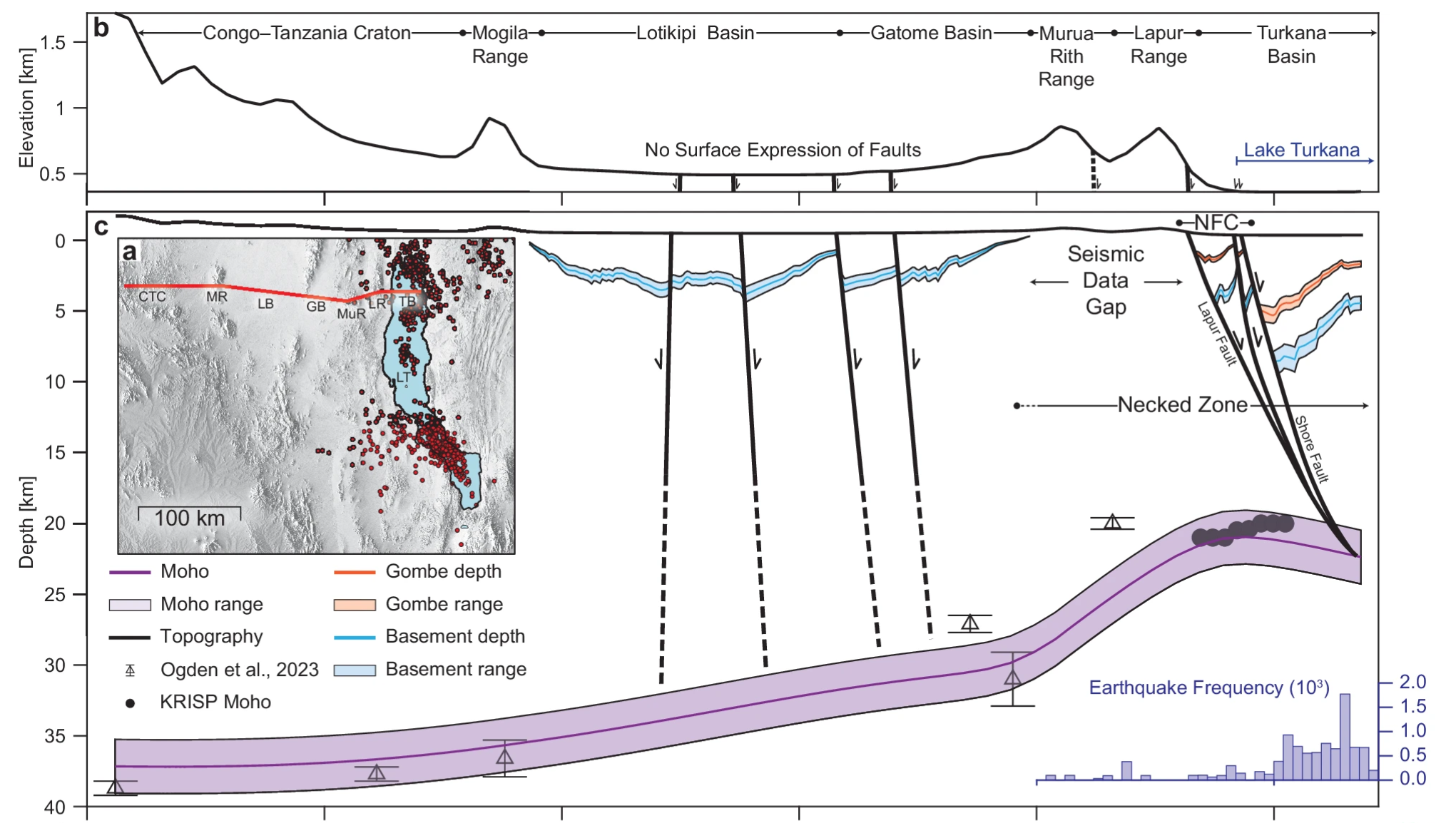
Beneath the Turkana Rift, which stretches across Kenya and Ethiopia, researchers say Earth’s crust has thinned much more than scientists realized. In places along the rift axis, it is only about 13 kilometers thick, down from more than 35 kilometers farther out. That degree of thinning places the region in a critical stage of continental breakup known as necking, when crust weakens, narrows and becomes more likely to split apart.
The study, published in Nature Communications, argues that the Turkana Rift is the first identified active continental rift now undergoing this phase. The finding matters for geology because it offers a rare chance to study a stage of rifting that usually has to be reconstructed from ancient, buried margins. It also matters for paleoanthropology, because the same tectonic changes may help explain why the Turkana Rift preserved such an extraordinary fossil record.
“We found that rifting in this zone is more advanced, and the crust is thinner, than anyone had recognized,” said lead author Christian Rowan, a PhD student in Earth and Environmental Sciences and researcher at the Lamont-Doherty Earth Observatory, part of the Columbia Climate School.
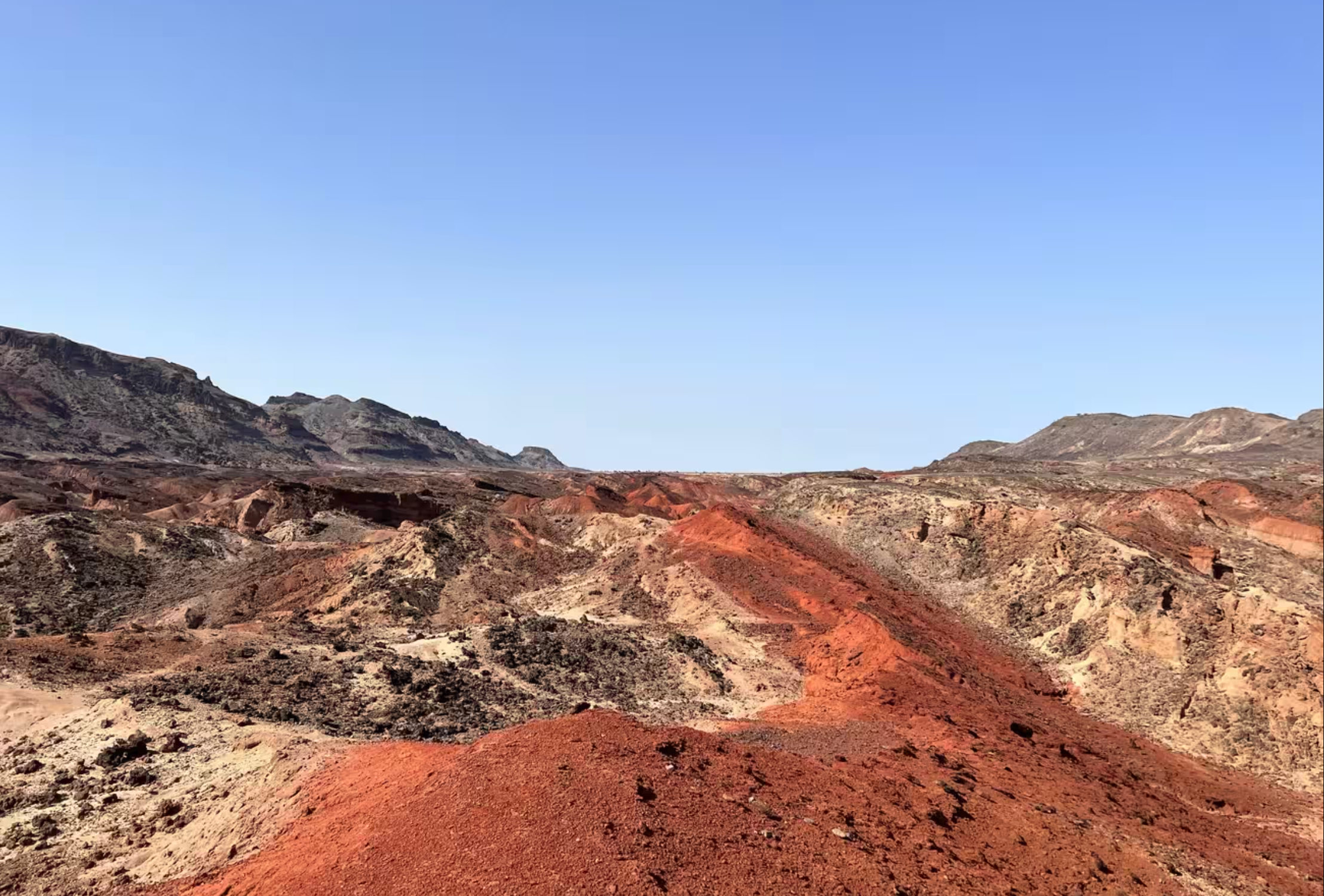
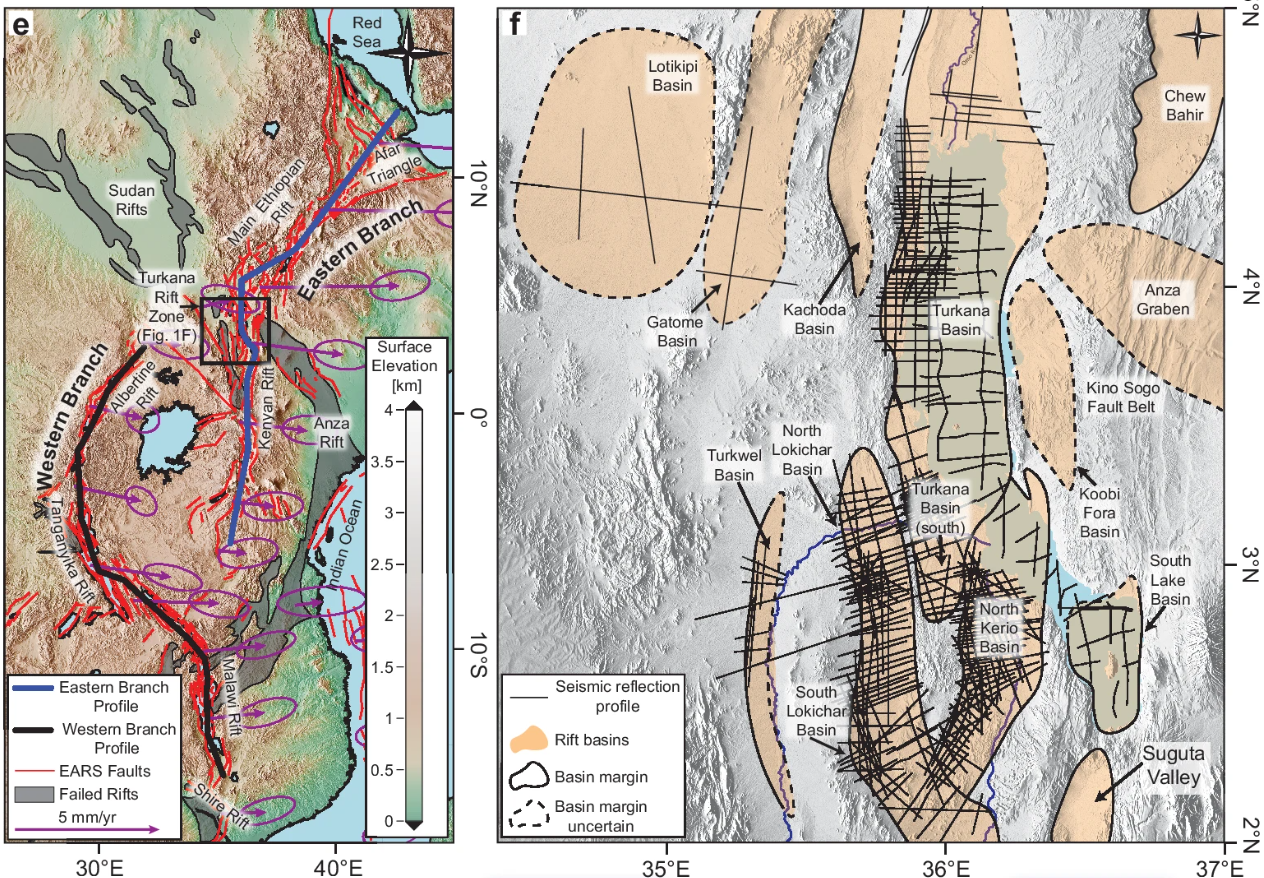
The Turkana Rift sits within the broader East African Rift System, a massive tectonic zone that runs from Ethiopia to Mozambique. At Turkana, the African and Somali plates are pulling apart at about 4.7 millimeters per year. That may sound slow, but over geologic time it reshapes continents.
To investigate what is happening there, Rowan and colleagues used high-quality seismic reflection data collected by industry partners and acquired in collaboration with the Turkana Basin Institute, the research organization founded by paleoanthropologist Richard Leakey. By tracking how acoustic waves bounced off subsurface layers and combining those interpretations with other deep imaging, the team mapped sediment structure and estimated the depth to the top of the crust.
What they found was a wedge-shaped crust, a hallmark of necking. Along the rift axis, the crust thins to 12.7 plus or minus 2.8 kilometers. The researchers also calculated beta values, a measure of thinning, ranging from 1.9 to 3.1 along the axis. In rifted margins, values above 1.5 are associated with necking rather than the earlier stretching phase.
“The thinner the crust gets, the weaker it becomes, which helps promote continued rifting,” Rowan said.
Anne Bécel, a Lamont geophysicist and co-author, put it more bluntly: “We’ve reached that critical threshold.” She added, “We think this is why it is more prone to separate.”
That does not mean the split is imminent in human terms. The Turkana Rift began pulling apart about 45 million years ago. The researchers estimate that necking started around 4 million years ago, after a major volcanic episode. Oceanization, the later stage when magma builds new seafloor and water can move in, is still a few million years away.
One of the study’s more interesting arguments is that Turkana did not begin from scratch.
The region intersects both the younger East African Rift System and an older rift system, the Central African Rift System. According to the researchers, evidence from outcrops, seismic profiles and basement maps shows that an earlier bout of extension had already weakened the crust there. Later rifting then exploited that inherited weakness.
That point challenges a more traditional picture in which rift maturity depends mostly on present-day plate motions. Conventional models suggest rifts farther from the rotation pole mature sooner because plate velocities are higher. Turkana lies closer to the Nubia-Somalia Euler pole than the Main Ethiopian Rift, so by that logic it should be less advanced. Yet the crustal structure says otherwise.
“We think this is why it is more prone to separate,” Bécel said of the thinned crust, but the broader implication is that a continent’s breakup may depend not just on how plates move now, but on the damage older tectonic events already left behind.
Rowan said that “it challenges some of the more traditional ideas of how continents break apart.”
The authors also note an important uncertainty. Brittle faulting explains only about half of the extension needed to account for the amount of crustal thinning they infer. Basin inversion may have erased some fault record, but lower-crustal flow or older thinning tied to crustal delamination may also be involved. In other words, the geometry is clear, while the full mechanical story remains less settled.
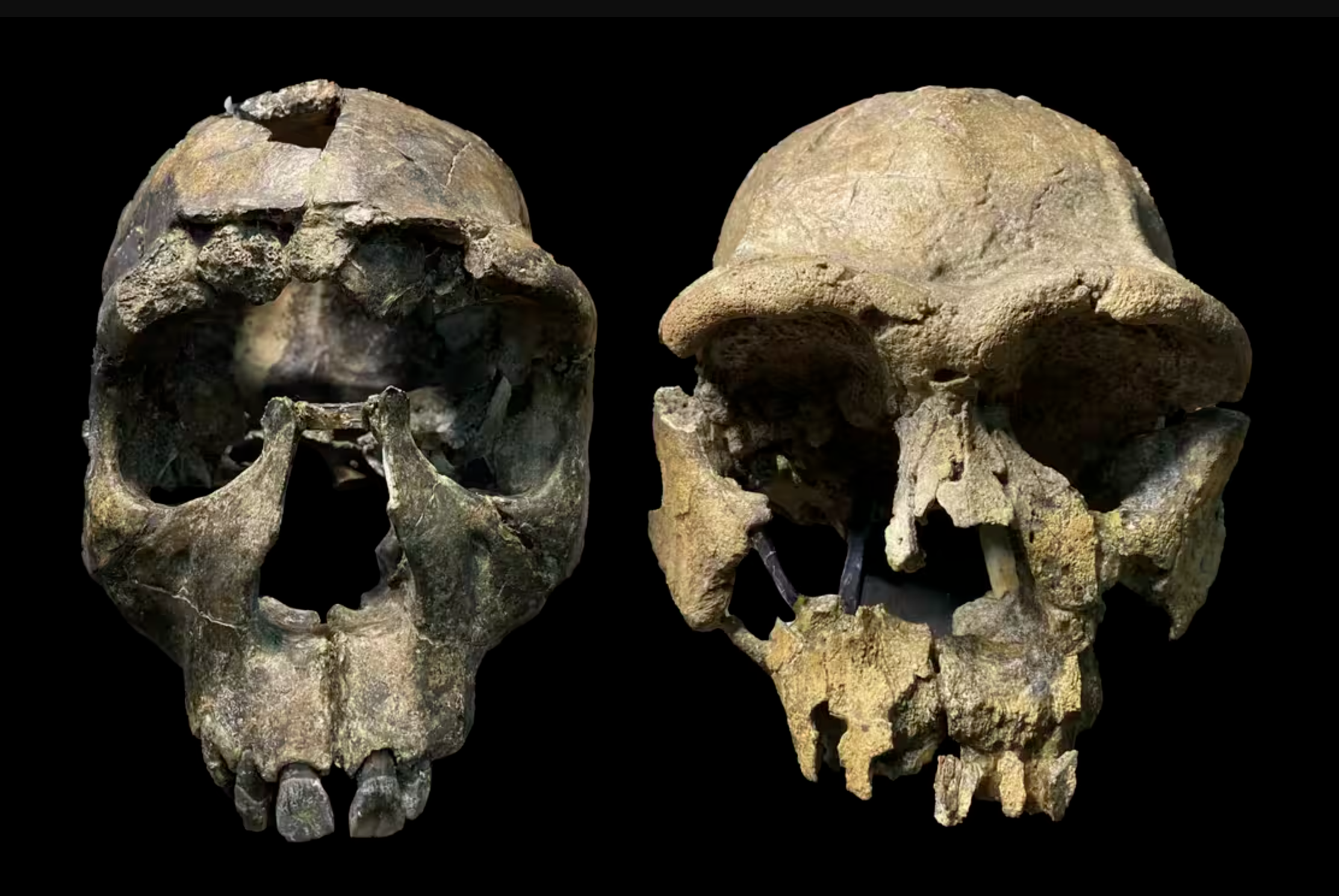
The Turkana Rift is famous for a different reason. It has yielded more than 1,200 hominin fossils from the last 4 million years, about one-third of all such fossils found in Africa. That record includes finds such as the Homo erectus crania known as Turkana Boy and ER 3733.
For decades, many researchers have treated the area as an evolutionary hotspot, a place unusually central to human origins. Rowan and his co-authors suggest a more cautious alternative. Perhaps Turkana was not uniquely important because it produced more evolution, but because it was better at preserving the evidence.
After widespread volcanism around 4 million years ago, the onset of necking increased subsidence and created a larger, more integrated basin system. Fine-grained sediments then accumulated rapidly, producing the thick, continuous deposits that later preserved fossils. Before that time, fossil-bearing sediments were patchier, more isolated and often interrupted by volcanic units.
“The conditions were right to preserve a continuous fossil record,” Rowan said.
That timing matters. The researchers note that the richest fossil-bearing units of the Omo Group span roughly 4 to 1 million years ago, while the earlier record is sparse and discontinuous. Large mammal species richness also rises after about 4 million years, a shift the paper links to the greater abundance of fossiliferous sediments.
So the Turkana Rift may be less a singular cradle than a remarkably good archive.
That remains a hypothesis, and Rowan says so directly. “But other researchers can now use our results to explore those ideas,” he said.
The study gives geologists something rare, an active rift caught in a phase that usually must be inferred from ancient examples. That could sharpen tectonic models, improve reconstructions of how continents break apart and help scientists compare Turkana with other rifts, including Afar and the Red Sea.
It also gives paleoanthropologists a new way to think about a famous fossil landscape. If tectonic changes helped create the conditions for steady sediment buildup and preservation, then some of the apparent richness of the human record in Turkana may reflect geology as much as biology.
That does not make the fossils less important. It changes the question from where evolution happened most intensely to where its traces were most likely to survive.
Research findings are available online in the journal Nature Communications.
The original story “East Africa’s Turkana Rift may be closer to splitting than scientists thought” is published in The Brighter Side of News.
Like these kind of feel good stories? Get The Brighter Side of News’ newsletter.
The post East Africa’s Turkana Rift may be closer to splitting than scientists thought appeared first on The Brighter Side of News.

