A giant planet was supposed to have the place to itself. Instead, in a star system 190 light-years away, a hot Jupiter shares space with a much smaller world, a mini-Neptune tucked even closer to the star. That pairing is rare enough on its own. Now, a fresh look at the smaller planet’s atmosphere is giving astronomers a clue to how both worlds may have ended up there.
Using the James Webb Space Telescope, a team led by MIT examined the atmosphere of TOI-1130 b, the inner planet in the unusual two-planet system. What they found was not a light, hydrogen-and-helium envelope of the kind often expected for a close-in planet. Instead, the atmosphere appears rich in heavier molecules, including water vapor, carbon dioxide, and sulfur dioxide, along with a tentative hint of methane.
That mix matters because TOI-1130 b now circles very close to its star, completing an orbit in a little more than four days. The outer planet, TOI-1130 c, a hot Jupiter, circles every 8.35 days. The team argues that the smaller planet’s atmosphere is too heavy to have formed where the planet sits today. In their view, both planets likely formed much farther out, beyond the system’s frost line, where water could condense into ice, and then slowly moved inward together.
“This is the first time we’ve observed the atmosphere of a planet that is inside the orbit of a hot Jupiter,” said Saugata Barat, a postdoc in MIT’s Kavli Institute for Astrophysics and Space Research and the study’s lead author. “This measurement tells us this mini-Neptune indeed formed beyond the frost line, giving confirmation that this formation channel does exist.”
The findings appear in Astrophysical Journal Letters.

Mini-Neptunes are among the most common kinds of planets found in the Milky Way. Even so, the TOI-1130 system stood out when it was first identified in 2020 with data from NASA’s Transiting Exoplanet Survey Satellite, or TESS. Chelsea X. Huang, then at MIT and now at the University of South Queensland, helped discover the system and quickly saw how odd it was.
Hot Jupiters tend to be “lonely.” Because they are massive and orbit close to their stars, they often lack nearby inner companions. In many models, anything interior to them gets scattered away.
“This was a one-of-a-kind system,” Huang said. “Hot Jupiters are ‘lonely,’ meaning they don’t have companion planets inside their orbits. They are so massive, and their gravity is so strong, that whatever is inside their orbit just gets scattered away. But somehow, with this hot Jupiter, an inner companion has survived. And that raises questions about how such a system could form.”
The system offers another clue. The two planets sit in a 2:1 mean motion resonance, meaning the inner world goes around the star twice for every one orbit by the outer giant. That kind of lockstep pattern strongly favors slow migration through the protoplanetary disk rather than a more violent history.
Getting the new measurements was not simple.
Because the planets tug on each other gravitationally, the timing of their transits changes by hours. For TOI-1130 b, the variation can reach about five hours from peak to peak, making it unusually difficult to predict exactly when the planet would cross the face of its star. To solve that, the team combined earlier observations from TESS, CHEOPS, and ground-based telescopes and updated the system’s timing model.
“It was a challenging prediction, and we had to be spot-on,” Barat said.
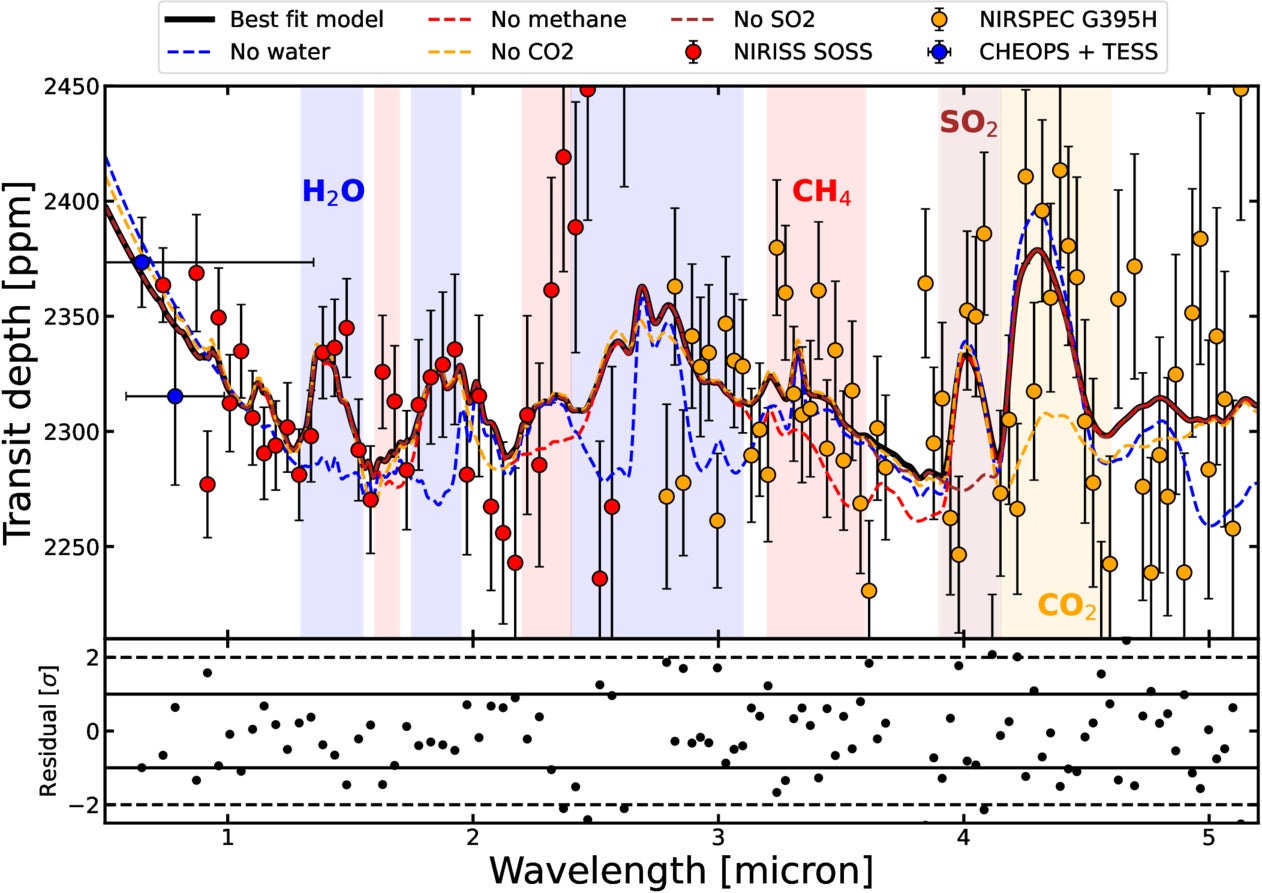
That effort paid off. The team caught two transits of TOI-1130 b with JWST in August 2024, using both NIRSpec and NIRISS. By looking at how the planet’s atmosphere absorbed starlight at different wavelengths, they could infer which molecules were present.
“The beauty of JWST is that it does not observe just in one color, but at different colors, or wavelengths,” Barat said. “And the specific wavelengths that a planet absorbs can tell you a lot about the composition of its atmosphere.”
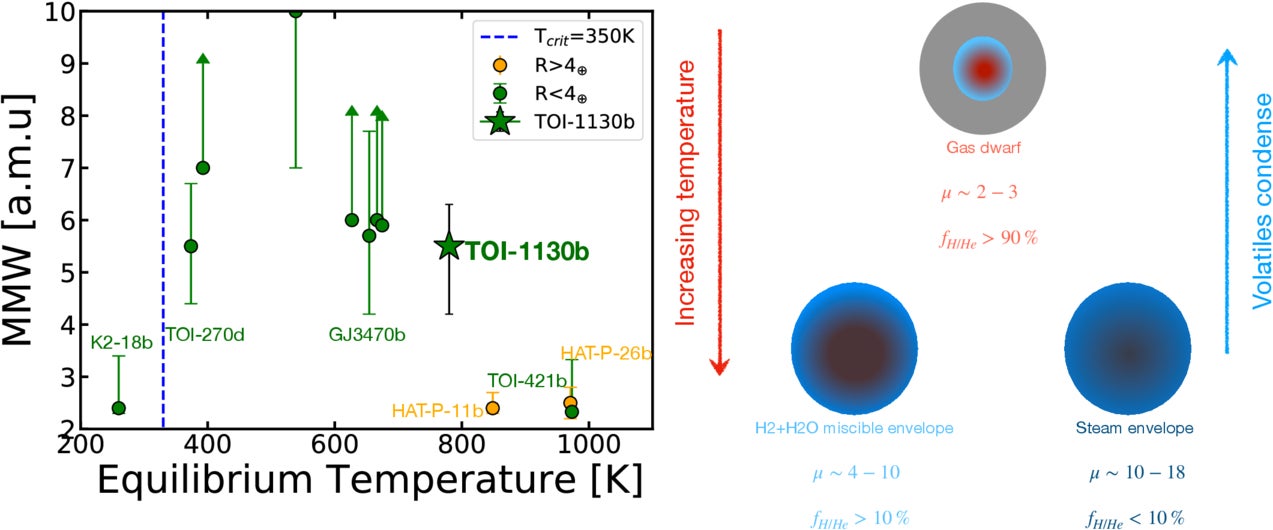
The researchers report strong evidence for water, carbon dioxide, and sulfur dioxide, with a weaker signal for methane. In their preferred interpretation, the atmosphere is metal-rich, with a mean molecular weight of about 5.5 atomic mass units. That puts it between a light hydrogen-helium envelope and a much heavier steam-dominated one.
That chemistry is the heart of the story.
The team argues that a planet forming close to the star would struggle to gather this kind of volatile-rich atmosphere. Near the star, solid material is expected to be dominated by rock rather than ice. In TOI-1130, the outer hot Jupiter would also have blocked inward-drifting pebbles, cutting off a supply of volatile-rich material to the inner planet.
Far beyond the frost line, conditions would have been different. Water could freeze onto dust grains, forming icy pebbles that a growing planet could accrete along with gas. A planet assembled in that colder region could build a heavier atmosphere and then carry it inward during gradual disk-driven migration.
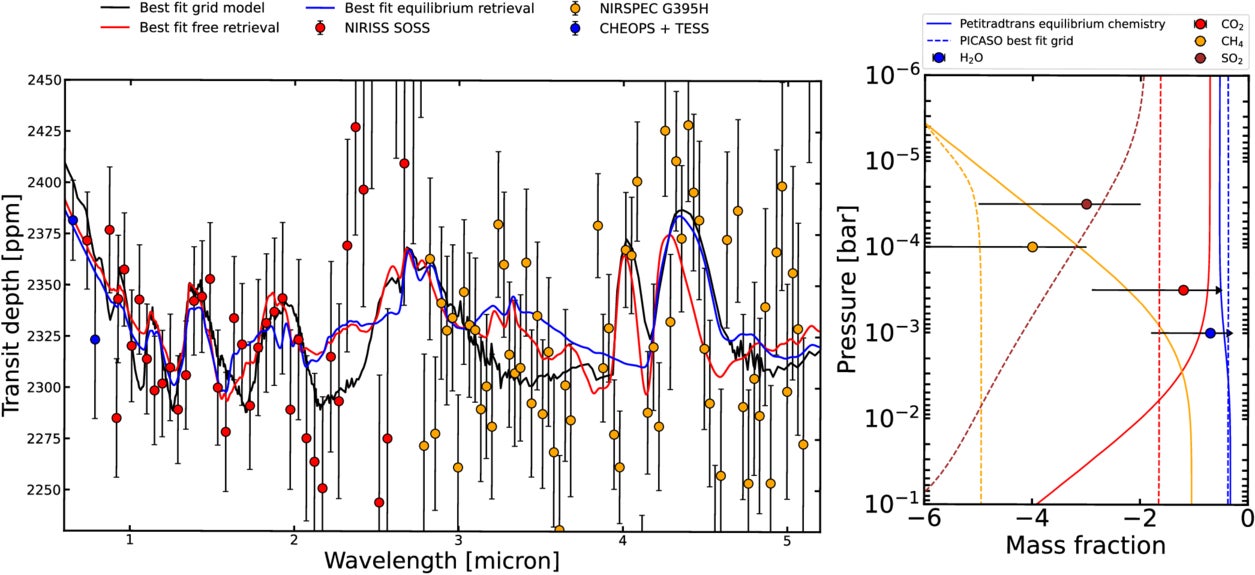
The sulfur dioxide signal helps strengthen that case. In the team’s modeling, sulfur dioxide is much easier to produce in a high-metallicity atmosphere than in a low-metallicity one. Its detection therefore supports the conclusion that TOI-1130 b is enriched in heavy elements.
The researchers also did not find a significant helium escape signal, which matters for another reason. A planet with a heavy atmosphere may lose less gas over time. That could help explain why TOI-1130 b still sits at the edge of the so-called radius cliff, a sparsely populated region of the size-period diagram where close-in planets larger than about 3 Earth radii become rare.
The study does note an important uncertainty. Another possible source for atmospheric volatiles is interaction between a planet’s interior and its atmosphere, including outgassing from a magma-rich boundary layer. The authors say current models do not yet show clearly how strongly those processes would affect a planet as massive as TOI-1130 b, so they cannot fully rule that out.
TOI-1130 b is not just another sub-Neptune with a JWST spectrum. It sits in an uncommon orbital setup, near an underpopulated part of exoplanet parameter space, with an atmosphere that does not fit neatly into a simple close-in formation story.
The team compares it with other mini-Neptunes whose atmospheres also appear volatile-rich, including TOI-270 d and GJ 3470 b. Together, those planets suggest that at least some mini-Neptunes may have formed far from their stars and moved inward later, rather than being built in place and sculpted mainly by atmospheric loss.
That does not overturn other formation pathways. The authors point out that observations of younger sub-Neptunes and evidence for atmospheric escape in other worlds still support in-place formation for part of the population. Their broader point is that mini-Neptunes may not share a single origin story.
The main practical value of this work is that it gives astronomers a clearer test for how planets form. TOI-1130 b links atmospheric chemistry with orbital architecture in a way that is unusually informative. Because the system’s layout already hints at slow inward migration, the atmosphere becomes a kind of cross-check.
That matters for future JWST studies. If similar heavy atmospheres turn up in other systems with inner planets and outer hot Jupiters, astronomers will have stronger evidence that some mini-Neptunes begin beyond the frost line and move inward with their larger companions.
It also sharpens the search for which planets near the radius cliff kept their original atmospheres and which were reshaped later by escape. In that sense, TOI-1130 b is not just an odd couple’s smaller half. It may be a useful marker for sorting out how one of the galaxy’s most common planet types came to be.
Research findings are available online in the Astrophysical Journal Letters.
The original story “JWST finds a heavy atmosphere on a mini-Neptune orbiting a hot Jupiter” is published in The Brighter Side of News.
Like these kind of feel good stories? Get The Brighter Side of News’ newsletter.
The post JWST finds a heavy atmosphere on a mini-Neptune orbiting a hot Jupiter appeared first on The Brighter Side of News.

