Blood cells carry a deep evolutionary history. A new analysis suggests their earliest ancestors were macrophage-like cells inherited from single-celled life. By tracing those lineages back 700 million years, the work opens a new window into immunity’s ancient roots.
Blood does more than move oxygen and fight infection. It also carries a record of where animals came from.
A new evolutionary analysis suggests that the roots of blood cells stretch back roughly 700 million years. That period was when the first multicellular animals were beginning to emerge. In that picture, some cells now circulating through vertebrate bodies may trace their origins to genetic programs inherited from single-celled ancestors.
The work, led by researchers at Kyoto University, set out to answer a basic but stubborn question. Scientists know a great deal about what human and mouse blood cells do. However, they know much less about when those cells first appeared and how they split into the many lineages seen today.
To tackle that, the team developed a new method for comparing gene expression profiles across cell lineages and across animal species. They then used those comparisons to build phylogenetic trees of cell lineages. This allowed them to estimate how blood-cell lineages evolved over time.
The researchers did not stop with animals. They also included unicellular organisms in their analysis, hoping to push the story back beyond the rise of complex life.
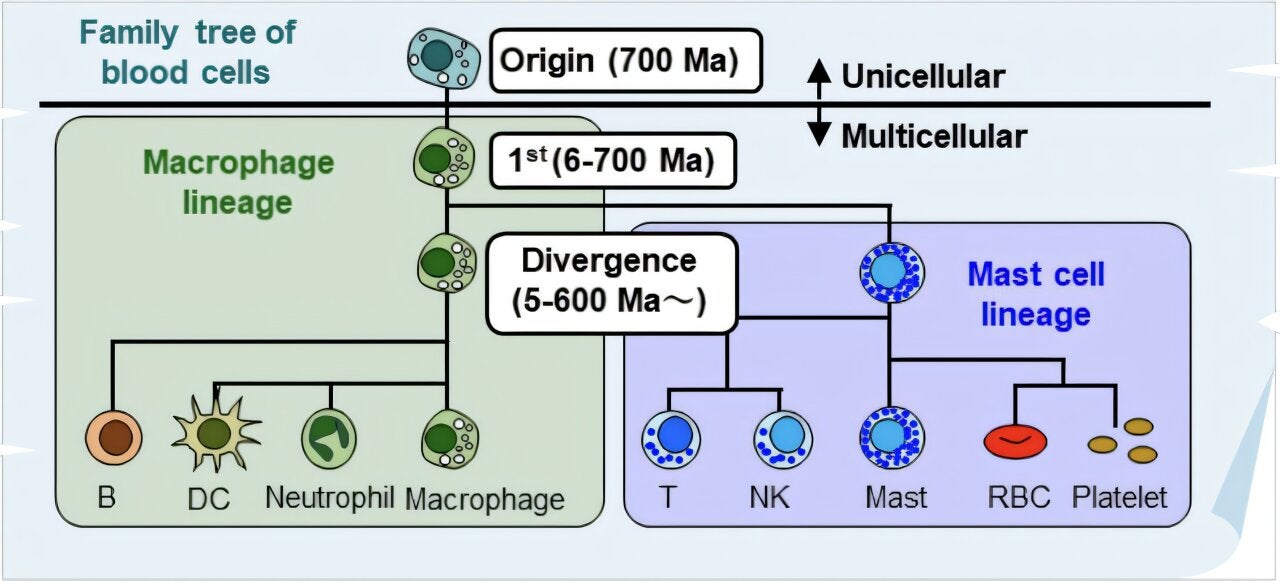
That broader comparison led them to one of the study’s most striking results. Among the human blood-cell lineages they examined, macrophages showed the strongest resemblance to unicellular organisms. That finding points to early blood cells being macrophage-like, rather than resembling the later, more specialized immune and blood cell types familiar in vertebrates.
The team also traced the gene FOS, which is commonly expressed in blood cells across animal species, back to a single-celled ancestor that lived about 700 million years ago. That timing suggests the first blood cells emerged around the same period as the onset of multicellular animals.
In effect, the researchers argue that early animals did not invent blood cells from scratch. Instead, they appear to have repurposed older genetic material inherited from single-celled predecessors. Early animals then built new cell types on top of that ancient foundation.
From there, the study reconstructed a branching history for major blood-cell lineages.
According to the team’s analysis, mast cells branched off from macrophages. After that, prototypic T cells and red blood cells split from mast cells. Prototypic B cells, meanwhile, branched off from macrophages after mast cells had already separated.
That pattern offers a proposed family tree spanning 700 million years. It connects today’s vertebrate blood and immune cells to much older biological ancestry. The researchers say that history is still visible in the differentiation pathways of those cells. This means the way blood cells develop today may preserve traces of the order in which those lineages first emerged.
The idea gives a different weight to familiar biology. Blood is often discussed in terms of its immediate jobs, carrying oxygen, clearing debris, attacking pathogens. This study instead frames blood and immune cells as living descendants of a much longer evolutionary story.
“I feel deeply moved by these findings, which represent the culmination of our work and illustrate that the differentiation pathways of vertebrate blood cells reflects the 700-million-year evolutionary history of these cells,” says team leader Hiroshi Kawamoto.
That sense of continuity appears again in the response from first author Yosuke Nagahata of the Institute of Evolutionary Biology, Spain.
“When I let it sink in that this legacy from so long ago is circulating within my body as blood cells, I feel closer to our distant ancestors,” Nagahata adds.
Part of the importance of the work lies in the method itself. By comparing gene expression profiles across both species and cell lineages, the researchers created a way to study cell evolution with more detail than has been possible in many earlier approaches.
That matters because blood cells are not just a medical subject. They are also an evolutionary one. Human and mouse blood have been studied closely through hematology and immunology. However, those fields mostly explain present-day structure and function. They do not automatically reveal how lineages arose or how one kind of cell gave rise to another over deep time.
This approach tries to bridge that gap. By placing blood cells into an evolutionary framework, the team was able to suggest not only which lineages appeared early. They also suggested how later branches may have emerged from them.
The findings do not just push the history of blood farther into the past. They also suggest that the immune systems of animals may have been built by modifying cellular traits that long predated animals themselves.
The researchers say the analytic method developed for this study could help trace the evolutionary origins of diseases such as cancer.
In practical terms, that could improve understanding of how disease mechanisms emerged. It could also improve understanding of how they are tied to older cellular programs.
If scientists can better map those deep histories, the work may eventually guide new ways of thinking about treatment and disease development.
Research findings are available online in the journal PNAS.
The original story “Blood cells originated from single-celled ancestors 700 million years ago” is published in The Brighter Side of News.
Like these kind of feel good stories? Get The Brighter Side of News’ newsletter.
The post Blood cells originated from single-celled ancestors 700 million years ago appeared first on The Brighter Side of News.


Leave a comment
You must be logged in to post a comment.