Quantum computing still stumbles on fragility, where tiny disturbances can wreck calculations. ETH Zurich researchers built a geometric swap gate with neutral atoms that stayed remarkably stable across 17,000 qubit pairs, hinting at a sturdier path toward large-scale quantum machines.
Quantum computers promise to solve problems that would overwhelm even the world’s fastest supercomputers. They could help researchers design new medicines, improve climate models and crack scientific mysteries that remain out of reach today. But one stubborn problem continues to slow progress: quantum systems are fragile.
Even tiny disturbances can disrupt a quantum calculation. A slight vibration, a fluctuation in laser intensity or a stray magnetic field may introduce errors that spread through the system. Building reliable quantum hardware has therefore become one of the greatest challenges in modern physics.
Now, researchers at ETH Zurich have developed a new kind of quantum gate that may bring scientists closer to large-scale, fault-tolerant quantum computers. Their work demonstrates an extremely stable “swap gate” using neutral atoms trapped in laser light. The system achieved a precision of 99.91% while operating simultaneously across 17,000 qubit pairs.
The breakthrough relies on geometry rather than delicate fine-tuning. That shift could make future quantum computers far more resistant to noise and instability.

Quantum computers rely on quantum bits, or qubits. Unlike ordinary computer bits, which hold either a 0 or a 1, qubits can exist in a superposition of both states at once. That strange property allows quantum machines to process information in radically different ways.
Researchers have explored many types of qubits, including superconducting circuits and trapped ions. In recent years, neutral atoms have emerged as another promising option.
Neutral atoms carry no electric charge, which makes them less sensitive to outside disturbances. Scientists can also trap thousands of them using laser light arranged into patterns called optical lattices. These lattices act like artificial crystals made entirely of light.
That scalability offers a major advantage. While some quantum systems struggle to control hundreds of qubits, neutral atom systems can already manage many thousands.
Still, these systems face their own technical hurdles. To perform useful calculations, qubits must interact through operations called quantum gates. Many earlier neutral atom gates depended on tunneling effects or highly excited atomic states called Rydberg states. Those methods often require extremely precise control because tiny imperfections can quickly lower accuracy.
The ETH Zurich team took a very different approach. Instead of relying mainly on fragile dynamical effects, they used something called a geometric phase.
“A few years ago, researchers managed to realise such gates using neutral atoms in their lowest energy state, albeit by exploiting dynamical phases due to tunnelling and collisions,” said postdoc Yann Kiefer.
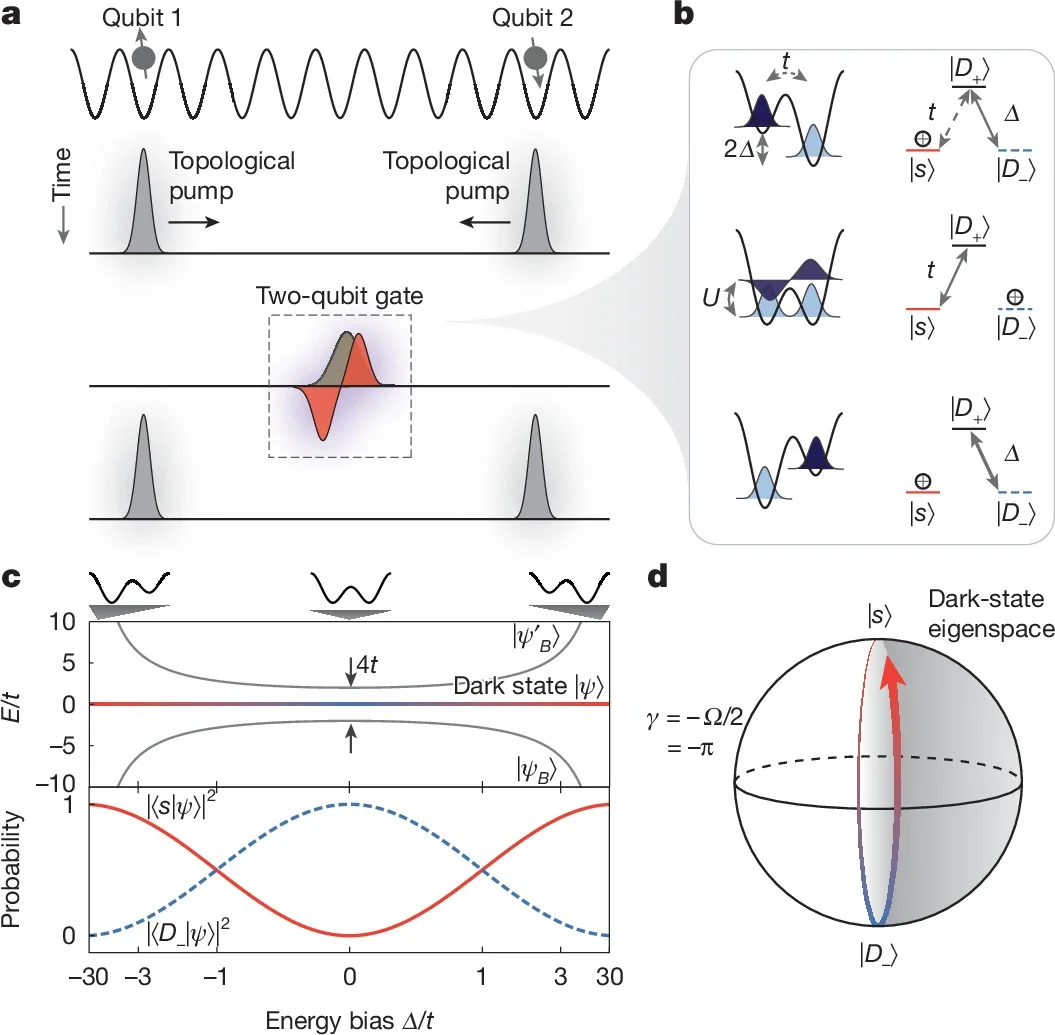
Dynamical phases depend strongly on timing, movement and interaction strength. Small fluctuations can therefore introduce large errors. Geometric phases behave differently. They depend mainly on the overall path a quantum system follows rather than the exact details of how quickly it moves.
That distinction gives geometric systems a natural form of protection against noise.
To create the new gate, the researchers cooled potassium atoms to extremely low temperatures and trapped them inside optical lattices. They then manipulated laser beams to bring pairs of atoms close enough for their quantum wavefunctions to overlap.
The atoms used in the experiment were fermions, particles that obey special quantum rules preventing them from occupying the exact same state. That property created a geometric phase that allowed the qubits to exchange states with remarkable stability.
A swap gate performs a simple but important task. It exchanges the states of two qubits.
If qubit A starts in state 0 and qubit B starts in state 1, the swap gate reverses them. After the operation, qubit A becomes 1 and qubit B becomes 0.
These gates are essential for moving quantum information around large processors. In future quantum computers, information may need to travel long distances across crowded qubit arrays. Reliable swap gates help make that possible.
In the ETH Zurich experiment, the researchers created the swap gate using a geometric process involving temporary “doublon” states. A doublon forms when two atoms briefly occupy the same orbital state.
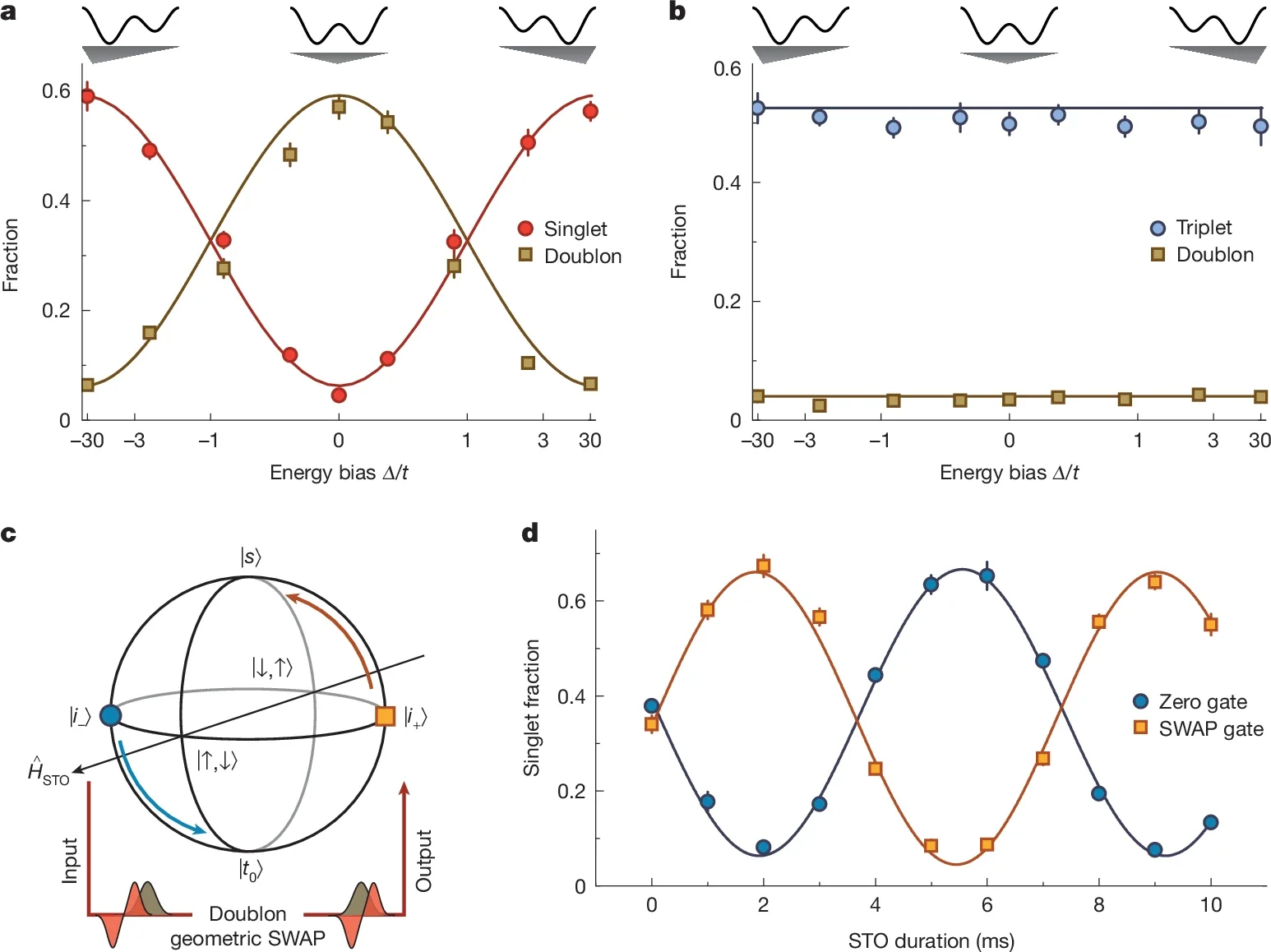
Earlier experiments often treated doublons as unwanted leakage states. Here, the team used them intentionally. By guiding the atoms through a carefully designed quantum pathway, they created a phase shift that depended purely on geometry.
“Unlike dynamical phases, this geometric phase is largely independent of the speed with which we manipulate the atoms, or how strongly the laser intensity fluctuates during the process,” explained Konrad Viebahn, junior group leader for the experiment.
The researchers tested the system using more than 58,000 potassium-40 atoms. Around 60% to 70% formed usable qubit pairs, giving the team over 17,000 operating pairs simultaneously.
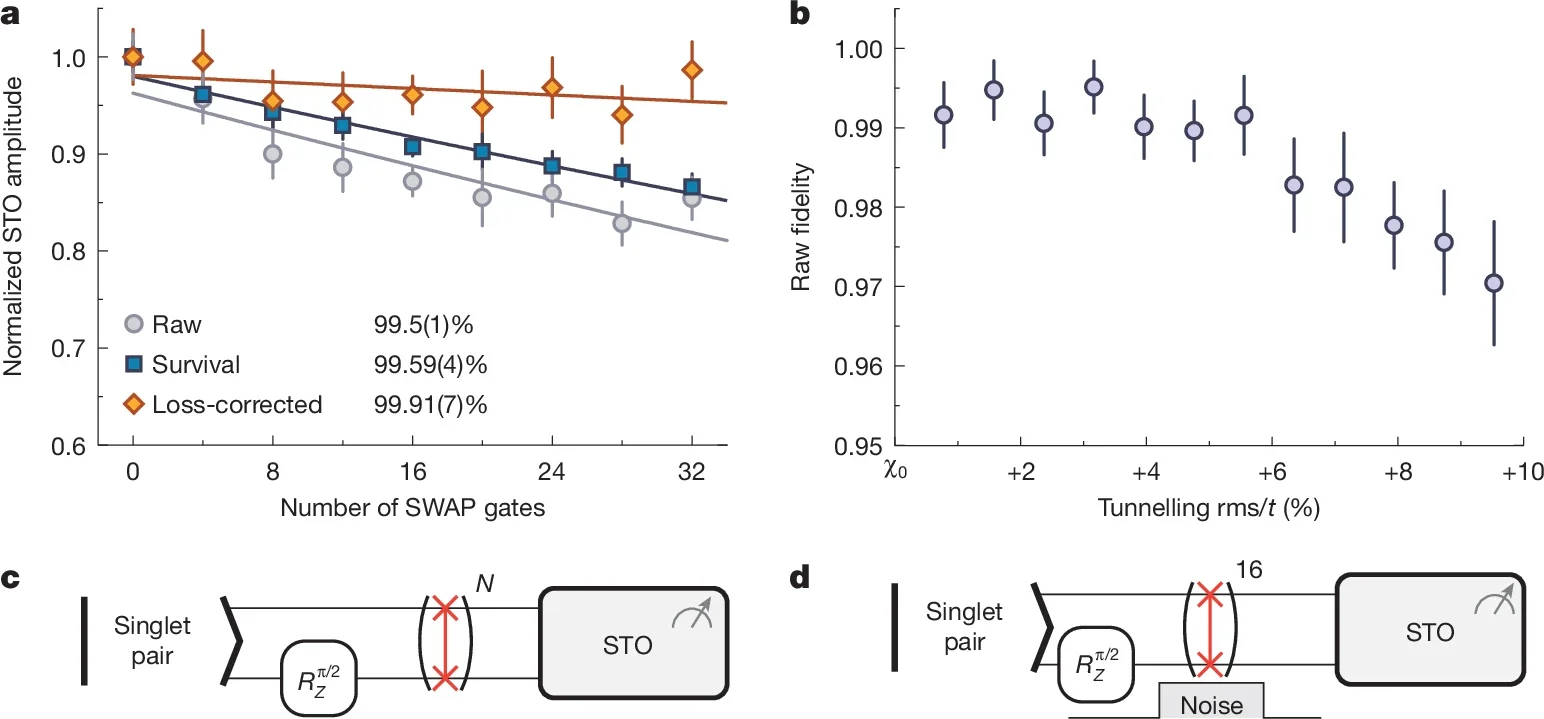
The gate completed its operation in less than one millisecond. Measurements showed a corrected fidelity of 99.91%, meaning the gate produced the correct result with extremely high reliability.
To verify the system, the team studied oscillations between quantum singlet and triplet states. After applying the swap gate, they observed the expected phase shift without losing oscillation strength. That confirmed the gate behaved exactly as predicted.
The team also tested how well the system resisted noise. They deliberately introduced fluctuations into the lattice potential and measured the resulting performance.
The gate remained stable even when significant tunneling noise was added. Only after the noise exceeded certain thresholds did the accuracy begin to fall sharply.
That robustness matters because noise remains one of the biggest obstacles in quantum computing. A gate that naturally resists disturbances could dramatically reduce future error-correction demands.
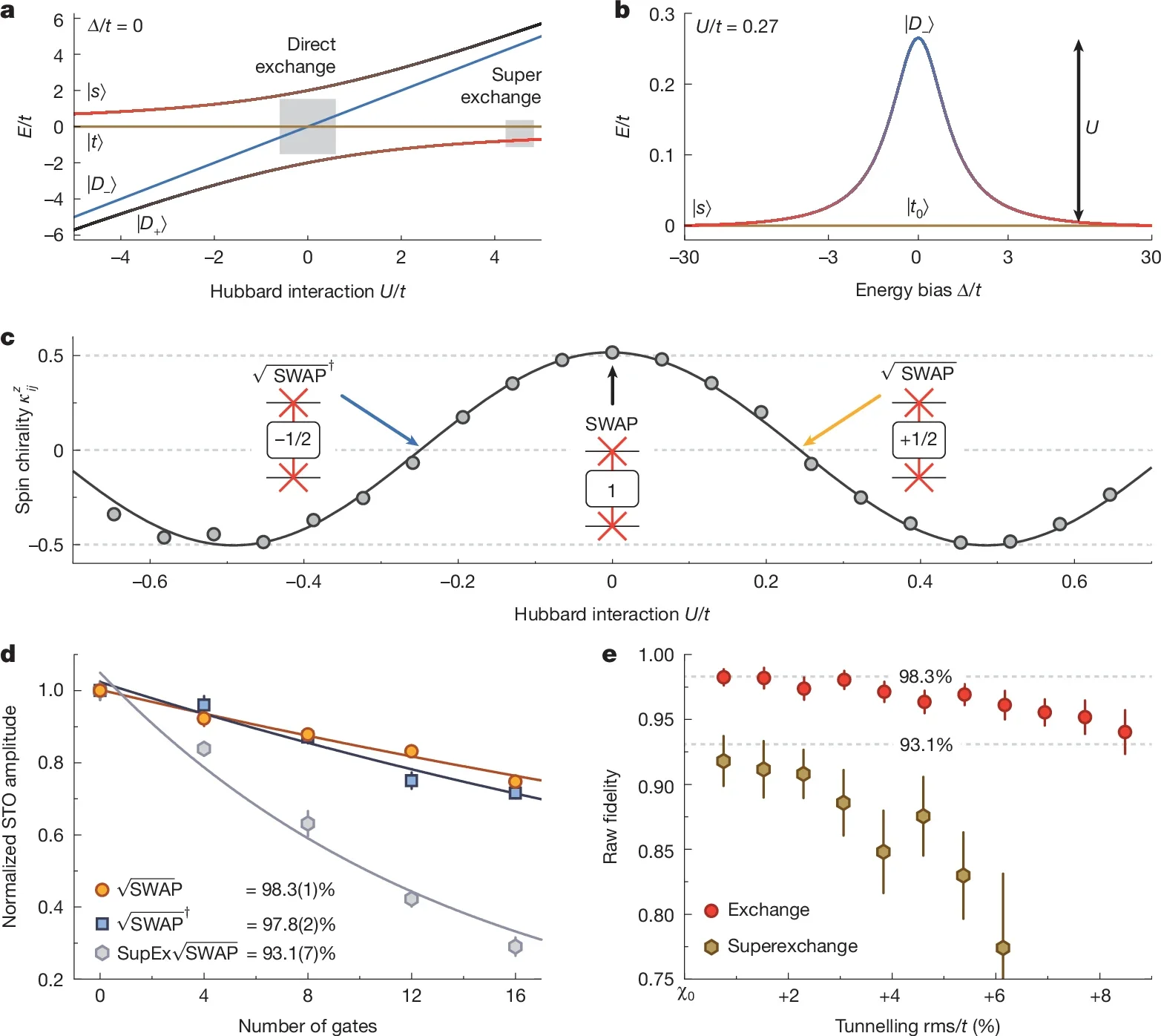
The researchers did not stop at ordinary swap operations. They also demonstrated “half-swap” gates by introducing controlled collisions between atoms.
These operations generate quantum entanglement, one of the most important resources in quantum computing. Entangled qubits become deeply connected, allowing changes to one qubit to affect another instantly across the system.
Without entanglement, quantum algorithms cannot outperform classical ones.
The team showed that these entangling operations also maintained high fidelities. In some cases, they significantly outperformed comparable methods based on superexchange interactions.
“We can now make lots of swap gates with neutral atoms,” said Tilman Esslinger. “But of course we still need a few other ingredients to build a working quantum computer.”
The researchers believe the next major step involves combining the swap gates with a quantum gas microscope. Such microscopes allow scientists to see and manipulate individual atoms directly.
That capability would make it possible to target specific qubit pairs rather than applying operations globally across the system.
The work may also influence other quantum platforms beyond neutral atoms. The underlying geometric principles could apply to semiconductor spin qubits and Rydberg atom arrays as well.
“This wonderful result underlines the strong collaboration between XRISM’s Japanese, European and American teams,” Matteo Guainazzi said in a separate context about international scientific partnerships. Although unrelated to this experiment directly, the broader message reflects a growing trend in physics: solving major scientific problems increasingly depends on global cooperation and advanced instrumentation.
For the ETH Zurich team, the achievement marks a major milestone. Instead of fighting against the strange rules of quantum mechanics, the researchers used those rules as a resource.
By harnessing symmetry, geometry and quantum statistics, they created a system that turns abstract mathematics into a practical tool for computation.
This research could help make future quantum computers more stable, scalable and efficient. High-fidelity swap gates are essential for moving information across large quantum processors. By creating gates that naturally resist noise, scientists may reduce the enormous burden of error correction that currently limits quantum hardware.
The ability to control more than 17,000 qubit pairs simultaneously also demonstrates that neutral atom systems can scale to very large sizes. That scalability could eventually support quantum machines capable of solving complex scientific, medical and engineering problems far beyond today’s computing power.
The geometric approach may also inspire new designs in other quantum platforms. Because geometric phases depend less on fragile timing and control details, they could improve reliability across many future quantum technologies.
Research findings are available online in the journal Nature.
The original story “ETH Zurich built an ultra-stable quantum gate across 17,000 qubit pairs” is published in The Brighter Side of News.
Like these kind of feel good stories? Get The Brighter Side of News’ newsletter.
The post ETH Zurich built an ultra-stable quantum gate across 17,000 qubit pairs appeared first on The Brighter Side of News.


Leave a comment
You must be logged in to post a comment.