Mars does not have Earth’s kind of magnetic shield, so it has often been treated as the solar system’s more exposed world. It is a planet left to take the sun’s blows with far less protection. But during a violent solar storm in December 2023, NASA’s MAVEN spacecraft caught Mars doing something scientists did not expect to see so clearly. Instead, it appeared to shove plasma aside inside its own atmosphere.
The observations offer the first direct evidence that a process called the Zwan-Wolf effect can happen within the ionosphere of an unmagnetized planet. Until now, that effect had largely been associated with places such as Earth’s magnetosphere. This is where a strong internal magnetic field helps redirect the solar wind before it can plunge too deeply toward the planet.
The new work, led by West Virginia University planetary scientist Christopher Fowler, shows that Mars can produce a similar response even without a global dipole magnetic field. Therefore, the finding broadens the picture of how space weather shapes worlds across the solar system, including Venus, Titan and comets.

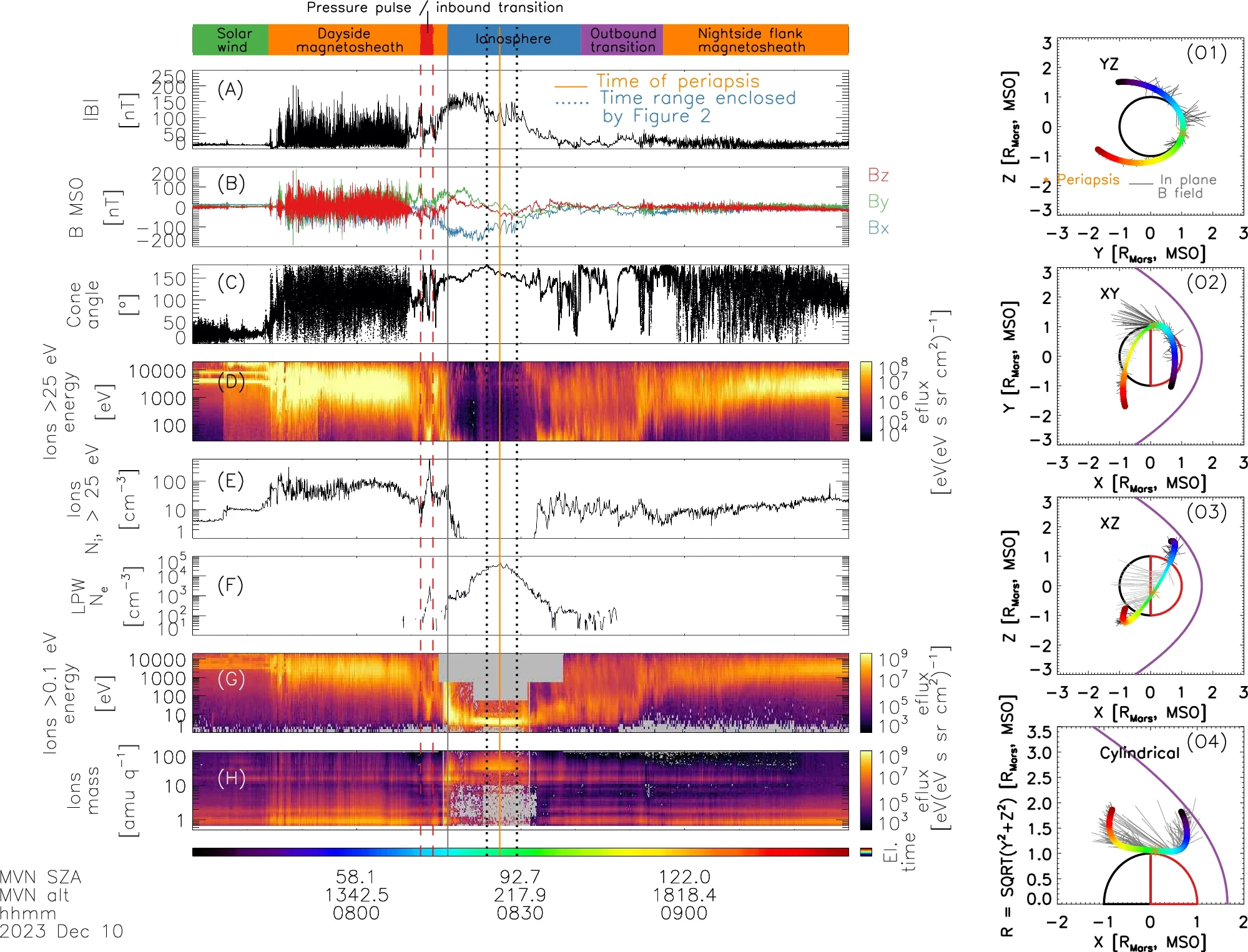
The key moment came after an interplanetary coronal mass ejection, or ICME, slammed into Mars on December 9, 2023. That eruption sent a disturbed cloud of solar plasma and magnetic fields racing through space. The Martian environment was left compressed and chaotic hours later when MAVEN sampled it on December 10.
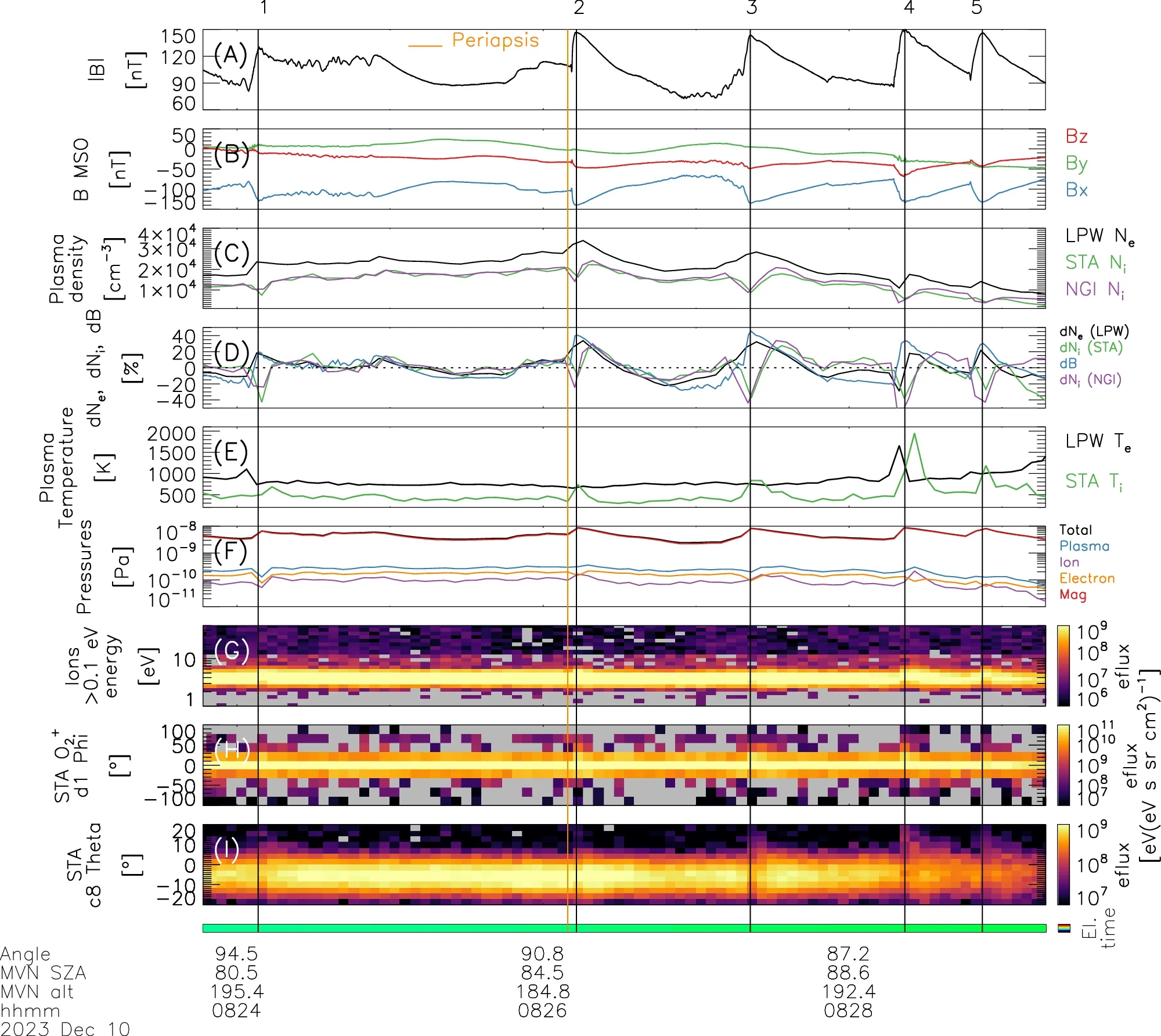
By then, the spacecraft was flying through a magnetosphere still recovering from the impact. The region around Mars was unusually dense, highly variable and magnetically disturbed. Near periapsis, when MAVEN dipped to about 185 kilometers above the surface near the terminator, it detected a series of large magnetic structures moving downward through the ionosphere.
Those structures stood out sharply. Their leading edges rose by about 50 nanotesla, roughly 40% of the already strong background magnetic field, then relaxed more gradually on the trailing side. Each sharp leading edge passed the spacecraft in about two seconds. This was followed by a slower recovery lasting roughly 30 to 60 seconds.
At the same moments, MAVEN saw something else. Ion density dropped by about 30% to 40%, while the plasma also shifted direction, flowing downward and tailward. The timing was hard to ignore. The strongest magnetic compression lined up with the local plasma depletion.
That is the pattern Fowler and his colleagues interpret as the Zwan-Wolf effect.
“When solar wind, the continuous flow of plasma emitted by the sun, encounters bodies such as planets and comets, it is deflected around them, much like the flow of water in a stream is deflected around a rock,” Fowler said.
But space, he noted, does not behave like water. “Because the water in that stream is relatively dense, physical collisions between water molecules bumping into each other and the rock determine how the water is diverted. In contrast, the environment in space is so tenuous that solar wind particles do not bump into each other. Instead, electromagnetic forces control how particles are deflected around these bodies.”
At Earth, the Zwan-Wolf effect happens when incoming magnetic flux tubes are compressed near the magnetopause, creating pressure gradients that squeeze plasma away from the stagnation region. The result is a local thinning of plasma density in front of the planet.
Mars was not expected to show the same thing in quite this way.
Scientists had already reported a depletion region between the Martian bow shock and ionosphere years ago, but the new MAVEN observations go further. They place the action within the ionosphere itself, not just in the space above it. The magnetic structures appear to have pushed ionospheric plasma tailward along draped magnetic field lines. This carved out temporary density depletions as they passed.
“The squeezing helps move the solar wind plasma around the planet, and it makes the plasma less dense in front of the planet,” Fowler said.
“By finding this effect in the atmosphere of Mars, we are discovering new ways in which our sun can interact with and affect planets in our solar system. It’s amazing to think that an eruption on the sun can disturb the atmosphere of Mars 142 million miles away.”
The team argues that Mars’ induced magnetosphere makes this possible. Even without a global magnetic field, the solar wind drapes magnetic field lines around the dayside of the planet. That draped geometry can produce pressure gradients similar in shape to those near Earth’s magnetopause. During quiet periods, the effect may still be there, just too weak for instruments to pick out. The 2023 solar storm appears to have amplified it enough to become visible.
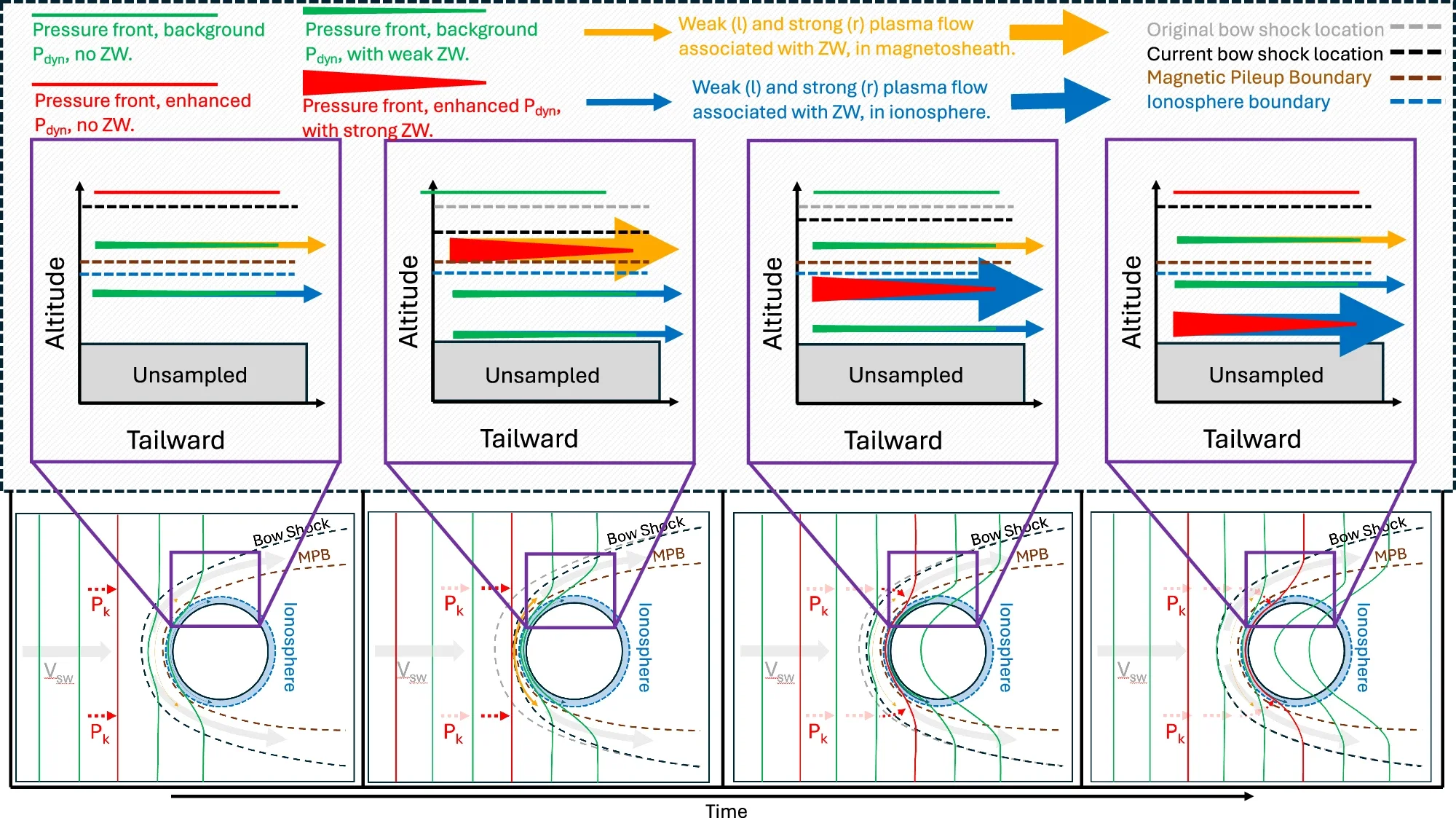
The paper suggests the magnetic structures were likely launched when dynamic pressure pulses in the disturbed magnetosheath struck the magnetic pileup boundary. This action converted pressure changes into magnetic compressions that then propagated downward into the ionosphere.
MAVEN observed the structures all the way to its lowest sampled altitude, implying the effect reached even deeper than the spacecraft could follow.
“We think this effect could occur in the Martian atmosphere all the time, but it’s usually such a small effect that our instruments aren’t sensitive enough to detect it,” Fowler said.
“The solar storm really hit Mars hard and disturbed the entire space environment around the planet. This seems to have amplified the Zwan-Wolf effect so that we could observe it during this time period. We got lucky, being in the right place at the right time with MAVEN to see this.”
The event also raised another question, what happened below MAVEN’s path. The researchers estimated that the energy carried by the structures was probably too small to strongly affect the neutral atmosphere. But ions are much less numerous, so the same energy could matter more for them. This is especially true if it was concentrated into part of the ion population.
That does not mean the event drove major atmospheric escape. The observed ion heating was modest, and the ions remained well below escape velocity at the altitudes sampled. Even so, the results suggest space weather can rearrange plasma inside the Martian ionosphere. These rearrangements can occur in ways that have not been documented before.
The study sharpens the picture of how solar eruptions affect planets that lack strong magnetic shields. That matters for Mars, where future robotic missions and eventual human exploration will depend on better forecasts of radiation and plasma disturbances. It also matters more broadly because Mars may not be unique.
Venus, Titan and comets could support similar behavior when strong solar wind pressure pulses hit them. The findings also show that important space weather effects can hide below normal detection limits until a major event exposes them.
In practical terms, that means models of planetary atmospheres and mission risk may need to account for subtle plasma processes. These processes only become obvious during extreme solar activity.
Research findings are available online in the journal Nature Communications.
The original story “Mars’ atmosphere is changing how scientists see unmagnetized planets” is published in The Brighter Side of News.
Like these kind of feel good stories? Get The Brighter Side of News’ newsletter.
The post Mars’ atmosphere is changing how scientists see unmagnetized planets appeared first on The Brighter Side of News.


Leave a comment
You must be logged in to post a comment.