A message from the future sounds like science fiction, until someone starts asking how many bits it could actually carry.
That is the question three physicists have now answered, using a setup inspired by Interstellar, where a father stranded near a black hole reaches back to his daughter across time. In the film, the scene plays as emotion and spectacle. In the new work, it becomes a communication problem with a hard limit, a noisy channel, and a precise mathematical answer.
Kaiyuan Ji of Cornell University worked on the analysis with collaborators at the Massachusetts Institute of Technology. Their paper, published in Physical Review Letters, asks what happens if information does not move forward in time as it normally does, but backward, through what physicists call a retrocausal channel.
The twist is that the channel is not assumed to be perfect. It can lose information, scramble it, or distort it, just as real communication channels do.
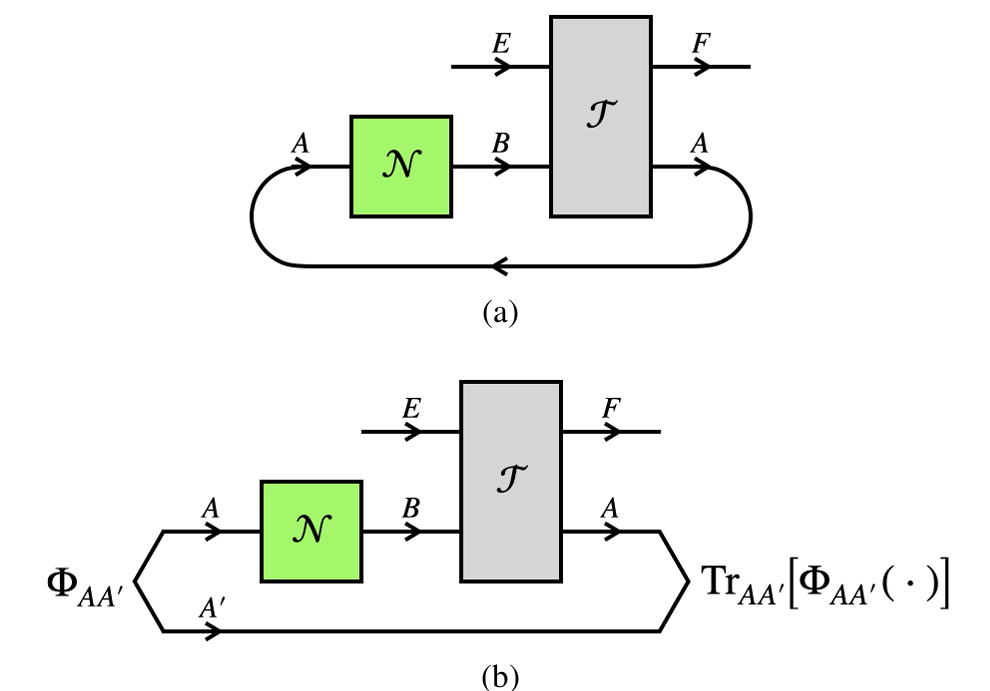
That matters because earlier work had mostly focused on ideal cases. A flawless backward-time channel can seem almost magical on paper, able to do things far beyond ordinary communication. But real systems are noisy, and noise is usually where bold ideas begin to break.
The new paper studies a model built around postselected closed timelike curves, or P-CTCs. In plain terms, that is a way to represent backward-in-time signaling within quantum mechanics without requiring anyone to physically bend spacetime in a laboratory.
The idea is not entirely abstract. Versions of P-CTCs can be simulated in quantum experiments using postselected teleportation, a method that has already been explored in the lab with entangled photons.
Still, the obvious problem comes first: paradox. If a person in the future sends a message to someone in the past, what stops the past from changing the future that sent it?
The authors handle that by allowing only self-consistent histories. A loop survives only if it closes neatly. Any message that would erase its own cause is filtered out by the mathematical structure of the model.
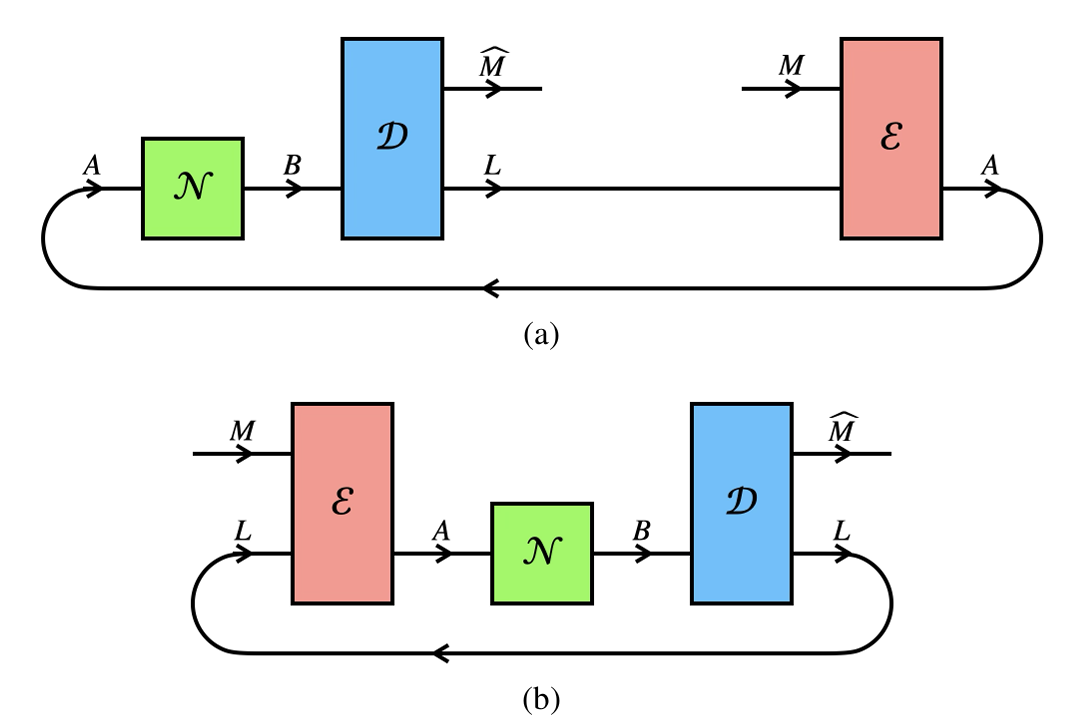
That is where the father-and-daughter framing becomes useful. The daughter, living in the past, decodes information and stores a record. Years later, the father retrieves that record and consults it before composing the message he sends back. The loop works only when the later action and earlier result agree.
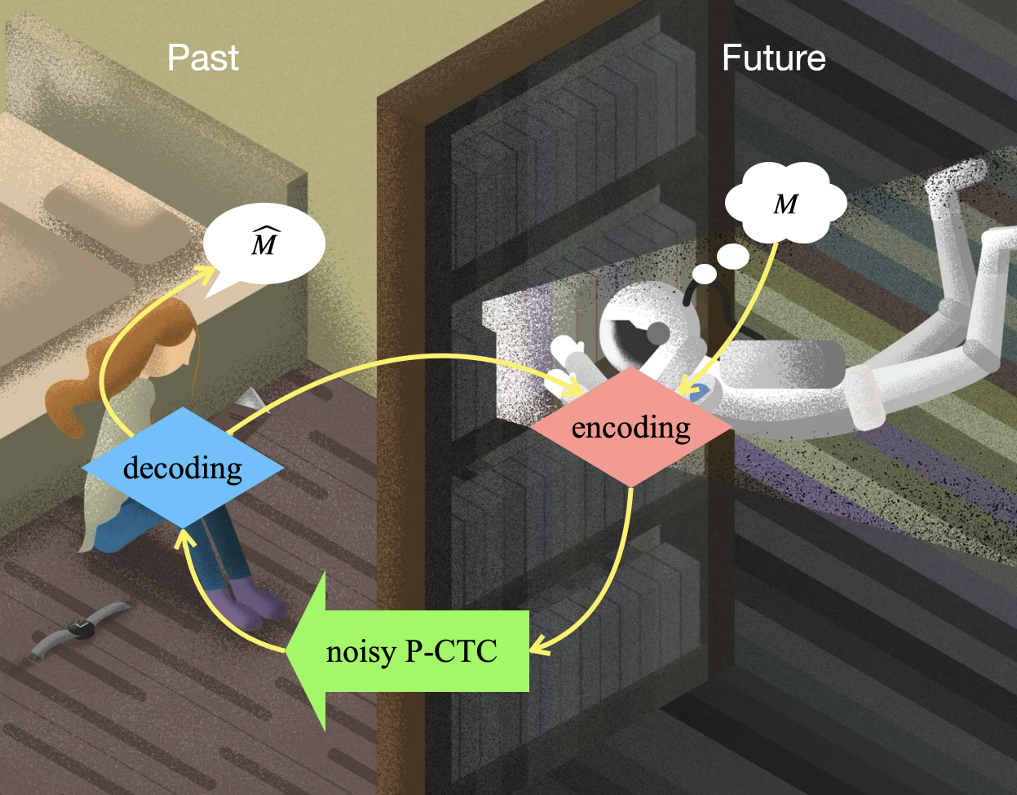
In ordinary communication, the sender comes first and the receiver comes later. Here, the order feels backward.
The daughter receives the output of the noisy backward-time channel and stores part of a linked quantum state in long-term memory. The father, years later, retrieves that stored state, performs a measurement that connects it to the message he wants to send, and feeds the result into the channel.
So the receiver effectively leaves behind a clue, and the sender later uses that clue to make the whole loop line up.
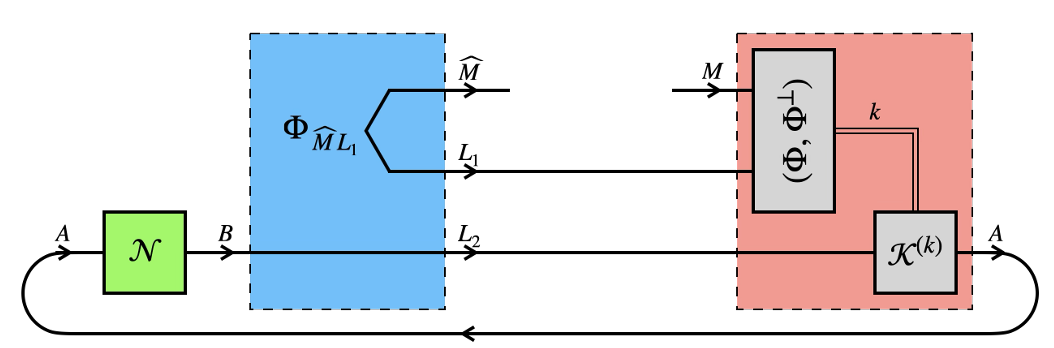
The authors call their scheme amplified probabilistic teleportation. Teleportation is the familiar quantum-information procedure in which a state can be transferred using entanglement and measurement. The “probabilistic” part matters because the desired outcome does not happen every time. The amplification is the new ingredient: by exploiting the causal loop, the setup boosts the chance that the message arrives intact.
Without that loop, the success probability would be far lower.
This is the central result of the paper. The team derives an exact formula for the retrocausal capacity of a noisy channel, meaning the maximum amount of information it can reliably send backward in time.
The formula depends on two quantities. One captures how well the channel can preserve information in the best case. The other captures how badly it can corrupt it in the worst case.
From those terms, the team obtains exact one-shot capacities for both quantum and classical messages, along with asymptotic limits for repeated uses of the channel. In practice, that means a researcher can take a realistic noisy channel, one that might lose photons or mix up quantum states, and calculate a concrete ceiling on backward communication.
That is a major change from the perfectly noiseless case, which the authors treat as an unrealistic ideal.
They also show that the same strategy is optimal in the one-shot setting. In their construction, the daughter stores quantum information in memory. The father later retrieves that memory, performs a Bell measurement, and then conditionally feeds a system into the noisy P-CTC. If the right outcome occurs, the daughter recovers the message perfectly. The nonlinear effect of the loop renormalizes the probabilities, making that favorable outcome much more likely than it would otherwise be.
The result gives an operational meaning to mathematical quantities known as max-information and Doeblin information. Those are technical terms from quantum information theory, but here they stop being abstract bookkeeping devices. They become the numbers that determine how much retrocausal communication a noisy channel can support.
The paper does not stop with time-travel thought experiments.
It ends by connecting the result to black holes, especially to final-state models of black-hole evaporation. One influential proposal, developed by Gary Horowitz and Juan Maldacena, treats black-hole evaporation as a kind of postselected teleportation. Seth Lloyd of MIT, a co-author of the new paper, has worked on related questions for years.
If those black-hole models are right, then the same math used to bound backward-time communication can also bound how much information escapes from an evaporating black hole.
That gives the new work a second life beyond its cinematic hook. The black hole information paradox, which has hung over theoretical physics for nearly half a century, asks whether information that falls into a black hole is truly destroyed. A precise capacity formula does not solve that paradox by itself, but it offers a sharper tool for probing which models preserve information and how much they can return.
In that sense, the study is less about science fiction than about accounting. It asks what the universe would permit under a strange but mathematically defined set of rules, then writes down the limit exactly.
The new result gives theorists a way to calculate how much information could survive in a backward-in-time quantum channel once noise is included, rather than relying on idealized cases. That makes comparisons between different retrocausal models far more concrete.
It also matters for black-hole theory. Because some evaporation models use the same postselected-teleportation structure, the capacity bound can serve as a test of how much information those models allow to escape.
For quantum information researchers, the work also sharpens the meaning of key channel measures and provides an explicit optimal strategy in the one-shot regime, something that is rare in quantum Shannon theory. Even if no real backward-time channel is ever built, the mathematics can still guide quantum experiments and help evaluate theories that use the same underlying structure.
Research findings are available online in the journal Physical Review Letters.
The original story “Sending short messages back in time may not break the laws of physics” is published in The Brighter Side of News.
Like these kind of feel good stories? Get The Brighter Side of News’ newsletter.
The post Sending short messages back in time may not break the laws of physics appeared first on The Brighter Side of News.


Leave a comment
You must be logged in to post a comment.