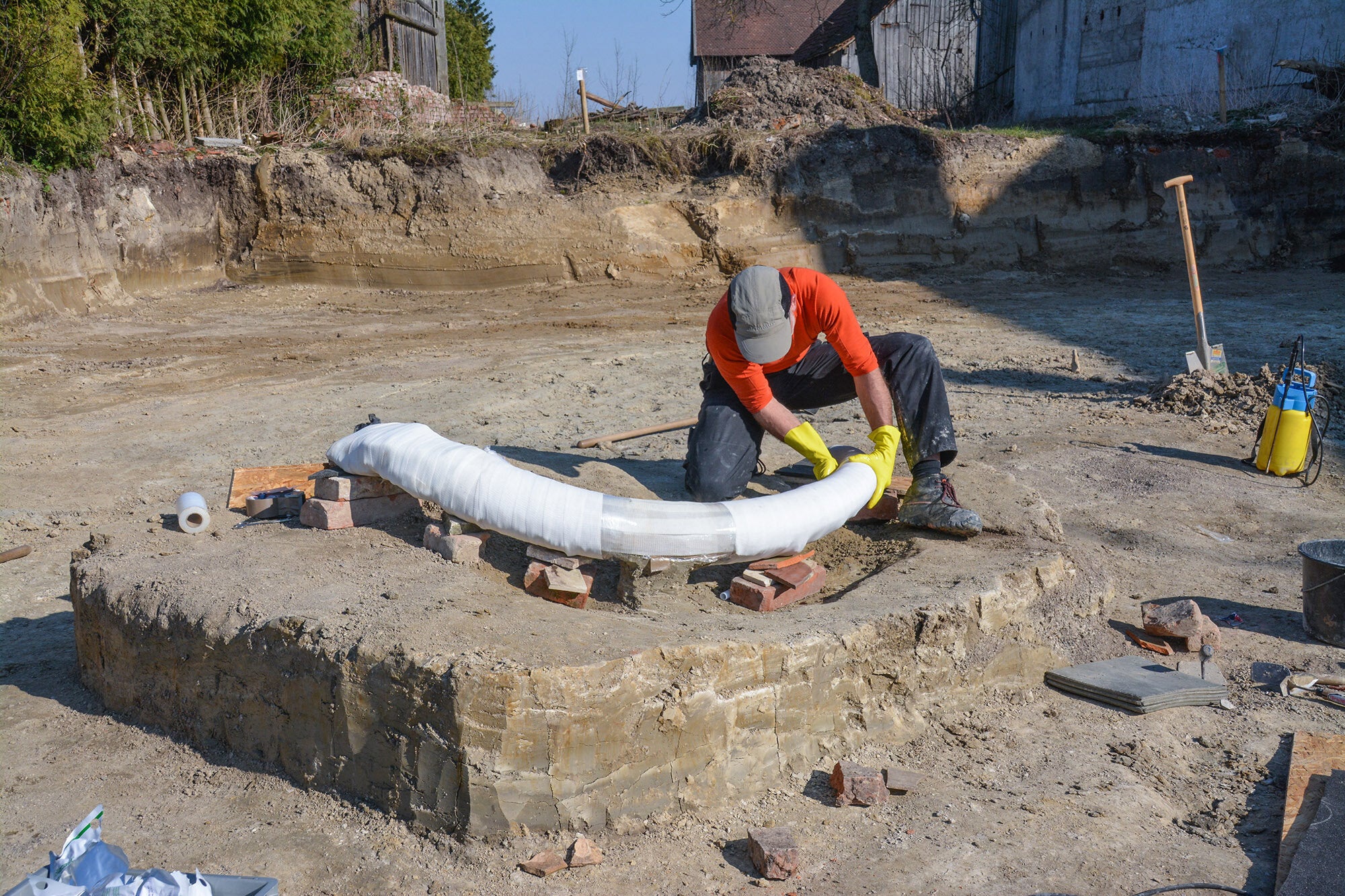
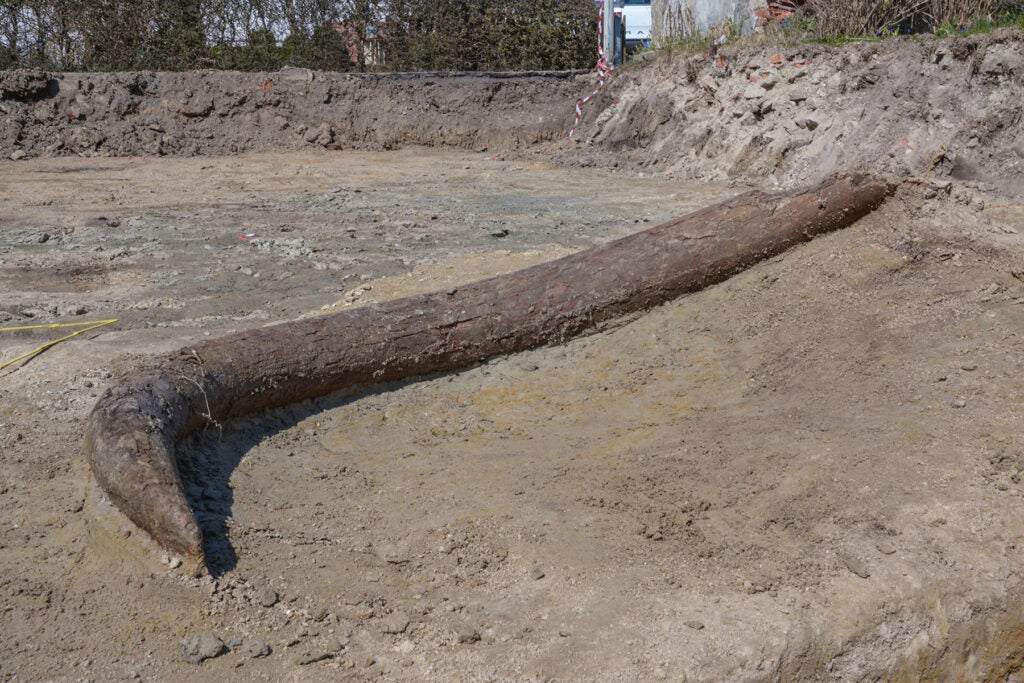
A woolly mammoth lay for thousands of years in wet ground near the Danube, its ribs, foot bones, and a nearly 2.5-meter tusk sealed in place until construction crews in Bavaria uncovered them by chance. What looked at first like a remarkable Ice Age fossil soon turned into something rarer. It became direct evidence that people handled the carcass during one of the coldest and harshest chapters of the last glacial period.
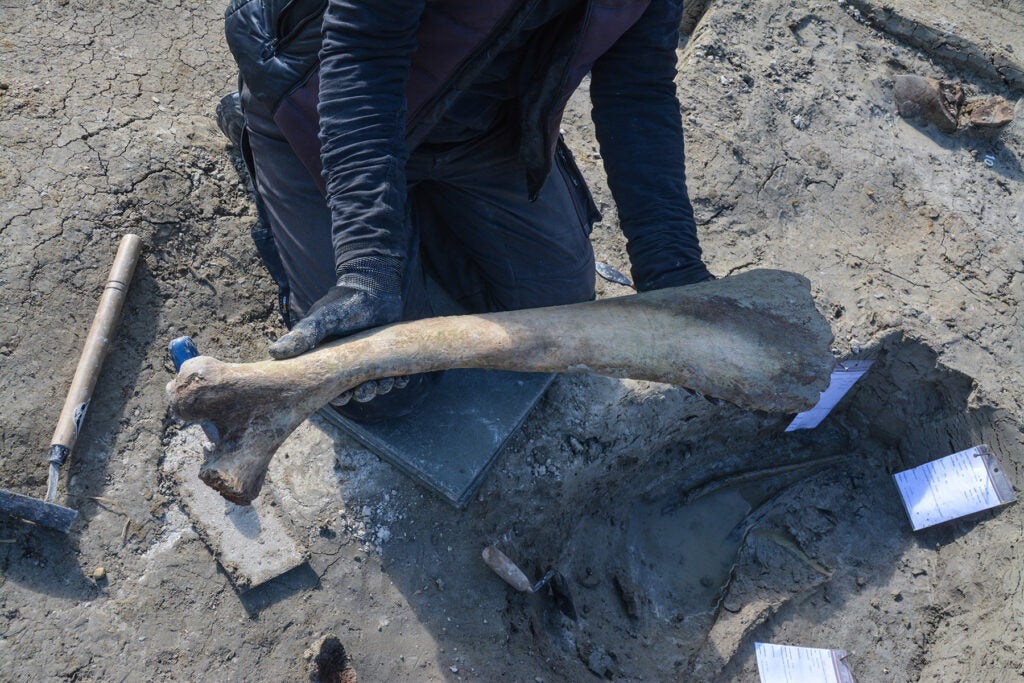
The partial skeleton was found at Taimering, near Regensburg in southern Germany, during excavations that had originally been aimed at medieval remains. Instead, workers and archaeologists recovered a large mammoth tusk and more than 70 bones and fragments. Most of them were ribs and bones from the hands and feet. The surfaces were preserved with unusual clarity because they had spent millennia in waterlogged sediments.
“The mammoth’s tusk and bones were exceptionally well-preserved due to their millennia-long conservation in the wet soil environment,” says Dr. Christoph Steinmann, deputy head of the Department of Archaeological Heritage Preservation for Lower Bavaria/Upper Palatinate at the BLfD.
That preservation mattered.
It allowed researchers to inspect the bones closely enough to distinguish old damage from fresh scratches, root marks, trampling, or excavation wear. What they found, especially on the ribs, points to deliberate cutting by people.
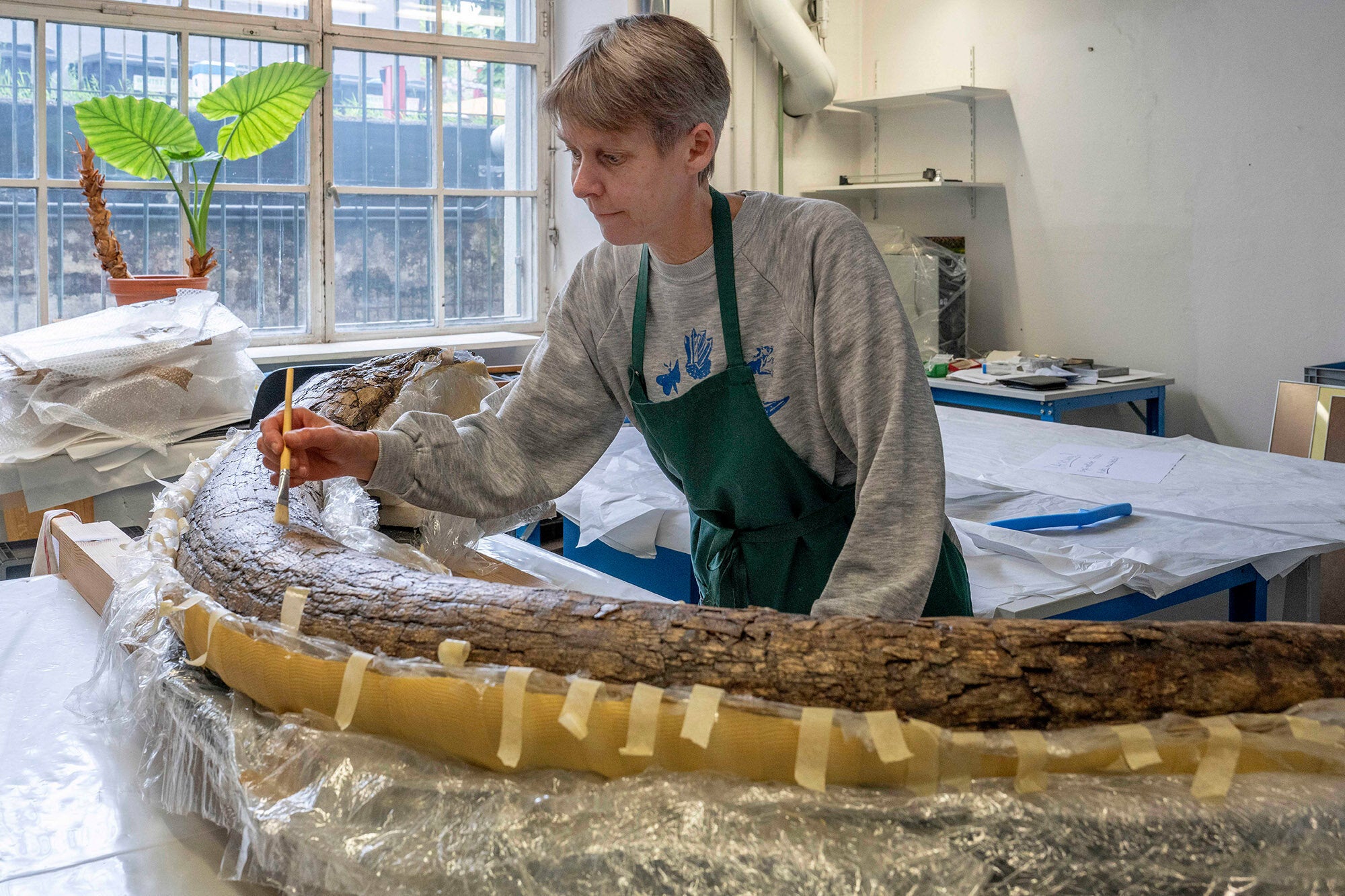
The animal itself was a single woolly mammoth, Mammuthus primigenius, a very large but not yet fully grown individual with an estimated shoulder height of about three meters. The bones and tusk all appear to belong to that one mammoth. Its remains were not dragged long distances by water.
There were also no signs that predators had pulled the carcass apart. The team concluded that the animal likely died at or near the spot where it was buried. It was in what was once a pond or a slow-moving side channel of the prehistoric Danube.
The most striking clues were etched into the ribs.
Researchers documented numerous grooves and incisions that matched known characteristics of cut marks made by tools. Many ran in roughly parallel lines. Some had V-shaped cross-sections. Others showed flaking at the edges and shoulder effects associated with repeated cutting motions. The marks were not scattered randomly across the skeleton. They were found only on the rib bones, and not on the joints.
That pattern matters because it fits butchery rather than natural damage.
Lead author Kerstin Pasda, who analyzed the modified bone surfaces, said the marks show that Palaeolithic hunter-gatherers processed the animal. One broad rib appears to have been used as a cutting board, with a concentrated patch of fine parallel cuts only about a millimeter long. The team could not determine whether people killed the mammoth or came upon it after it had already died. However, they are confident that humans butchered it.
No stone tools or settlement remains were found alongside the bones.
That absence leaves the case resting almost entirely on the marks themselves, but the authors argue that the evidence is strong. They compared the grooves against established criteria used to separate butchery marks from trampling damage. They concluded that the Taimering ribs preserve genuine anthropogenic traces.
Radiocarbon dating placed the bones in a narrow and important window near the height of the last glacial period. The most reliable dates came from one rib, which was tested multiple times in two different laboratories. Those results place the mammoth between about 26,900 and 25,300 calibrated years ago.
Some dates from a radius bone came out younger, but the researchers say those are less reliable because the bone had been treated with a conservation agent, likely skewing the radiocarbon results. For interpretation, they place greater weight on the rib dates.
That timing puts the Taimering mammoth in the late Gravettian, a period when human presence in much of Central Europe had sharply declined.
According to the study, populations across Western and Central Europe were shrinking as glaciers expanded and the climate worsened. In the region north of the Alps, evidence of human activity becomes sparse. In present-day Bavaria and nearby areas, many earlier populations seem to disappear from the record between about 29,000 and 25,000 years ago.
That is what makes Taimering stand out.
“First of all, mammoth skeletal remains are extremely rare in our latitudes. We are familiar with finds mainly from regions of Eurasia further to the east,” says PD Dr. Gertrud Rößner, a palaeontologist at the Bavarian State Collections of Natural History.
The site is also unusual because signs of human activity from this peak Ice Age interval are so scarce in the region. “Due to climate change, hunter-gatherer communities in Europe retreated southward and eastward,” add archaeology professors Andreas Maier of the University of Cologne and Thorsten Uthmeier of FAU Erlangen-Nürnberg.
Pollen recovered from the site helped reconstruct the landscape where the mammoth lived and died. The findings point to a treeless, tundra-like steppe with herbs and scattered dwarf shrubs. This was part of the vast “Mammoth Steppe” that once stretched across Eurasia between northern ice sheets and the glaciers farther south.
It was a harsh environment, but not an empty one.
Its grasses and shrubs supported large grazing animals, including mammoths. The Taimering animal seems to have been buried relatively quickly after death, which helps explain the excellent preservation of most of the skeleton. Only the ilium and tusk, found closer to the former ground surface, showed stronger weathering.
The researchers describe the discovery as one of the most recent signs of late Gravettian people with eastern connections in Bavaria before a settlement hiatus during the Last Glacial Maximum. They suggest these hunter-gatherers may have come from farther east, where mammoths were a more important resource. Nevertheless, no artifacts at the site allow a firmer cultural link.
So the bones do not tell the whole story. They do, however, fix a brief human presence in a place and time where almost no such traces survive.
That may be the most important part of the find. The Taimering mammoth is not just an Ice Age animal pulled from wet soil. It is evidence that, even as the climate worsened and populations thinned, people still moved through this cold edge of Europe. They cut meat from a mammoth’s ribs and left behind one small, stubborn record of their passage.
The Taimering mammoth adds a rare data point to a poorly documented period in Central Europe. It helps archaeologists map where people still moved during the late Gravettian and how close they came to a later settlement break.
It also shows how much information can survive on bone surfaces when preservation conditions are favorable.
Beyond the single animal, the site sharpens the picture of how Ice Age people used large mammals. It shows how thinly spread human activity had become in Bavaria. It also demonstrates how isolated finds can still reshape regional prehistory when dating, taphonomy, and microscopic surface analysis are combined carefully.
Research findings are available online in the Journal of Archaeological Science.
The original story “Wooly mammoths were likely butchered by hunters and gatherers, study finds” is published in The Brighter Side of News.
Like these kind of feel good stories? Get The Brighter Side of News’ newsletter.
The post Woolly mammoths were likely butchered by hunters and gatherers, study finds appeared first on The Brighter Side of News.


Leave a comment
You must be logged in to post a comment.