The Milky Way’s central black hole has long posed an awkward problem. By every standard picture of how black holes behave, Sagittarius A* should be blowing material back into space as it feeds. Yet for more than half a century, astronomers could not find clear evidence that it was doing so.
Now they say that missing wind has finally turned up.
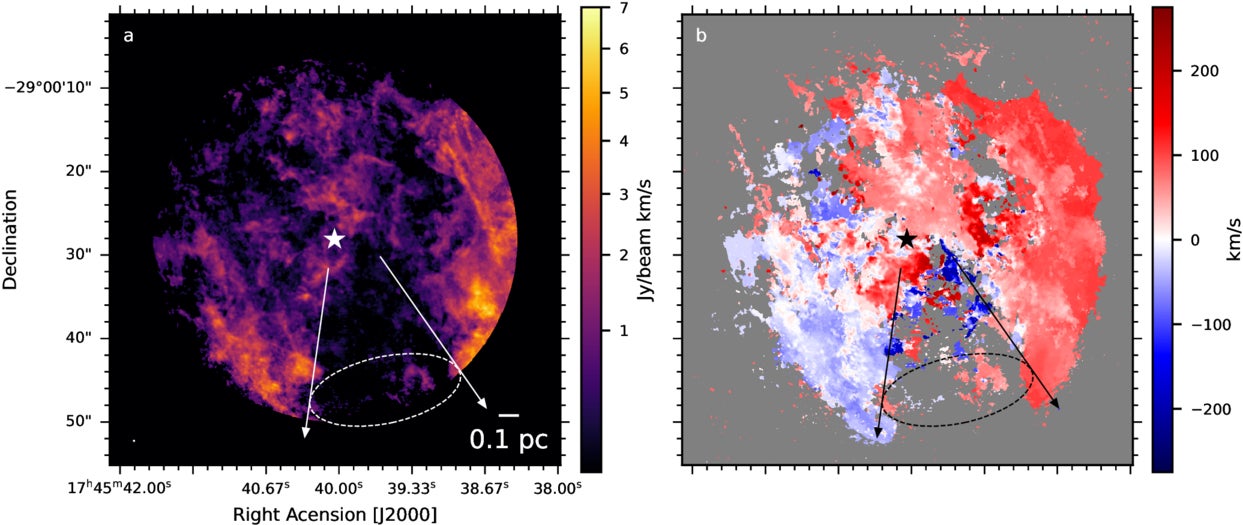
A team at Northwestern University used years of observations from the Atacama Large Millimeter/Submillimeter Array, or ALMA, in Chile to build an unusually sharp map of the cold gas crowding the black hole’s neighborhood. In that map, they found a broad, cone-shaped cavity carved out of molecular gas within about one parsec, or roughly three light-years, of Sagittarius A*.
The researchers argue that only a hot wind from the black hole can explain the feature. Therefore, this offers what they describe as the clearest evidence yet that the Milky Way’s central black hole is not an exception to the usual rules.
“Unless a black hole exists in a perfect vacuum, it must blow a wind somehow,” said Mark Gorski of Northwestern University, who co-led the study. “And there is no perfect vacuum in the universe. With new observations, this is the first time we’ve had a clean enough view to see the wind’s imprint. We looked at the data and said, ‘There it is. There is the thing that everybody’s been looking for for 50 years.’”
Black holes are known for pulling matter inward, but that is only part of the story. As gas falls toward a black hole, it heats up and releases enormous amounts of energy. Some of that energy can drive material back out in winds or, in more tightly focused cases, jets.
That broad picture has long suggested Sagittarius A* should produce some kind of outflow. Evidence of past activity on much larger scales has existed for years. The problem was finding a wind that appears to be active now, close to the black hole itself.
That has been especially hard in the center of the Milky Way, where astronomers must look through layers of gas, dust and ionized structures. “To observe our own black hole, we have to look through the plane of our galaxy,” said Elena Murchikova, who co-led the study with Gorski. “That means we have to peer through gas, dust and ionized structures, and you can’t really see through all of that easily.”
Using about five years of ALMA observations at around 230 gigahertz, the team built what it described as the deepest and highest-resolution map yet of cold molecular gas near Sagittarius A*. After subtracting the bright radio emission from the black hole itself, the researchers produced an image they say is 100 times deeper and 80 times sharper than earlier maps of the region.
What emerged was not an empty inner zone, as earlier views had often suggested. Instead, there was a dense and intricate pattern of cold gas structures extending deep into the central parsec. The most striking feature was a clearing in that gas, a cone roughly one parsec long with an opening angle of about 45 degrees.
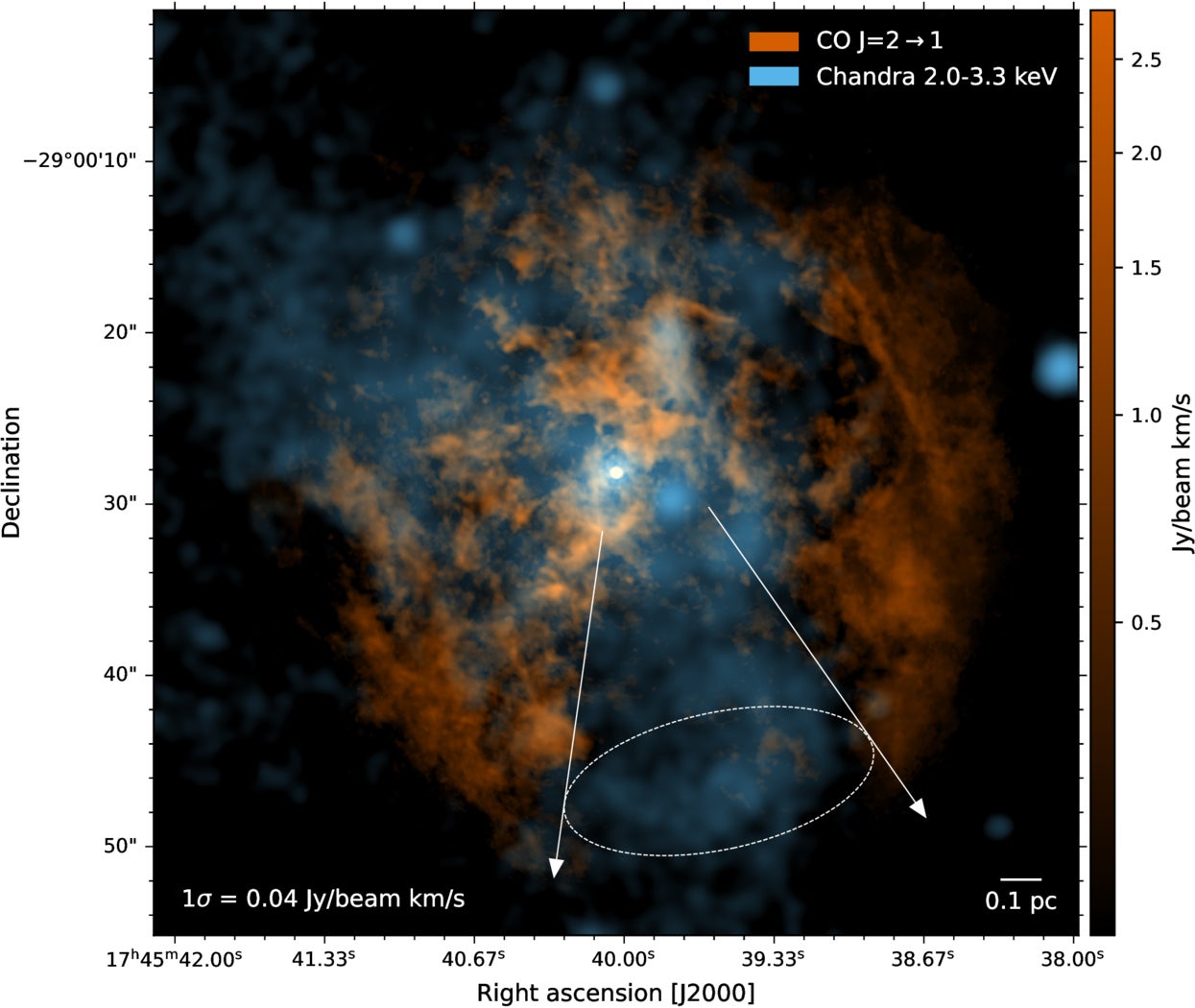
“If you blow hot material from the black hole, it’s not going to want to exist with the cold material,” Gorski said. “It’s either going to push the cold material out or heat it up. And, if it’s too hot, you will no longer see the cold gas.”
The team considered whether nearby stars could have produced the cavity instead. Massive stars do drive winds, and the Galactic center is packed with them. But the numbers did not work.
“It’s a huge absence of material,” Gorski said. “We calculated how much energy was needed to create this cavity. It is more than can be provided by the stars in that area. Basically, there has to be input from the supermassive black hole. And, if you follow the shape of the cone, it’s pointed directly at the black hole.”
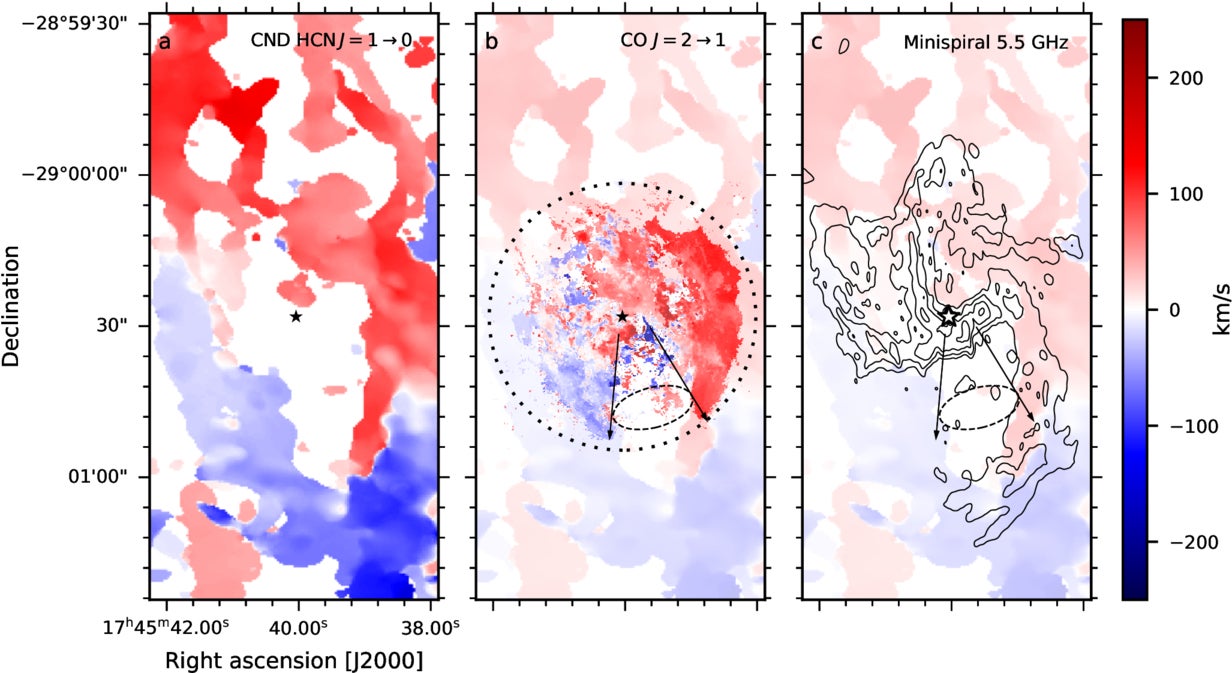
The researchers also looked for independent support. They found that earlier X-ray observations from NASA’s Chandra X-ray Observatory showed bright X-ray emission in the same area where the new ALMA map showed a hollow in the cold gas. That pairing matters because hot X-ray-emitting plasma and cold molecular gas are not expected to occupy the same space.
“Exceptional claims require exceptional evidence,” Gorski said. “We wanted to make sure that we weren’t just looking at some sort of imaging artifact. Then, the X-ray image from Chandra just slotted in perfectly. The molecular features lined up.”
Murchikova said the first reaction was caution, not celebration. “When you find something that no one has seen before, the first thought that runs through your mind is not ‘Oh my god, we made a discovery,’” she said. “It’s ‘Oh my god, what’s wrong with my analysis?’ But when we overlaid our image with the X-ray image, it started to make sense.”
The study also argues against other possible explanations, including stellar winds and a recent supernova. The cavity’s shape, scale and energy needs all point back to Sagittarius A*.
The wind does not appear especially powerful by the standards of actively feeding black holes in other galaxies. The team estimates a wind or jet power of about 10^37 to 10^38 ergs per second. That is enough to clear and heat nearby gas but still consistent with a black hole in a quiescent phase.
That quieter state may be exactly why this result matters.
“The majority of other galaxies spend most of their lives in a state where they are not particularly active,” Murchikova said. “But we can only see them when they are in a fireworks stage. It is very attractive to study black holes when they are in the fireworks stage, but that’s not actually their dominant state. Sgr A* finally gives us a window into the life of a black hole in this quiet state.”
The researchers estimate the wind has likely been active for at least 20,000 years, based on how far its effects appear to reach into nearby ionized gas. They also suggest the outflow may not keep a fixed direction. Because the gas around Sagittarius A* is uneven, a relatively weak wind can be bent or redirected as it pushes through the surrounding material.
That makes the Milky Way’s black hole look less like a cosmic exception. Instead, it appears more like a nearby example of a common phase in galactic life.
“We were the first to show that molecular gas very, very close to the black hole is feeding it,” Murchikova said. “The wind is not powerful, and its direction probably wanders with time. It shows that our black hole is not unique, and our place in the universe is not unique.”
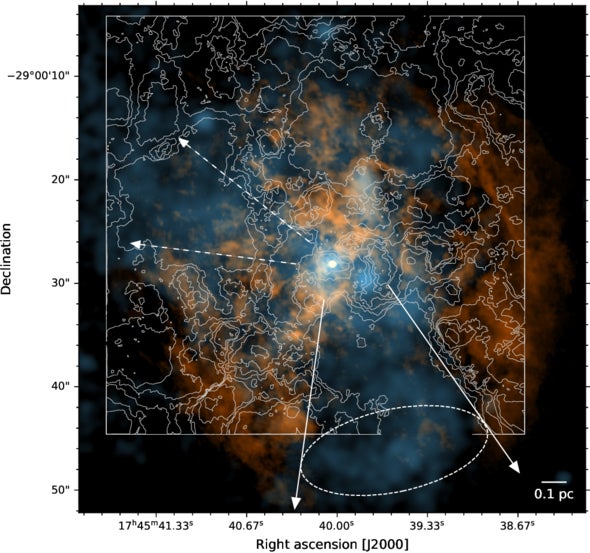
The findings give astronomers a clearer view of how a supermassive black hole can feed and still push back, even when it is not in a dramatic outburst phase. That matters because quiet black holes are thought to represent the dominant state of large galaxies over cosmic time.
By showing that Sagittarius A* is still shaping nearby gas through a weak, active wind, the study offers a closer look at the kind of slow, ongoing feedback that may influence many otherwise calm galaxies.
It also provides a new observational target for future work on how gas falls toward black holes. Moreover, it may inform how outflows heat or clear that gas, and how those two processes stay linked in the crowded centers of galaxies.
Research findings are available online in The Astrophysical Journal Letters.
The original story “Milky Way’s central black hole wind finally detected ending 50-year search” is published in The Brighter Side of News.
Like these kind of feel good stories? Get The Brighter Side of News’ newsletter.
The post Milky Way’s central black hole wind finally detected ending 50-year search appeared first on The Brighter Side of News.


Leave a comment
You must be logged in to post a comment.