Fern-like bodies once covered the seafloor, some stretching as tall as a person. Yet for millions of years, the animal world barely seemed to budge.
That long pause has puzzled paleontologists for decades. The first large animals appeared during the Ediacaran Period. Early communities changed slowly, despite the arrival of multicellular life after billions of years dominated by microbes. However, a new analysis argues that part of the answer lies in how those early animals reproduced. It also points to how that reproductive strategy kept competition low.
Researchers from the University of Cambridge say many of Earth’s earliest animals spread asexually, sending out connected clones by runner-like structures called stolons. In stable deep-water environments, that strategy worked well. But it also appears to have limited dispersal, softened competition, and slowed the pressures that usually drive evolution.
“Life was pretty nice during the Ediacaran, so the need for sex was rather limited,” said lead author Dr Emily Mitchell from Cambridge’s Department of Zoology. “There was relatively little competition, so there was no real pressure to change anything.”
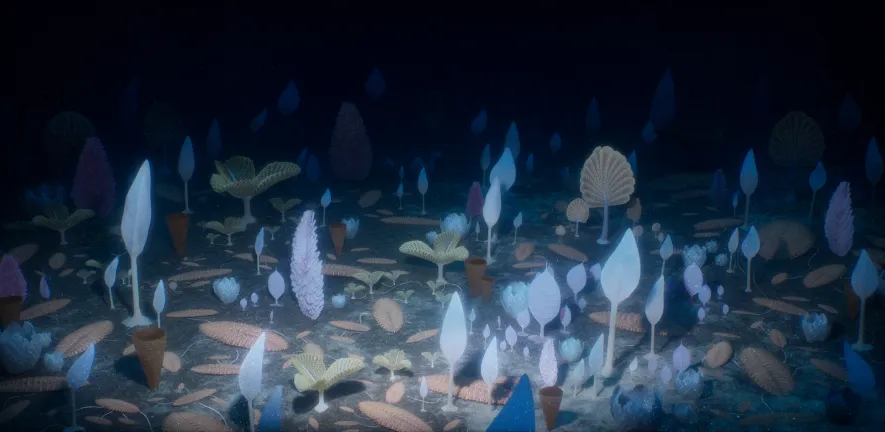
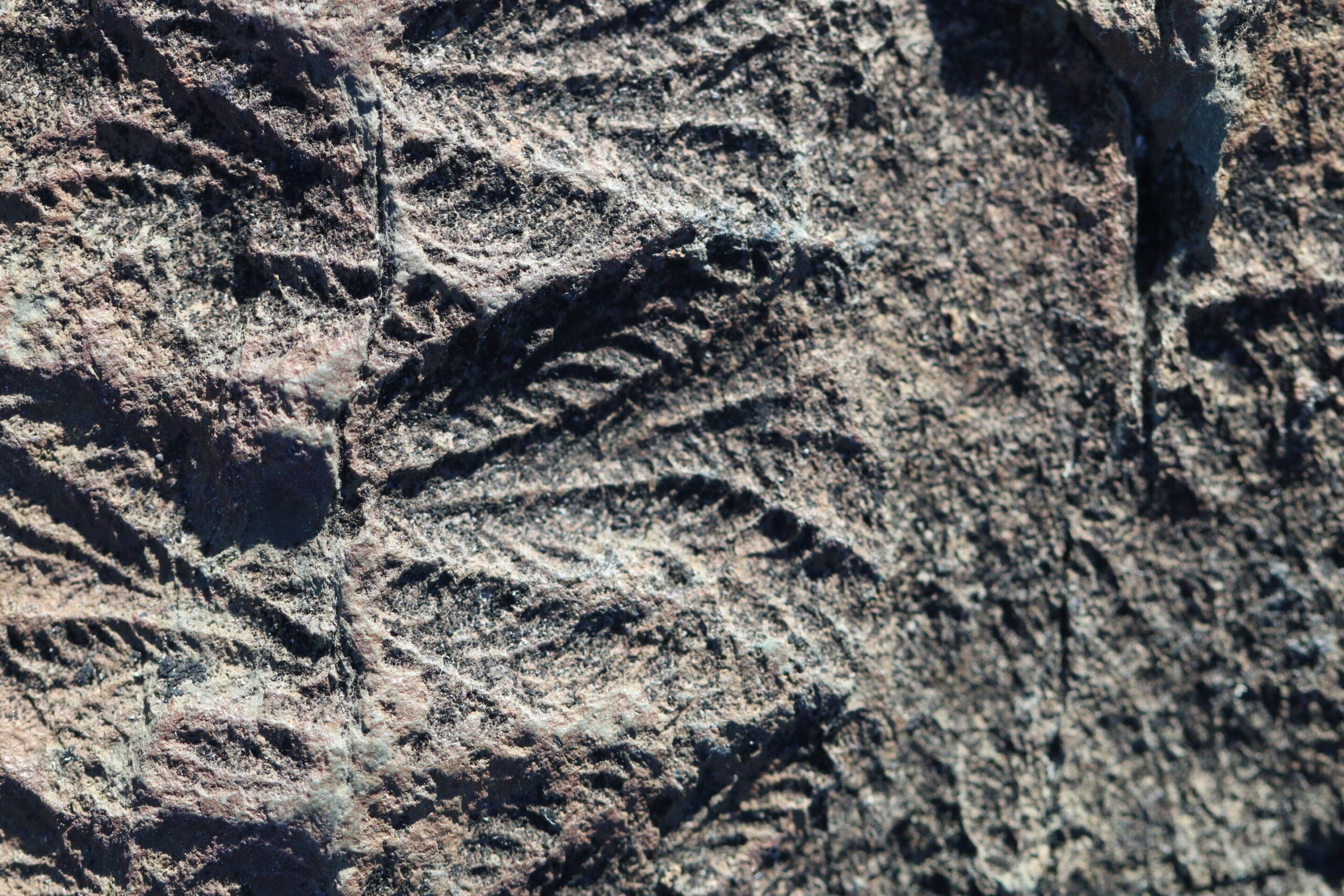
The study, published in Nature Ecology & Evolution, focuses on fossils from some of the oldest known animal communities, especially those preserved at Mistaken Point in Newfoundland. These organisms lived about 574 million years ago, during the Ediacaran, between 635 and 539 million years ago.
They did not look much like animals alive today. Many lacked mouths, organs, and any clear means of movement. Instead, they are thought to have absorbed nutrients directly from the surrounding water. Among them was Fractofusus, a form that could reach up to two metres tall. Still, many Ediacaran organisms were much smaller.
Earlier work had already suggested that some of these organisms reproduced asexually. Rather than releasing widely dispersed offspring, they produced connected clones, much like strawberry plants sending out runners. That mattered because the clones may have remained linked, sharing nutrients across a small network.
“If you’re connected to your neighbour by these runners, then you’re sharing nutrients and you don’t need to compete with them,” said co-author Professor Andrea Manica.
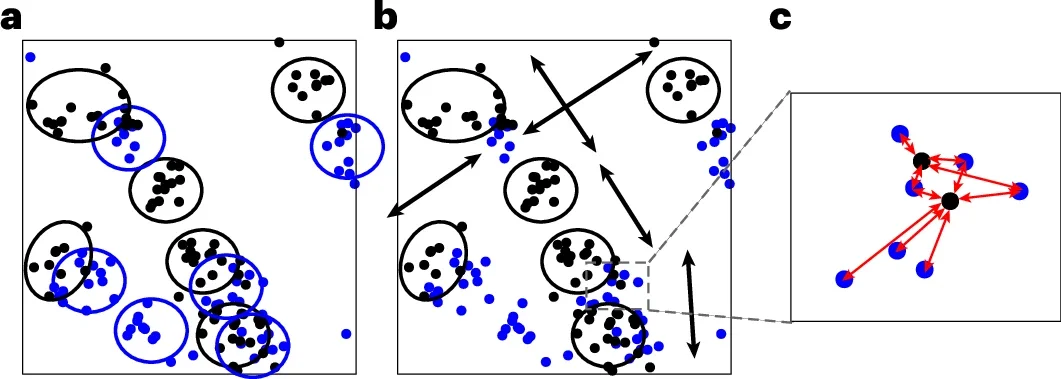
To test how much that reproductive mode shaped whole communities, the researchers combined laser scanning, spatial analysis, and artificial intelligence. They examined fossils from Mistaken Point and other Ediacaran sites in Newfoundland and Charnwood Forest in the United Kingdom. In this analysis, they looked at how individuals of the same species clustered and how different species were spaced relative to one another.
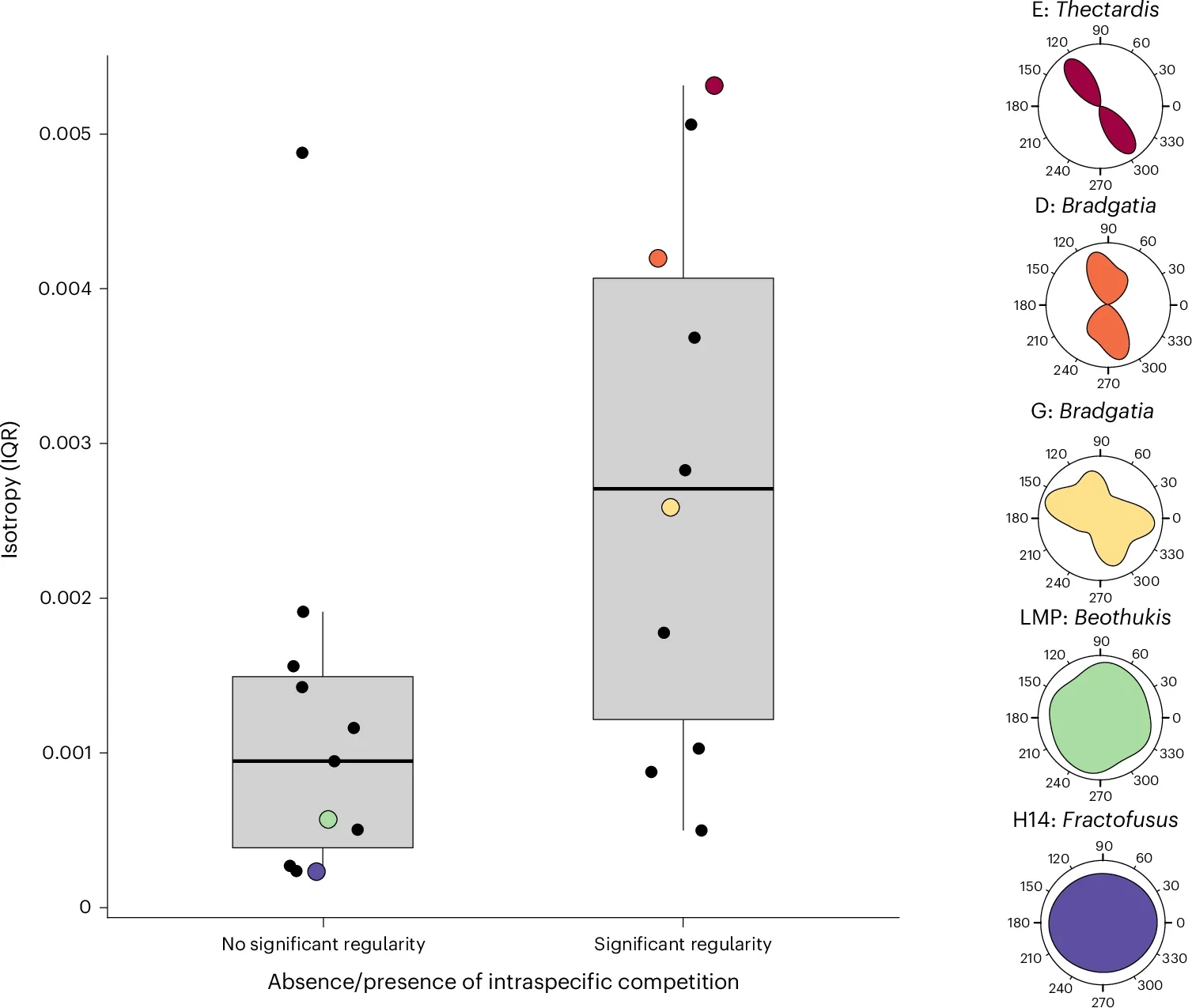
The team measured how circular or directional fossil clusters were. Rounder clusters pointed to stolon-based reproduction, because connected offspring would stay close to their parent rather than being swept away by currents. More elongated clusters would fit a more waterborne dispersal style.
They also tracked the strength of competition using spatial point process analyses, which can detect whether organisms are spaced in ways that suggest competition for resources rather than simple random placement. Across 21 populations on eight bedding planes, they found that stronger evidence of stolon-like reproduction was associated with weaker signs of intraspecific competition.
That result helps explain an unusual ecological pattern seen in these ancient communities, known as heteromyopia. In simple terms, competition between species sometimes appeared at smaller spatial scales than competition within a species. The authors argue that connected clonal networks offer the most likely explanation.
Modern seafloor communities are often highly competitive, with organisms jostling for food, space, or both. These Ediacaran communities were different. Competition existed, but it was often weak and patchy.
The new analysis suggests that connected reproduction could have buffered individuals against poor conditions. If one clone sat in a low-resource patch, it could still receive nutrients through its stolon links to a better-placed clone. That would reduce the need for individuals in the same clonal network to compete directly.
The researchers also weighed other possible explanations for the strange spatial patterns, including pathogens, predation, chemical interference, or strong niche segregation. They concluded those alternatives fit the fossil evidence less well. There is no evidence of macropredation in these communities until later in the Ediacaran. Furthermore, the expected spatial signatures of pathogens or chemical effects were not observed.
The broader consequence, the team argues, was evolutionary calm. When dispersal is tightly limited, weaker competitors can hang on beside stronger ones. That happens because the strongest forms cannot easily spread everywhere. As a result, that eases the pressure of natural selection and can hold diversity down.
The fossil record fits that picture. Avalonian communities, the oldest widespread animal communities from about 574 million to 560 million years ago, show relatively low diversity and slow change.
That did not last forever.
As Ediacaran life spread from deep, relatively stable settings into shallower waters, conditions became harsher. Tides, storms, shifting temperatures, and changing nutrient levels would have made survival less predictable.
“If you’re suddenly in an environment where you’re essentially getting killed a couple of times per year, then that changes everything,” said Mitchell. “Stress essentially leads to sexual reproduction, and when that happens, we can see a massive increase in dispersal distances as animals attempt to colonise new areas due to an increase in competition.”
To test whether wider dispersal could explain the later jump in diversity, the researchers built a mechanistic computer model covering the Avalon, White Sea, and Nama assemblages, three major groupings of Ediacaran fossil communities. They ran 10,000 simulations and used approximate Bayesian computation with a simple neural network. This process helped them find which scenarios best matched the diversity patterns seen in the fossil record.
The model reproduced the broad pattern paleontologists have long noted: low diversity in Avalon communities, a sharp increase in the White Sea assemblage, and then a more limited drop in the Nama. The inferred change in dispersal was a key part of that shift. If dispersal had not mattered, the model’s dispersal parameter should not have changed so clearly across those assemblages.
Instead, the results suggest that a move away from stolon-dominated reproduction, toward more waterborne and likely sexual reproduction, helped break the old ecological pattern. As a result, competition increased, selection pressure intensified, and diversification sped up.
That shift appears to have helped set the stage for the Cambrian, when animals became mobile and evolutionary change accelerated even further.
The study offers a new explanation for one of the biggest puzzles in early animal history: why complex life appeared, then seemed to evolve so slowly before diversification surged.
By tying reproductive mode to dispersal, competition, and selection pressure, the work suggests that evolution was not held back by a lack of life. Instead, it was held back by the ecological structure of the first animal communities.
It also shows how fossil spacing, not just fossil shape, can reveal how ancient ecosystems functioned and why major evolutionary transitions happened when they did.
Research findings are available online in the journal Nature Ecology & Evolution.
The original story “574 million-year-old fossils reveal a lack of sex delayed evolution for millions of years” is published in The Brighter Side of News.
Like these kind of feel good stories? Get The Brighter Side of News’ newsletter.
The post 574 million-year-old fossils reveal a lack of sex delayed evolution for millions of years appeared first on The Brighter Side of News.


Leave a comment
You must be logged in to post a comment.