Titan and Pluto sit at opposite ends of the solar system, one a giant moon wrapped in thick orange haze. The other is a frozen dwarf planet at the edge of sunlight. Yet new telescope data suggest they may share a chemical clue that no one can yet explain.
Using observations from the James Webb Space Telescope, a team of scientists found an unusual absorption feature at 5.11 micrometers in spectra from both worlds. The signal appears in data from Titan and Pluto at essentially the same wavelength. However, it does not match any known spectral fingerprint the team could find in published studies or laboratory databases.
That leaves researchers with a puzzle. Something on the surfaces of both bodies seems to be absorbing infrared light in the same narrow part of the spectrum. This hints at a shared chemical pathway in two places that look very different at first glance.
Titan, Saturn’s largest moon, has rivers, lakes, dune fields and a dense nitrogen-rich atmosphere loaded with methane. Pluto is far colder, much smaller, and carries an atmosphere so thin it barely compares. Even so, both worlds have nitrogen-dominated atmospheres with methane. Both worlds develop thick organic hazes as sunlight drives chemistry high above their surfaces.
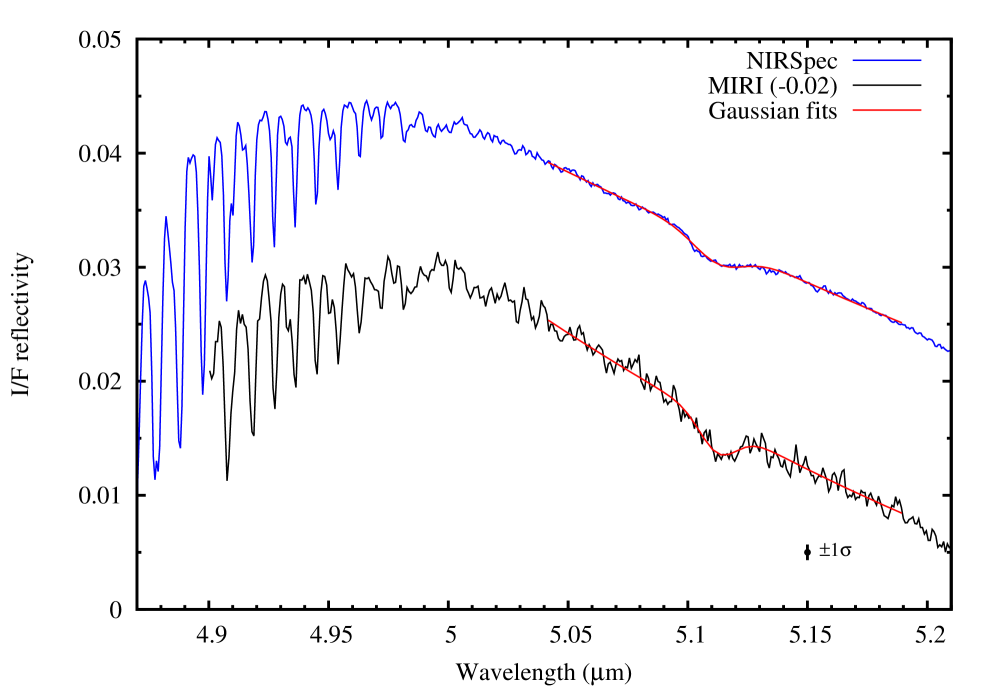
The newly reported feature turned up in a part of the infrared spectrum that gives researchers one of their best chances to peer through Titan’s atmosphere and glimpse the surface below. The team analyzed Titan data from JWST’s Near Infrared Spectrograph, collected on November 4, 2022. They also analyzed data from the Mid Infrared Instrument, gathered on July 11, 2023.
In both sets, they saw the same absorption centered near 5.1126 micrometers.
That mattered for a simple reason. A spectral blip that appears in one instrument might be a glitch. A feature that appears in two separate instruments, taken months apart, is much harder to dismiss.
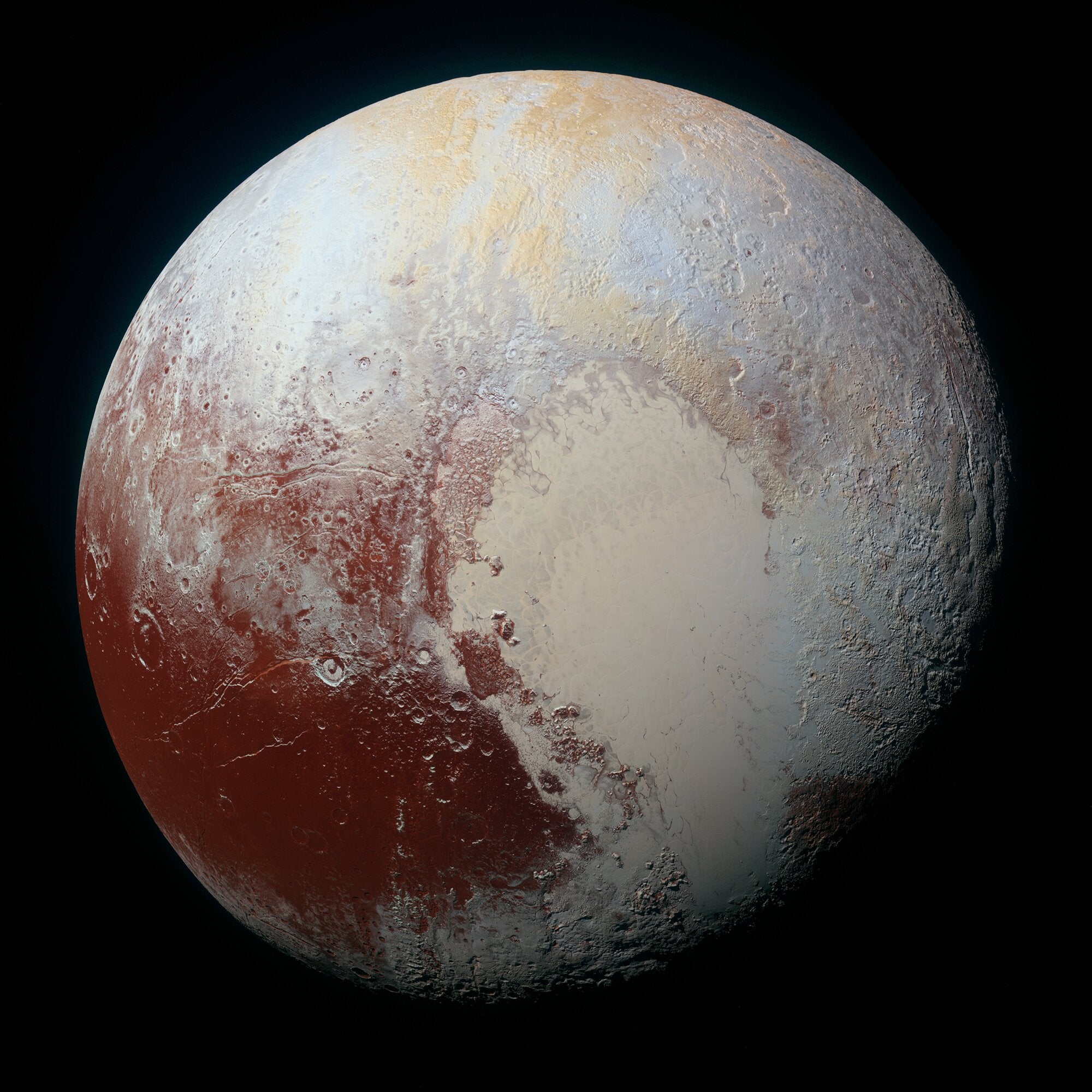
The same kind of dip also appeared in Pluto data from JWST’s Mid Infrared Instrument, collected on May 4, 2023. There, the signal was centered at 5.1128 micrometers, essentially the same position within the error bars.
The Pluto feature, however, looked different in one important way. It was much broader, about three times wider than the one seen on Titan.
The team fit the features with Gaussian profiles and found that Titan’s signal in the higher-quality NIRSpec data had a full width at half maximum of 0.0241 micrometers. Pluto’s measured 0.069 micrometers. The equivalent width on Pluto was also about twice that estimated for Titan’s surface.
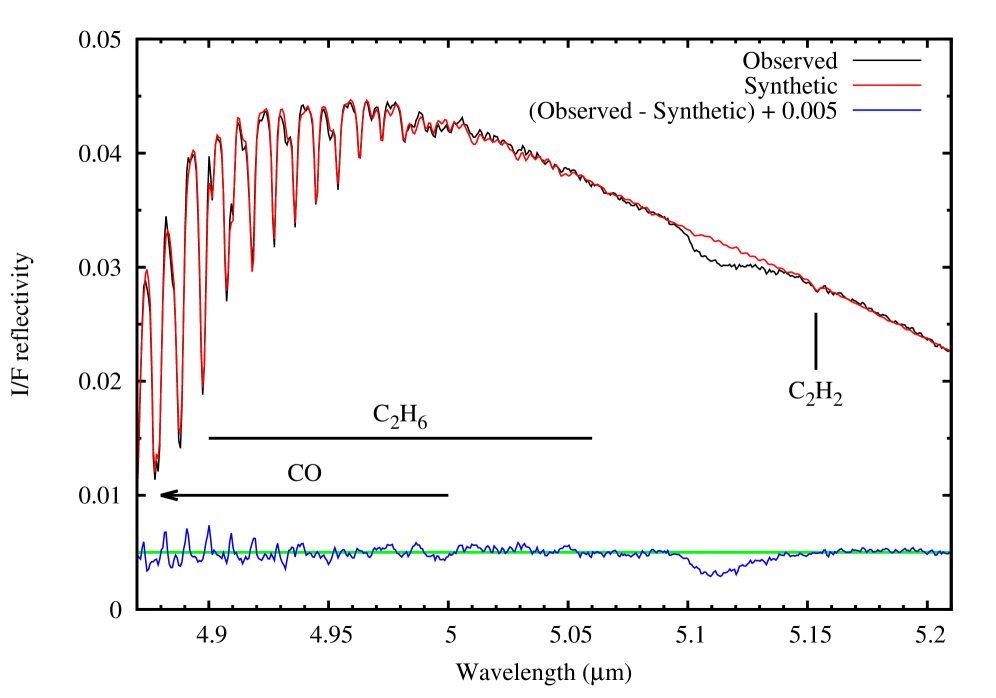
On Titan, the researchers tested whether the 5.11-micrometer feature could be produced by atmospheric gases. Their radiative transfer model included methane, carbon monoxide, ethane, acetylene, ethylene, haze effects and other known contributors. It reproduced subtle atmospheric features elsewhere in the same spectral region, but not the mysterious dip at 5.11 micrometers.
That mismatch pushed the team toward a different explanation: the signal most likely comes from the surface.
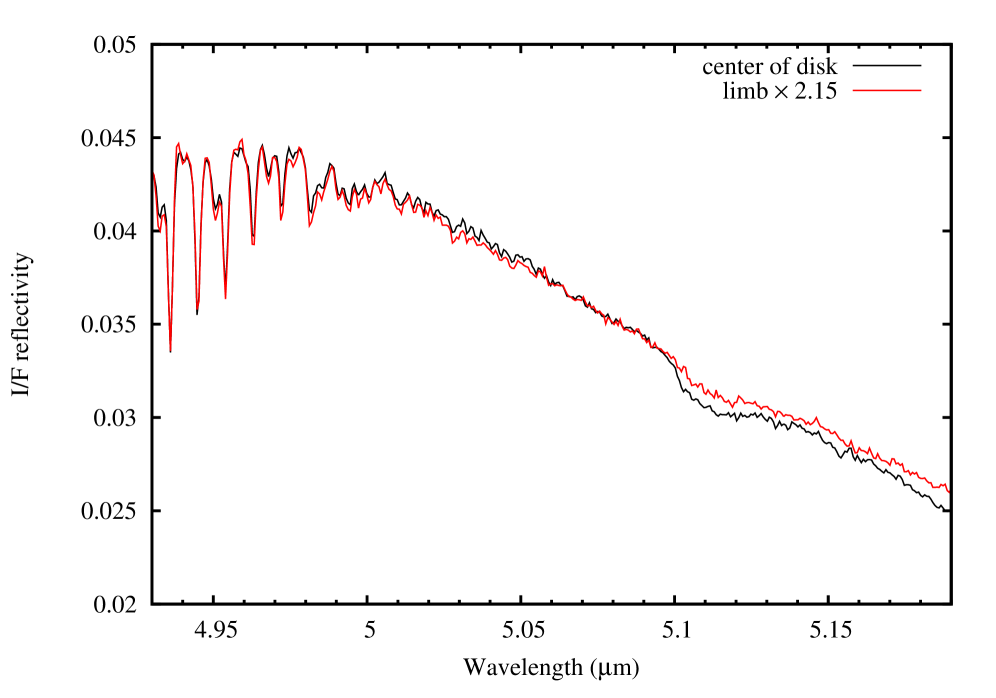
A second clue came from where the feature looked strongest. When the scientists compared spectra from Titan’s disk center with spectra closer to the limb, the 5.11-micrometer absorption weakened relative to the continuum. Meanwhile, weak carbon monoxide lines behaved differently. That pattern fits a surface origin better than an atmospheric one. If the feature came from the main haze, it should have looked stronger toward the limb, not weaker.
Pluto offers another piece of supporting evidence. Its atmosphere is much thinner, making it easier to detect surface signatures. The fact that the same feature shows up there as well strengthens the case that both signals are tied to surface materials rather than atmospheric gases.
The hard part is naming the culprit.
The researchers searched the literature for likely candidates among compounds already known or suspected on Titan and Pluto, including various ices, nitriles and hydrocarbons. They also checked laboratory spectra of tholins made from nitrogen-methane mixtures. However, they found no reported band that landed where the observed feature does.
“We did not find any band referenced in these publications that corresponds to the location of the observed absorption in Titan and Pluto. However, a signature may shift if the compound is mixed with other species.”
That caveat keeps a few possibilities alive.
One is acetylene ice, or C2H2, which has a weak band fairly close to the observed wavelength. But the match is imperfect, and other expected acetylene features do not line up cleanly, especially in Pluto’s spectrum. Benzene is another possibility, particularly if it is mixed with other compounds rather than sitting in a pure crystalline form. The team also points to the broader family of allenes, molecules built around a C=C=C pattern, because that group is one of the few organic classes known to produce strong absorption in this general range.
Ketene and a weak band seen in irradiated methanol residues also get brief consideration, though neither offers a simple fit.
In the end, none of the candidates fully solves the problem.
The width difference between Titan and Pluto may turn out to be one of the most useful clues. The paper argues that ordinary factors such as grain size or large-scale mixing are unlikely to explain why Pluto’s feature is so much broader.
Temperature alone does not help much either. In icy materials, bands usually broaden as temperature rises, but Pluto is colder than Titan.
Instead, the team suggests the answer may lie in the physical state of the molecules and the diversity of their molecular surroundings. If the same species sits in different mixtures, cluster sizes, or irradiation environments, its spectral signature can shift and broaden. Pluto’s surface may offer exactly that kind of more varied molecular environment.
Both worlds are exposed to energetic particles over long timescales, but in different ways. Titan’s surface chemistry is influenced mainly by secondary electrons generated by galactic cosmic rays in the atmosphere. Pluto’s much thinner atmosphere allows galactic cosmic ray ions to penetrate the surface directly. This can potentially alter materials down to depths of centimeters or more. Those processes can break bonds, create radicals, form new molecules and change the structure of ices.
The authors write, “A more likely mechanism is related to the physical state of the molecular species involved, and more specifically to the diversity of its environment at the molecular scale.”
The finding gives planetary scientists a new target to chase as they try to understand how complex chemistry unfolds on cold, nitrogen-methane worlds.
On Titan, better mapping of the 5.11-micrometer feature across the surface could show whether it tracks with dunes, icy crust, lake regions or other terrain. This would narrow the list of possible compounds.
More laboratory work will also be crucial, especially measurements of candidate molecules in realistic mixtures instead of pure samples. The mystery may remain unresolved for now. Nevertheless, it offers a rare shared clue between Titan and Pluto, and a new way to test how radiation, ice chemistry and local environment shape the surfaces of distant worlds.
NASA’s Dragonfly mission, expected to reach Titan in the mid-2030s, may help identify some possible surface molecules directly. Even though it will not be able to observe the 5.11-micrometer feature itself, this mission could still provide valuable clues.
Research findings are available online in the journal arXiv.
The original story “JWST spots the same unexplained chemical signal on Titan and Pluto” is published in The Brighter Side of News.
Like these kind of feel good stories? Get The Brighter Side of News’ newsletter.
The post JWST spots the same unexplained chemical signal on Titan and Pluto appeared first on The Brighter Side of News.


Leave a comment
You must be logged in to post a comment.