Ganymede’s auroras have always stood apart for one simple reason: this is a moon, not a planet, and yet it carries its own magnetic field. Now, close-range observations from NASA’s Juno spacecraft have revealed something even more surprising. The team saw bright auroral patches that closely resemble the bead-like structures seen in Earth’s polar skies.
That similarity matters because those beads on Earth are tied to violent magnetic disruptions that release large amounts of energy. On Ganymede, the finding suggests the same basic physics may be at work far from home. This would occur in a vastly different environment shaped not by the solar wind alone but by Jupiter’s immense magnetosphere.
The results come from an international team led by researchers at the University of Liège’s Laboratory of Atmospheric and Planetary Physics. Their analysis, published in Astronomy & Astrophysics, is based on ultraviolet observations gathered during Juno’s June 7, 2021, flyby of the Jovian moon.
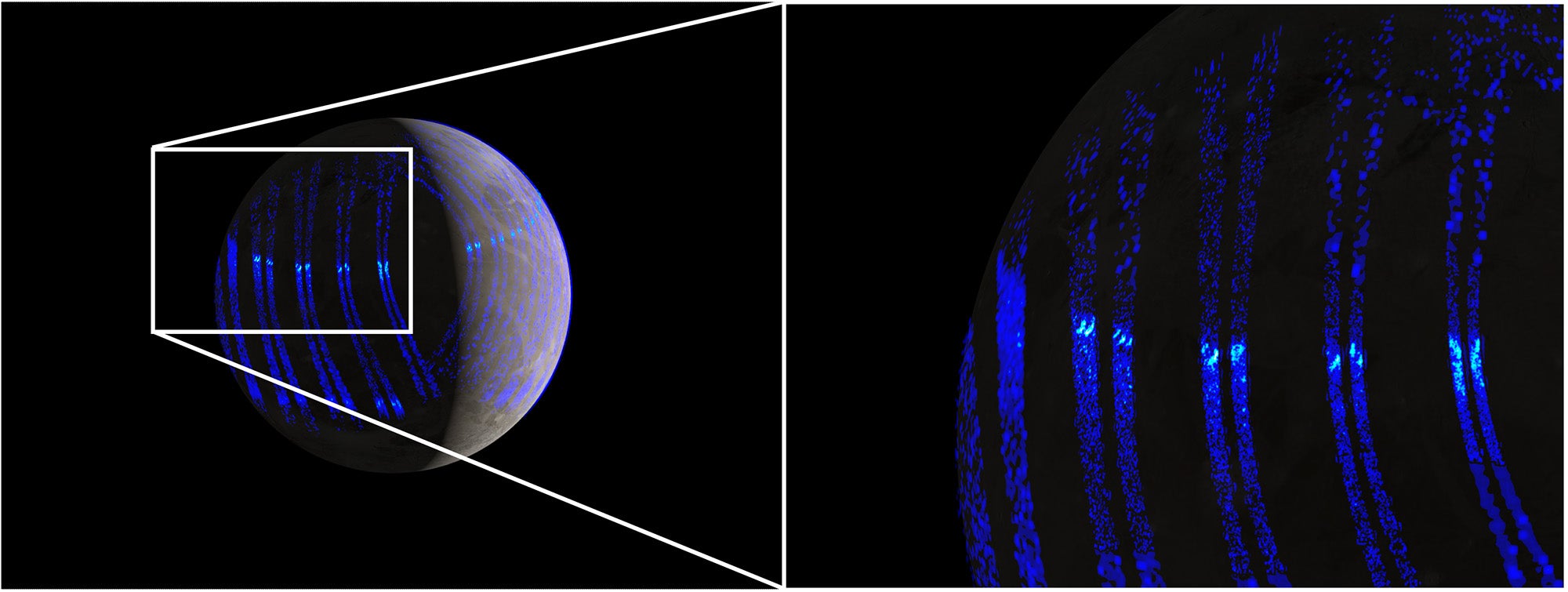
Ganymede is the largest moon in the solar system and the only one known to generate its own intrinsic magnetic field. That field creates a small magnetosphere around the moon. Meanwhile, Ganymede itself moves through the much larger magnetic environment surrounding Jupiter.
It also has a thin atmosphere made mainly of oxygen and other sparse gases. When charged particles plunge into that atmosphere, they trigger far-ultraviolet emissions from oxygen, producing auroras. Astronomers have observed those emissions for decades. However, until Juno, the view was too coarse to pick apart their smaller structure.
Philippe Gusbin, whose master’s thesis formed the basis of the work, said earlier observations could not resolve the kinds of fine features commonly seen in planetary auroras. Juno changed that.
Its ultraviolet spectrograph watched Ganymede from 16:52 to 17:04 UTC during the flyby, while the spacecraft passed as close as about 1,000 kilometers above the surface. The instrument captured far-ultraviolet oxygen emissions at wavelengths of 130.4 and 135.6 nanometers with spatial resolution ranging from roughly 4 to 27 kilometers. Near closest approach, the team could inspect some features on scales of just a few kilometers.
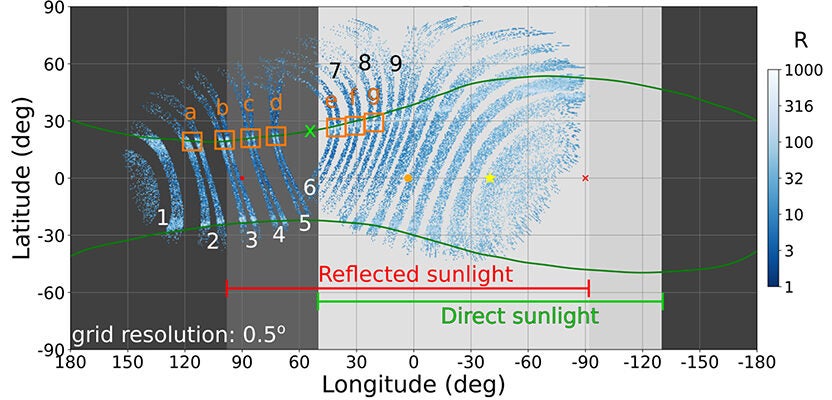
What they found was not a smooth auroral curtain. Instead, parts of Ganymede’s aurora were broken into a chain of distinct glowing patches, each with a typical crosswise size of about 50 kilometers. The brightest reached about 200 Rayleighs, a standard unit used to describe auroral brightness.
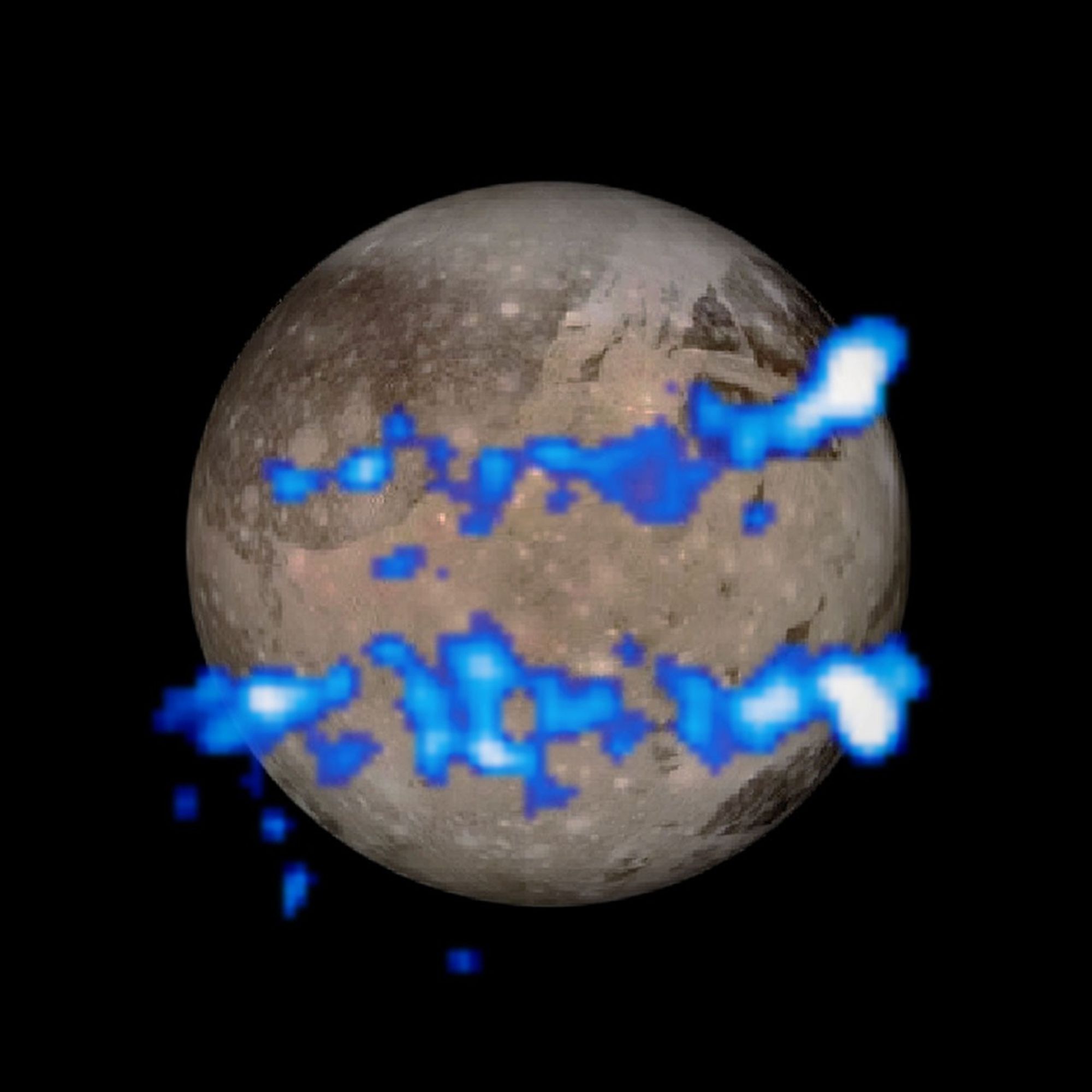
These patches appeared on the moon’s leading side, near the boundary between open and closed magnetic field lines. That border is important because it marks the region where Ganymede’s own magnetic field connects and competes with Jupiter’s.
The southern hemisphere did not show the same pattern, but the team says that may simply be a viewing problem. Juno saw the southern aurora from farther away and at high emission angles, conditions that would make small patches harder to distinguish. The paper also notes that true asymmetry cannot be ruled out. This could be because Ganymede’s position within Jupiter’s plasma environment could affect how each hemisphere responds.
Alessandro Moirano, a postdoctoral researcher at LPAP, compared the new structures to auroral “beads” seen on Earth and at Jupiter. On Earth, such beads often appear before substorms, large rearrangements in the magnetosphere that dump energy into the upper atmosphere and intensify auroral activity. Jupiter shows similar bead-like structures before so-called dawn storms.
That parallel is the heart of the new study. Ganymede’s auroras seem to carry the same fingerprint.
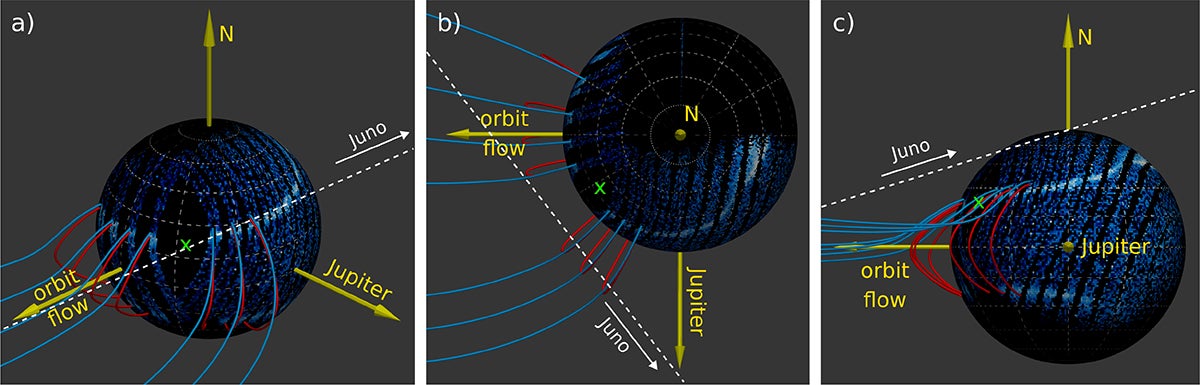
To test what might be producing the patches, the team used a magnetohydrodynamic model of Ganymede’s magnetosphere. The model traced magnetic field lines near the moon’s open-closed field line boundary. It also suggested the auroral patches connect to the outer downstream magnetosphere and the downstream reconnection region, places where magnetic fields can rapidly rearrange and release energy.
The researchers then asked whether the patch size fit with known auroral instabilities. On Earth, scientists have debated whether beads arise from cross-field current instability, shear flow ballooning instability, or related magnetotail processes. The Ganymede patches offered a way to check.
Using magnetic flux conservation, the authors mapped a surface patch about 50 kilometers wide to a structure with a radius of about 75 kilometers in Ganymede’s magnetotail. They then compared that scale with the gyroradius of different ions in the local magnetic field.
Protons and molecular hydrogen ions would need energies of roughly 1 to 3 kilo-electronvolts to match the observed size, much higher than the few tens of electronvolts measured around Ganymede. But oxygen ions and molecular oxygen ions at about 200 and 100 electronvolts fit much better. That match points to ballooning instability as the likely driver.
If that interpretation is right, then the lack of visible patches in the southern aurora probably says more about Juno’s viewing geometry than about any real absence there.
The study is careful on one point: the signal was limited. Depending on patch size, the observations recorded roughly 20 to 150 events per patch, with signal-to-noise ratios around 1.5 to 3 on the finer grid. The edges of the structures are therefore not perfectly certain. Even so, the authors note that shrinking the patch estimate to about 30 to 40 kilometers does not change their conclusion.
Juno’s look at Ganymede lasted less than 15 minutes, and the spacecraft will not make another flyby of the moon. That leaves major questions unanswered. How often do these patches form? How fast do they change? Does Ganymede experience its own versions of substorms or dawn storms? How stable is the boundary between open and closed magnetic field lines?
Those questions now shift to ESA’s Juice mission, short for Jupiter Icy Moons Explorer, which is on its way to the Jovian system. Juice is expected to arrive in 2031. Juice carries an ultraviolet spectrograph similar to Juno’s and should be able to watch Ganymede over much longer periods.
Bertrand Bonfond, an astrophysicist on the project, said those future observations could track the evolution of Ganymede’s auroras and uncover new mysteries.
The new observations do more than sharpen the picture of one distant moon. They suggest that auroras can reveal the same core magnetospheric processes across very different worlds, including bodies that are not planets. That gives scientists a fresh way to compare how magnetic fields, charged particles and thin atmospheres interact throughout the solar system.
Ganymede may now become one of the most useful natural laboratories for understanding space weather beyond Earth.
With Juice set to arrive in 2031, researchers should finally get the longer, repeated observations needed to test whether these patchy auroras are rare flashes or part of a persistent magnetic rhythm.
Research findings are available online in the journal Astronomy and Astrophysics.
The original story “Strange beads of light on Ganymede look strikingly like Earth’s auroras” is published in The Brighter Side of News.
Like these kind of feel good stories? Get The Brighter Side of News’ newsletter.
The post Strange beads of light on Ganymede look strikingly like Earth’s auroras appeared first on The Brighter Side of News.


Leave a comment
You must be logged in to post a comment.