A small tail vertebra picked up on a windswept Antarctic island in 1985 did not look like much. For decades, it was treated as the remains of a marine reptile. Now that same bone has been reidentified as something far rarer, the first dinosaur bone ever discovered on Antarctica.
The fossil came from James Ross Island, off the northeastern tip of the Antarctic Peninsula. Today the region is cold, rocky, and icebound. However, around 82.6 million years ago, during the early Campanian stage of the Late Cretaceous, it belonged to a very different world. That world had forests, rivers, and a wider range of dinosaurs than the continent’s sparse fossil record has so far revealed.
In a paper published in Acta Palaeontologica Polonica, researchers identified the specimen, cataloged as BAS D.8621.25, as a partial anterior tail vertebra from a non-saltasaurine eutitanosaurian sauropod. In plainer terms, it belonged to a titanosaur relative. This group included some of the largest land animals ever to live.
“Believe it or not, this is the first bit of dinosaur ever discovered on Antarctica,” Paul Barrett, merit researcher at the Natural History Museum, London, said. “It was overlooked because I think it was misidentified while under harsh field conditions, but it is a sauropod and it’s only the second sauropod bone from the entire continent.”
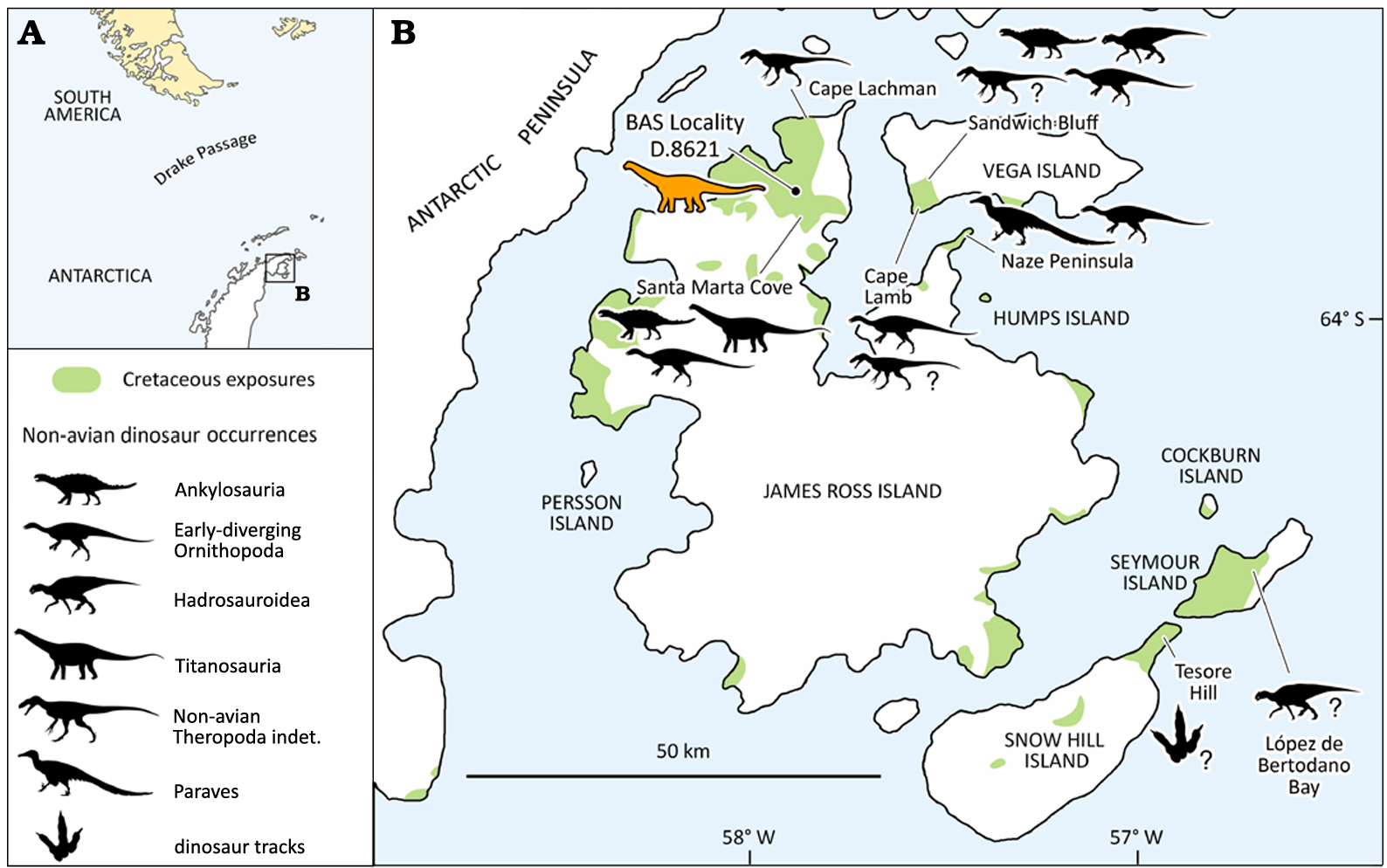
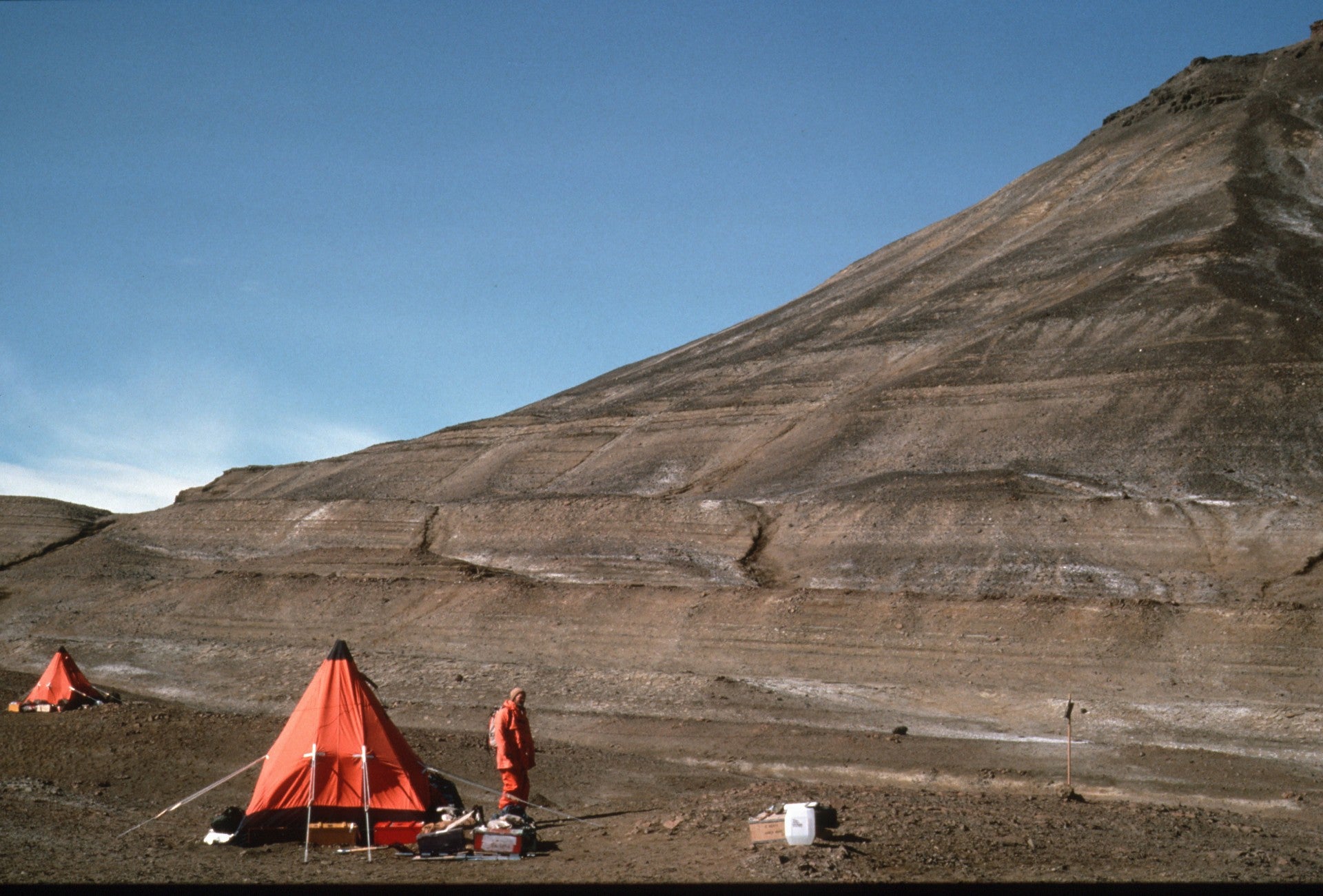
The vertebra was collected by Michael R.A. Thomson and Reinhard Förster during a British Antarctic Survey expedition on December 9, 1985. It came from the Beta Member of the Santa Marta Formation on the Ulu Peninsula of James Ross Island. The fossil had never been formally described in the scientific literature.
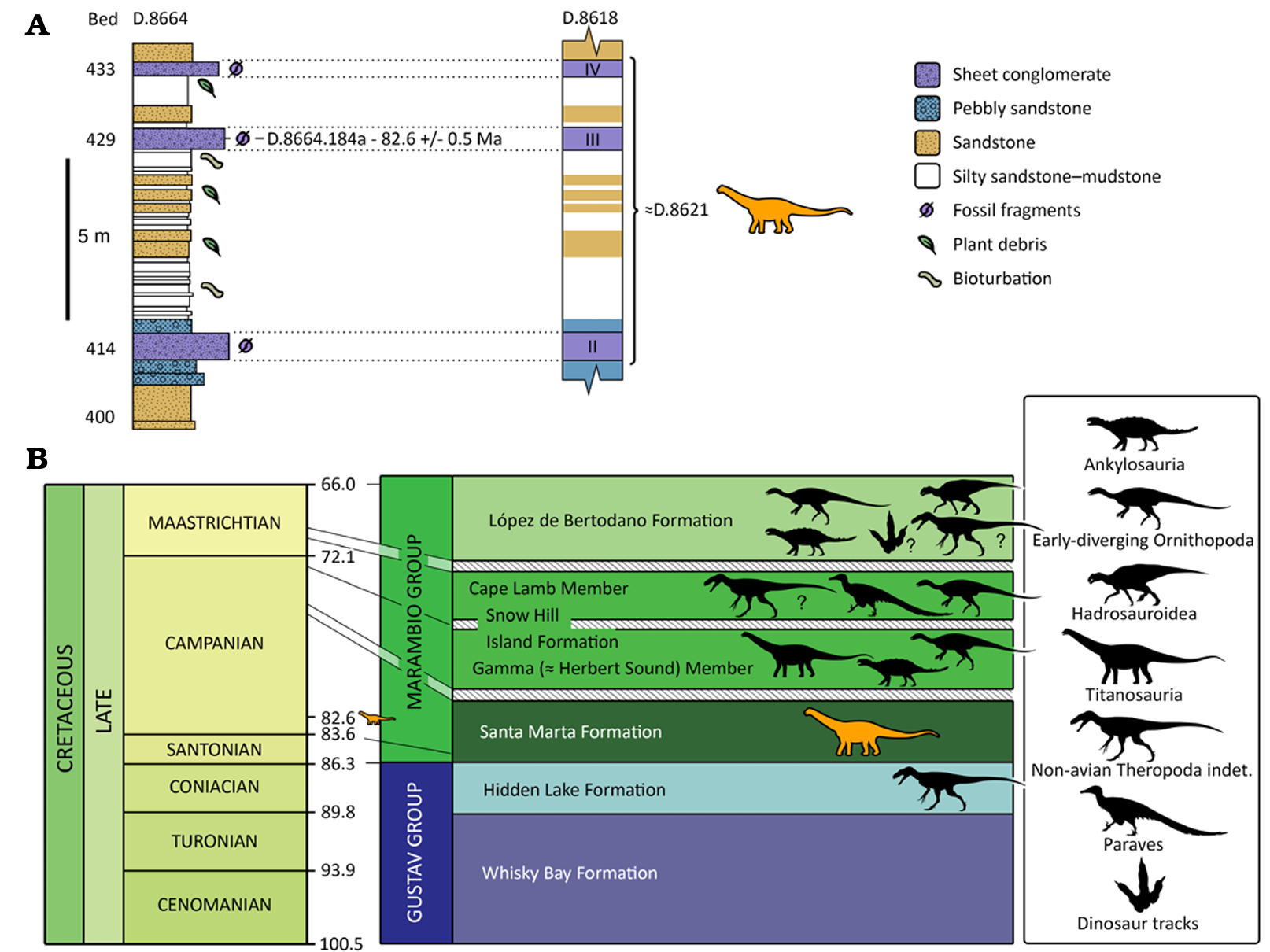
That formation is rich in marine fossils, especially ammonites, which gave the team an unusually precise way to date the rock. Material from the same horizon has yielded a numerical age of 82.6 ± 0.5 million years, placing the bone in the lower Campanian. Furthermore, the researchers argue that the dinosaur probably died on land and its remains later washed out to sea, where they were buried in marine sediments.
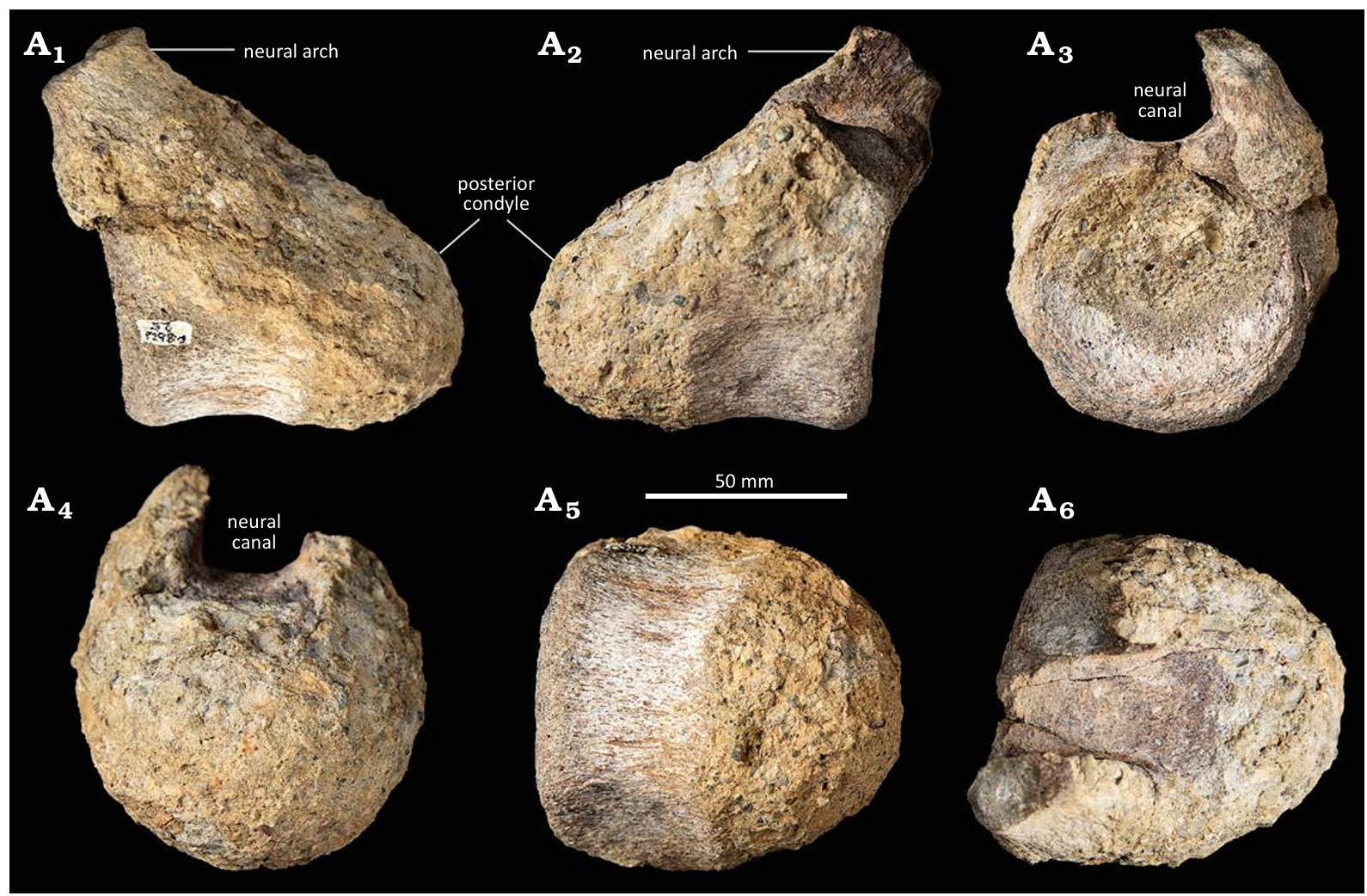
The bone itself is incomplete, just a centrum and parts of the neural arch pedicles, but it preserves enough detail to be diagnostic. Its shape shows strong procoely, with a concave front surface and a rounded convex rear surface. This feature is associated with lithostrotian titanosaurs. Additionally, CT scans showed dense, apneumatic internal bone rather than the camellate structure seen in some other titanosaurs, helping narrow the identification.
The team could not assign the vertebra to a species. It also remains unclear whether the animal was a juvenile or a small-bodied adult. Based on the size of the bone, Barrett said the dinosaur was likely about six to seven meters long.
That may not sound giant by sauropod standards, but the importance of the fossil has less to do with body size than with place and timing.
Antarctica has the sparsest Mesozoic dinosaur record of any continent. A handful of named species are known from the region, including the armored ankylosaur Antarctopelta, the plant-eaters Trinisaura and Morrosaurus, and the predator Imperobator. But dinosaur fossils from the Antarctic Peninsula are still rare. They are often fragmentary and unevenly spread through the rock record.
This newly identified vertebra matters in part because it is the only dinosaur fossil known so far from the Santa Marta Formation. That makes it the first dinosaur specimen from that unit. In addition, it is one of the oldest known Cretaceous dinosaur fossils from Antarctica.
It also strengthens the case that sauropods were part of Antarctic ecosystems in the Late Cretaceous. Before this study, only one sauropod body fossil had been reported from the continent, another caudal vertebra from younger rocks on James Ross Island. Furthermore, the new paper also revisits that earlier specimen and agrees that it, too, likely belonged to a non-saltasaurine eutitanosaur.
The result is still modest in one sense. Antarctica has not suddenly yielded a rich sauropod fauna. What it does have now is firmer evidence that titanosaurs reached the continent and lived there. Even if only scraps of them have survived.
The discovery also feeds into a larger paleogeographic puzzle. Sauropods are well known from South America and Australia, and titanosaurs have also been found in New Zealand. Yet eutitanosaurs are not currently known from Cretaceous Australia.
That odd pattern has raised the possibility that some titanosaurs moved from South America to Zealandia by way of the Antarctic Peninsula, rather than through Australia. During the Late Cretaceous, the southern continents were arranged differently. Specifically, the western end of Antarctica, southern South America, and the ancient continent of Zealandia lay closer together than they do now.
The Antarctic vertebra does not prove that route by itself. The fossil is too incomplete for that, and the broader record remains patchy. But its presence fits the idea that Antarctica served as a dispersal corridor for at least some sauropod lineages.
The paper notes that habitat suitability models have suggested parts of northern Antarctica could have supported sauropods in the Late Cretaceous, though perhaps only marginally. As a result, that may help explain why their fossils are so scarce there compared with those of theropods and ornithischians.
The Santa Marta Formation also gives hints about what that lost landscape was like. Plant fossils from the unit and nearby deposits point to a warm, wet setting with mean annual temperatures around 19 degrees Celsius in part of the formation. Rainfall levels were comparable to modern tropical rainforests. The researchers note that these plants likely grew on the nearby emergent Antarctic Peninsula volcanic arc. This was the same general environment the dinosaurs would have occupied.
That picture is a long way from modern Antarctica, but it helps explain how a long-necked herbivore could have lived at such high paleolatitudes. This was not an ice desert. It was a temperate to subtropical world with forests, seasonal darkness, and enough plant life to support large animals.
The study does not just add one more dinosaur to a list. It reshapes the history of Antarctic dinosaur discovery by showing that the continent’s first collected dinosaur fossil was recognized only decades later. Moreover, it also shows how museum collections can still hold major surprises, especially when fragmentary fossils are revisited with newer comparisons and scanning tools.
More broadly, the vertebra gives researchers another anchor point for tracing dinosaur movement across the southern continents. Even a single bone can sharpen the map of how animals spread through Gondwana. It can clarify which habitats they could tolerate, and why Antarctica’s dinosaur record looks so thin.
The next step is simple in concept, though hard in practice: find more fossils from the same rocks and test whether this lone tail bone was an outlier or part of a larger, still hidden fauna.
Research findings are available online in the journal Acta Palaeontologica Polonica.
The original story “Massive Titanosaurs roamed Antarctica over 80 million years ago” is published in The Brighter Side of News.
Like these kind of feel good stories? Get The Brighter Side of News’ newsletter.
The post Massive Titanosaurs roamed Antarctica over 80 million years ago appeared first on The Brighter Side of News.


Leave a comment
You must be logged in to post a comment.