WD 1856 b circles the burnt-out core of a dead star at a distance that seems almost impossible. The giant planet skims around a white dwarf in just 1.4 days, far too close to have survived if it had always lived there, and now Webb has helped explain why.
The world, about 80 light-years from Earth, is roughly the size of Jupiter but travels around a host star only about as large as Earth. That mismatch makes the system striking on its own. As lead author Ryan MacDonald of the University of St Andrews put it, “The planet is quite the oddball. It’s about the size of Jupiter, but the white dwarf it orbits is the size of Earth, so the planet is seven times larger than its star.”
That bizarre pairing matters because it offers a rare look at what can happen to planets after a Sun-like star dies. In about five billion years, the Sun is expected to swell into a red giant, destroying Mercury and Venus and possibly Earth before ending as a white dwarf. What happens farther out, especially to the giant planets, is far less certain.
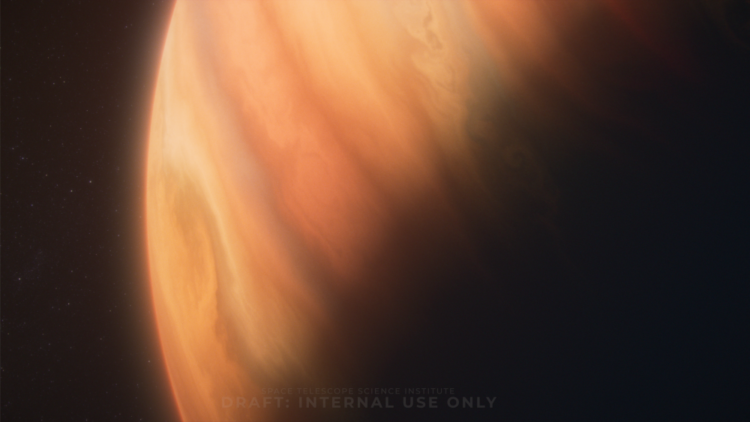
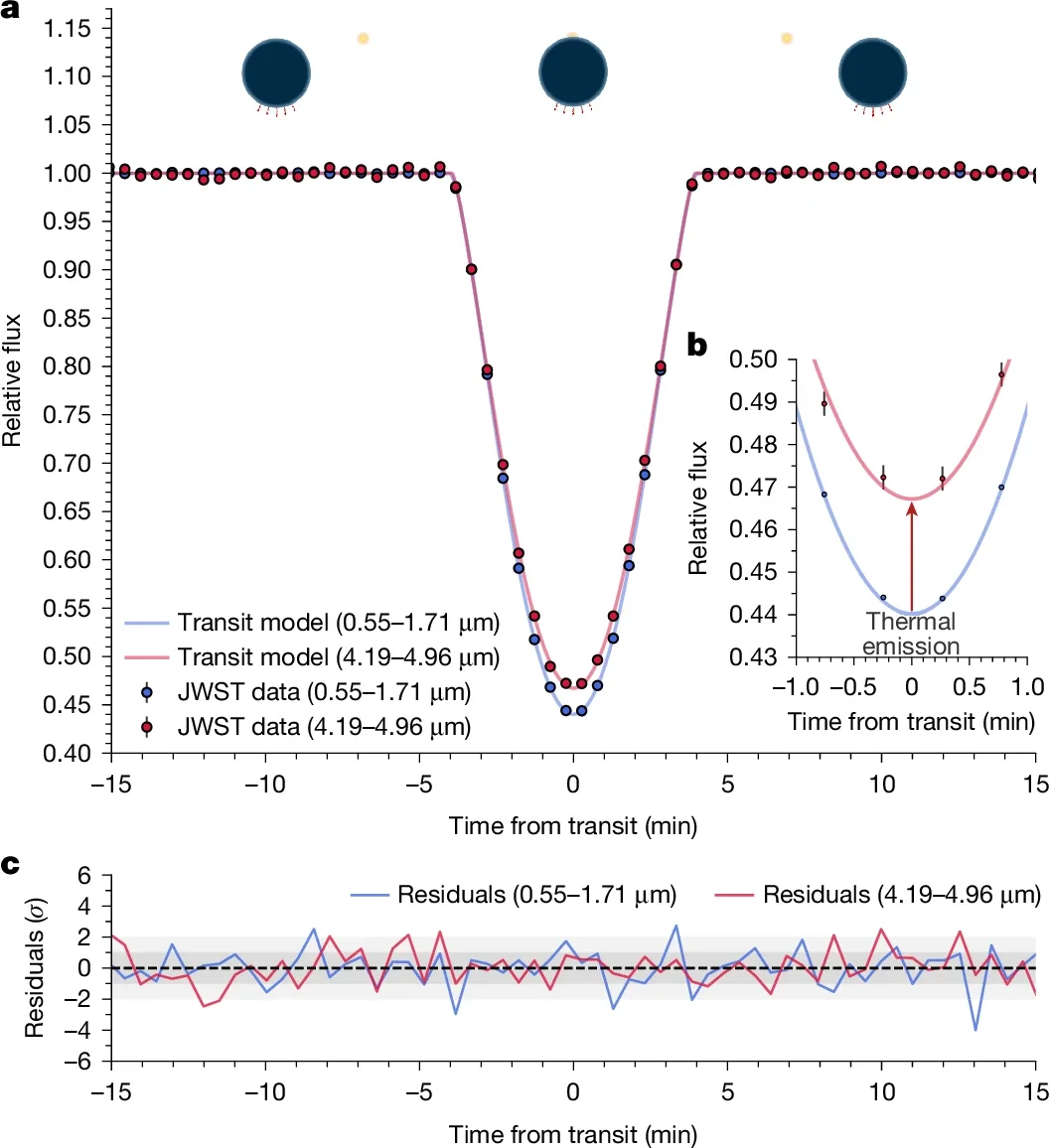
WD 1856 b was first spotted in 2020, but the new observations, published in Nature, go much further. Using the James Webb Space Telescope, astronomers watched the planet pass across the face of its white dwarf host in an eight-minute transit. The event was brief and difficult to catch.
“White dwarfs like WD 1856 are exceptionally dim compared to the planet-hosting stars we normally observe with Webb,” said Victoria Boehm of Cornell University. “To make things even harder, the planet’s transit only lasts 8 minutes, so it’s very much if you blink you miss it! Capturing enough light to see WD 1856’s spectrum, while also doing so quickly enough to not miss the transit, is something only Webb can do.”
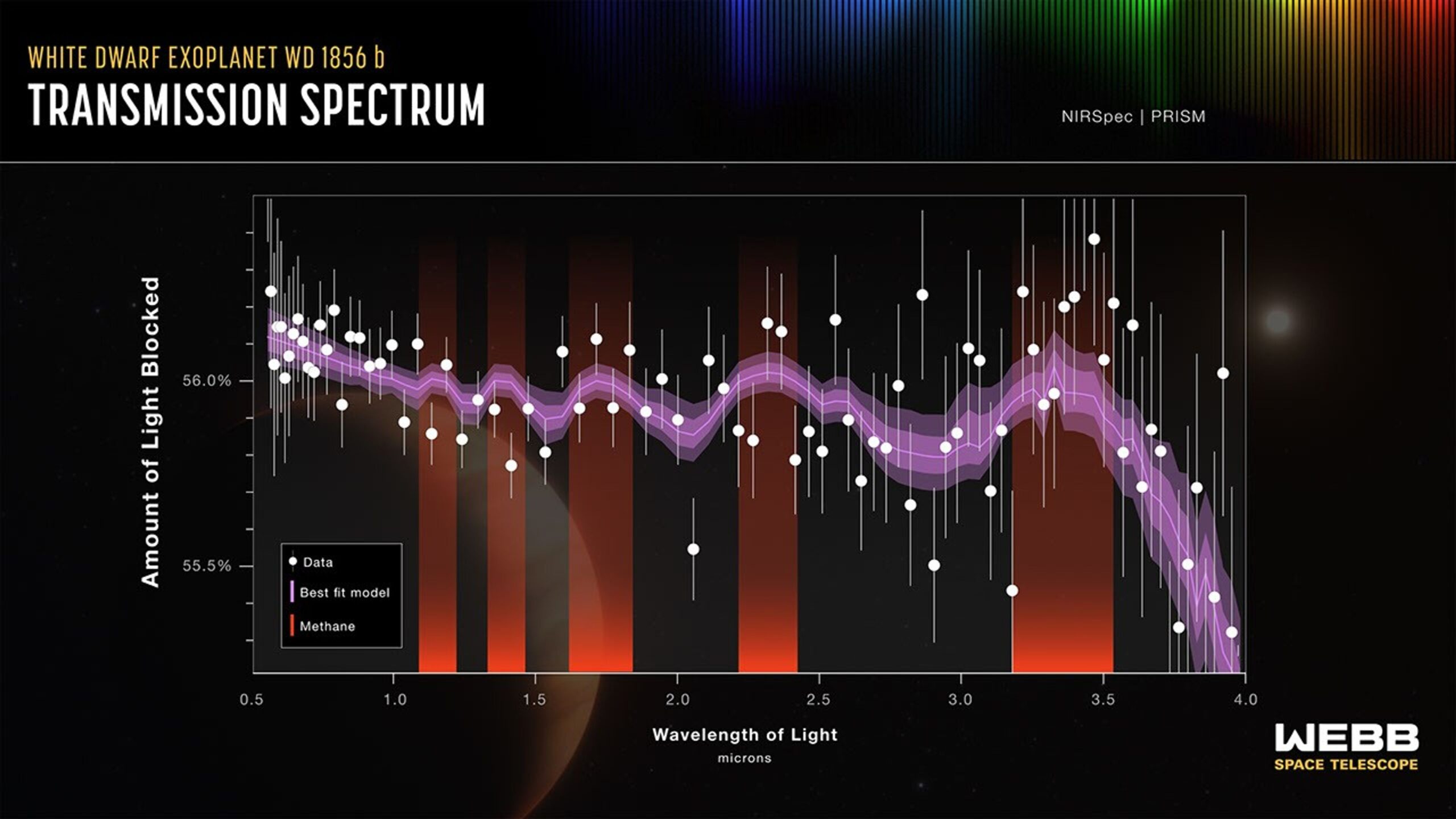
That short crossing still revealed a surprising amount. The team estimated the planet’s mass at between about four and eleven times that of Jupiter. They also detected signs of its atmosphere, including hydrocarbons, most likely methane, along with evidence for small cloud particles.
The most puzzling result was its temperature.
By the team’s estimate, WD 1856 b is about 400 Kelvin, or 126 degrees Celsius. That is roughly 240 degrees hotter than expected if the weak light from the white dwarf were its only heat source. The excess heat pointed to something important in the planet’s past.
Two broad ideas had been competing to explain how the planet got into such a tight orbit. One held that the planet was engulfed when its star ballooned into a red giant, then somehow survived inside the stellar envelope. The other suggested that the planet stayed at a safer distance during the giant phase and only later moved inward, pushed by gravitational interactions in the system.
WD 1856 sits in a triple-star system, which makes that second option plausible. Two distant stellar companions could have disturbed the planet’s orbit over time.
“The big question is how WD 1856 b ended up where it is today, and there are two theories,” said Christopher O’Connor of Northwestern University. “One is that the planet was swallowed by the host star as it was dying, and managed to survive on the inside. The other is that the migration took place due to the gravitational effect of other objects in the system. The white dwarf is part of a triple star system, and the outer companion stars could have influenced WD 1856 b’s orbit.”
The planet’s warmth became the clue that helped sort those possibilities out. The researchers argued that no present-day energy source can account for it. Instead, the heat is most likely leftover energy from an earlier upheaval, either from engulfment or from a dramatic inward migration.
To test the competing ideas, the team combined Webb’s new measurements with cooling models for giant planets. Since such worlds cool in predictable ways, the observed mass and temperature can be used to estimate when the planet was last strongly heated.
Their conclusion was clear. The reheating most likely happened between about 3 and 5.5 billion years after the star had already become a white dwarf. That timing does not fit a scenario in which the planet was swallowed during the star’s brief red giant or later asymptotic giant branch phase.
Instead, the results favor a later inward move. In that picture, WD 1856 b spent the destructive phase of stellar death farther out, where it was safe. Much later, gravitational disturbances drove it onto a highly stretched orbit that brought it close to the white dwarf. As the orbit shrank and circularized, tides from the white dwarf heated the planet, and it has been cooling ever since.
“As the planet moved inwards, its interactions with the strong gravity of the white dwarf will have caused it to warm up considerably, and it has been cooling ever since,” O’Connor said.
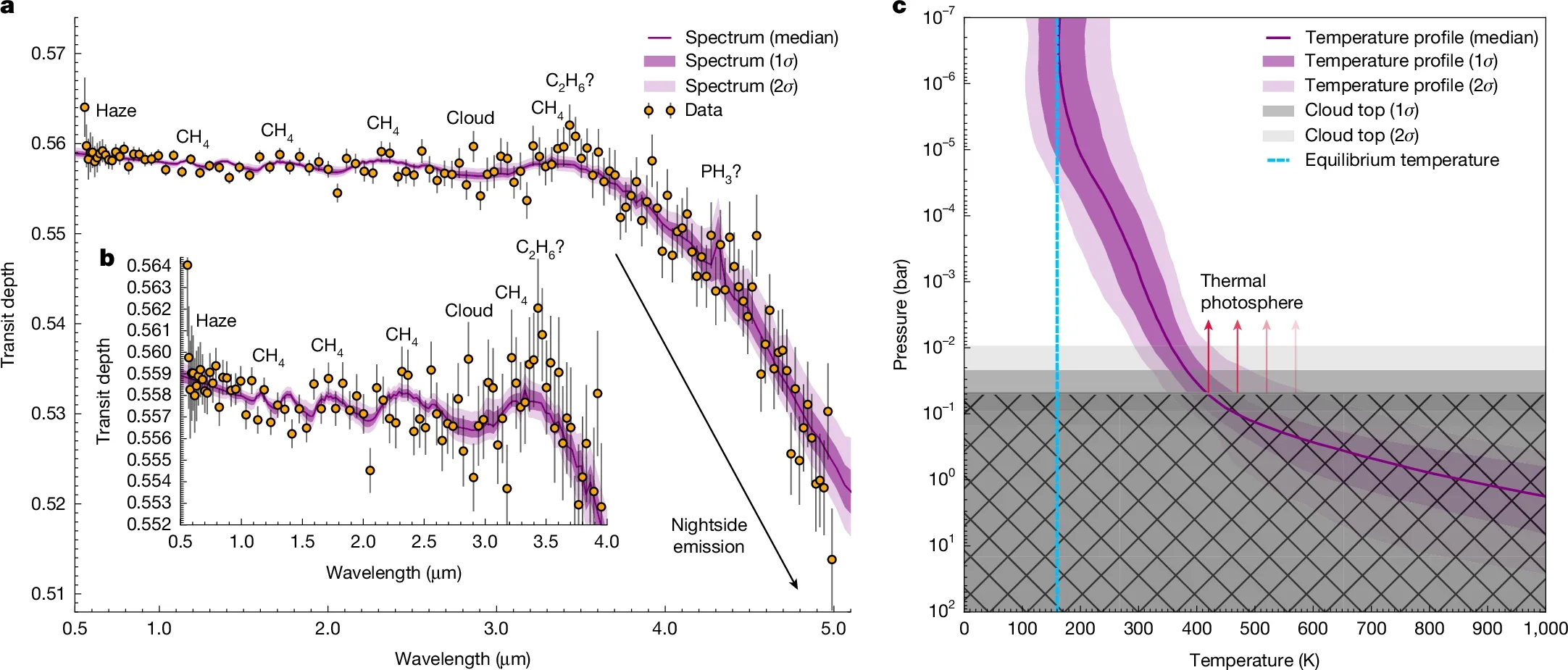
The transit spectrum also opened a new line of research. Boehm said, “Our Webb observations saw the telltale signatures of small cloud particles and hydrocarbons, most likely methane, which is the first time we have seen an atmosphere on a planet transiting a dead star, we recently observed four more transits of WD 1856 b with Webb to take a deeper look into its atmospheric chemistry and can’t wait to see the results.”
For all its strangeness, the planet may be useful because it is not entirely alien to the Solar System’s future. It offers a real example of a giant world surviving the death of a Sun-like star, then settling into a second life around the remnant.
MacDonald framed it in unusually direct terms: “We’re used to looking back in time when we use telescopes, but this is the first time we have been able to look forward to what might happen to the outer planets around the remnant of a Sun-like star, it’s like using a time machine to peer into the distant future of our Solar System.”
The work does not say Jupiter itself will follow this exact path. But it does show that stellar death does not always end a planetary system’s story. In some cases, it may begin a chaotic new chapter.

The findings give astronomers a new way to test what becomes of planetary systems after stars like the Sun die.
They also show that Webb can do more than detect such planets, it can probe their atmospheres, measure their heat, and help reconstruct how they moved.
That could turn white dwarf systems into a valuable laboratory for studying the long-term survival, migration, and chemistry of giant planets, including possible analogs to the outer worlds of our own Solar System.
Research findings are available online in the journal Nature.
The original story “University of St Andrews scientists discover what will happen when our sun dies” is published in The Brighter Side of News.
Like these kind of feel good stories? Get The Brighter Side of News’ newsletter.
The post University of St Andrews scientists discover what will happen when our sun dies appeared first on The Brighter Side of News.


Leave a comment
You must be logged in to post a comment.