A giant planet circling a dead star should not be there.
That was the puzzle hanging over WD 1856 b ever since astronomers spotted it in 2020. The planet is huge, somewhere between four and 11 times the mass of Jupiter, yet it skims around an Earth-sized white dwarf every 1.4 days. Its orbit is so tight that, by ordinary expectations, the planet should have been destroyed when its star swelled into a red giant.
New observations from NASA’s James Webb Space Telescope now offer the clearest answer yet. Instead of surviving a plunge through the star’s bloated outer layers, the planet appears to have spent billions of years at a safer distance, then moved inward long after the star had already died.
That makes WD 1856 b more than an oddball.
It turns the system into a rare look ahead at what might happen to planets after a sun-like star reaches the end of its life.
“Our findings have bearing on the long-term fate of our solar system,” said Christopher O’Connor of Northwestern University’s Center for Interdisciplinary Exploration and Research in Astrophysics. “In roughly five billion years, our sun will die, and we don’t know precisely what will happen to the planets at that time. The fact that planets can survive into that final stage of the stellar life cycle really widens the range of possibilities for where and when habitable planets might exist in the universe.”
The study, led by Ryan J. MacDonald of the University of St. Andrews and published in Nature, marks the first time scientists have characterized the atmosphere of a planet orbiting a dead star.
WD 1856 b sits about 80 light-years from Earth and circles the white dwarf WD 1856+534, a dense remnant left behind after a star like the sun runs out of fuel. The white dwarf is tiny compared with its planet, making the system visually strange even before the orbital math enters the picture.
“This is one of the most bizarre planetary systems we know of,” O’Connor said. “The planet’s radius is about eight times larger than the white dwarf, and it orbits at an extremely close distance, completing a full revolution every 1.4 days.”
That closeness is the core problem. During the red giant phase, a dying sun-like star swells to more than 100 times its original size. Worlds that drift too near can be swallowed. In our own solar system, Mercury and Venus are expected to be engulfed, and Earth might be as well.
So how did WD 1856 b avoid that fate?
Astronomers had two main ideas. One held that the planet was swallowed by the star during its death throes and somehow survived a passage through the envelope. The other suggested the planet stayed farther out, then later had its orbit reshaped by gravity, possibly with help from the system’s outer stellar companions. WD 1856 is part of a triple star system, which gives that second scenario a natural source of disturbance.
To sort between those possibilities, the team turned to Webb.
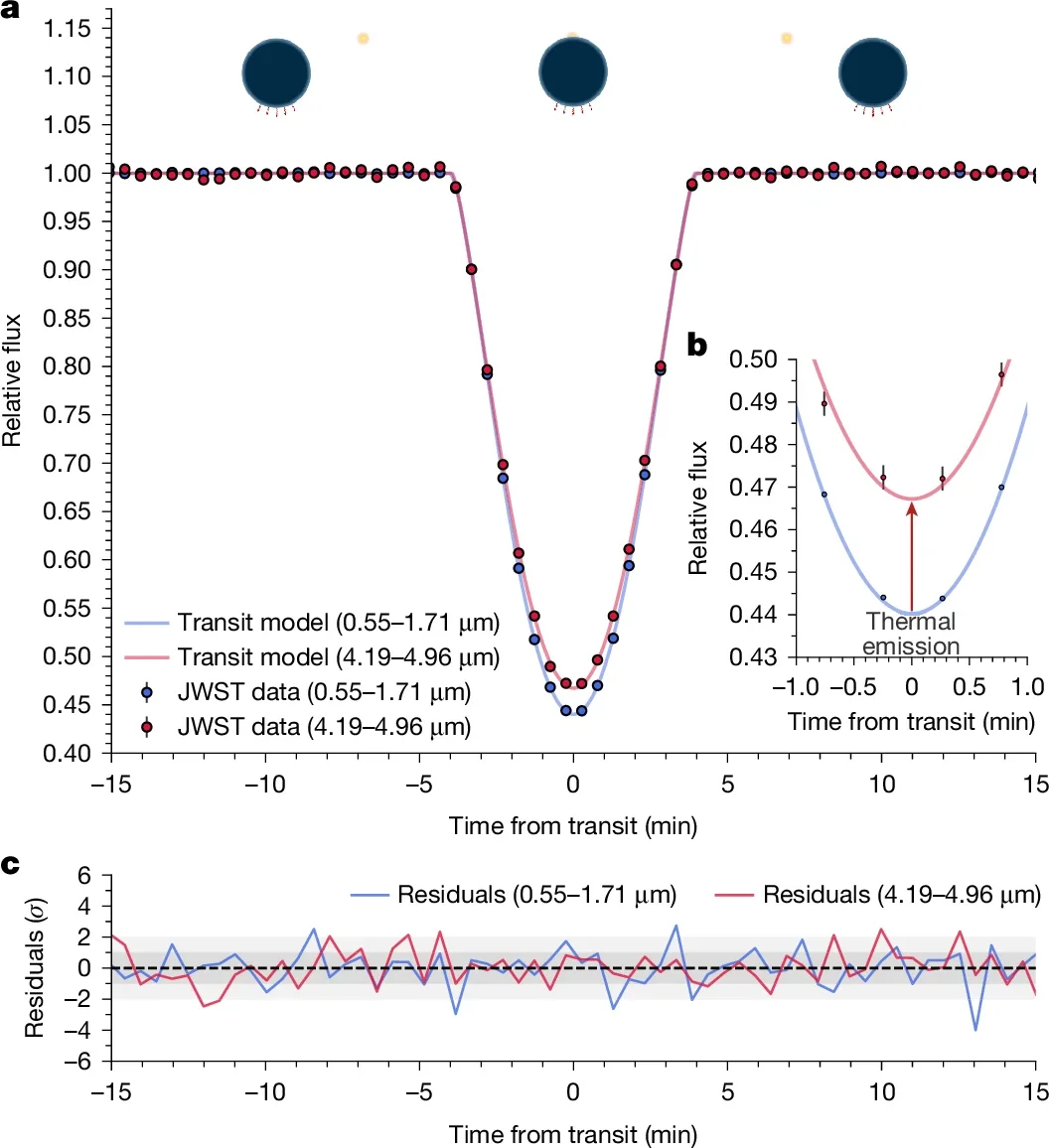
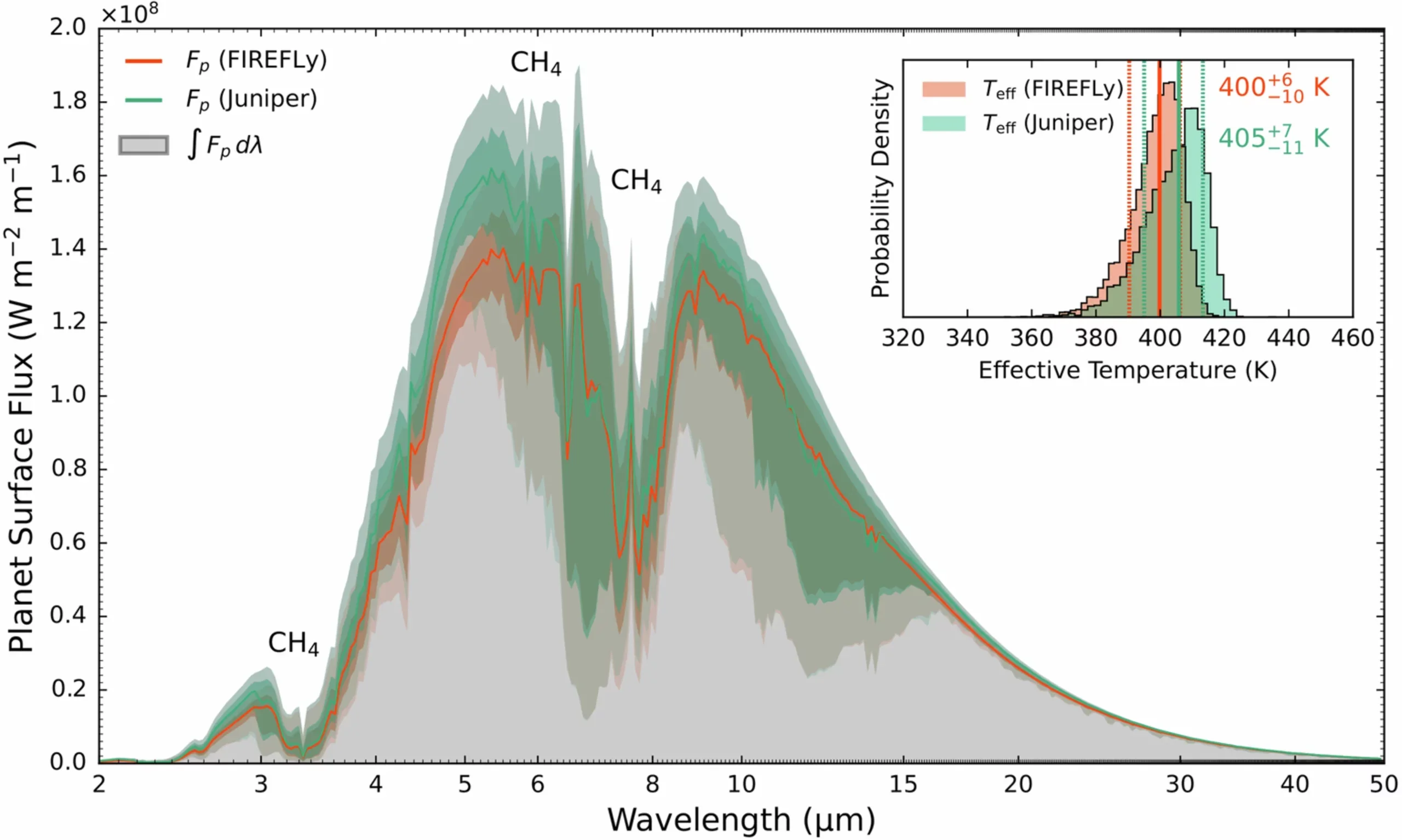
Using JWST’s NIRSpec instrument, the researchers observed a transit of WD 1856 b on April 27, 2023. The event itself was brief, only eight minutes within a 1.98-hour observation, but the data reached from visible wavelengths to 5.5 microns. That broad span let the team probe both the planet’s atmosphere and its temperature.
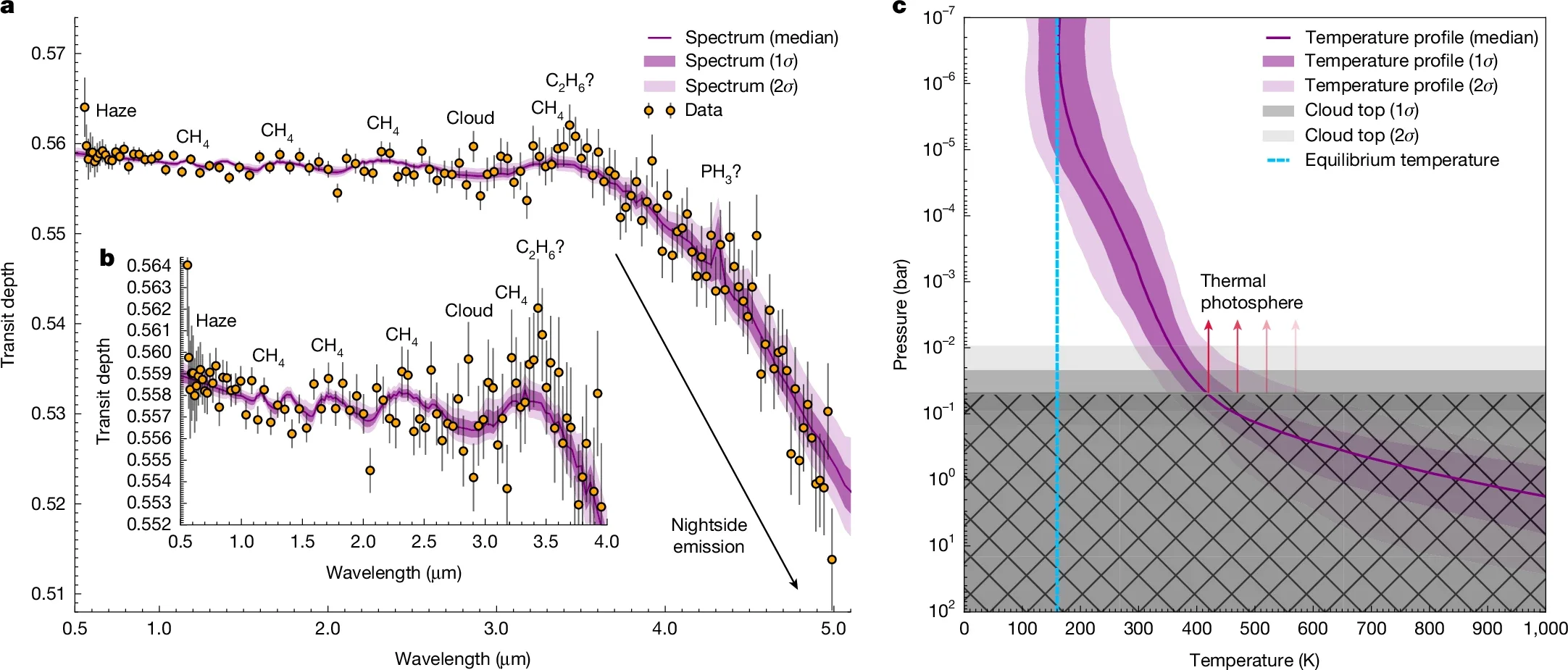
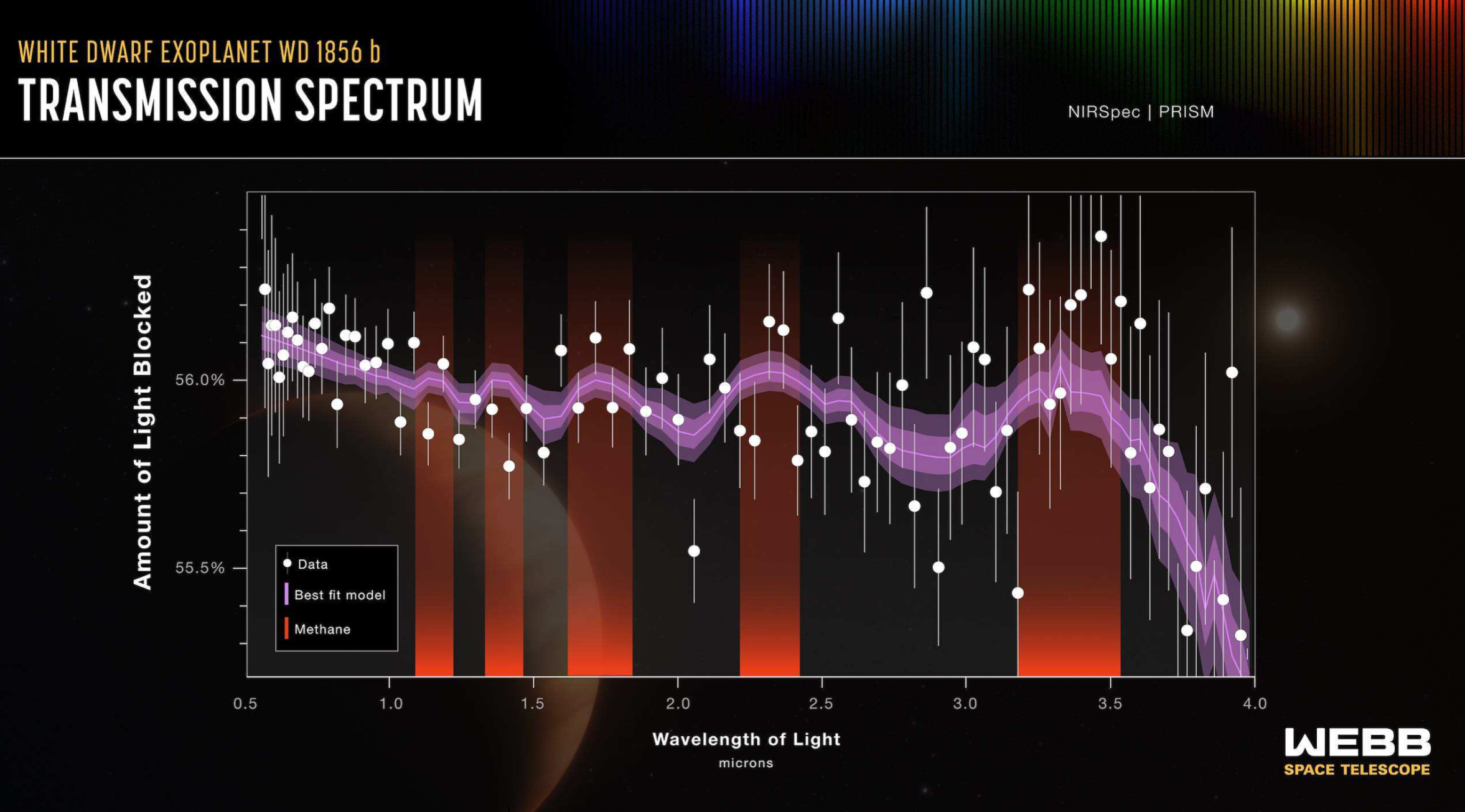
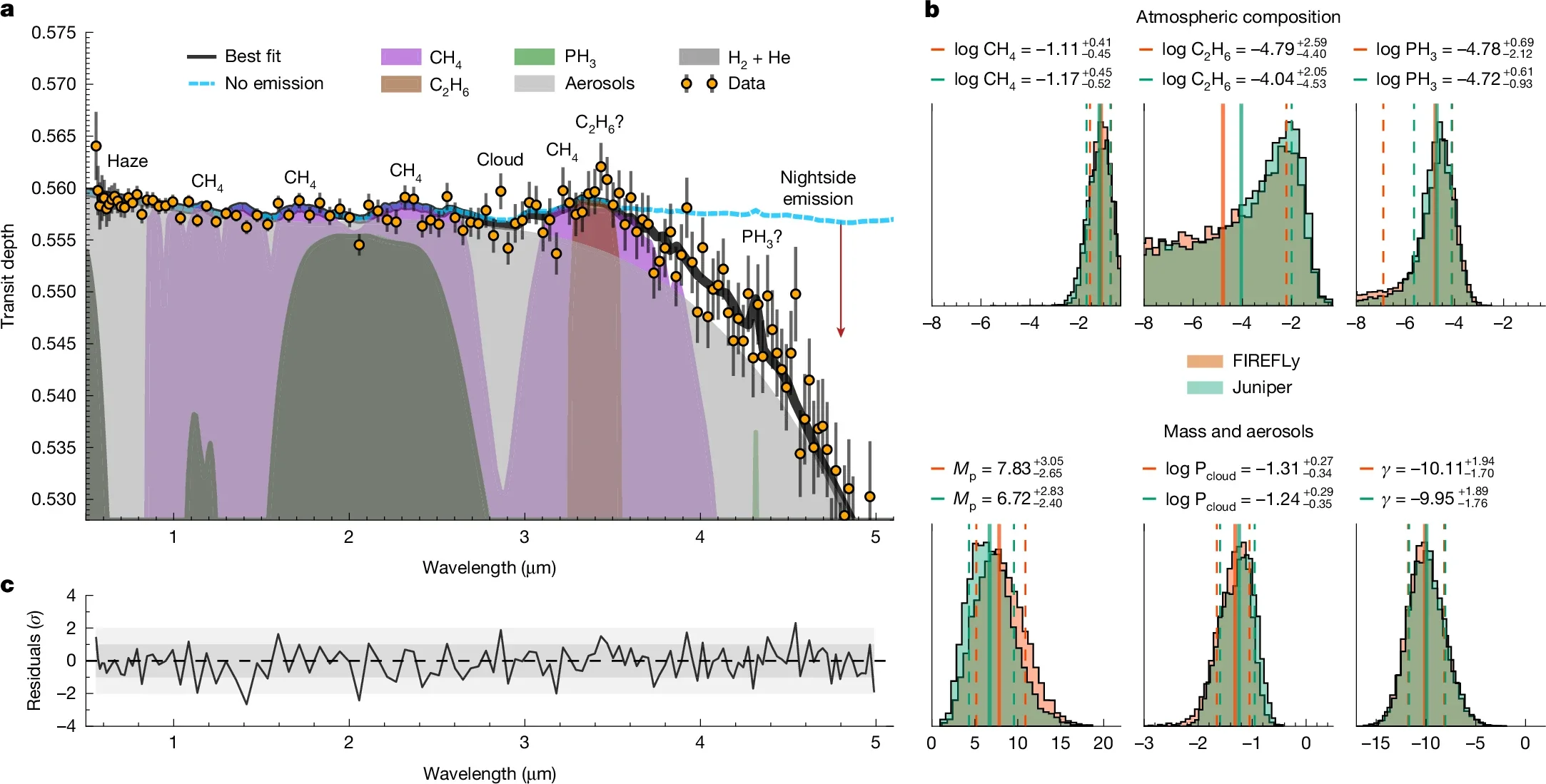
The atmosphere carried its own surprises. The observations revealed methane and clouds, with tentative evidence of phosphine and ethane. The team also found statistically significant evidence for hydrocarbons overall. Just as important, the data gave the first constrained mass estimate for the planet, placing it between 4.3 and 10.9 Jupiter masses.
But the biggest clue was thermal.
The planet’s observer-facing nightside appeared much warmer than expected, around 400 Kelvin, or about 127 degrees Celsius. That is far above the roughly 160 Kelvin equilibrium temperature expected from the white dwarf’s weak illumination alone, and far above the temperature expected for an old giant planet that has simply been cooling for billions of years.
In other words, WD 1856 b still seems to be carrying leftover heat from a major event.
“As the planet moves inward, its interactions with the strong gravity of the white dwarf caused it to warm up considerably,” O’Connor said. “It has been cooling ever since.”
That excess heat let the team work backward.
Because giant planets cool in a predictable way, the researchers combined the Webb measurements with cooling models to reconstruct the planet’s thermal history. The result pointed away from the dramatic survival-through-engulfment idea.
If WD 1856 b had gone through a common-envelope phase during the star’s red giant or asymptotic giant branch stage, the reheating would have happened at about the same time the star died. But the reconstructed history says otherwise. The planet appears to have been reheated 3.0 to 5.5 billion years after the end of the star’s asymptotic giant branch phase. Even the more conservative lower limits still place that reheating at least 1.4 to 2.1 billion years later.
That timing does not fit a planet that barely survived being swallowed.
Instead, it strongly favors high-eccentricity migration, a slower process in which gravitational nudges push a planet onto an elongated orbit. Over time, repeated close passes near the white dwarf would raise tides inside the planet, dumping energy into it and shrinking the orbit until it became the tight, nearly circular path seen today.
The picture that emerges is calmer at first and stranger later. WD 1856 b likely remained at a safe distance while its star expanded and died. Only billions of years afterward did it start moving inward toward the stellar remnant.
That delayed migration matters because it extends the life story of planetary systems far beyond the death of the star itself.
“We’re used to looking back in time when we use telescopes, but this is the first time we have been able to look forward to what might happen to the outer planets around the remnant of a sun-like star,” MacDonald said. “It’s like using a time machine to peer into the distant future of our solar system.”
The atmosphere adds another layer to the story. The methane abundance points to a strongly metal-enriched atmosphere, and the data also suggest aerosols, including an optically thick cloud deck. Those details do more than fill out a chemical portrait. They show that white-dwarf planets can be studied with the same kinds of atmospheric tools used on worlds around living stars.
That opens a new branch of exoplanet science, one focused not on how planetary systems form, but on what survives them.
“This is just the beginning of our exploration of planets orbiting dead stars with JWST, and the search for further planets orbiting white dwarfs is ongoing,” MacDonald said. “Our results show that stellar death is not the end, some planets experience a vibrant and lively future after the death of their star.”
The study gives astronomers a tested way to investigate what happens to planets after sun-like stars die. By linking a planet’s present-day temperature, mass and atmosphere to models of long-term cooling, researchers can reconstruct when major orbital changes took place.
For the solar system, the work suggests the sun’s death may not mark the end of planetary evolution. Outer worlds could keep shifting long afterward, and some planets may remain physically intact in environments once thought hopeless.
More broadly, the findings widen the range of places astronomers may need to consider when searching for long-lived planetary systems and possible habitable niches in the universe.
Research findings are available online in the journal Nature.
The original story “JWST solves the mystery of the giant planet orbiting a dead star” is published in The Brighter Side of News.
Like these kind of feel good stories? Get The Brighter Side of News’ newsletter.
The post JWST solves the mystery of the giant planet orbiting a dead star appeared first on The Brighter Side of News.


Leave a comment
You must be logged in to post a comment.