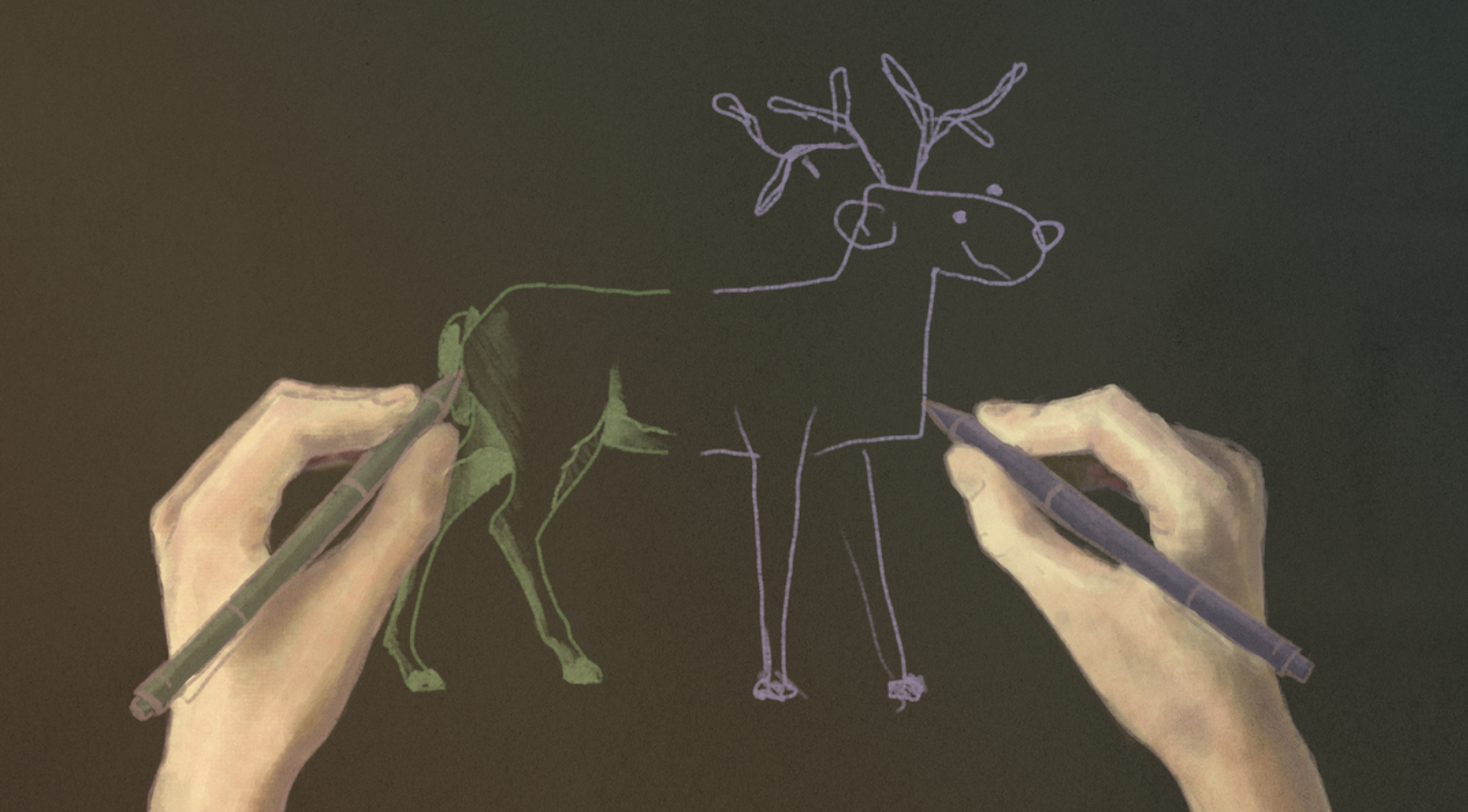
Most people can feel the gap without thinking about it. One hand writes neatly, throws cleanly, and handles tools with ease. The other usually looks awkward trying to keep up. That familiar split has long seemed like proof that the dominant hand starts life with a built-in advantage. A new study argues otherwise, and the difference matters more than it may sound.
The work, published in PNAS, separates two ideas that are often bundled together under the word handedness. One is preference, the tendency to favor one hand over the other. The other is dominance, the actual skill gap between the two sides. The authors argue that preference may have biological roots, but dominance, the part people notice in everyday life, appears to be something you build.
“You don’t prefer your dominant hand because it’s more skilled,” John Krakauer of Johns Hopkins University said. “It becomes more skilled because you prefer it. And you wouldn’t notice any difference between your two hands without tools and objects in the world that demand practice to use well.”
Krakauer worked on the study with Ahmet Arac and Nicolas Y. H. Jeong Lee. Together, they set out to test a long-running idea in motor control research: that the dominant side has an inherent advantage because one brain hemisphere is specialized for controlling movement.
To probe that question, the team used a 3D reaching task with high-speed cameras and markerless motion tracking. Participants, all healthy young right-handed adults, reached toward targets on a table with each arm under three conditions.
In the first, they simply reached with the hand. In the second, they repeated the task with a 4-pound weight strapped to the wrist, adding an inertial challenge. In the third, they reached with a very light bamboo stick attached to the forearm, turning the action into something closer to tool use.
If the dominant arm truly had a built-in advantage for controlling movement dynamics, the weighted task should have brought it out. It did not.
Ordinary reaching showed little difference between the two arms. Adding weight increased variability for both sides, but it did not create a meaningful dominant-arm edge. The split that most people associate with handedness appeared only when the task required guiding the tip of the lightweight stick through a more complex path.
That result pointed away from a general motor-control advantage and toward something more specific. The dominant side did not win when the arm was merely working harder. It pulled ahead when the task resembled the kind of practiced, trajectory-shaping action people perform with tools and objects over years.
The stick condition changed the movement itself. Reaches became more curved, especially near the end, and the nondominant arm was less consistent at controlling that shape. The researchers found a clear dominant-versus-nondominant difference in the trajectory only in this tool-like condition, not in the regular or weighted reaches.
That pattern matters because it cuts against a simple story about built-in limb superiority. A heavy wrist should have favored the dominant side if it were naturally better at handling dynamics. Instead, the sharpest difference appeared with a light object that added little inertial burden but demanded practiced control of an extended tip.
The study links that kind of control to many everyday skills people think of as proof of handedness. Writing, using chopsticks, throwing, conducting, or steering a racket all require shaping the path of an object or tool with precision. In that view, the dominant hand is not universally better. It is better at tasks it has practiced more.
Arac pushed that idea further. “Since humans are uniquely prolific tool users and makers, handedness may be a byproduct of our inventiveness,” he said. In that sense, he added, handedness “can be seen as a fingerprint of human tool-use culture.”
The team then tried a very different test. If dominance grows through repeated practice with a familiar effector, then using a body part with almost no such history should erase the usual advantage.
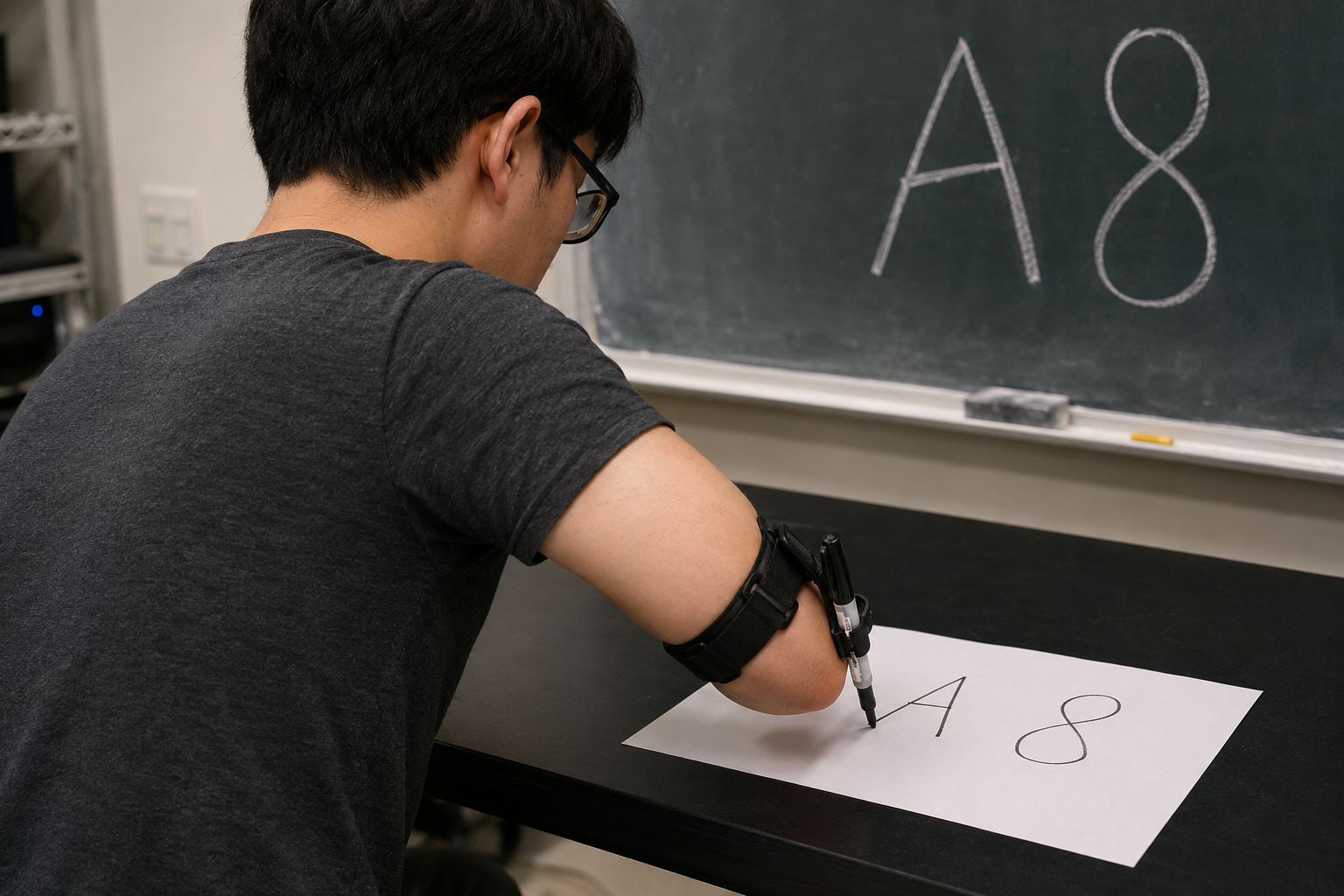
Participants wrote characters with pens attached not to their hands, but to their elbows. It was an awkward setup, yet that was the point. The elbow is involved in many movements, but almost never used as the end effector for a writing tool.
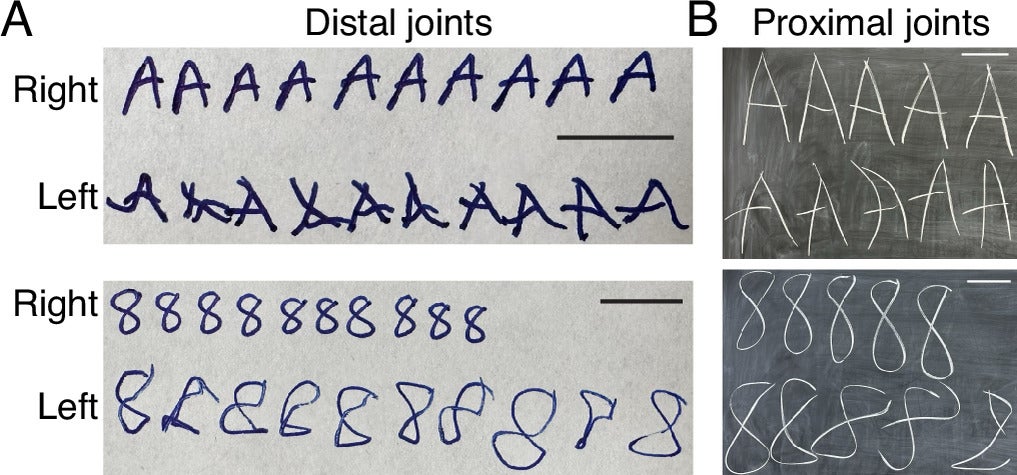
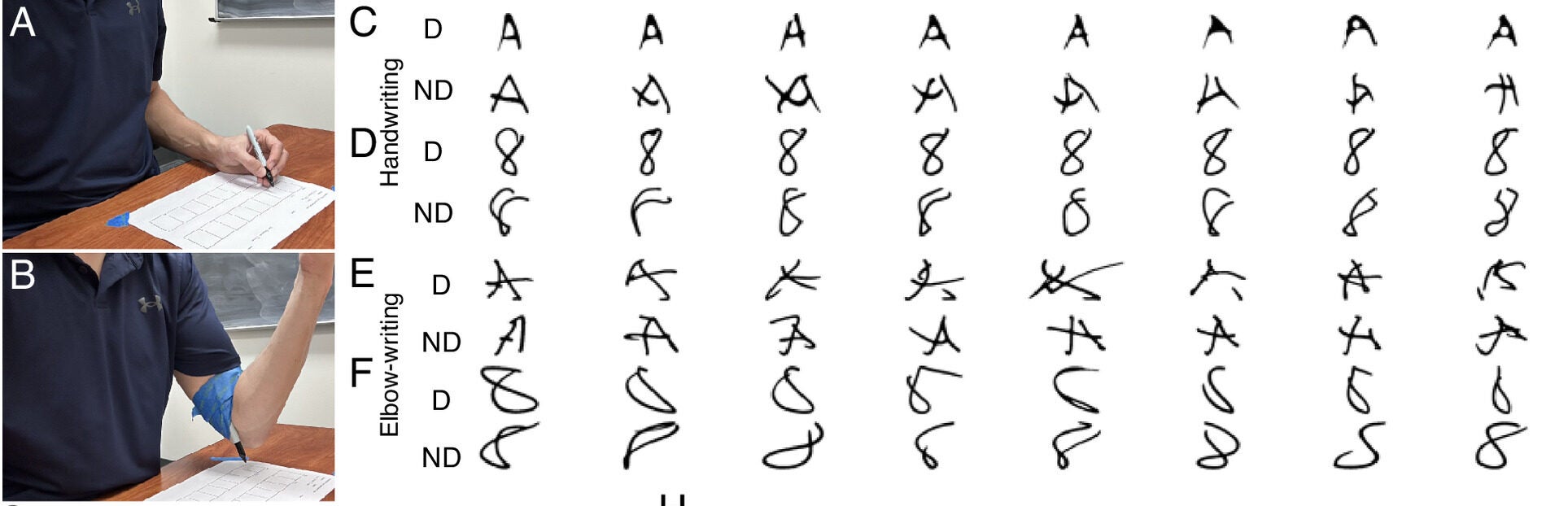
When people wrote with their hands, the normal dominance gap appeared. The nondominant side produced poorer shapes. But when they wrote with their elbows, the gap vanished. Both elbows were similarly clumsy.
That finding might have been dismissed if the elbow were simply incapable of precise control. So the researchers added a training experiment. They trained volunteers to write with either their dominant or nondominant elbow, then tested them again.
Both sides improved. Just as important, they improved by the same amount.
After practice, elbow writing on either side became better than untrained writing with the nondominant hand. That suggests the elbow was never the problem. The issue was inexperience.
The study does not argue that all of handedness is learned. The authors accept earlier evidence suggesting that hand preference appears before birth and likely has biological roots. Their claim is narrower, but still striking. The skill advantage that people usually mean when they talk about a dominant hand may not be innate at all.
Instead, it may emerge task by task, tool by tool, as one side racks up more practice over a lifetime.
That also helps explain why the nondominant hand often seems to know what to do, but fails to do it well. A person trying to write an “A” with the wrong hand usually does not produce a random mark. The intended shape is there, but the execution is shaky. The plan may transfer across sides, while the fine control needed to carry it out does not.
The authors say future work could test this idea in people whose preference and practice histories do not line up neatly, including left-handers forced to use right-handed tools, stroke survivors whose hand use changes, and amputees who become skilled with unusual effectors.
The findings suggest that the visible skill gap between your hands may be more trainable than it looks. If dominance reflects accumulated practice rather than a built-in control advantage, then some one-sided limits could be reduced with targeted training, especially for tool-based tasks.
That could matter in rehabilitation, where patients may need to build skill with a less-used limb after stroke or injury. It could also matter in education, sports, and adaptive design, where people often assume one side is naturally destined to perform better.
More broadly, the study offers a different way to think about a deeply familiar trait. Your preferred hand may begin with biology, but its everyday superiority appears to be shaped, sharpened, and made visible by culture, tools, and repetition.
Research findings are available online in the journal PNAS.
The original story “New study finds your dominant hand may not be set at birth” is published in The Brighter Side of News.
Like these kind of feel good stories? Get The Brighter Side of News’ newsletter.
The post New study finds your dominant hand may not be set at birth appeared first on The Brighter Side of News.


Leave a comment
You must be logged in to post a comment.