Earth’s story may have hardened into place almost as soon as the Solar System began.
That is the striking claim in new research tracing when the young planet locked in the chemical makeup that still defines it. According to the analysis, proto-Earth appears to have reached that point no later than about 3 million years after the first solids formed in the Solar System, an eye blink in planetary terms. Yet that early world was probably nothing like the one you know now. It was likely dry, depleted in volatile elements, and missing much of what life would later need.
The work points to a two-stage history. First came a fast chemical settling of the material that built Earth’s main body. Much later, a giant impact may have supplied the water and other volatile ingredients that made the planet habitable.
The result shifts the timing. It also changes the mood of Earth’s origin story.
Instead of a steadily improving world that gradually gathered all the right pieces, the picture here is of a rocky planet that formed early, stayed chemically austere, and then got a late rescue from a violent collision.
Researchers from the University of Bern involved in the study argue that Earth’s current habitability may depend on that later accident. Without it, the planet could have remained barren.
“Our results show proto-Earth was initially a dry rocky body,” lead author Pascal Kruttasch said. “It can therefore be said that only the collision with Theia supplied volatile elements to Earth and ultimately enabled life.”
To reach that conclusion, the team used isotope analysis and computer modeling to reconstruct how Earth’s chemistry changed in the Solar System’s earliest phase. The study focused on manganese and chromium, two moderately volatile elements whose ratio can preserve a record of when planetary reservoirs formed and stopped chemically evolving.
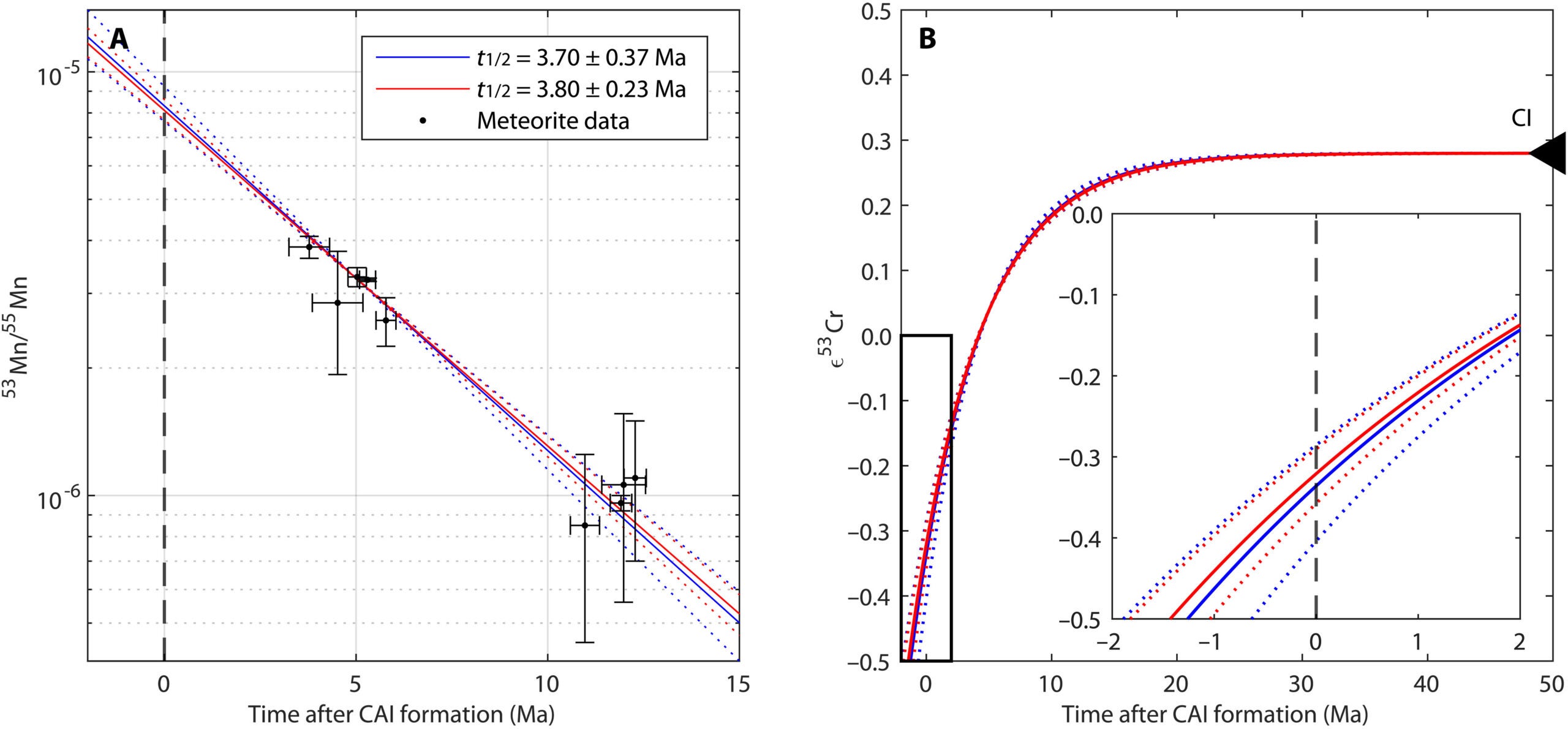
The key is a radioactive clock. Manganese-53 decays into chromium-53 with a half-life of 3.80 million years. Because that decay unfolded rapidly during the first stretch of Solar System history, it gives scientists a way to date early chemical fractionation with unusual precision.
The Bern team modeled the chromium isotope evolution of proto-Earth and compared it with carbonaceous chondrites, primitive meteorites that preserve material from the early Solar System. By tracing present-day isotope values backward through time, they estimated when these reservoirs separated from the bulk Solar System composition.
“These measurements were possible because the University of Bern has world-class expertise in the analysis of extraterrestrial materials,” co-author Klaus Mezger, professor emeritus of geochemistry at the University of Bern’s Institute of Geological Sciences, said.
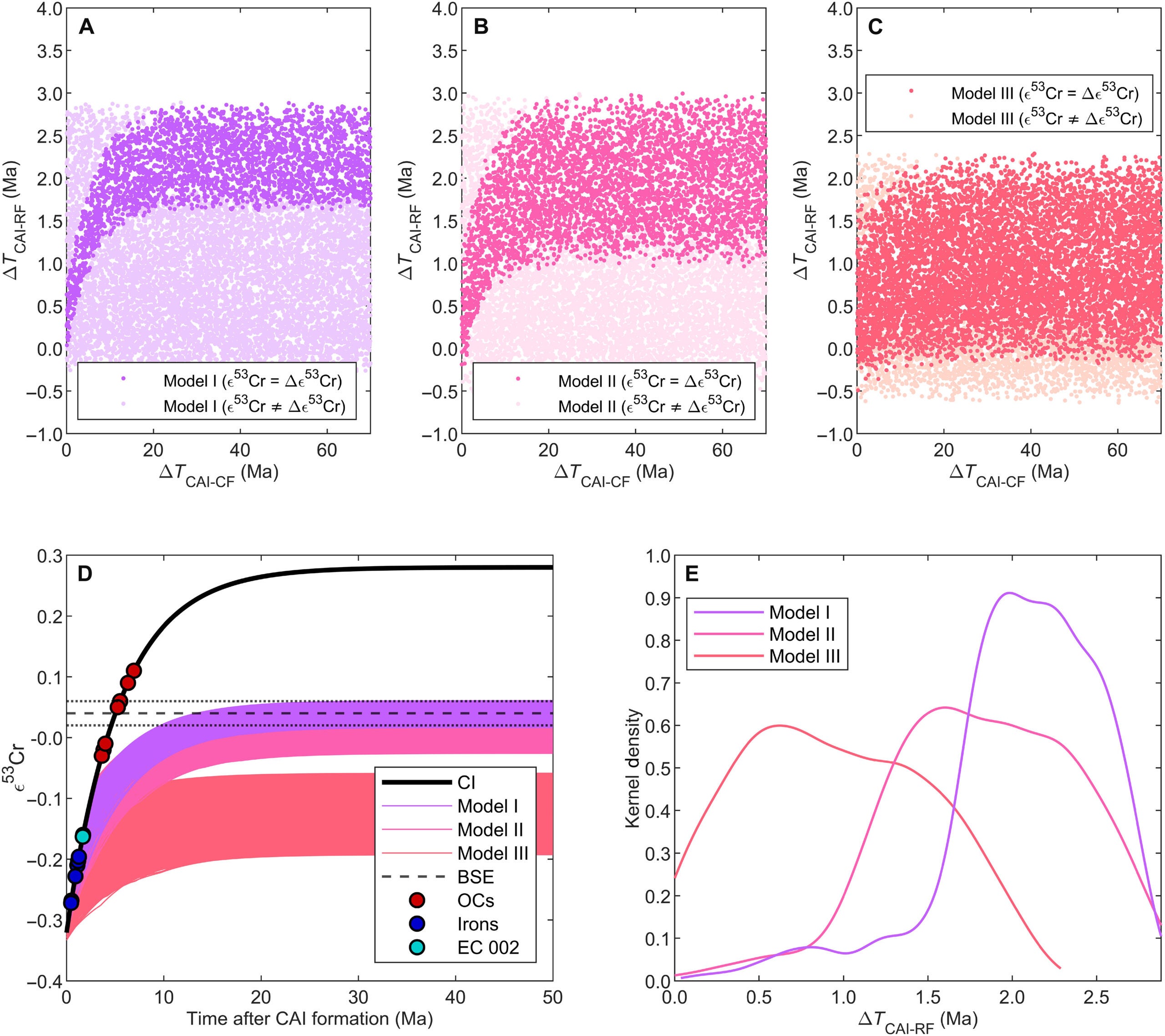
That approach does not suggest Earth formed all at once in 3 million years. Rather, it indicates that the reservoir feeding proto-Earth had already undergone the manganese-chromium fractionation that gave it its lasting chemical signature by then. In the team’s models, that happened no later than about 3 million years after the formation of calcium-aluminium-rich inclusions, the oldest known Solar System solids.
The favored scenario in the analysis places the peak likelihood around 1.7 to 2.0 million years after the Solar System began, though one model peaks even earlier, at about 0.5 million years.
That early chemical closure came with a cost. The findings indicate that proto-Earth was strongly depleted in volatile elements compared with the bulk Solar System.
In practical terms, that means the early planet either formed from already volatile-poor matter or lost much of its volatile inventory during accretion. The researchers discuss both possibilities. Material in the inner Solar System may have been stripped by evaporation and condensation processes in the protoplanetary disk. Proto-Earth may also have lost volatiles through energetic collisions, magma ocean degassing, or evaporation from silicate melt during large-scale melting events.
Either way, the young world appears to have ended up dry.
That conclusion fits a broader pattern across the inner Solar System. The study notes that Mercury and Venus are also strongly depleted in volatile elements, while Mars appears richer in them than proto-Earth. Those differences likely reflect the temperature gradient in the protoplanetary disk, which cooled with increasing distance from the Sun.
Closer in, heat made it harder for volatile components to condense into solids. Farther out, colder conditions preserved more water-rich and carbon-bearing material.
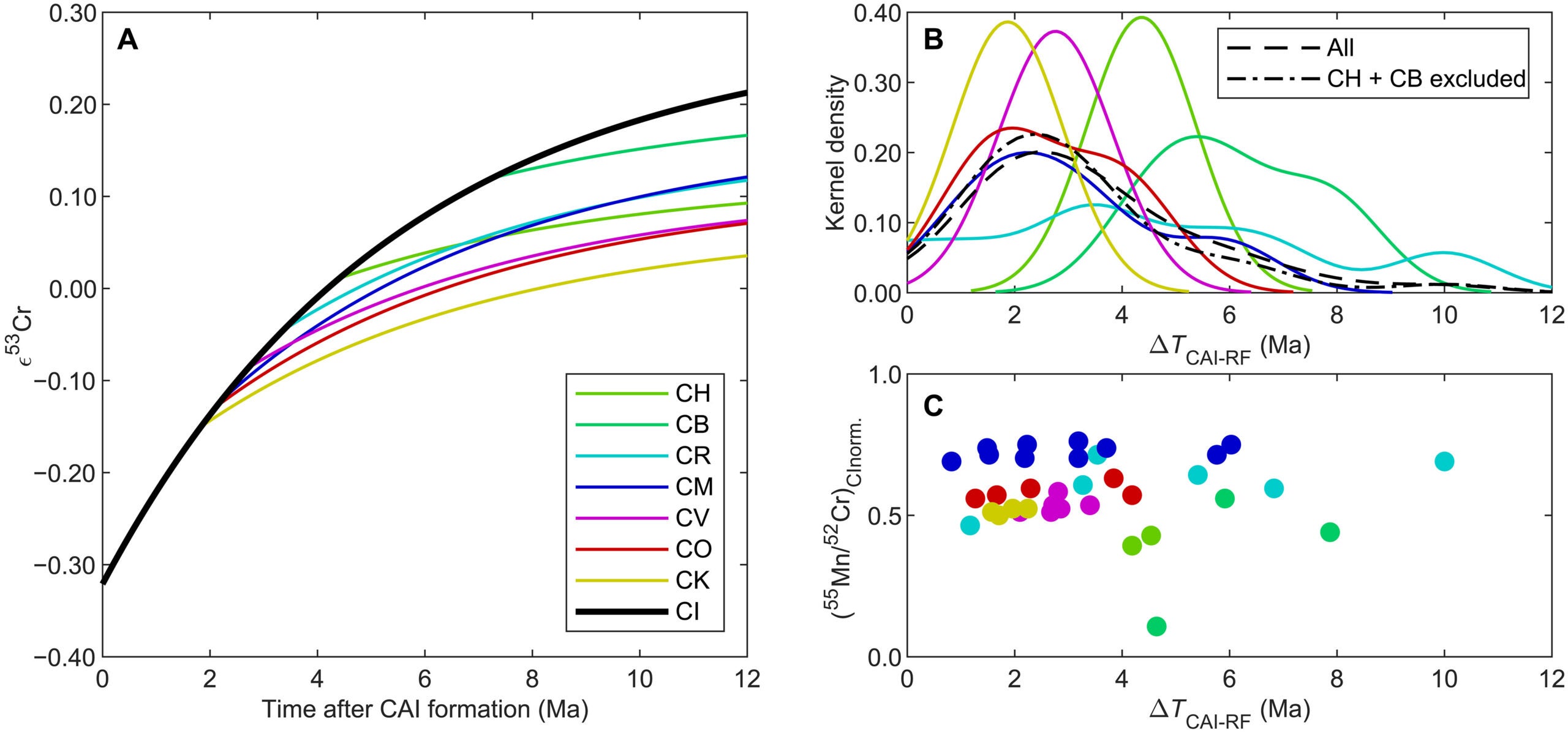
Meteorites tell a related story. Different carbonaceous chondrite groups record volatile depletion at different times, generally within the first few million years of Solar System history. Most of those groups cluster around an average model age of about 2.4 million years after calcium-aluminium-rich inclusions formed, although CH and CB chondrites look younger and may reflect impact-related processes rather than ordinary nebular evolution.
That timing matters because it overlaps with what astronomers already infer from young star systems. Protoplanetary disks tend to dissipate in roughly 3 to 5 million years. The Earth result fits that window, suggesting the region of the disk that formed proto-Earth also stopped exchanging solids and gas early.
If Earth’s main body became chemically fixed early and stayed volatile-poor, then the obvious question follows: where did the water and other life-friendly ingredients come from?
The study points to Theia, the Mars-sized body widely linked to the Moon-forming impact.
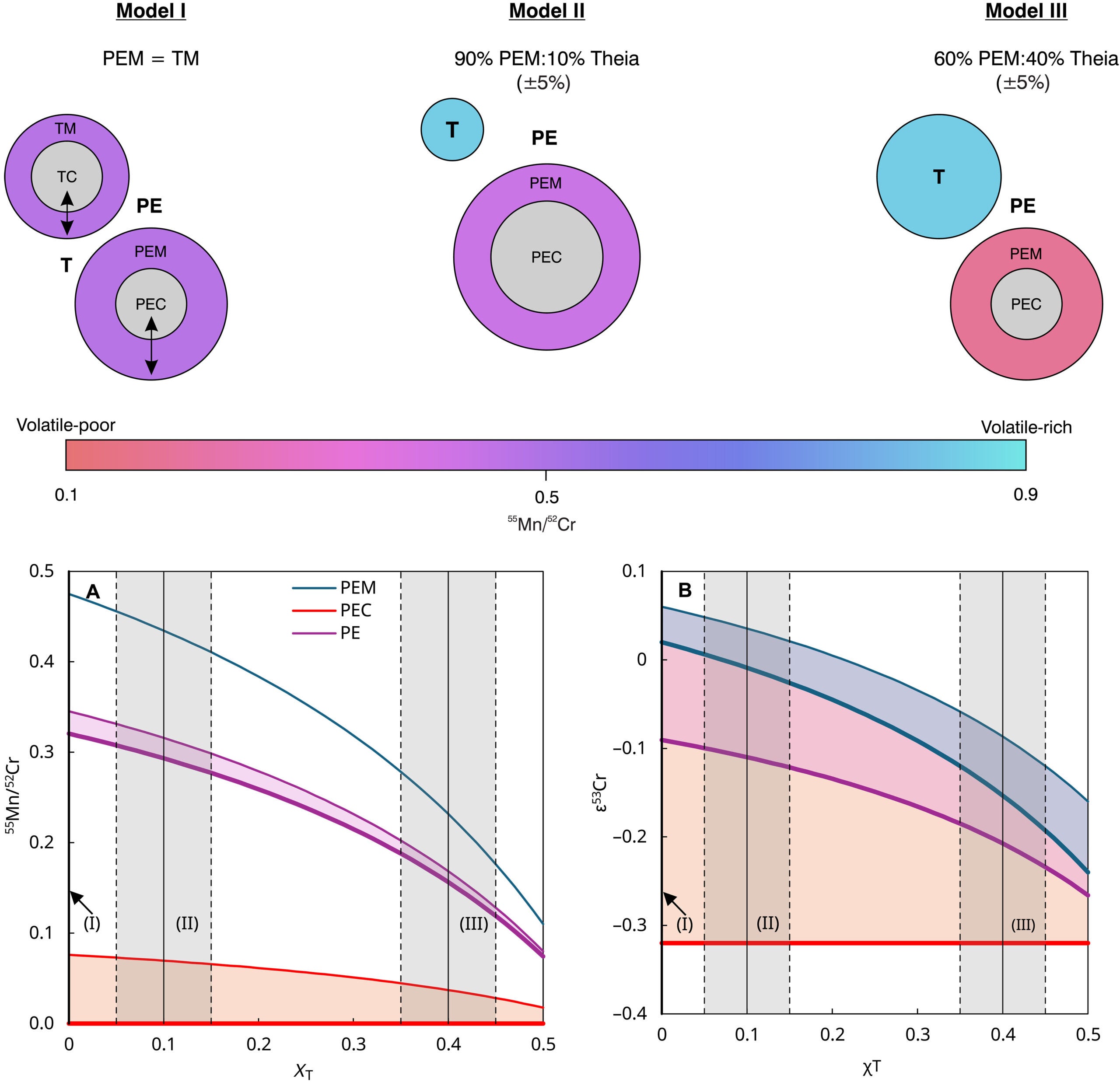
In the team’s modeling, Earth today is not just proto-Earth preserved intact. The present-day bulk silicate Earth likely reflects a mixture of proto-Earth, Theia, and a small late veneer of additional material. One model discussed in the research suggests about 90 percent proto-Earth, 10 percent Theia, and 0.4 percent late veneer. Other models allow much larger contributions from Theia, even around 40 percent.
Those different mixing scenarios matter, but they do not erase the central result. Across the tested cases, proto-Earth’s manganese-chromium fractionation still had to occur no later than about 3 million years after Solar System formation.
So the giant impact did not create Earth’s core chemical identity from scratch. It modified a body whose basic composition had already been set.
What it may have done, according to the researchers, is deliver volatile-rich material in sufficient abundance to transform a dry planet into a habitable one. In some versions of the story, Theia had a composition approaching that of CI chondrites, a volatile-rich class of meteorites. In others, Theia looked more like enstatite meteorites and shared a much closer composition with proto-Earth. That disagreement remains one of the central unresolved questions.
Still, the broader point survives the uncertainty. If proto-Earth began severely depleted in volatiles, then later delivery mattered enormously.
Mezger put the implication starkly: “The Earth’s current friendliness to life is not the result of a continuous evolution but probably the result of an accident, its late impact with an extraterrestrial, water-rich body. This underscores the fact that life-friendliness in the cosmos is by no means a matter of course.”
The study is precise, but it is not simple.
Its dating framework depends on assumptions about the initial distribution of manganese-53 and chromium-53 in the early Solar System, the present-day manganese-to-chromium ratios of hypothetical proto-Earth reservoirs, and the extent to which Theia resembled volatile-rich carbonaceous material or more reduced inner Solar System material. The researchers tested three mixing scenarios to cover much of the range proposed in earlier Earth-Moon formation models.
That is a strength, but also a reminder that the details are still contested.
The paper leaves major open questions: how much material Theia contributed, how volatile compounds survived the heat of the Moon-forming event, and how the Moon ended up with isotope signatures so close to Earth’s in many systems. Giant impact models differ sharply on these points. Some require high angular momentum and large-scale homogenization. Others favor “hit-and-run” outcomes and more similar starting compositions for proto-Earth and Theia.
There is also uncertainty about how proto-Earth lost its volatiles in the first place. The analysis allows for depletion inherited from the solar nebula, depletion during early collisions and magma ocean stages, or some combination.
What the work does rule out is prolonged manganese-chromium fractionation during the later Moon-forming impact. The authors argue that after about 3 million years, proto-Earth’s manganese-chromium system had already mostly stabilized. High escape velocities and short-lived extreme heating during the Earth-Moon event likely limited additional loss of those elements.
That leaves a picture of early chemical sorting followed by later delivery, not one long continuous process.
The deeper implication is unsettling.
A rocky planet may reach chemical maturity quickly and still remain sterile. Habitability, in that view, is not simply what happens once a solid planet forms in the right general neighborhood. It may depend on a second event, late, violent, and far less guaranteed.
That possibility reaches beyond Earth. If many rocky planets become volatile-poor early, then life-friendly worlds may require more than the usual checklist of size, orbit, and temperature. They may also need the right collision history.
The Bern team does not claim to settle how common such histories are. But it does sharpen the question. A planet can be chemically complete and still lack the ingredients that make oceans, atmospheres, and biology possible.
Earth may have become Earth-like in composition almost immediately, while remaining profoundly unlike Earth in every other sense that matters to life.
The study gives planetary scientists a tighter timeline for when Earth’s earliest chemical differentiation took place. That matters because it links the formation of Earth’s main reservoir to the brief lifetime of the protoplanetary disk, rather than to much later events alone.
It also suggests that habitability may depend less on slow, inevitable planetary evolution and more on whether a dry rocky world later receives volatile-rich material. That could influence how researchers think about potentially habitable exoplanets and about what kinds of planetary systems deserve closer attention.
Closer to home, the work sharpens models of the Earth-Moon system by putting stricter limits on when manganese-chromium fractionation could have happened and when it likely stopped. At the same time, it leaves open major questions about Theia’s composition, the mechanics of volatile delivery, and how the Moon retained isotope similarities to Earth. Those unresolved issues mean the study is less a final answer than a firmer frame for the next round of models.
Research findings are available online in the journal Science Advances.
The original story “Ancient impact with Theia may have brought water and life to Earth” is published in The Brighter Side of News.
Like these kind of feel good stories? Get The Brighter Side of News’ newsletter.
The post Ancient impact with Theia may have brought water and life to Earth appeared first on The Brighter Side of News.

