A dark matter signal that appears in one place but not another might look like a contradiction. This new study argues it may be something else entirely.
At the center of the Milky Way, astronomers have long seen an excess of gamma rays, a form of high-energy light. That glow, known as the Galactic Center Gamma-Ray Excess, has remained one of the more intriguing clues in the hunt for dark matter. Some researchers think it could come from dark matter particles annihilating each other. Others argue it may come from more ordinary sources. In particular, they suggest a large population of faint millisecond pulsars could be responsible.
A paper published in the Journal of Cosmology and Astroparticle Physics takes aim at one of the strongest objections to the dark matter idea. If dark matter is causing the gamma-ray excess near the Milky Way’s center, then why do dwarf galaxies, which are also packed with dark matter, not show the same kind of signal?
According to the authors, that absence does not necessarily sink the dark matter case.
Dark matter is thought to make up much of the matter in the universe, yet it has never been seen directly. Researchers infer its presence from gravity. They especially see its influence in the way galaxies rotate and how matter clumps on large scales. Many models treat it as a particle, or a set of particles. These could sometimes collide and annihilate, producing detectable radiation such as gamma rays.
The basic expectation has been fairly simple. If dark matter produces gamma rays in one dark matter-rich place, it should do something similar in another.
That is why dwarf galaxies matter so much. These systems are small, faint, and rich in dark matter. They also have little astrophysical clutter, with fewer stars and less ordinary radiation to confuse the picture. In a standard scenario where dark matter annihilates with a velocity-independent rate, the gamma-ray signal from dwarf galaxies should be much fainter than the one from the Galactic Center. Typically, the difference is by a factor of about 10,000, but it should still follow a predictable relationship.
So if the Milky Way’s center glows and dwarfs stay dark, the usual interpretation starts to wobble.
“What we’re trying to point out in this paper is that you could have a different kind of environmental dependence, even if the annihilation probability is constant in the center of the galaxy,” said Gordan Krnjaic, a theoretical physicist at Fermi National Accelerator Laboratory and one of the study’s authors.
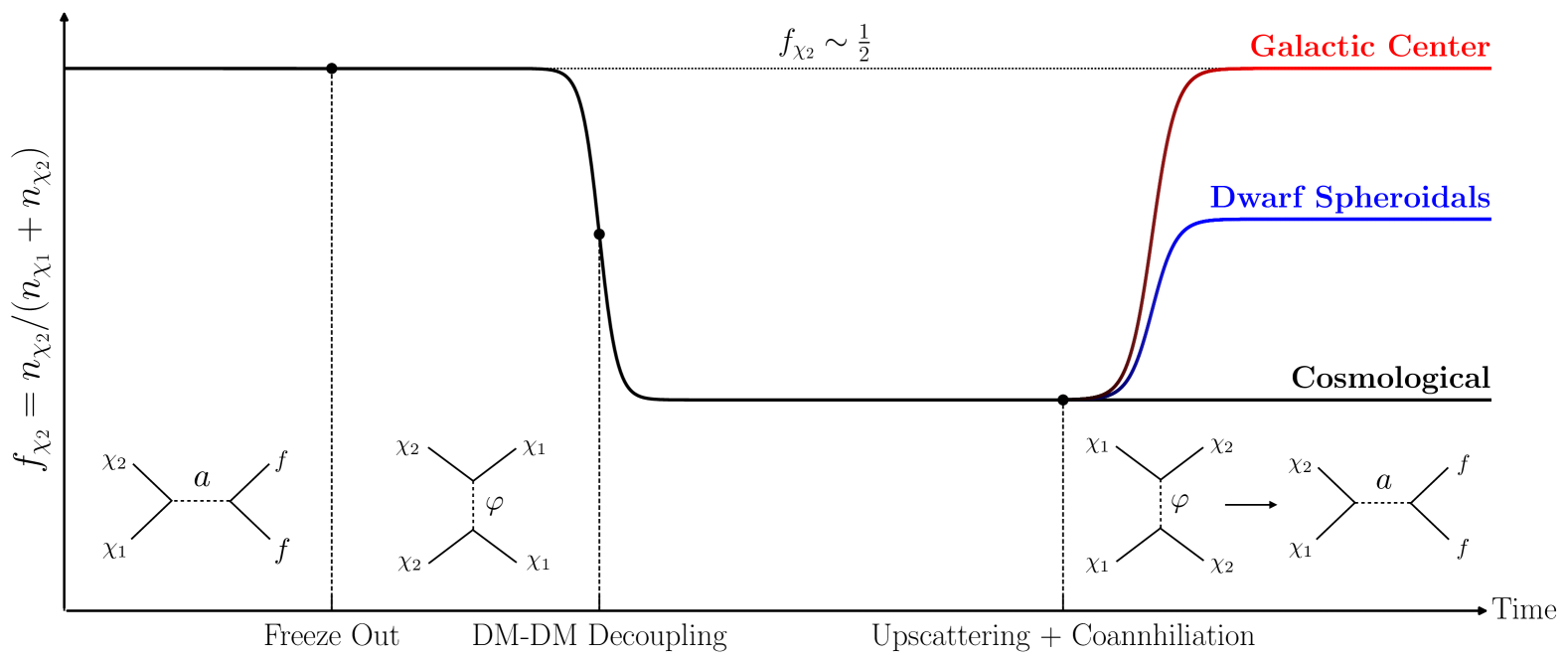
The paper explores a more complicated picture. Instead of one kind of dark matter particle, the model includes two closely related states, labeled χ1 and χ2. There is only a small mass difference between them.
That detail changes the story.
In this setup, the gamma-ray signal does not come from identical particles annihilating each other. It comes from coannihilation, meaning the lighter state and the slightly heavier state must meet. If one of those states is scarce in a given environment, the signal can drop sharply.
“Dark matter could straightforwardly be two different particles, and the two different particles need to find each other in order to annihilate,” Krnjaic said.
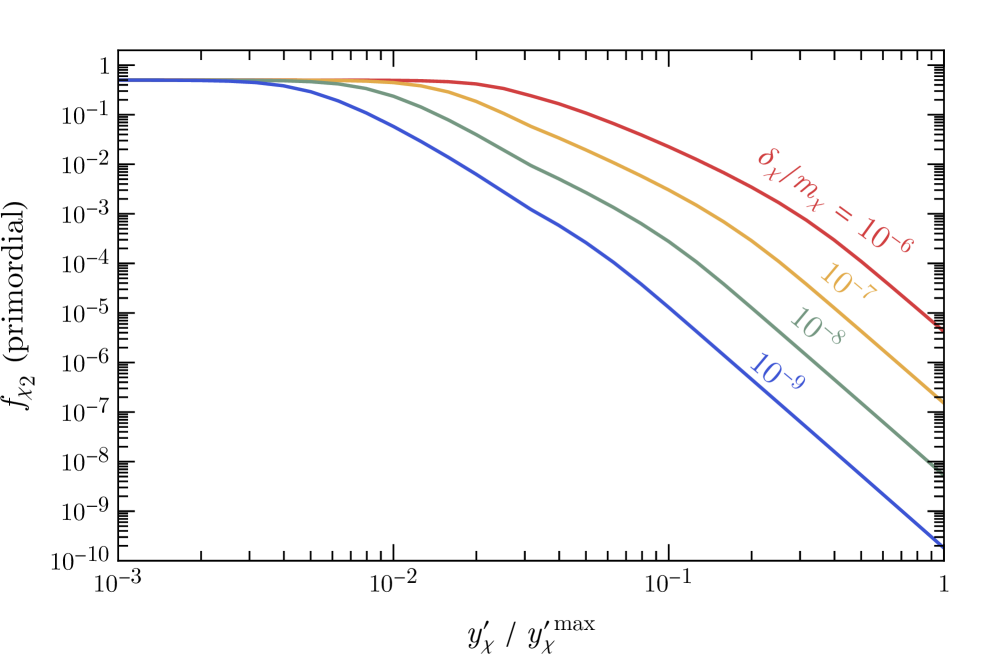
The model suggests that the heavier state was largely depleted early in cosmic history. Later on, it can be regenerated when dark matter particles collide hard enough to kick each other into the excited state. That is easier in places where dark matter particles move faster.
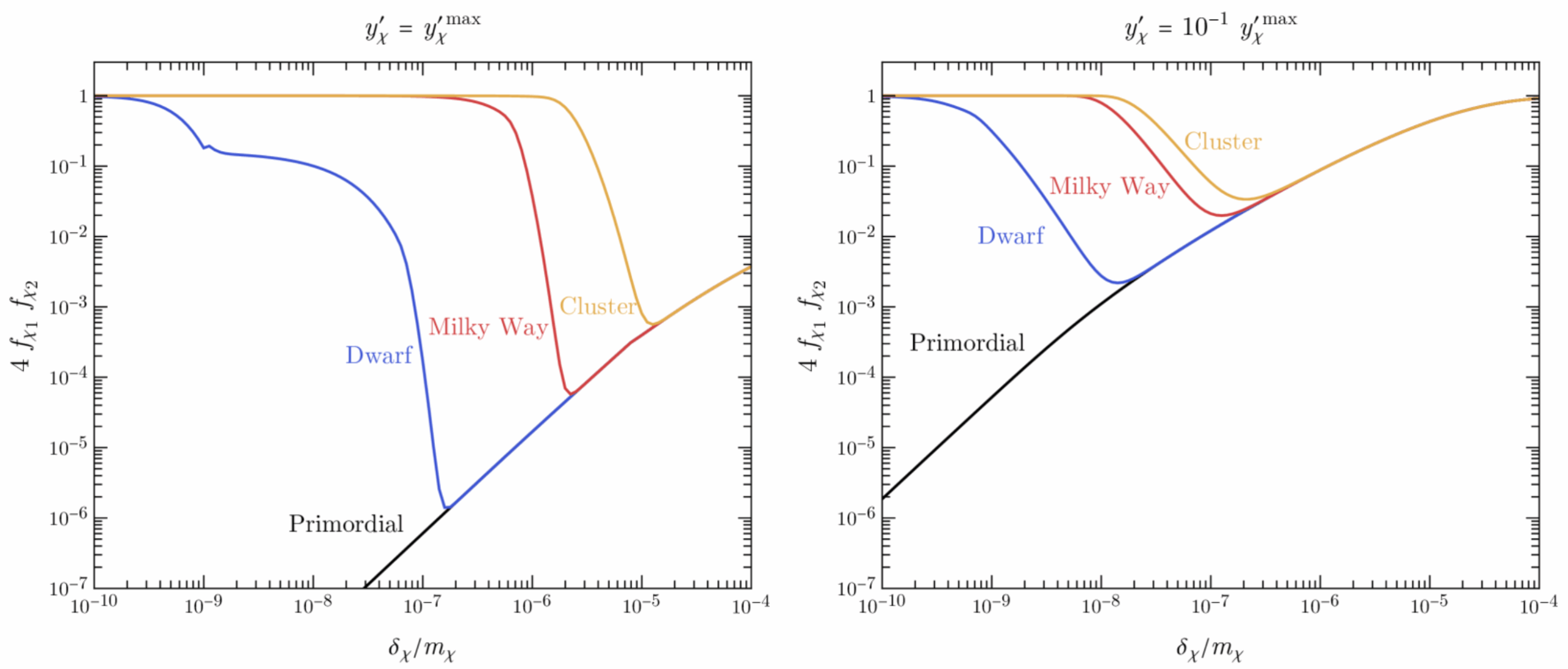
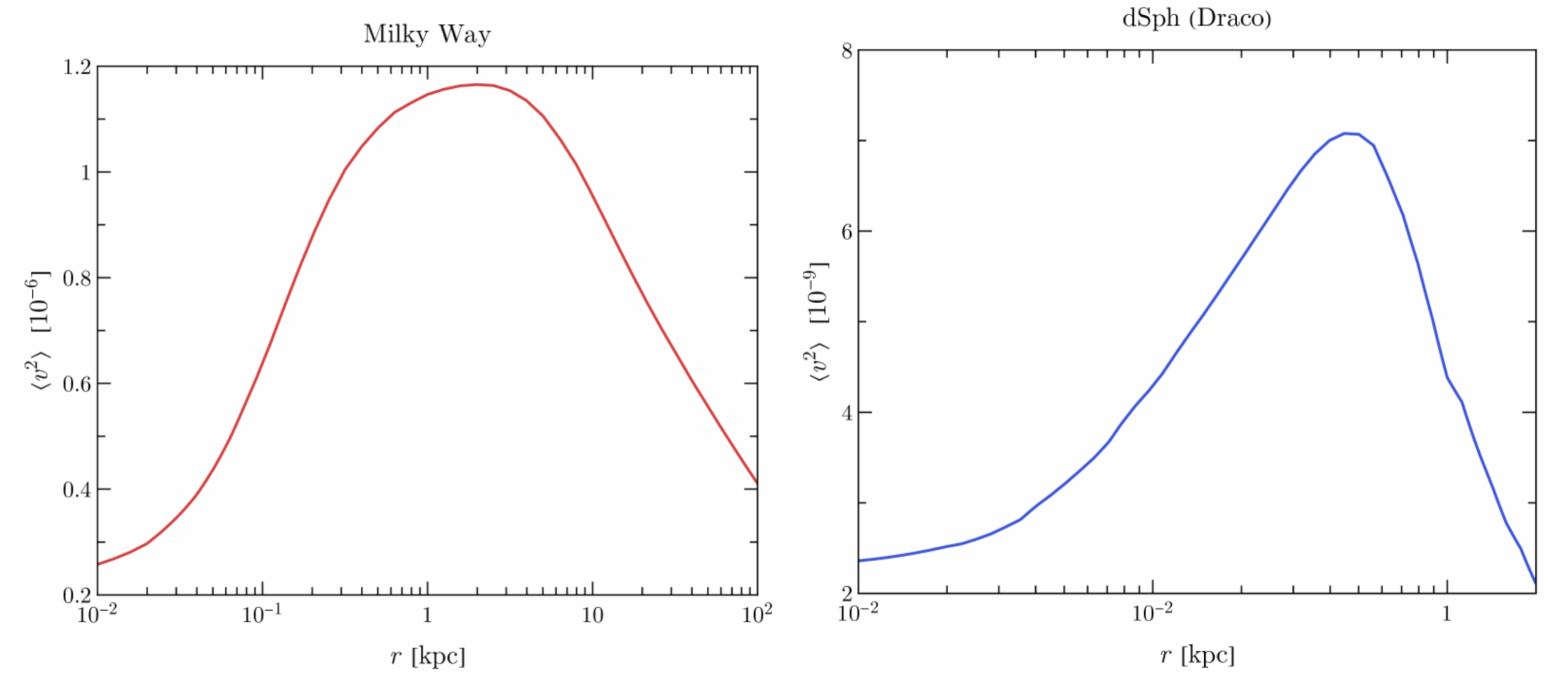
The study points to a striking contrast in those speeds. In dwarf spheroidal galaxies, the characteristic dark matter velocity is far lower than in the Milky Way halo. If the mass splitting between the two states falls in the right range, upscattering into the heavier state can happen efficiently in the Milky Way. In contrast, it can remain suppressed in dwarfs.
That means the Galactic Center could produce a visible gamma-ray signal while dwarf galaxies produce little or none.
The researchers built their analysis around a benchmark dark matter mass of 50 GeV, close to the value often discussed in connection with the Galactic Center excess. In the paper, the excess is described as bright, highly statistically significant, and consistent in spectrum and angular distribution with annihilating dark matter of roughly that mass. The cross section needed to explain it is also close to the familiar thermal relic value, around 10^-26 cubic centimeters per second. That has made the signal especially interesting.
But the paper argues that matching the Galactic Center does not force dwarf galaxies to behave the same way.
In the model, dark matter in the Milky Way halo can be efficiently upscattered into the heavier state, creating the mixed population needed for coannihilation and gamma-ray production. In dwarf galaxies, where the particle motions are much slower, that repopulation process is kinematically suppressed. As a result, the paper finds that this can greatly reduce the effective annihilation signal in dwarfs relative to standard expectations.
The authors also note that this suppression can extend to the epoch of recombination. This helps the scenario avoid some cosmological limits.
There are caveats. Dwarf galaxies are not truly isolated, because they sit inside the larger halo of the Milky Way. The study includes interactions between dwarf dark matter and Milky Way halo dark matter, and finds that these can somewhat regenerate the heavier state in dwarfs under some conditions. Even with that effect included, the overall dwarf signal can remain strongly reduced.
The interpretation is also not unique. Astrophysical backgrounds near the Galactic Center remain a major challenge, and the millisecond pulsar explanation has not gone away.
The paper does not claim to prove that dark matter causes the Galactic Center gamma-ray excess. It claims something narrower, but still important: a future non-detection in dwarf galaxies would not automatically kill the dark matter explanation.
That matters because dwarf galaxies have often been treated as a decisive check. The authors argue that this is only true under simpler assumptions. In particular, they mean the assumption that the effective annihilation rate does not depend on environment in this way.
Future observations could sharpen the test. The Fermi Gamma-ray Space Telescope may improve measurements of dwarf galaxies as more data accumulate. New dwarf galaxies could also be discovered by the Rubin Observatory and other surveys. Farther ahead, the proposed Advanced Particle-astrophysics Telescope could probe even weaker dwarf-galaxy signals.
Even then, the outcome may not be neat. A signal in dwarfs could suggest that the two dark matter states exist there in similar proportions. No signal could mean one state is much rarer. Or something else in the astrophysics could be getting in the way.
That is the uncomfortable part, and also the interesting one. In this version of the dark matter hunt, silence is not empty. It has to be interpreted.
This study could change how astronomers interpret gamma-ray searches for dark matter.
It suggests that missing signals in dwarf galaxies may not be enough, by themselves, to rule out a dark matter explanation for the Milky Way’s gamma-ray excess.
That gives theorists a broader set of models to test. In addition, it means future telescope results may need more careful reading than a simple yes-or-no comparison.
Research findings are available online in the journal arXiv.
The original story “Astronomers discover a mysterious duality in dark matter” is published in The Brighter Side of News.
Like these kind of feel good stories? Get The Brighter Side of News’ newsletter.
The post Astronomers discover a mysterious duality in dark matter appeared first on The Brighter Side of News.


Leave a comment
You must be logged in to post a comment.