A giant planet circling a nearby star has given astronomers a rare look at what a colder, more Jupiter-like world can be like, and the picture is already messier than many models expected.
The planet, called Epsilon Indi Ab, sits far enough from its star to avoid the blistering heat seen on many giant exoplanets studied so far. That alone makes it unusual. Most worlds whose atmospheres have been examined in detail orbit much closer to their stars, which makes them easier to detect but also much hotter than Jupiter. Epsilon Indi Ab is different: cold, massive, and dim, with a temperature estimated at roughly 200 to 300 Kelvin, or about minus 70 to plus 20 degrees Celsius.
That places it much closer to the kind of giant planet astronomers have long wanted to study. It is not a twin of Jupiter, but it is one of the nearest things yet to a true analogue. The new observations suggest that its atmosphere may contain thick, patchy water-ice clouds, a finding that helps explain why the planet does not behave the way simpler atmospheric models said it should.
Elisabeth Matthews of the Max Planck Institute for Astronomy, who led the study, put the broader importance this way: “JWST is finally allowing us to study solar-system analogue planets in detail. If we were aliens, several light years away, and looking back at the Sun, JWST is the first telescope that would allow us to study Jupiter in detail. For studying Earth in detail, we would need much more advanced telescopes, though.”
Exoplanet research has moved in stages. For years, the main goal was simply to find planets around other stars and measure basic properties such as mass or size. That changed with the arrival of the James Webb Space Telescope, which began delivering much sharper atmospheric data for a growing list of distant worlds.
Even so, the planets easiest to study have tended to be hot ones. A common method depends on a planet passing in front of its star from Earth’s point of view, and that geometry is much more likely for planets on tight orbits. Cooler planets, especially those on wider paths more like Jupiter’s, are harder to pin down.
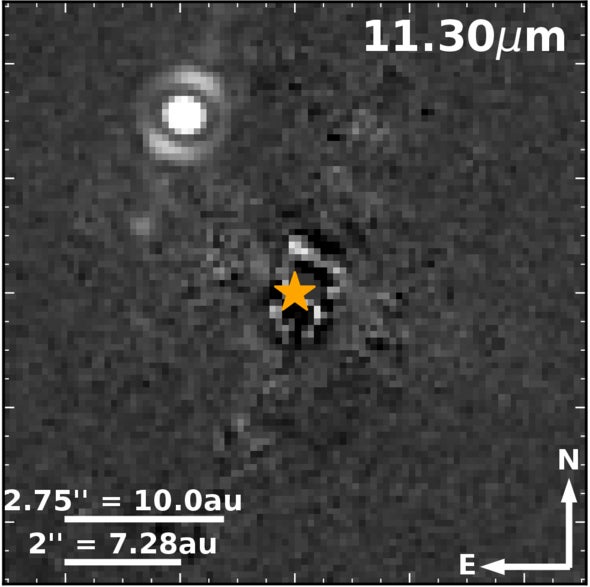
Epsilon Indi Ab offered a chance to do just that. Instead of relying on a transit, the team used direct imaging with Webb’s MIRI instrument. A coronagraph blocked the overwhelming glare of the host star, Epsilon Indi A, allowing the planet’s faint glow to come through. The planet orbits about four times farther from its star than Jupiter does from the Sun, and the star itself is slightly smaller and cooler than the Sun.
Bhavesh Rajpoot, a PhD student at the Max Planck Institute for Astronomy and a member of the team, said, “This planet has a considerably greater mass than Jupiter – the new study fixes its mass at 7.6 Jupiter masses – but the diameter is about the same as for its solar-system cousin.”
That combination makes Epsilon Indi Ab an odd but useful comparison point. It is more massive than Jupiter and still retaining heat from its formation, which is why it remains somewhat warmer than our own gas giant. Over billions of years, it is expected to cool further.
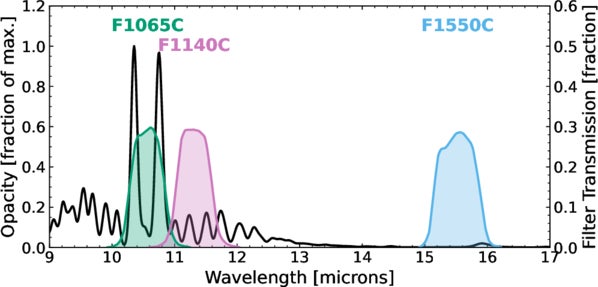
The team focused on a narrow slice of the mid-infrared where ammonia leaves a telltale signature. They took a new image at 11.3 micrometers and compared it with earlier observations at 10.6 micrometers. The difference between those two measurements gave them strong evidence that ammonia is present in the atmosphere.
The signal was statistically strong. The planet’s brightness differed sharply between the two neighboring filters, exactly the kind of contrast expected when ammonia is absorbing light.
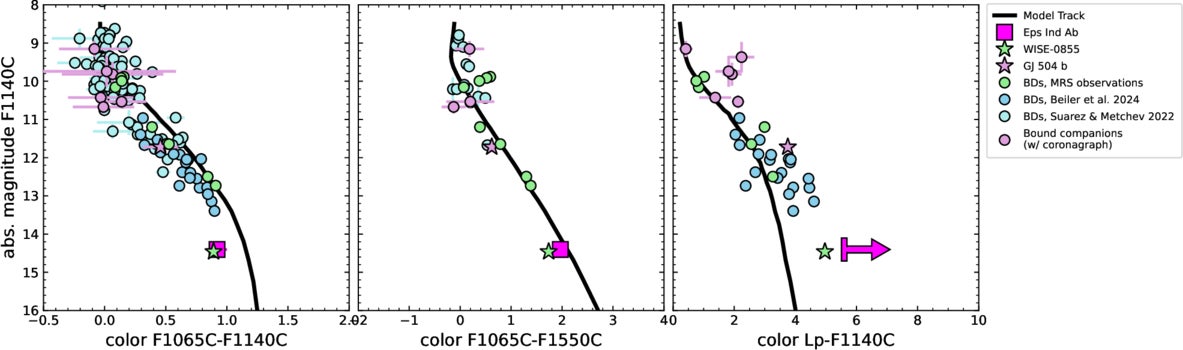
Yet the surprise came in how weak that ammonia feature turned out to be. For a world this cold, cloud-free models predicted a deeper ammonia signature. Instead, the feature appeared shallower than expected.
That mismatch pushed the researchers into a more complicated set of explanations. One possibility was that the planet had lower metallicity, meaning fewer heavy elements in the atmosphere. But that idea runs into trouble because models with low metallicity would also make the planet brighter at wavelengths from 3 to 5 micrometers, and observations have not seen that brightness.
Another option was that nitrogen might be strongly depleted, which could weaken the ammonia feature. The team tested that too. In some models, cutting nitrogen to a small fraction of its expected abundance helped reproduce the ammonia signal. But that explanation also raised questions. The level of depletion needed was extreme, and none of the proposed routes to create it fully matched the observations.
The explanation the researchers favor is thick water-ice clouds.
Those clouds would do two things at once. First, they could reduce the apparent depth of the ammonia feature. Second, they could suppress the planet’s glow at near- and mid-infrared wavelengths, helping explain why the world has been so faint in earlier ground-based observations.
To test that idea, the team built atmospheric models that included water-ice clouds. Those cloudier versions fit the available data much better. In their best-fitting case, the atmosphere held a very optically thick water cloud layer. The cloud-rich model matched the three Webb photometric points and also kept the planet dim enough to remain consistent with earlier non-detections in the 3 to 5 micrometer range.
That still does not solve everything. Even with clouds included, the best fit points to elevated metallicity and a high carbon-to-oxygen ratio, both of which remain difficult to square with current formation models for a planet this massive.
James Mang of the University of Texas at Austin, a co-author of the study, said, “It’s a great problem to have, and it speaks to the immense progress we’re making thanks to JWST. What once seemed impossible to detect is now within reach, allowing us to probe the structure of these atmospheres, including the presence of clouds. This reveals new layers of complexity that our models are now beginning to capture, and opens the door to even more detailed characterization of these cold, distant worlds.”
The cloud idea also gains interest because Epsilon Indi Ab is not alone. The cold brown dwarf WISE 0855 shows a similarly shallow ammonia feature. That raises the possibility that very cold atmospheres may commonly behave this way, which would mean the issue lies not with one strange object, but with the assumptions built into many models.
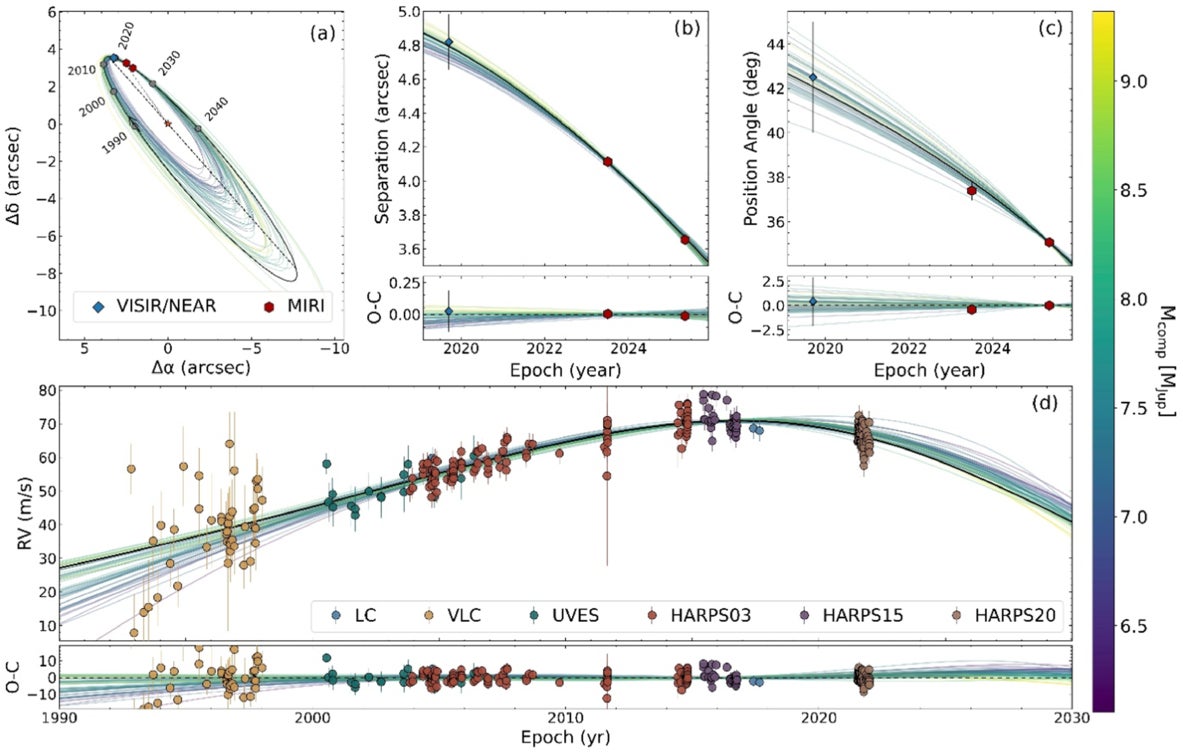
The new observations also settled another question. Epsilon Indi A moves quickly across the sky, which made it possible to test whether the faint point of light was truly orbiting the star or was just a background object. The answer is now clear: the planet shares the star’s motion.
This latest Webb detection is the third time the object has been seen, and the second time with a significance greater than 5 sigma. That common proper motion confirms it is a real companion.
The researchers also updated the planet’s orbit using imaging data, radial velocity measurements, and the host star’s motion tracked by Hipparcos and Gaia. Their revised fit places the planet at 7.6 Jupiter masses, with a somewhat lower eccentricity than earlier estimates suggested. The added Webb data sharpened the orbital picture, especially the inclination.
More observations are already on the horizon. The team notes that future Webb photometry and spectroscopy from 3 to 20 micrometers should help test whether water-ice clouds are truly present and may clarify why the ammonia feature is weaker than expected.
This work matters beyond a single planet. Epsilon Indi Ab is one of the clearest examples yet that cold giant exoplanets can defy simple, cloud-free atmospheric models. If water-ice clouds really are shaping what astronomers see, then future searches for cold planets will need to account for worlds that look much fainter than expected at certain wavelengths.
That affects how scientists plan observations, which filters they choose, and how they interpret what telescopes detect or fail to detect. It also makes upcoming missions more valuable. The Nancy Grace Roman Space Telescope, expected to launch in 2026 or 2027, could be well suited to observing reflective cloud layers more directly.
For now, Epsilon Indi Ab stands as a reminder that getting closer to an Earth-like planet will not just require better telescopes. It will also require better atmospheric models, especially for worlds where clouds hide more than they reveal.
Research findings are available online in The Astrophysical Journal Letters.
The original story “Astronomers find thick water-ice clouds on Jupiter-like exoplanet Epsilon Indi Ab” is published in The Brighter Side of News.
Like these kind of feel good stories? Get The Brighter Side of News’ newsletter.
The post Astronomers find thick water-ice clouds on Jupiter-like exoplanet Epsilon Indi Ab appeared first on The Brighter Side of News.

