A supermassive black hole in the spiral galaxy NGC 3783 just delivered an X-ray surprise that astronomers have never watched unfold so quickly. Using the European Space Agency’s XMM-Newton and the JAXA-led XRISM mission, researchers saw a bright flare rise and fade, and then saw a burst of ultra-fast wind appear within about a day, racing outward at roughly 60,000 kilometers per second, near one-fifth the speed of light.
The lead researcher is Liyi Gu of the Space Research Organization Netherlands (SRON). ESA scientists, including Matteo Guainazzi, XRISM Project Scientist, and ESA XMM-Newton Project Scientist Erik Kuulkers, are also part of the team. Their findings were published in Astronomy & Astrophysics.
“We’ve not watched a black hole create winds this speedily before,” Gu says. “For the first time, we’ve seen how a rapid burst of X-ray light from a black hole immediately triggers ultra-fast winds, with these winds forming in just a single day.”

NGC 3783 hosts a black hole with a mass near 30 million suns. It sits in a bright, active core called an active galactic nucleus, or AGN. As gas and dust spiral in, the region shines across many wavelengths and can throw material outward as winds.
To catch the event in detail, the team ran a coordinated observing campaign in late July 2024 that lasted about 10 days. XRISM led the effort, with support from XMM-Newton and the NuSTAR X-ray telescope, among others. XMM-Newton tracked how the flare changed over time and helped measure the overall strength of the outflow. XRISM, using its high-resolution Resolve instrument, measured the wind’s speed and structure by separating narrow features in the X-ray spectrum that older instruments often blurred together.
“AGNs are really fascinating and intense regions, and key targets for both XMM-Newton and XRISM,” Guainazzi adds.
Across the campaign, the galaxy’s X-ray brightness rose by about 60% in both soft and hard bands. Several flares repeated on a rhythm of about 1.7 days, but one stood out. During that episode, hard X-rays rose first and peaked, while the softer X-rays kept climbing and peaked later. Because the soft peak defined the event, the team labeled it the “soft flare.”
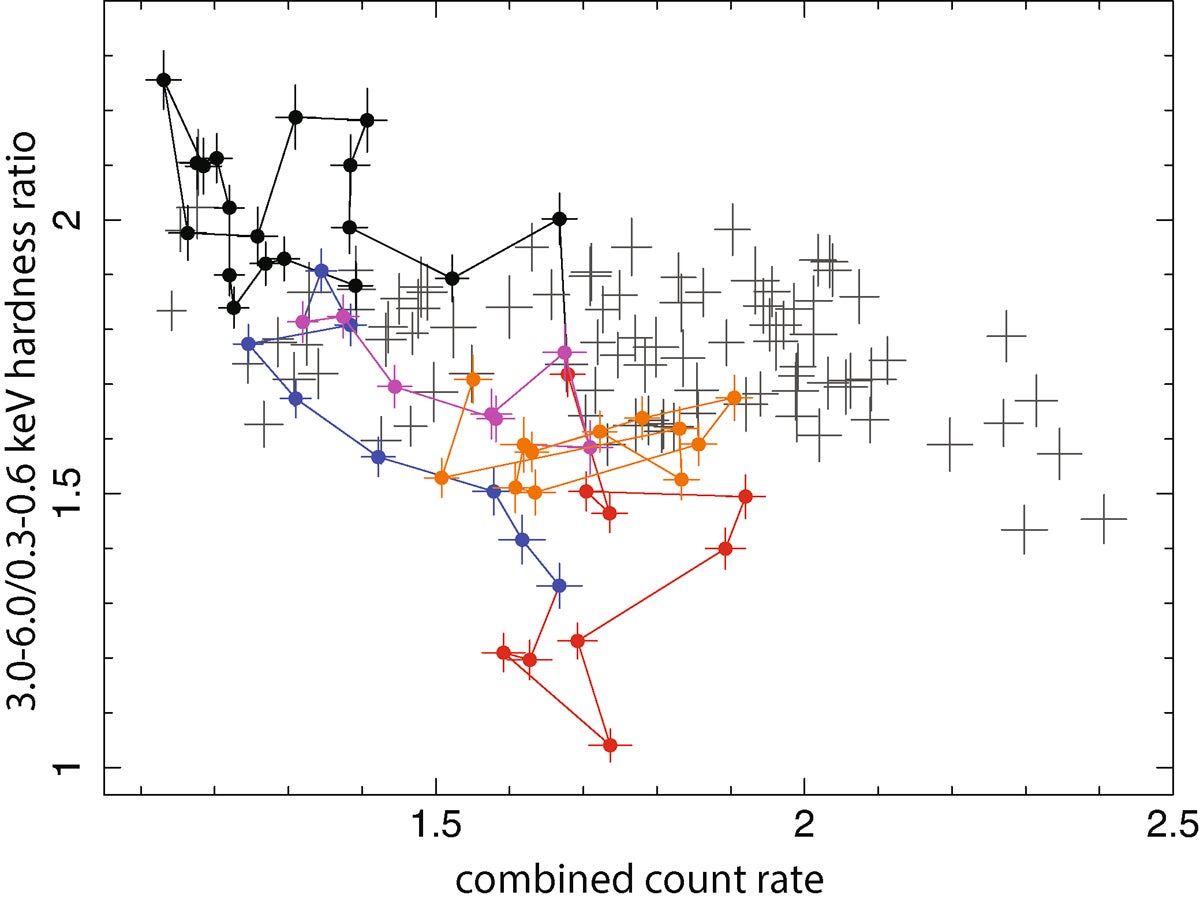
They divided the flare into phases to track rapid changes. The source swung from its hardest spectrum and lowest luminosity into a much softer, brighter state, then bounced between states before calming down. That big change in “hardness” mattered, because ultra-fast outflows can appear and vanish quickly. If you only average the data, the strongest signal can disappear into the blur.
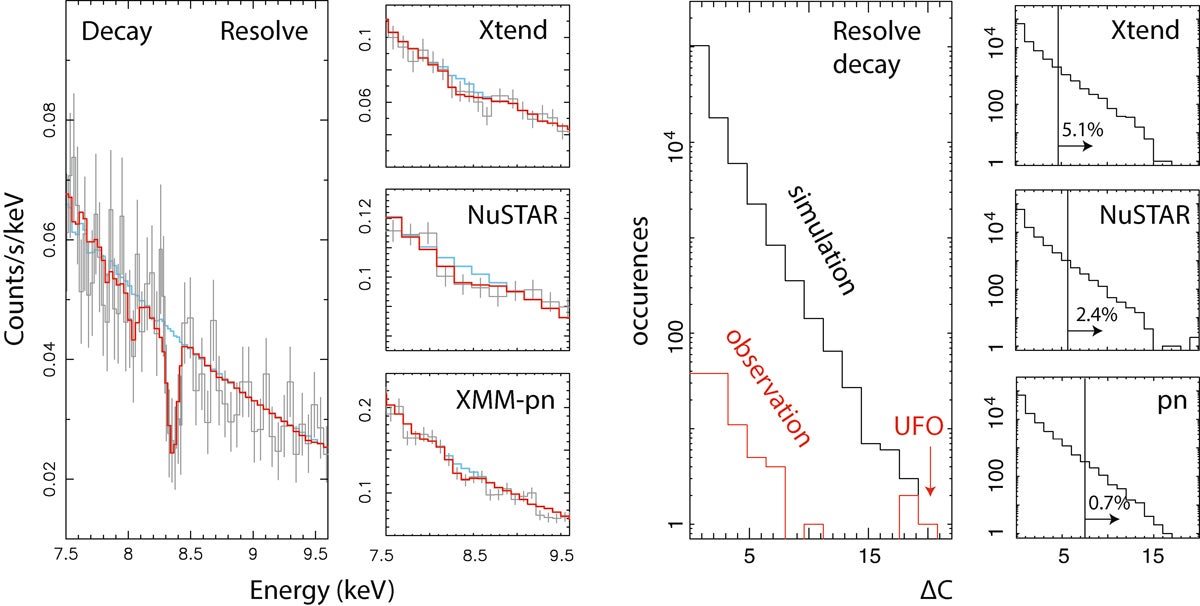
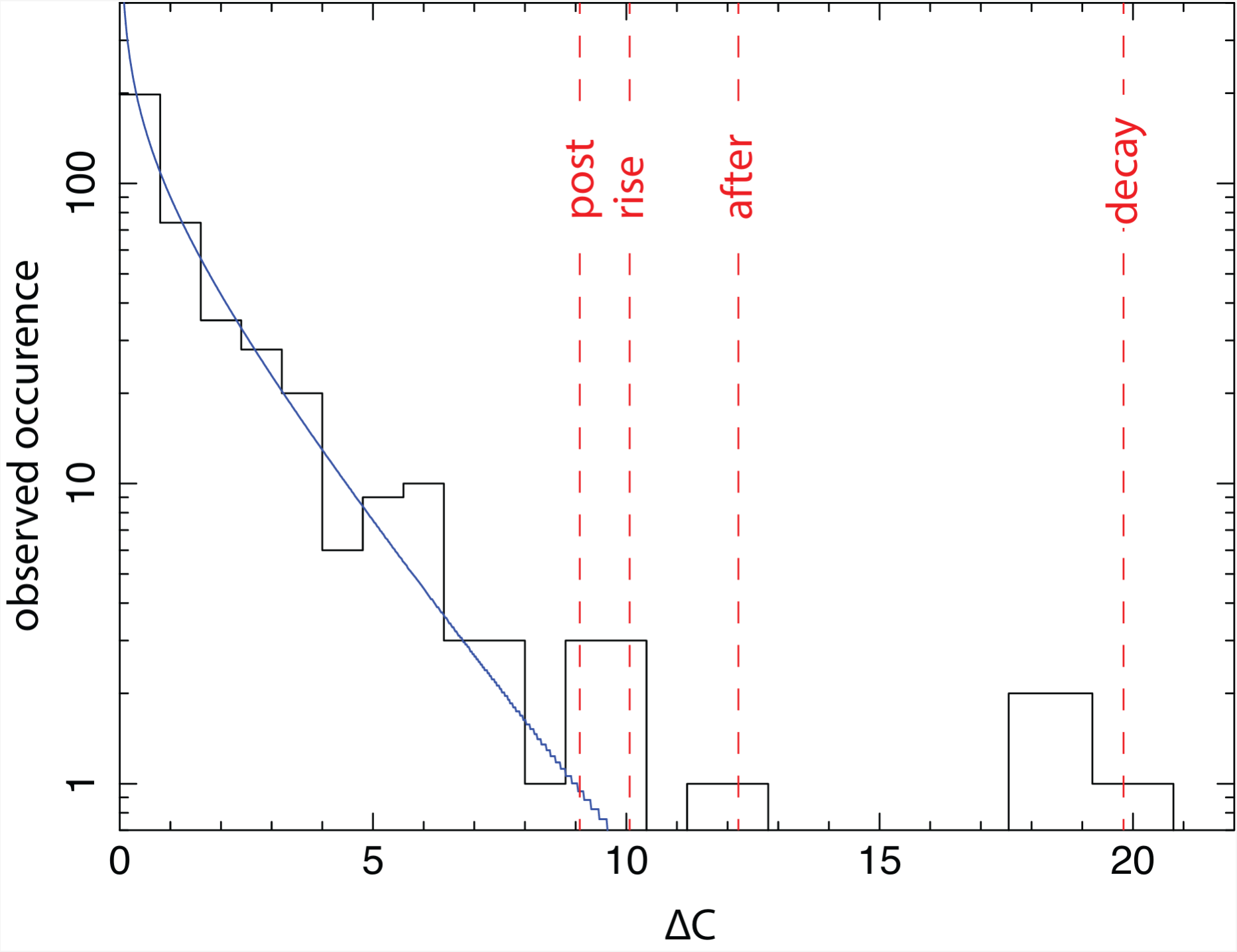
During the flare’s decay phase, Resolve recorded an absorption dip centered near 8.4 keV, a fingerprint of extremely ionized iron absorbing X-rays. The team’s baseline model could not explain it. When they added a photoionized absorber, the fit improved strongly, and the best-fit wind speed came out to 56,780 ± 450 kilometers per second, about 0.19c.
“Other telescopes in the campaign had lower spectral resolution, but they still supported the signal. When our team added the same absorber to data from XRISM’s Xtend detector, XMM-Newton, and NuSTAR, the combined improvement remained significant. Our team also ran extensive simulations to account for the chance of finding a random feature when scanning many energies. After that correction, we reported a very low random probability, consistent with a real detection,” Gu shared with The Brighter Side of News.
In plain terms, the black hole did not just have a fast wind. It built one on a human-friendly timescale, within the same observing run that captured the flare.
The decay phase held another oddity. A narrow iron emission line, Fe Kβ, seemed to disappear on a timescale of about 40 kiloseconds. The team argues that a true change in the line’s normal ratio would be too extreme and too fast for a distant reflector. Instead, they tested whether extra absorption near 7 keV could hide the line.
That idea worked. A second absorber with a much slower speed, about 3,720 ± 480 kilometers per second, improved the fit. It is faster than the galaxy’s usual “warm absorber” winds, but far slower than the ultra-fast outflow. The pattern suggests a messy environment where multiple layers of gas can cross the line of sight.
The team also saw hints that the ultra-fast wind may be clumpy. Column density stayed modest through most phases, but jumped during the decay phase, consistent with a denser pocket of gas moving across the view. Because the wind’s covering factor is uncertain, the true density could be higher than the simplest model suggests.
This work matters because the launch mechanism for ultra-fast outflows remains unsettled. Winds can be driven by heat, radiation, magnetic forces, or a mix. In many AGNs with relatively modest accretion rates, the gas is so ionized that radiation has trouble pushing it efficiently through line driving. That makes magnetic driving a strong candidate.
“The winds around this black hole seem to have been created as the AGN’s tangled magnetic field suddenly ‘untwisted’ – similar to the flares that erupt from the sun, but on a scale almost too big to imagine,” Guainazzi says.
The team’s timing supports a two-stage picture that resembles solar coronal mass ejections, where a slow rise is followed by fast acceleration. During the flare, they also noted a modest UV increase that followed the soft X-ray peak, consistent with a broader disturbance in the system.
“By zeroing in on an active supermassive black hole, the two telescopes have found something we’ve not seen before: rapid, ultra-fast, flare-triggered winds reminiscent of those that form at the sun,” Kuulkers says.
“Windy AGNs also play a big role in how their host galaxies evolve over time, and how they form new stars,” adds Camille Diez, an ESA Research Fellow and team member. “Because they’re so influential, knowing more about the magnetism of AGNs, and how they whip up winds such as these, is key to understanding the history of galaxies throughout the universe.”
Catching an ultra-fast outflow forming in near real time changes what you can test. Instead of debating whether a wind existed in an averaged spectrum, researchers can now link a specific flare to the wind that followed and measure how quickly the gas responded. That helps narrow down the physics that launches these outflows, especially the role of magnetic reconnection and short, impulsive acceleration.
Over time, better measurements of wind speed, density, and geometry will sharpen estimates of how much momentum and energy these outflows carry. That is central to “AGN feedback,” the idea that black holes can reshape their host galaxies by heating or pushing out star-forming gas.
As XRISM and XMM-Newton continue coordinated monitoring, you can expect more time-resolved “cause and effect” cases like this one, which should improve models of how galaxies grow and when star formation gets shut down.
Research findings are available online in the journal Astronomy & Astrophysics.
Like these kind of feel good stories? Get The Brighter Side of News’ newsletter.
The post Astronomers watch a supermassive black hole X-ray flare ignite an ultra-fast galactic wind appeared first on The Brighter Side of News.

