On November 12, 2025, a ripple passed through the fabric of spacetime and triggered alarms at three gravitational-wave observatories across two continents. The signal, catalogued as S251112cm, was unusual in a way that stopped astrophysicists cold: at least one of the objects that created it appeared to weigh less than the sun.
No known stellar process produces a black hole that small. Stars that collapse into black holes leave remnants several times the sun’s mass, at minimum. Something lighter has only one plausible origin, an object that formed not from a dying star but from the raw density of the universe itself, fractions of a second after the Big Bang.
Two researchers at the University of Miami believe they now have a framework to explain what LIGO may have found.
Nico Cappelluti, an associate professor in the Department of Physics, and Ph.D. student Alberto Magaraggia have published research in the Astrophysical Journal building a quantitative case that the November signal is consistent with a primordial black hole, a class of objects first proposed by Soviet physicists Yakov Zeldovich and Igor Novikov and later expanded upon by Stephen Hawking in the early 1970s.
Primordial black holes, if they exist, would have formed during a period known as the QCD epoch, a phase transition in the early universe when quarks combined to form protons and neutrons. The physics of that moment would have briefly softened the equation of state of the cosmos, allowing regions of extreme density to collapse directly into black holes across a wide range of masses, from asteroid-sized objects all the way up to supermassive giants.
The connection to one of cosmology’s deepest puzzles runs directly through that mass range. Dark matter, the invisible substance that makes up roughly 85 percent of all matter in the universe, has never been directly detected. Primordial black holes could account for a significant portion of it, or potentially all of it.
“Our research indicates that these primordial black holes could account for a significant portion, if not all, of dark matter,” Cappelluti said.
The Miami team’s approach was to test whether the scarcity of the LIGO signal was actually a problem or a prediction. Sub-solar black hole mergers, if primordial black holes exist at the expected abundance, should be rare. The fact that only one candidate has appeared across more than four years of gravitational-wave observations is not a strike against the theory; it is what the theory would lead you to expect.
“We attempted to estimate how many primordial black holes may exist in the universe and how many of them LIGO should be able to detect,” Magaraggia said. “Our results are encouraging. We predict that subsolar black holes like the one LIGO may have observed should indeed be rare, consistent with how infrequently such events have been seen so far.”
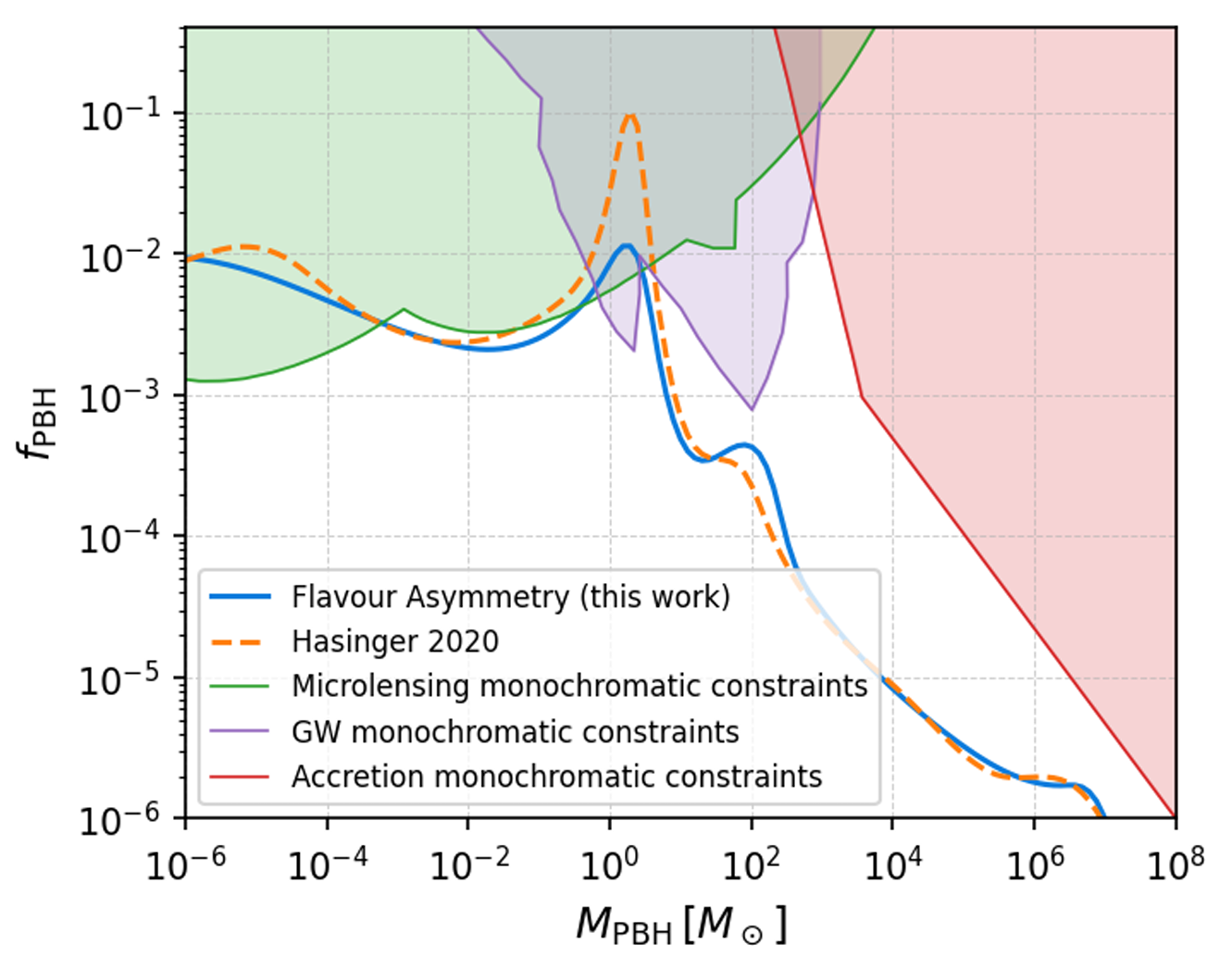
Working from an extended mass function that accounts for the physics of the early universe, including the effects of lepton-flavor asymmetries, the researchers calculated a predicted detection rate for an instrument with LIGO’s sensitivity. Their figure sits comfortably within the statistical range implied by a single observed detection. The numbers fit.

Importantly, their model also allows them to work the argument in reverse. Rather than assuming a particular abundance of primordial black holes to generate a predicted rate, they used the observed rate to constrain how abundant those objects could be.
The result places a conservative lower limit on the fraction of dark matter that primordial black holes could represent. Even in the most cautious statistical scenario, the signal is consistent with primordial black holes making up a meaningful share of the universe’s dark matter content.
The researchers are careful about what their work does and does not establish. The November signal still carries a false alarm rate of roughly once every four years, and the final parameter analysis from the LIGO collaboration had not been publicly released at the time of publication. The chirp mass estimate, which places the lighter object firmly in sub-solar territory, could still shift when full offline analysis is completed.
Alternative explanations exist. Sub-solar neutron stars from rare stellar processes are theoretically possible, though the probability that S251112cm involved a neutron star is estimated below 8 percent.
Extensive electromagnetic follow-up by multiple teams across optical and high-energy wavelengths found no kilonova counterpart in the detection region, which would be expected if a neutron star were involved. Every candidate source identified was either classified as a supernova or inconsistent with the distance constraints of the event.
“LIGO picked up what is very strong evidence that these types of black holes exist. But we’ll need to detect another such signal or even several others to get the smoking-gun confirmation that they are real,” Cappelluti said. “What is clear is that they cannot be excluded as being real.”
The next phase depends heavily on what the detectors find next.
LIGO, which first detected gravitational waves in September 2015, is scheduled for future upgrades that will increase its sensitivity, potentially widening the window for detecting rare sub-solar events. But the technology that could truly resolve the question is still years away.
The European Space Agency’s Laser Interferometer Space Antenna, set to launch in 2035, is designed to detect gravitational waves from the earliest epochs after the Big Bang. A proposed U.S. ground-based facility called Cosmic Explorer, currently in design, would be ten times more sensitive than LIGO.
For researchers and cosmologists tracking the dark matter problem, those instruments represent the next real test. If primordial black holes are responsible for even a fraction of the universe’s missing mass, future detectors should accumulate enough sub-solar merger events to move the question from plausible to proven.
For now, one anomalous signal from November sits at the center of a calculation that has held up under scrutiny, waiting for the universe to repeat itself.
Research findings are available online in the journal Astrophysical Journal.
The original story “Astrophysicists are close to proving the existence of primordial black holes” is published in The Brighter Side of News.
Like these kind of feel good stories? Get The Brighter Side of News’ newsletter.
The post Astrophysicists are close to proving the existence of primordial black holes appeared first on The Brighter Side of News.


Leave a comment
You must be logged in to post a comment.