A dark point inside a wave of light sounds like a contradiction. It is also something researchers say they have now viewed in real time, moving so quickly that, by one measure, it outran light itself.
That claim comes from a team led by researchers at the Technion-Israel Institute of Technology, whose study in Nature describes direct measurements of what they call optical phase singularities, tiny spots where a light wave’s amplitude falls to zero.
These “dark points,” also known as vortices, are not bits of matter. They do not carry energy or information. That is why, the team says, their motion can appear to exceed light speed without violating Einstein’s limit.
The work confirms a theoretical idea dating back to the 1970s. Physicists had long predicted that singularities inside wave fields could show extreme, even formally unbounded, velocities, especially when pairs of opposite-charge singularities are created or annihilated. Until now, that prediction had remained out of experimental reach.
“This breakthrough provides us with a powerful technological tool,” said Prof. Ido Kaminer of the Technion’s Andrew and Erna Viterbi Faculty of Electrical and Computer Engineering. He said the new method could help scientists map delicate nanoscale phenomena in materials and study hidden processes in physics, chemistry and biology.
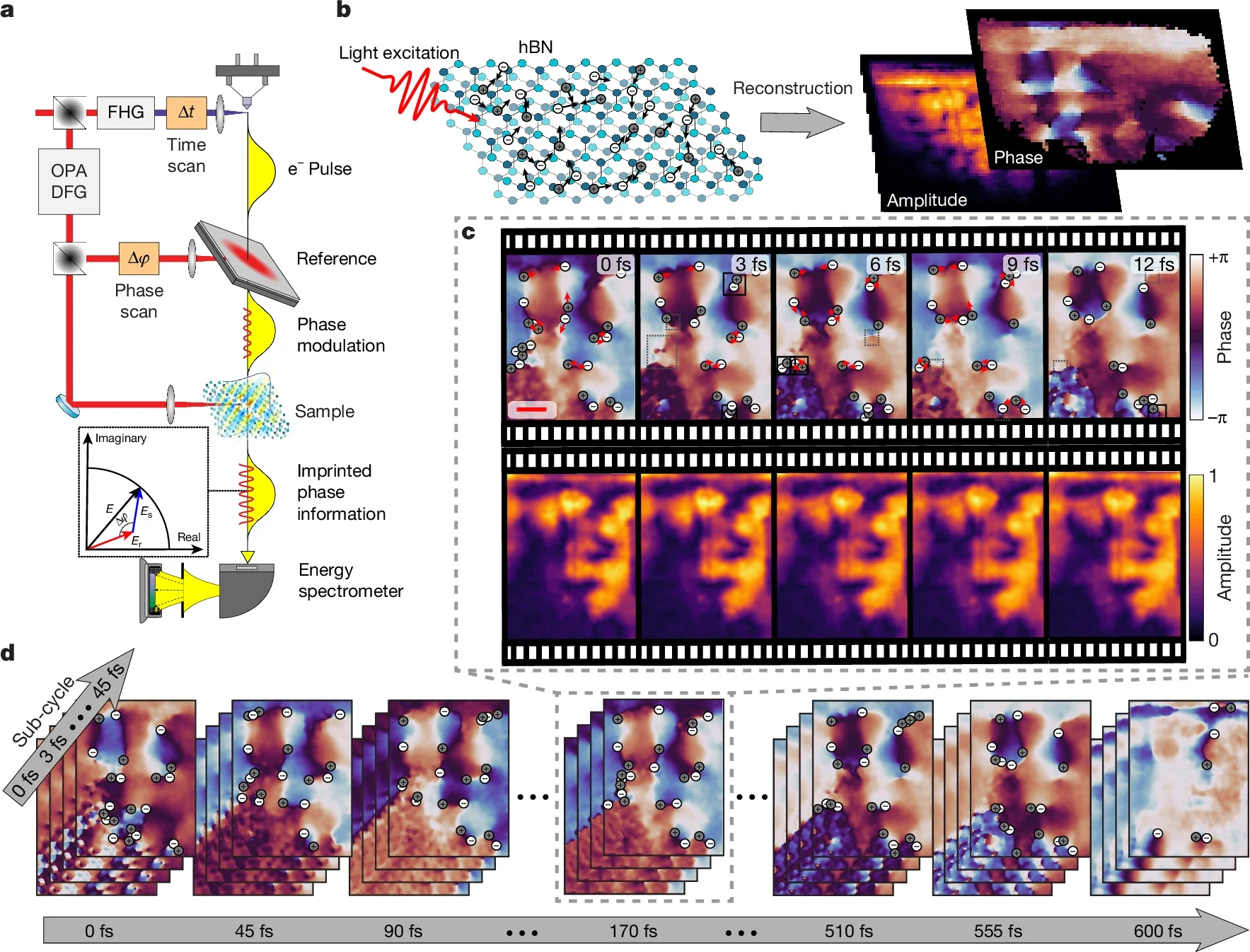
The experiment focused on hexagonal boron nitride, or hBN, a material prepared by Prof. Hanan Herzig Sheinfux of Bar-Ilan University. In that material, light can turn into hyperbolic phonon-polaritons, hybrid wave packets sometimes described as “light-sound” waves. They move much more slowly than light in a vacuum, more than 100 times slower in this case, which made them easier to examine with unusual precision.
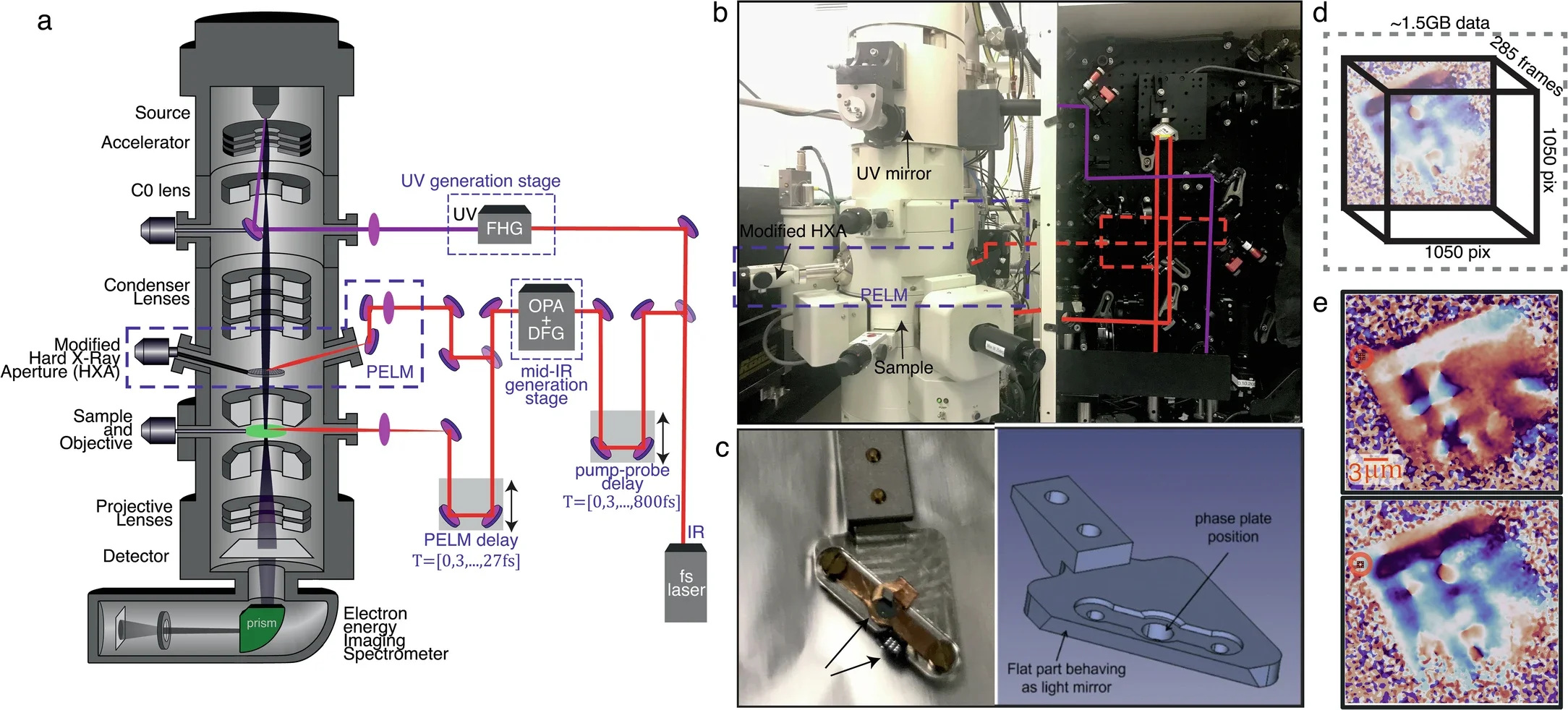
To capture the waves, the team built a specialized microscopy setup at the Technion’s Electron Microscopy Center. It combined a laser system, opto-mechanical components and an ultrafast transmission electron microscope. The system reached a spatial resolution of 20 nanometers and a temporal resolution of 3 femtoseconds, enough to follow events that play out within a fraction of a light-wave cycle.
That mattered because singularities are not static marks. They appear, move, pair up and disappear inside complicated interference patterns. In the Technion experiment, the researchers tracked about 50 singularities per frame across a 21 by 21 micrometer field of view over 800 femtoseconds, analyzing 285 phase-resolved frames.
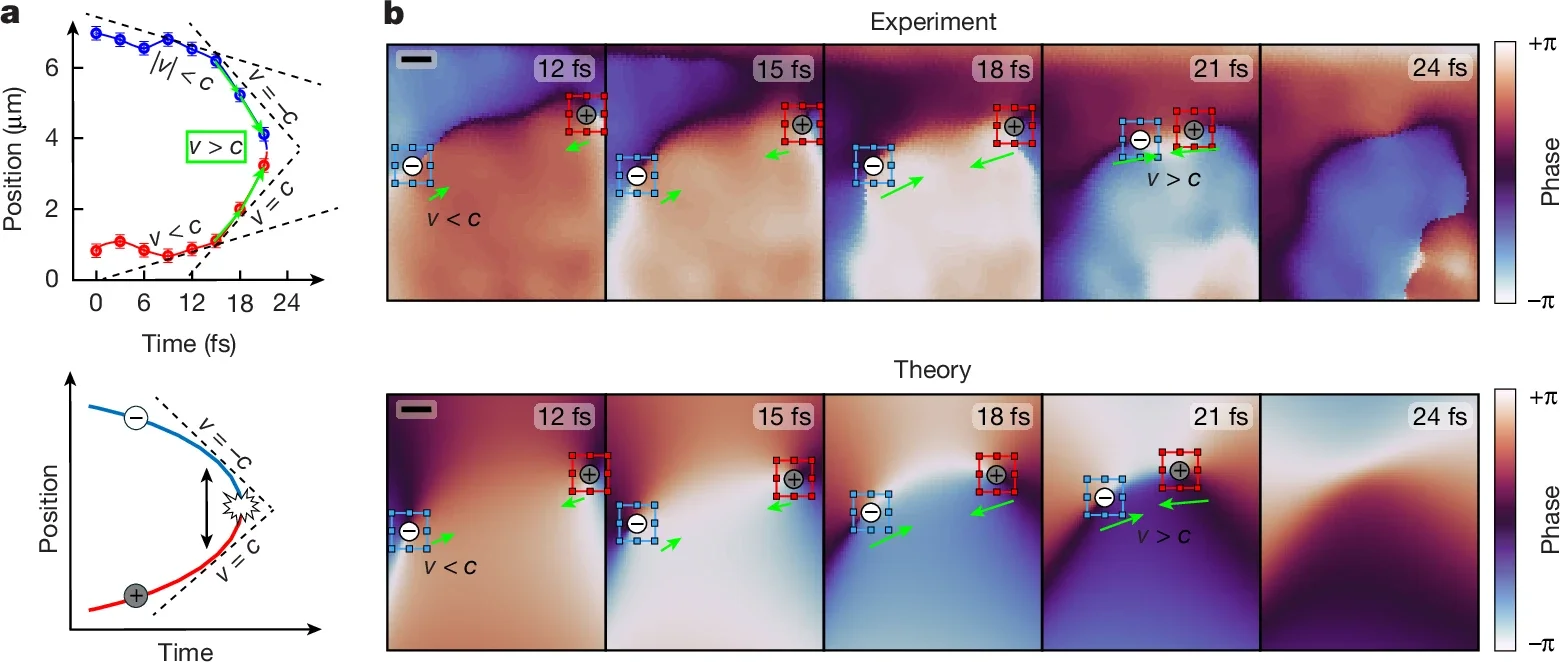
One annihilation event stood out. As two oppositely charged singularities rushed toward each other, their trajectories forced them into a sharp acceleration just before they vanished. The motion looked superluminal, exactly the sort of extreme behavior theory had predicted.
The researchers stress that the result does not break relativity. Einstein’s speed limit applies to objects with mass and to signals that carry energy or information. These singularities are neither. They are zero points in the wave field, places of complete darkness inside light.
That strange status helps explain why physicists have long compared singularities to particles, but only up to a point. They carry topological charge, either positive or negative, and opposite charges can annihilate each other, much like particle-antiparticle pairs. Earlier experiments had already shown that their spatial arrangement resembles the short-range order seen in liquids.
This study went further by measuring how fast the singularities move. The team found a heavy-tailed velocity distribution, meaning extreme speeds were not rare outliers. The average singularity velocity was measured at about 3.12 × 10^8 meters per second, or roughly 1.04 times the speed of light in vacuum.
According to the paper, 29 percent of the singularities in their system exceeded light speed. In free space, under the same laser parameters, theory suggested that figure would drop to just 0.4 percent.
That difference came from the special properties of the hBN platform. Its slow group velocity broadened the distribution of possible singularity speeds, making extreme events much easier to catch.
The researchers argue that the finding is not just about one optical material. Singularities show up across physics, from superconductors and crystal defects to fluid vortices and superfluids. The team says the same underlying mathematics can govern these systems, even if the details differ.
Still, the study has limits. The experiment examined singularities in two-dimensional random Gaussian waves, not every kind of wave system. The fastest observable singularity speeds were also capped by the current microscope’s spatial and temporal resolution.
Some regions in the data did not contain enough events to produce reliable statistics. And the paper notes that extending this kind of imaging into three-dimensional near fields remains a major technical challenge.
Even with those caveats, the result opens a new window on motion that normally stays hidden. The same microscopy approach could be used to study polaritons in other two-dimensional materials, probe more complex topological states and possibly improve electron holography and related imaging methods.
The immediate value of the work is not faster-than-light technology. It is better measurement.
By tracking ultrafast nanoscale changes inside wave fields, this method could sharpen microscopy, improve studies of nanostructured optics and superconductors, and help researchers explore new ways of encoding quantum information in materials.
Research findings are available online in the journal Nature.
The original story “Darkness can move faster than light without breaking relativity” is published in The Brighter Side of News.
Like these kind of feel good stories? Get The Brighter Side of News’ newsletter.
The post Darkness can move faster than light without breaking relativity appeared first on The Brighter Side of News.


Leave a comment
You must be logged in to post a comment.