A cloud of water larger than anything ever seen in space has turned up around one of the brightest objects in the early universe. The reservoir surrounds the quasar APM 08279+5255, a blazing source powered by a supermassive black hole more than 12 billion light-years from Earth.
The scale is hard to grasp. Astronomers estimated that the water there equals about 140 trillion times the volume of Earth’s oceans. It is also the most distant water reservoir ever detected, placing it in a period when the universe was far younger than it is today.
That alone made the finding unusual. What made it more revealing was the setting. The water is not sitting quietly in a cold cloud. It exists in a harsh, energized region around a black hole with a mass about 20 billion times that of the sun. The quasar’s total energy output matches roughly a thousand trillion suns, flooding nearby gas with radiation.
“The environment around this quasar is very unique in that it’s producing this huge mass of water,” said Matt Bradford of NASA’s Jet Propulsion Laboratory. “It’s another demonstration that water is pervasive throughout the universe, even at the very earliest times.”
Bradford led one of the teams behind the work, published in Astrophysical Journal Letters.
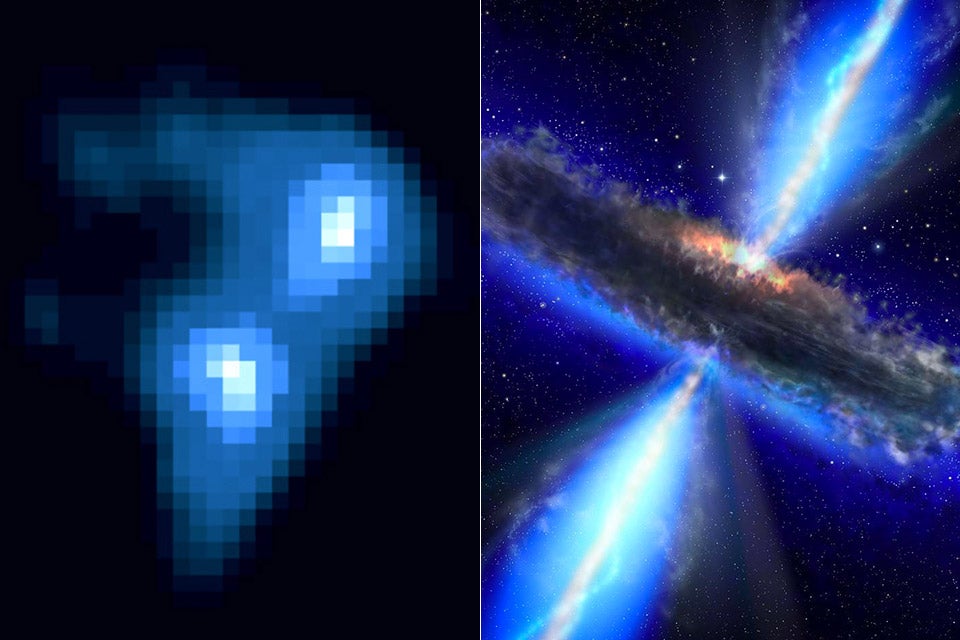
Astronomers had expected water vapor to exist in deep space, but not on this scale and not at such distance. The Milky Way contains water vapor too, yet in amounts about 4,000 times smaller than what appears to surround this quasar. Much of the water in our own galaxy is locked up as ice, which makes the newly measured vapor reservoir stand out even more.
In APM 08279+5255, the water stretches across a gaseous region spanning hundreds of light-years. The quasar bathes that gas in intense infrared radiation and X-rays, creating conditions far more extreme than those found in ordinary interstellar clouds.
Even so, the numbers are striking. The gas is measured at minus 63 degrees Fahrenheit, which sounds frigid but is still about five times hotter than what is typical in galaxies. It is also between 10 and 100 times denser than normal galactic gas. In that environment, water vapor becomes a powerful clue to what is happening inside the quasar’s surrounding material.
The black hole itself is still feeding. Gas around it could keep fueling its growth until it becomes six times more massive, according to the research. But that gas may not all fall inward. Some of it could collapse into new stars, while some may be pushed out into space by the quasar’s fierce energy.
Water does more than mark the presence of oxygen and hydrogen. Under the right conditions, it can help astronomers trace how radiation moves through gas and dust, and how energy changes the chemistry of a distant object.
In this case, Bradford’s team studied the water vapor spectrum, measuring several transitions from the quasar with Z-Spec at the California Institute of Technology’s Submillimeter Observatory on Mauna Kea in Hawaii. They began those observations in 2008. Follow-up work came from the Combined Array for Research in Millimeter-Wave Astronomy, or CARMA, in California’s Inyo Mountains.

A second team, led by Dariusz Lis of Caltech, used the Plateau de Bure Interferometer in the French Alps. Lis’s group first detected water in APM 08279+5255 in 2010 by accident. Bradford’s team then filled in a more detailed picture by detecting multiple spectral signatures, allowing them to better estimate the amount and behavior of the water.
The observations suggested that the water was not being excited mainly by collisions among gas particles. Instead, the quasar’s powerful dust glow appears to be pumping energy into the water molecules. That matters because it ties the water directly to the quasar’s radiation field and helps explain how such a large volume of gas can stay active over a broad region.
The same observations also included carbon monoxide, another important tracer of galactic gas. Together, the water and carbon monoxide showed that the quasar is doing more than shining brightly. It is remaking its surroundings.
The analysis points to gas spread over scales larger than 200 parsecs, roughly in the same range as a 550-parsec structure inferred from carbon monoxide imaging. The total mass of water vapor is estimated at at least about 25,000 times the mass of the sun. That is at least 50 times the amount modeled in the galaxy Mrk 231, which had already been known as an extreme case.
The water appears to be mixed into a huge molecular gas reservoir. The broader gas mass in APM 08279+5255 has been estimated at about 100 billion solar masses after correcting for lensing. That helps explain how the system can support so much vapor, provided the radiation field is strong enough to excite it.
The work also adds to a larger idea in astronomy. Water is common across the universe, turning up in interstellar clouds, protoplanetary disks, comets, asteroids, planetary atmospheres, and some exoplanets. But this quasar shows that water was already present in extraordinary amounts in the early universe, inside one of its most violent environments.

That does not mean the region is hospitable. It is anything but. Still, the finding shows that the basic ingredients and processes tied to water chemistry were already widespread when the cosmos was much younger.
These are vast regions of gas and dust in space where stars are born. Water exists in the form of ice on dust grains and as water vapor within these clouds.
One well-known interstellar cloud where scientists have found water is the Orion Nebula (Messier 42 or M42). The Orion Nebula is a massive star-forming region located about 1,344 light-years away from Earth.
Observations using various telescopes, including the Herschel Space Observatory, have detected water in the form of both ice and vapor within this nebula.
The Herschel Space Observatory, in particular, has identified water vapor in the warm gas surrounding newly formed stars in the Orion Nebula, providing insights into the processes that lead to the formation of water in interstellar space.
These are disks of gas and dust that surround young stars and eventually form planets. Water ice is commonly found in these disks and can be incorporated into forming planets and other celestial bodies.

One notable protoplanetary disk where scientists have found water is around the young star PDS 70. This star system, located about 370 light-years away from Earth in the constellation Centaurus, has been extensively studied due to its two forming planets and the presence of water in its protoplanetary disk.
Observations made using the Atacama Large Millimeter/submillimeter Array (ALMA) detected water vapor within the disk, providing crucial insights into the processes of planet formation and the distribution of water in young planetary systems.
These icy bodies originate from the outer regions of planetary systems, such as the Kuiper Belt and the Oort Cloud in our solar system. Comets are rich in water ice, which sublimates (turns into gas) when they approach the Sun, creating their characteristic tails.
Scientists have found water on several comets, with one of the most notable examples being Comet 67P/Churyumov-Gerasimenko. The European Space Agency’s Rosetta mission, which included the Philae lander, made significant discoveries about the composition of this comet, including the presence of water.
The Rosetta spacecraft detected water vapor being released from the comet’s nucleus as it approached the Sun. The mission provided detailed measurements of the water content and other volatile substances on Comet 67P/Churyumov-Gerasimenko, enhancing our understanding of the role comets play in delivering water to planetary bodies.
Another example is Comet Hartley 2 (103P/Hartley). Observations by NASA’s EPOXI mission revealed that the water in this comet has a similar isotopic composition to Earth’s oceans, suggesting that comets like Hartley 2 could have contributed to the delivery of water to Earth.

Some asteroids, particularly those in the outer regions of the asteroid belt, contain significant amounts of water in the form of hydrated minerals or ice.
One of the asteroids where scientists have found water is Ceres, the largest object in the asteroid belt between Mars and Jupiter.
NASA’s Dawn mission, which orbited Ceres from 2015 to 2018, detected water vapor on Ceres. The spacecraft found that the surface of Ceres has a significant amount of water ice and identified evidence of a subsurface ocean, making it a key object of interest in the study of water in the solar system .
Planets and moons, especially those in the habitable zones around their stars, can have substantial amounts of water. Earth is a prime example, with abundant liquid water on its surface. Other bodies, like Europa (a moon of Jupiter) and Enceladus (a moon of Saturn), have subsurface oceans beneath their icy crusts.
Water has been detected in the atmospheres of some exoplanets (planets outside our solar system). These detections are often made using spectroscopy, which can identify water vapor by its unique absorption lines in the light spectrum.
One notable exoplanet where scientists have found water is K2-18b. Located about 124 light-years away in the constellation Leo, K2-18b is a super-Earth that orbits within the habitable zone of its star. In 2019, scientists detected water vapor in the atmosphere of K2-18b using data from the Hubble Space Telescope.
This discovery marked the first time water had been identified in the atmosphere of an exoplanet within the habitable zone, where conditions might be right for liquid water to exist on the surface .

Water in the universe is primarily formed through chemical reactions between hydrogen and oxygen, the two most abundant elements. In the cold environments of space, these reactions can lead to the formation of water ice on dust grains, which then coalesce to form larger bodies containing water.
This finding gives astronomers a new way to study how supermassive black holes affect the gas around them. Water vapor can act as a probe of temperature, density, and radiation, helping researchers test how these powerful systems grow and how they shape nearby matter.
It also pushes water studies much farther back in cosmic time. By showing that water was abundant around a quasar more than 12 billion light-years away, the research expands what astronomers can measure in the early universe and sharpens future searches for complex chemistry in distant galaxies.
Research findings are available online in the Astrophysical Journal Letters.
The original story “Deep-space water reservoir contains trillions of times more water than all Earth’s oceans combined” is published in The Brighter Side of News.
Like these kind of feel good stories? Get The Brighter Side of News’ newsletter.
The post Deep-space water reservoir contains trillions of times more water than all Earth’s oceans combined appeared first on The Brighter Side of News.

