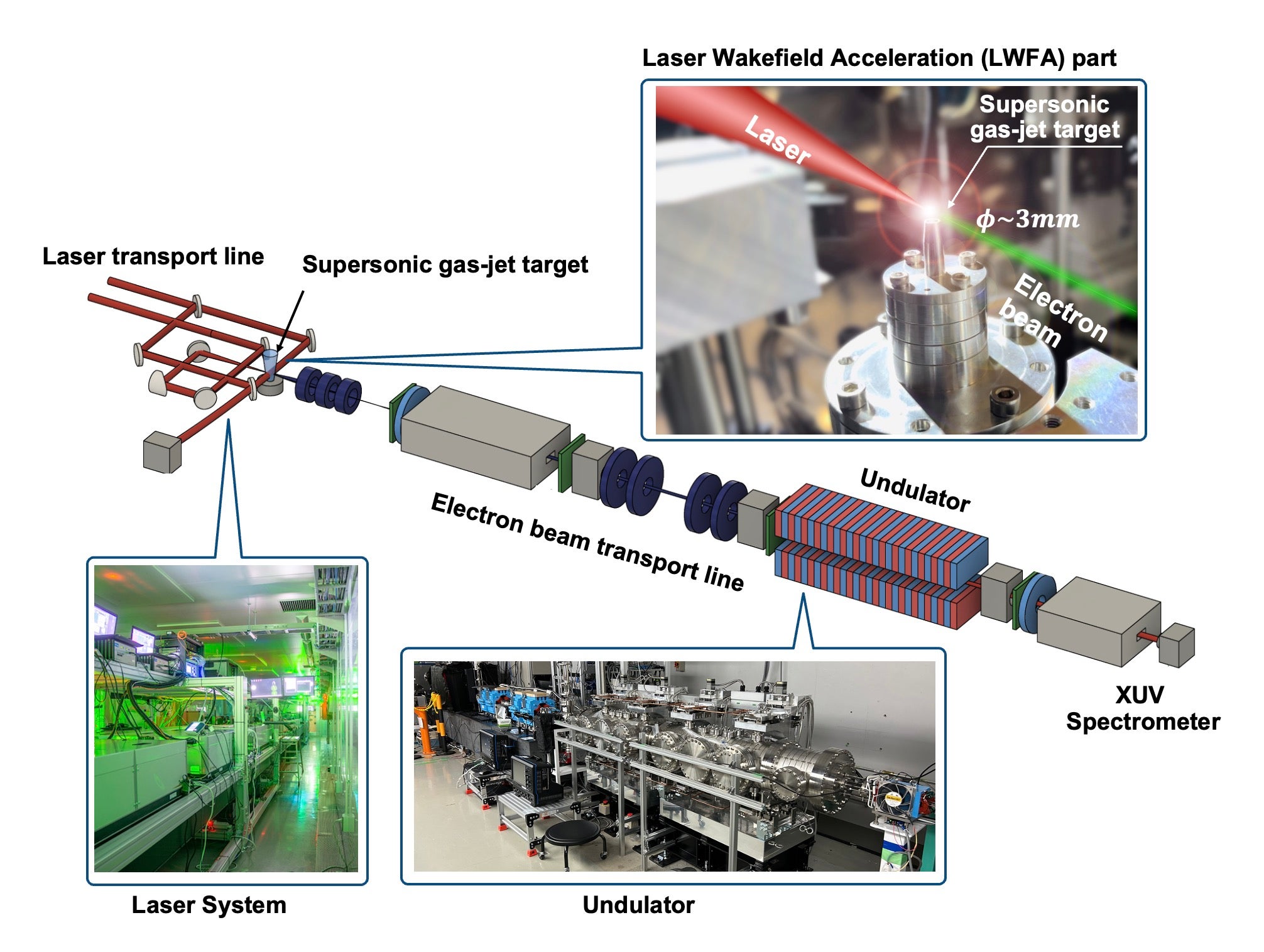
A beam of electrons crossed just a few millimeters of plasma, then helped trigger an effect that usually belongs to massive research sites. In this case, the light produced fell in the extreme ultraviolet range, at wavelengths from 27 to 50 nanometers. The result points toward a future where some accelerator technology may shrink from building-sized systems to something much smaller.
That is the promise behind a new demonstration led by researchers at the University of Osaka’s Institute of Scientific and Industrial Research, working with collaborators at the Kansai Institute for Photon Science, the National Institutes for Quantum Science and Technology, the RIKEN SPring-8 Center, and KEK. Their focus was laser wakefield acceleration, a method that uses an ultraintense laser pulse to drive waves through plasma. This method creates electric fields strong enough to accelerate electrons over extremely short distances.
“Our work has made several substantial improvements over previous techniques, allowing us to achieve free-electron laser amplification at extreme ultraviolet wavelengths,” lead author Zhan Jin said.
Traditional particle accelerators, including radiofrequency linear accelerators and synchrotrons, have pushed physics forward for decades. They are also expensive, physically large, and limited in how strongly they can accelerate particles over a given distance.
Laser wakefield acceleration offers a very different path. Instead of relying on long conventional structures, it sends a powerful laser through plasma, where it creates a trailing wave. Electrons can ride that wave and gain energy quickly. According to the researchers, the accelerating fields in this setup can exceed 100 gigavolts per meter. This is more than 1,000 times stronger than those in conventional accelerators.
The challenge has always been control.
Free-electron lasers need very clean electron beams, with tight energy spread, stable pointing, and enough consistency from shot to shot to survive transport into an undulator, the magnetic structure that generates intense, coherent radiation. Laser wakefield accelerators have struggled on that front because the plasma and the laser can both fluctuate.
“Laser wakefield acceleration has long been considered impractical, because of the difficulty in stabilizing the plasma it relies on,” senior author Tomonao Hosokai said.
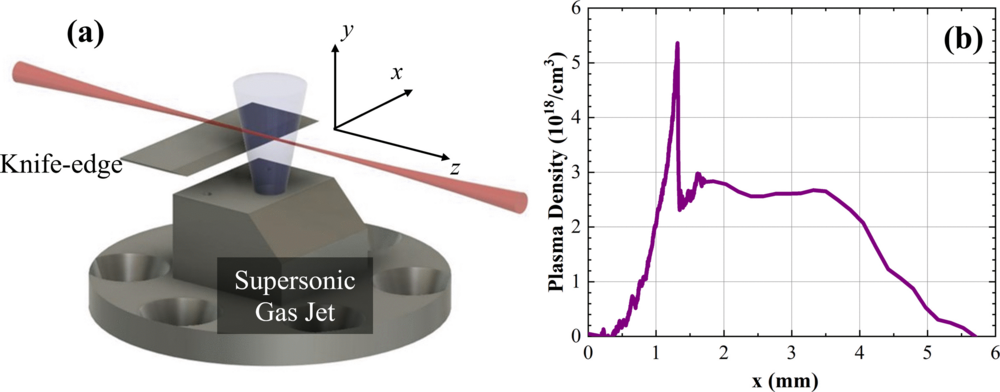
To improve stability, the team worked on several parts of the system at once. They used a supersonic hydrogen gas jet and a knife edge to create a shock wave that tightly controlled where electrons were injected into the plasma wake. That mattered because a short, well-defined injection region helps keep the beam energy spread low.
They also improved the laser wave front. One simple but effective step was adding a circular mask before the focusing mirror. That cut wave front instability by about 50%, though it also reduced laser energy from 800 to 600 millijoules. Even with that tradeoff, electron pointing stability improved dramatically, from 10 milliradians without the mask to 1.3 milliradians with it.
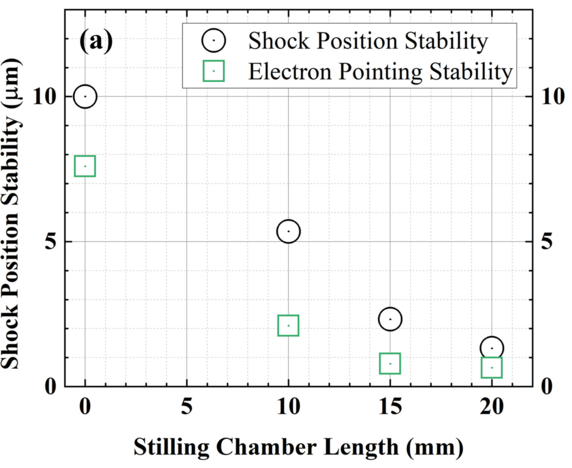
The team also redesigned gas nozzles to calm turbulence. A longer stilling chamber improved gas-density stability by a factor of four and shock-position stability by nearly an order of magnitude. Those changes helped steady the electron beam itself.
By balancing injection charge, beam loading, and a process called phase rotation, the researchers generated monoenergetic electron beams with an energy spread below 1%, energies near 400 megaelectronvolts, pointing stability below 0.5 milliradians, and energy stability below 6%. In one optimized case, they measured an energy spread of 0.7%, though they noted that spectrometer limits may have affected the estimate. A deconvolution suggested the spread could be as low as about 0.2%. However, the team said that would need confirmation with a higher-resolution instrument.
After generating the beam, the researchers sent it through a 9-meter beamline and into a 2-meter undulator with 80 periods. There, they observed a free-electron laser gain of 20 times in the extreme ultraviolet range.
That matters because free-electron lasers are among the brightest light sources available. The researchers noted that x-ray free-electron lasers can produce coherent x-rays 10 billion times brighter than the sun and emit ultrashort femtosecond pulses. Today, those machines are restricted to large facilities.
This new result does not yet deliver a compact x-ray free-electron laser, but it does show that laser wakefield acceleration can amplify radiation in the XUV range. This is a crucial first step toward shorter wavelengths.
The study also included checks to make sure the gain was real. When the team inserted a thin aluminum foil to degrade the electron beam and suppress self-amplification, the radiation followed the expected linear pattern of spontaneous emission instead of the stronger nonlinear growth seen in the main experiments.
Even so, the work has clear limits. The amplification still fluctuated, the beam remained sensitive to alignment, and the researchers said laser quality still needs further improvement. Some simulation inputs also had to be adjusted to reproduce the observed gain. This included narrowing the assumed energy spread from 0.8% to 0.5%.
If this technology becomes reliable, it could move powerful light sources out of a few giant facilities and into ordinary research settings.
The team said compact accelerators and x-ray free-electron lasers could support work in life sciences, materials science, semiconductor development, and quantum science.
That would change who gets to use them. Small laboratories could run experiments that now require access to large accelerator centers, making advanced imaging and ultrafast measurements far more accessible.
Research findings are available online in the journal Physical Review Research.
The original story “Desktop particle accelerators are opening new frontiers in physics” is published in The Brighter Side of News.
Like these kind of feel good stories? Get The Brighter Side of News’ newsletter.
The post Desktop particle accelerators are opening new frontiers in physics appeared first on The Brighter Side of News.


Leave a comment
You must be logged in to post a comment.