A stone tomb near Paris held generations of dead, but the people buried there did not all belong to the same world.
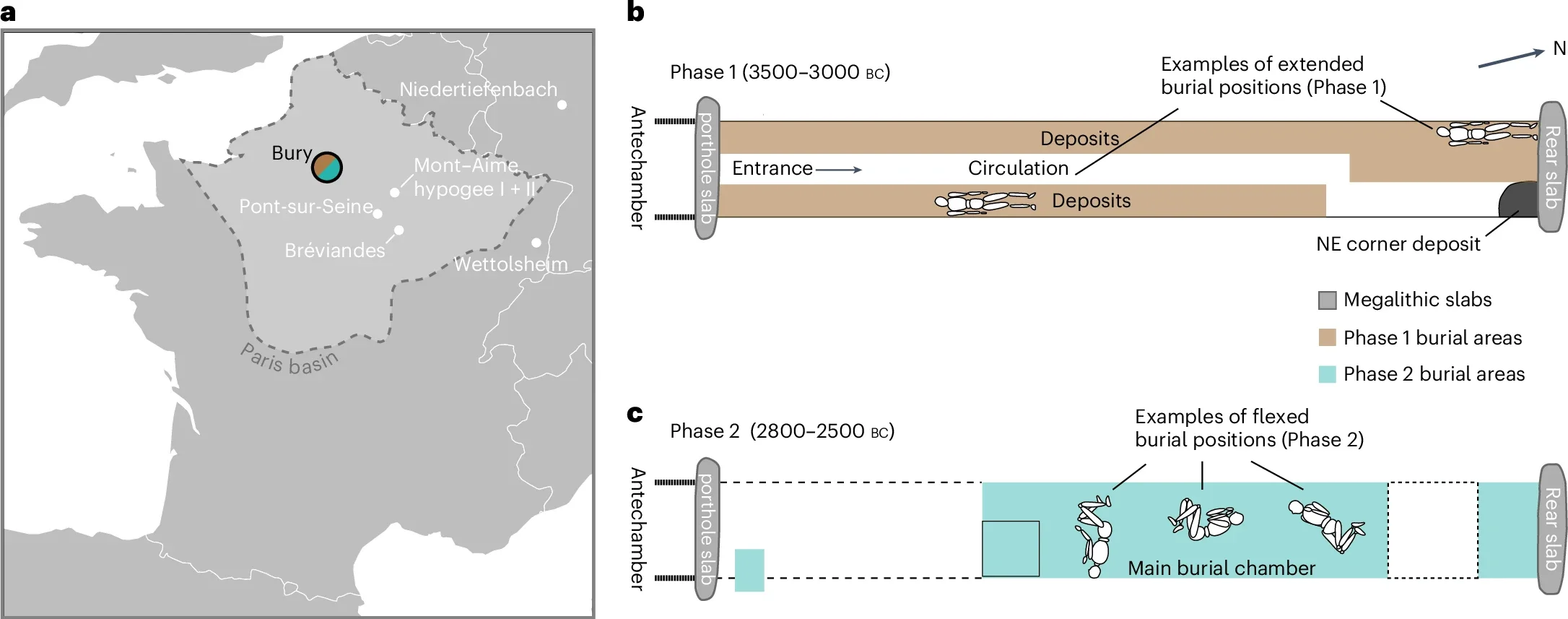
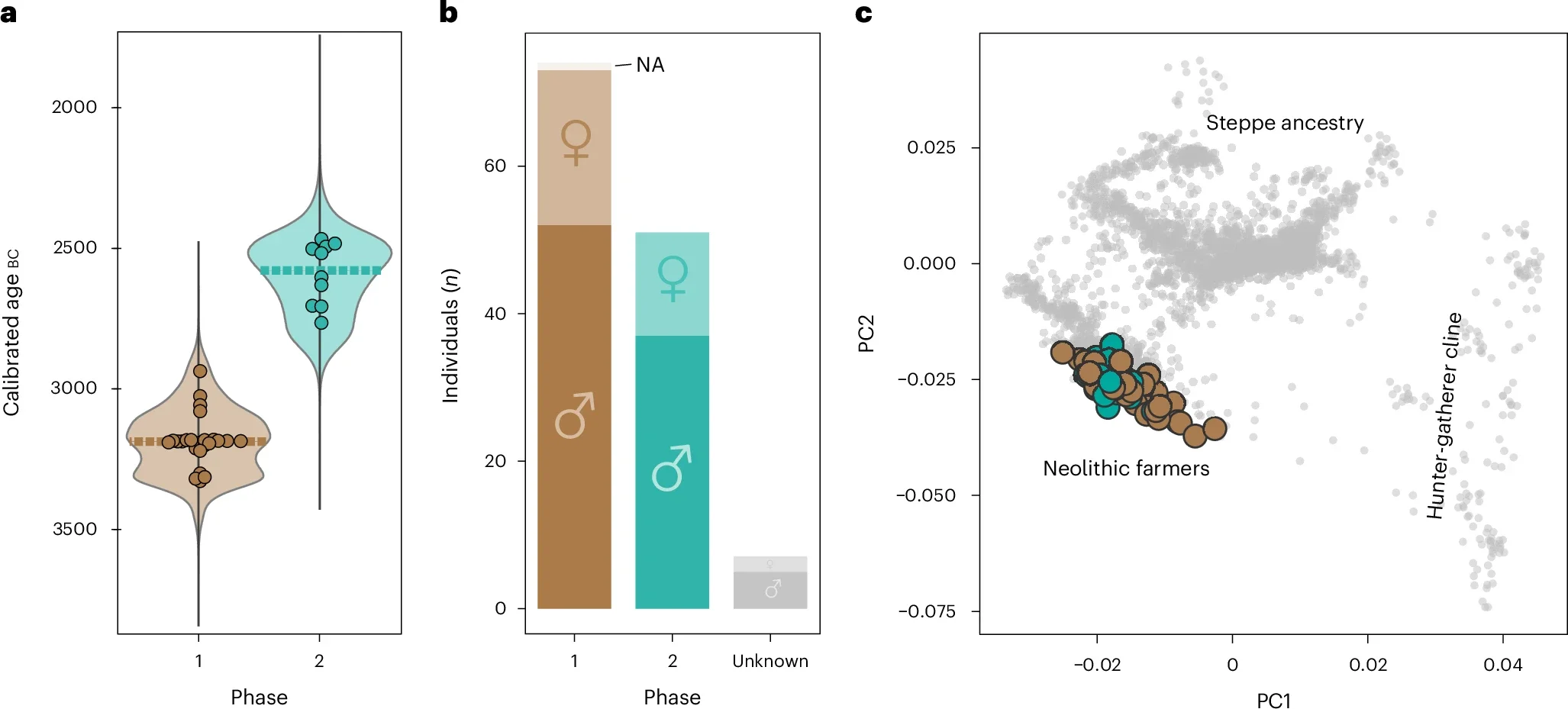
That is the striking picture emerging from new genetic work on 132 individuals buried at Bury, a large Neolithic megalithic site about 50 kilometers north of Paris. The tomb was used in two separate phases, first around 3200 to 3100 BC. Then it was used again across much of the third millennium BC until about 2450 BC. Between those periods, something appears to have gone badly wrong.
The break is not subtle. The people buried in the earlier phase were not closely related to the later group. Instead, the DNA points to a major population turnover. This fits into a broader pattern of demographic upheaval that seems to have affected much of northwestern Europe at the end of the fourth millennium BC.
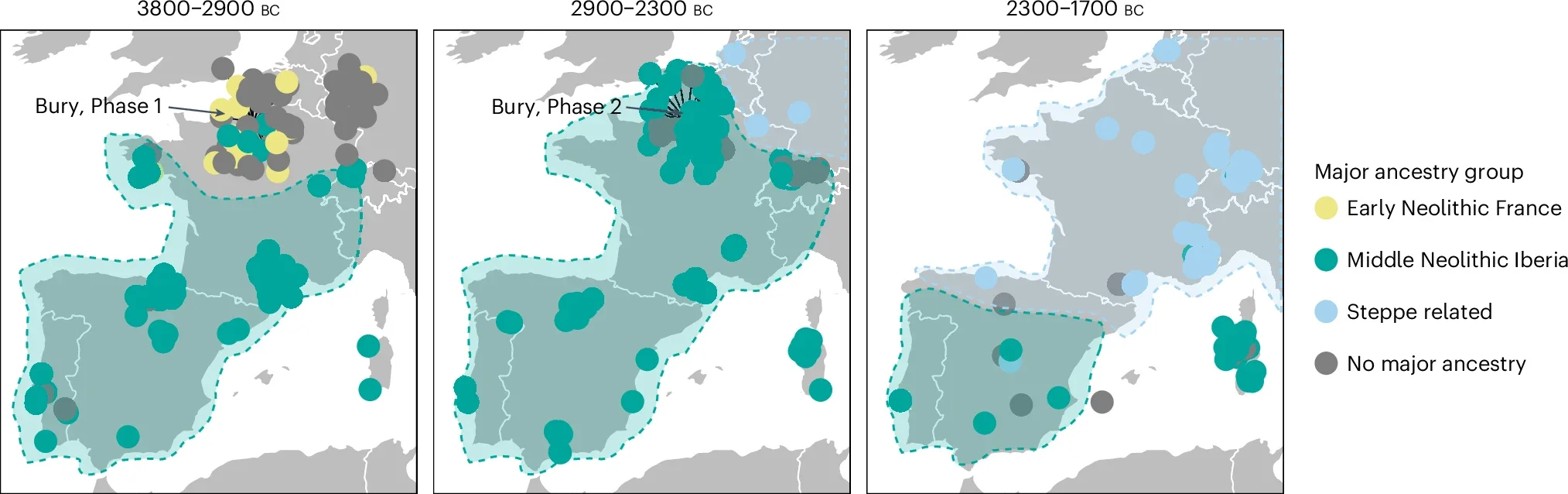
“We see a clear genetic break between the two periods,” said Frederik Valeur Seersholm, an assistant professor at the Globe Institute at the University of Copenhagen and one of the study’s lead authors. “The earlier group resembles Stone Age farming populations from northern France and Germany, while the later group shows strong genetic links to southern France and the Iberian Peninsula.”
That finding suggests the local population declined sharply, then new groups moved in from the south.
The shift matters for more than one burial ground. It may help explain why the era of building large megalithic tombs, one of the defining features of late Neolithic Europe, came to an end around the same time across wide parts of the continent.
Bury is no small burial site. Archaeologists previously identified the remains of 316 people there, and the tomb itself is a classic example of the long stone chamber graves found in the Paris Basin.
But the way the grave was used changed over time.
The earlier phase included bodies placed in extended positions, aligned along the tomb’s main axis. The later phase looked different. During it, bodies were buried in flexed positions, with no preferred orientation. The contrast in burial practice already hinted that the people returning to the monument centuries later may not have shared the same customs as those who first used it.
The DNA now strengthens that impression. Researchers found that the earlier group was genetically more diverse, while the later phase was more uniform and carried strong southern ancestry. More than 80 percent of the later group’s ancestry was linked to Neolithic populations from Iberia.
The two phases did not appear to be closest to each other genetically. In fact, each group shared more genetic similarity with other Neolithic populations elsewhere in Europe. They were less similar to the people buried in the same tomb during the other phase.
That makes simple continuity unlikely.
The earlier burial phase also carries signs of trouble. Archaeological analysis had already shown an unusual mortality pattern, especially among children and young people.
“The demographic pattern is a strong indicator of crisis,” said Laure Salanova, research director at France’s National Centre for Scientific Research.
The new work added another layer. By scanning preserved genetic material in bone, the researchers detected traces of several pathogens. These included Yersinia pestis, the bacterium that causes plague, and Borrelia recurrentis, which causes louse-borne relapsing fever.
Plague was present in both phases, but more often in the earlier one. Three plague cases were found among the first-phase burials, compared with one in the second. The researchers also identified yersiniosis and herpes simplex virus 1 in a handful of individuals.
Still, plague alone does not seem to explain the collapse.
“We can confirm that plague was present, but the evidence does not support it as the sole cause of the population collapse,” said Martin Sikora, an associate professor at the University of Copenhagen and senior author of the study. “The decline was likely driven by a combination of disease, environmental stress and other disruptive events.”
That caution matters. The number of plague-positive individuals was relatively low, and the infected people were not clustered in the final generations of the earlier burial phase in a way that would clearly point to a single devastating outbreak. The researchers argue that disease may have been part of a broader crisis rather than the only driver.
Pollen records from the Paris Basin add to that picture. They suggest forest regeneration between 2900 and 2500 BC, a pattern often linked to reduced farming and abandoned land. Similar signals have been reported in parts of Sweden, Denmark and Germany.
The DNA did more than track ancestry. It also opened a window into how the buried communities were organized.
In the first phase, the tomb was used by large biological family groups stretching across several generations. Many individuals had first- or second-degree relatives buried nearby. Some pedigrees were extensive, with networks spanning up to five generations. The pattern suggests a tightly connected community using the grave collectively.
The second phase looked different. Burials became more selective. Fewer individuals were closely related, and one male line dominated the Y chromosome pattern. That points to a more patrilineal structure. Smaller hereditary networks and a higher share of unrelated individuals were included in the tomb.
“This indicates that the population change was accompanied by a shift in how society was structured,” Seersholm said.
The contrast is sharp enough to suggest more than a change in ritual. It looks like a different social system attached to the same monument.
There was another notable imbalance. In both phases, males made up roughly 70 percent of the genetically sexed burials. That pattern is far from what would be expected in a normal population. It suggests that many females were excluded from burial in the tomb.
The broader implication may be one of the study’s most important. The decline at Bury fits mounting evidence that the so-called Neolithic decline was not limited to Scandinavia or northern Germany. Instead, it may have spread across much of northern and western Europe.
At Bury, the end of the first burial phase coincides with the disappearance of the people who likely built and first used the monument. Later groups reused the tomb. However, they were genetically distinct and socially organized in different ways.
“We now see that end of these monumental constructions coincides with the disappearance of the population that built them,” Seersholm said.
That does not mean the story is simple. The researchers stress that the timing of decline varied from region to region, and that no single cause is likely to explain everything. Environmental strain, disease and other disruptions may have weakened populations over time. Thus, these created openings for newcomers to move in.
This research changes how archaeologists can interpret major cultural breaks in prehistory. It suggests that the end of megalith building was not just a change in fashion or ritual.
In at least some regions, it reflected a real demographic collapse followed by migration and social reorganization.
It also shows how ancient DNA, burial practice and environmental evidence can be combined to track population crises that left no written record.
Research findings are available online in the journal Nature Ecology and Evolution.
The original story “DNA evidence points to a massive stone age population collapse” is published in The Brighter Side of News.
Like these kind of feel good stories? Get The Brighter Side of News’ newsletter.
The post DNA evidence points to a massive stone age population collapse appeared first on The Brighter Side of News.

