A storm from the Sun can make a planet’s sky glow or a spacecraft’s computer stumble. At Mars in May 2024, it did both, just without the auroras people photographed on Earth.
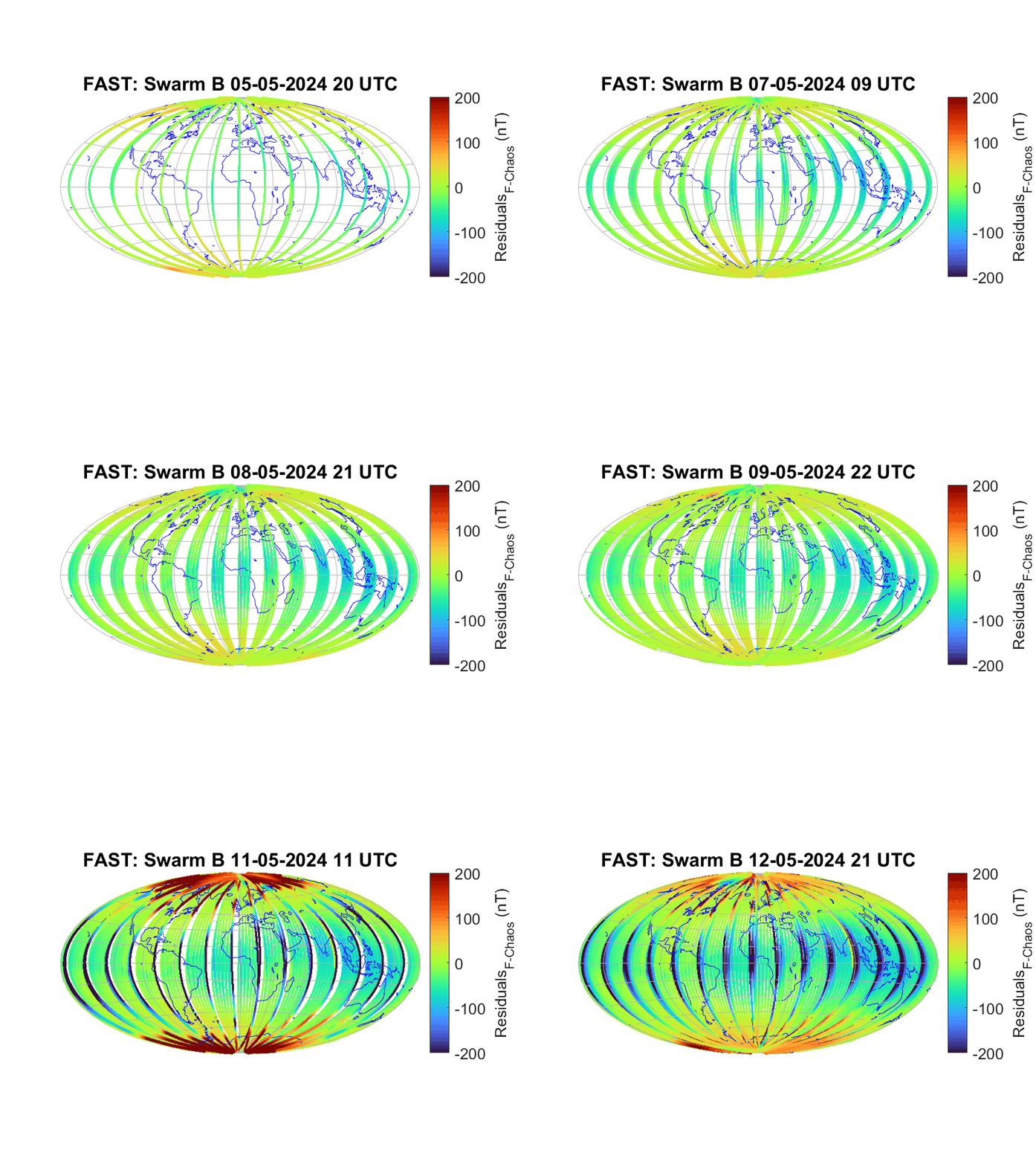
That month, Earth experienced its biggest solar storm in more than 20 years, with auroras seen as far south as Mexico. The same unrest in space also slammed into Mars. Two European Space Agency orbiters, Mars Express and the ExoMars Trace Gas Orbiter (TGO), were already in position to watch what happened next.
A radiation monitor on TGO measured a dose equivalent to 200 “normal” days over just 64 hours. During the storm, both spacecraft also suffered computer errors, a familiar risk when energetic particles flood space. ESA says the orbiters recovered quickly, helped by radiation-resistant components and onboard systems meant to detect and correct faults.
A study published in Nature Communications takes a closer look at what the storm did to Mars’ ionosphere, the charged upper region of the atmosphere.
“The impact was remarkable: Mars’s upper atmosphere was flooded by electrons,” said ESA Research Fellow Jacob Parrott, the study’s lead author. “It was the biggest response to a solar storm we’ve ever seen at Mars.”
Parrott and colleagues found a dramatic jump in electron density in two layers of Mars’s atmosphere, around 110 kilometers and 130 kilometers in altitude.
The lower layer’s electron numbers rose by 278%. The higher layer increased by 45%. According to the report, that 278% surge represents the most electrons scientists have seen in that particular Martian layer.
The storm also lifted both of those layers upward. The study reports an altitude increase of 6.5 kilometers for the M1 and M2 layers. Yet not everything changed. The researchers did not see major structural changes below 100 kilometers. They also report no significant compression in the topside of the M2 layer, and the separation between the M1 and M2 layers shifted by only about 1 kilometer, which they did not consider significant.
Those details matter because Mars lacks Earth’s global magnetic field. Earth’s field helps deflect many charged particles and funnels others toward the poles, where auroras brighten the sky. Mars, with a very different magnetic environment, responds in its own way. Instead of a “muted” upper-atmosphere response like Earth’s, the storm at Mars produced an unusually strong electron buildup.
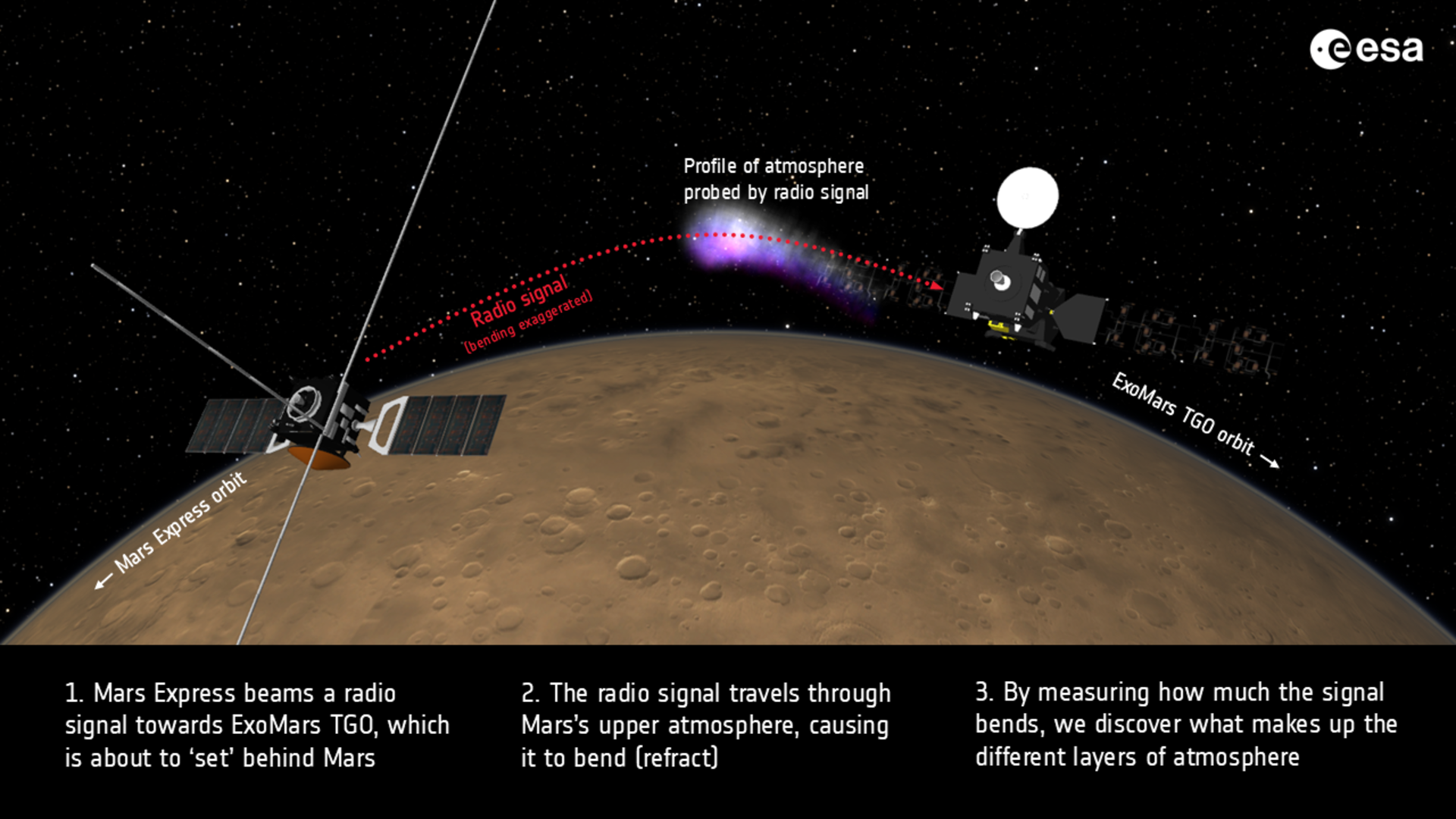
To capture the storm’s impact, the team leaned on a technique ESA has been developing at Mars: orbiter-to-orbiter radio occultation.
Here is the basic setup. Mars Express transmitted a radio signal to TGO as Mars Express slipped behind the planet’s horizon from TGO’s viewpoint. As TGO “watched” the signal pass through the atmosphere, the signal bent due to refraction. That bending carries information about the layers it traveled through. The team also used observations from NASA’s MAVEN mission to confirm the electron densities.
Colin Wilson, ESA project scientist for Mars Express and TGO and a co-author, said radio occultation has been used for decades, but usually with signals traveling from spacecraft to Earth. Only in roughly the past five years, he said, has ESA started using it at Mars between two spacecraft.
“It’s great to see it in action,” Wilson said.
ESA already uses orbiter-to-orbiter radio occultation routinely at Earth, and plans to use it more regularly in future planetary missions.
The timing was also unusually fortunate. Parrott said the team performed the occultation just 10 minutes after a large solar flare hit Mars, even though ESA currently runs only two observations per week at Mars.
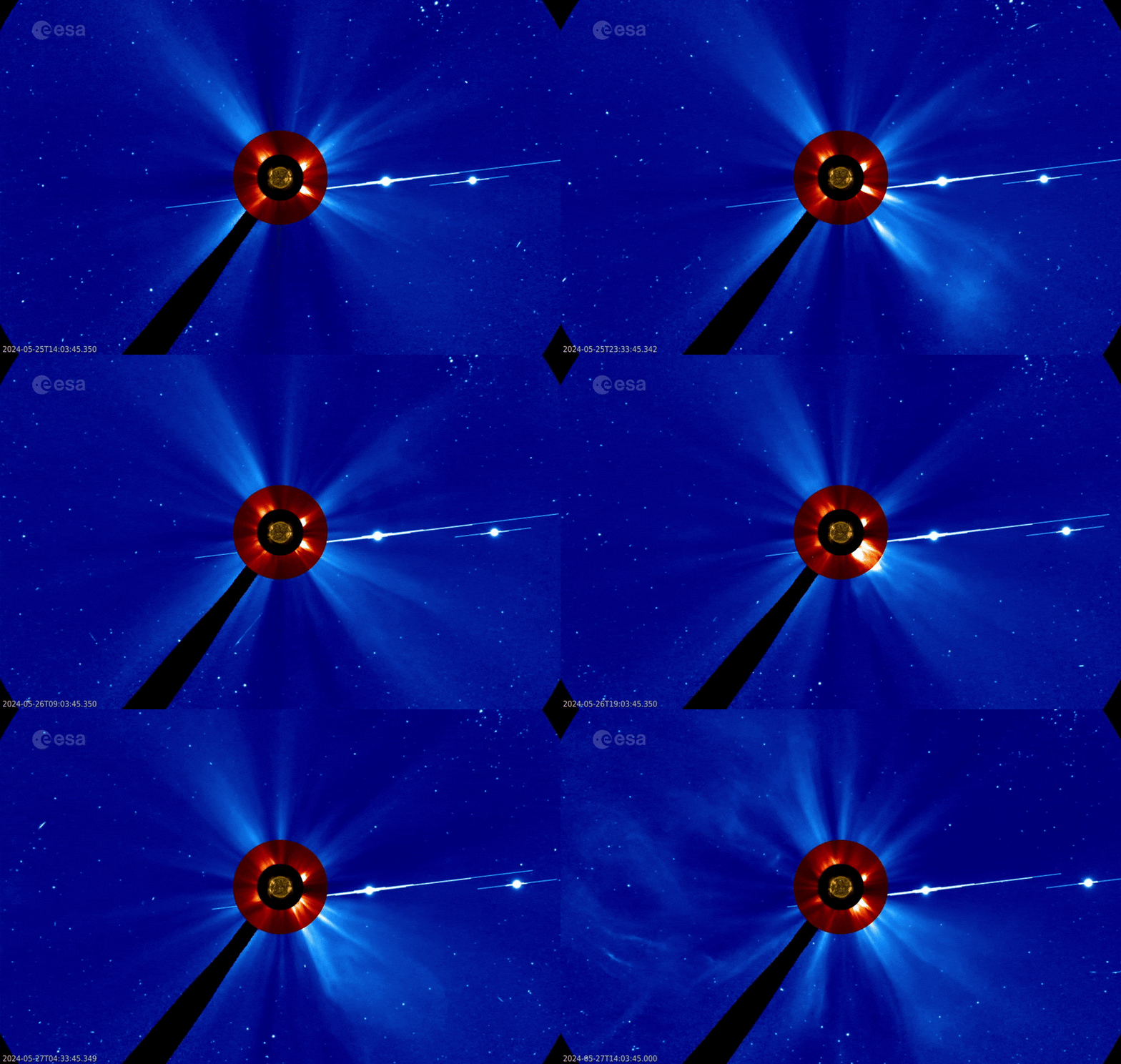
The May 2024 event was not a single clean blast. The study focuses on three solar events tied to the same storm, each behaving differently: a flare of radiation, a burst of high-energy particles, and a coronal mass ejection, or CME.
Together, these events delivered fast-moving, magnetized plasma and X-rays toward Mars. When that material hit the upper atmosphere, it collided with neutral atoms and stripped away electrons, filling the region with charged particles.
In the study’s discussion, the authors argue that the biggest standout is the M1 layer enhancement. They link the M1 layer’s behavior to photoionization driven by high-energy soft X-ray photons. They also propose that secondary ionizations, cascades triggered by energetic photoelectrons, may contribute more than expected during a flare.
They draw a contrast with the M2 layer, which is tied to lower-energy extreme ultraviolet photons. The M2 layer’s smaller increase fits with that picture. The study also reports that solar energetic particles had a negligible effect on the ionosphere’s structure, because those particles tend to ionize deeper, typically below 100 kilometers, when the neutral density is high enough.
Wilson said the results help explain how solar storms deposit energy and particles into Mars’s atmosphere, a topic tied to the planet’s long-term loss of water and atmosphere to space.
He also flagged a practical concern: electron-rich upper air can affect radio signals. If the upper atmosphere is packed with electrons, it could block radar signals used to probe the surface. That becomes a mission-planning issue, not just a scientific curiosity.
Research findings are available online in the journal Nature Communications.
The original story “ESA orbiter reveals strange behavior within Mars’ upper atmosphere during a solar superstorm” is published in The Brighter Side of News.
Like these kind of feel good stories? Get The Brighter Side of News’ newsletter.
The post ESA orbiter reveals strange behavior within Mars’ upper atmosphere during a solar superstorm appeared first on The Brighter Side of News.

