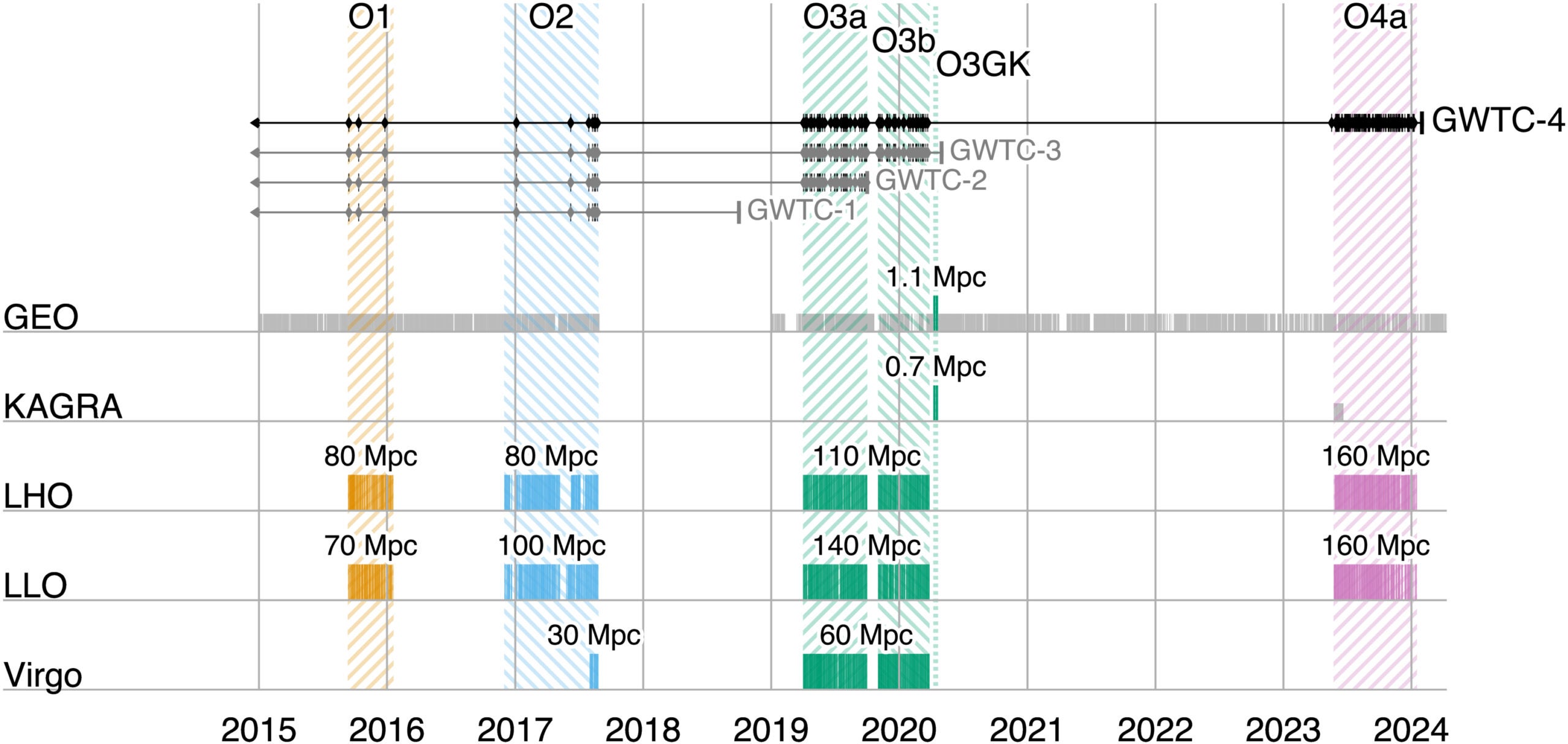
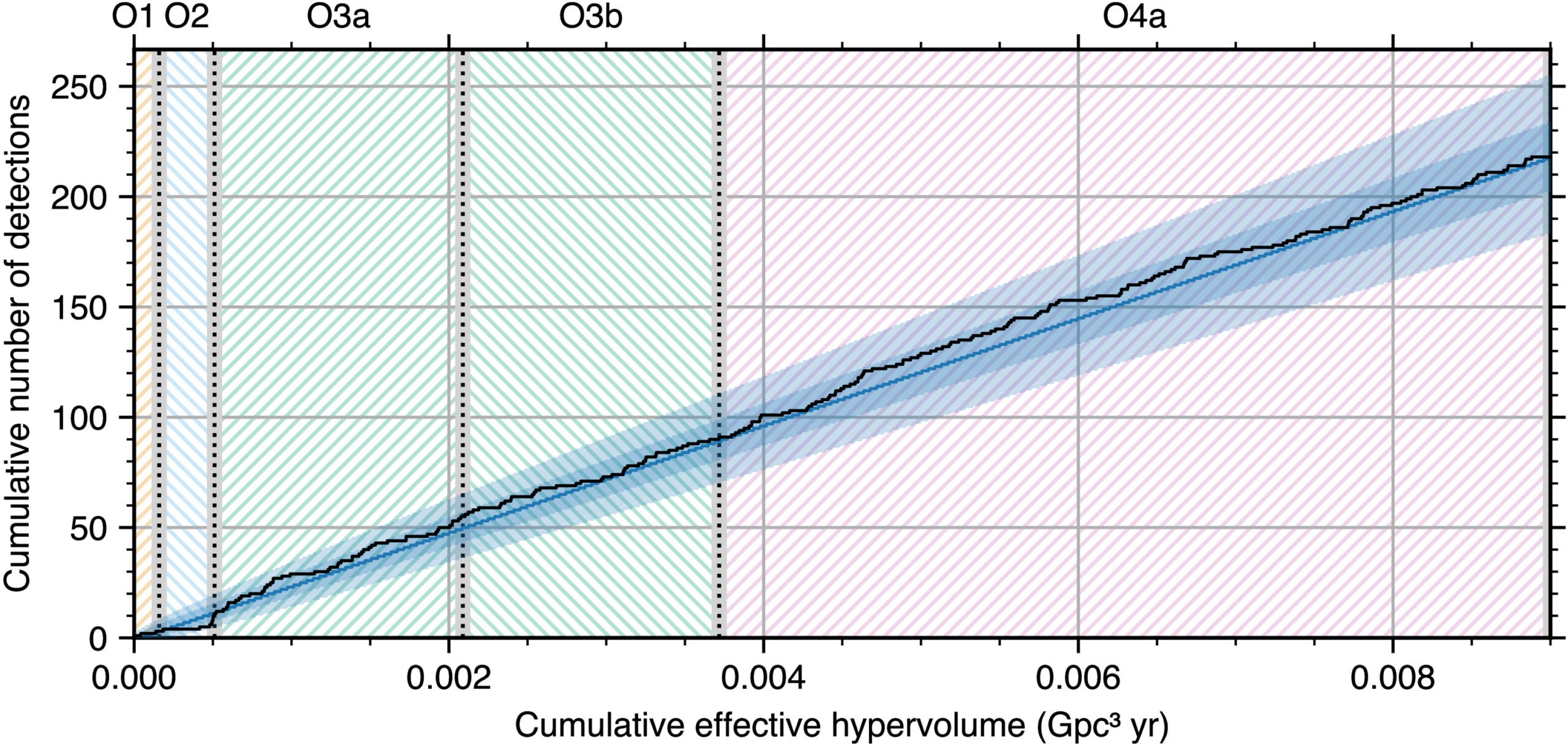
Between May 2023 and January 2024, a global network of gravitational-wave detectors picked up 128 new cosmic signals, more than doubling the entire catalog built across the previous decade. The universe, it turns out, is not quiet. It is constantly shaking.
The LIGO-Virgo-KAGRA Collaboration, an international partnership spanning observatories in the United States, Italy, and Japan, has published its fourth gravitational-wave catalog, GWTC-4.0, in a forthcoming special issue of Astrophysical Journal Letters. The collection represents the most comprehensive census yet of colliding black holes and neutron stars, and it is already pushing physics into territory no one has mapped before.
“The beautiful science that we are able to do with this catalog is enabled by significant improvements in the sensitivity of the gravitational-wave detectors as well as more powerful analysis techniques,” said Nergis Mavalvala, dean of the MIT School of Science and a member of the collaboration.
Gravitational waves are ripples in the fabric of spacetime, generated when the most massive and compact objects in the universe collide and merge. Black holes, which form when massive stars collapse into single points, are among the densest things that exist. When two black holes spiral toward each other and finally merge, the energy released shakes spacetime itself. By the time those waves reach Earth after traveling hundreds of millions or even billions of light-years, they are almost unimaginably faint.
The detectors that catch them are L-shaped instruments with arms stretching four kilometers. Laser beams travel down each arm and back, and the system measures any difference in their return times with extreme precision. A passing gravitational wave shifts that timing by a fraction of the width of a proton.
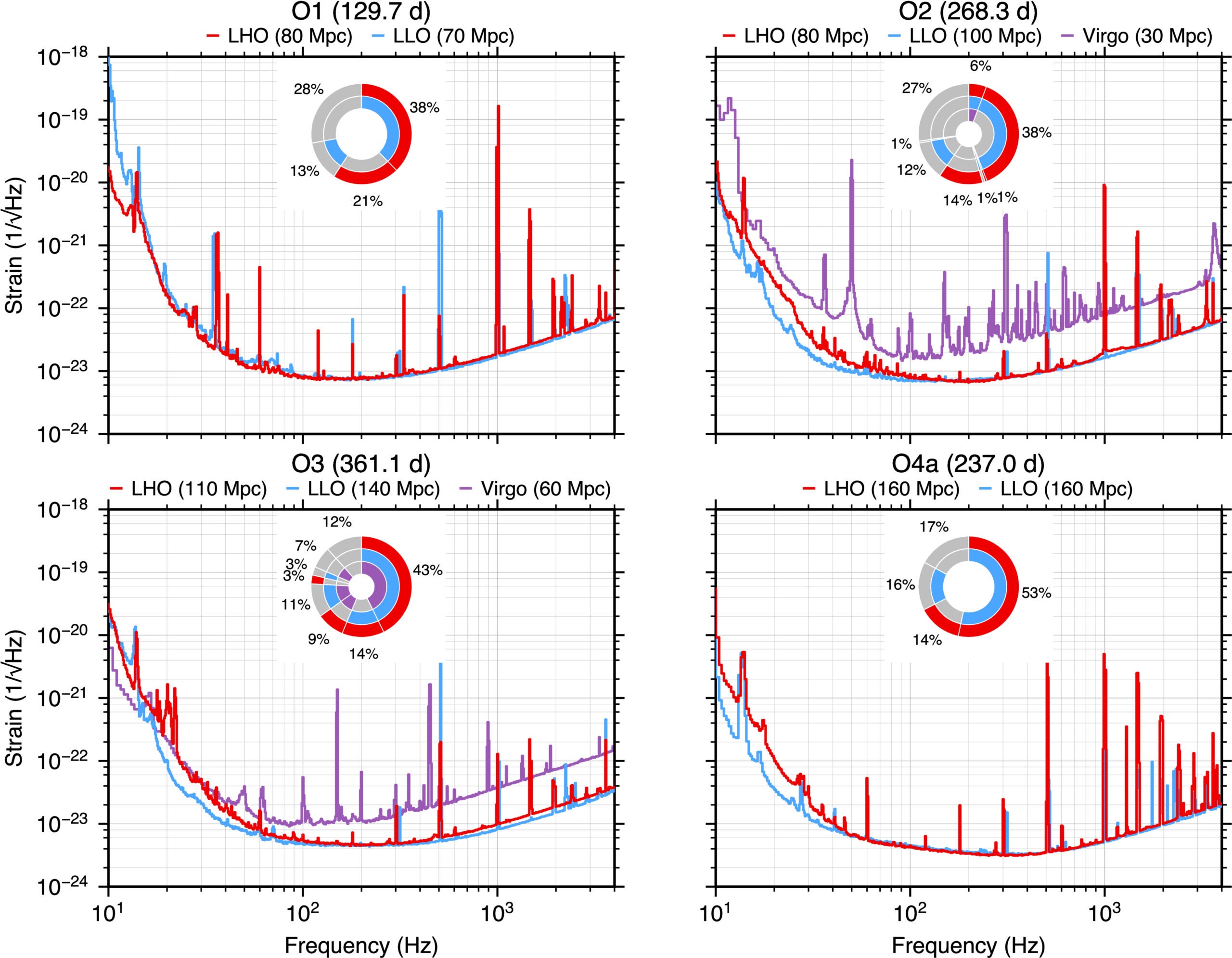
The latest nine-month observing run was conducted by the two LIGO detectors alone, one in Hanford, Washington, and one in Livingston, Louisiana, both upgraded before the run to search for signals from merging neutron stars as far as roughly one billion light-years away and black hole collisions far beyond that. The 128 new detections more than double the 90 candidates previously accumulated across all earlier runs combined.
“In the past decade, gravitational-wave astronomy has progressed from the first detection to the observation of hundreds of black hole mergers,” said Stephen Fairhurst, a professor at Cardiff University and spokesperson for the LIGO Scientific Collaboration. “These observations enable us to better understand how black holes form from the collapse of massive stars, probe the cosmological evolution of the universe, and provide increasingly rigorous confirmations of the theory of general relativity.”
Most gravitational-wave detections involve two black holes of comparable size, each weighing several tens of times the mass of the Sun, spiraling together into one larger remnant. The new catalog still has plenty of those. But buried among them are several events that don’t fit the standard picture at all.
GW231123_135430 stands out as the heaviest black hole binary detected to date. Scientists estimate the signal came from the collision of two black holes each roughly 130 times as massive as the Sun. Most detected black holes weigh around 30 solar masses. At those extreme weights, each object may itself be a product of a prior merger, a so-called second-generation black hole formed when two smaller predecessors collided.
GW231028_153006 is unusual for a different reason. Both black holes in this pair were spinning extremely fast, at roughly 40 percent the speed of light. Scientists again suspect previous mergers spun these objects up as they formed. A third standout, GW231118_005626, involved a lopsided pair with one black hole twice as massive as its partner.
“One of the striking things about our collection of black holes is their broad range of properties,” said Jack Heinzel, an MIT graduate student who contributed to the catalog’s analysis. “Some of them are over 100 times the mass of our sun, others are as small as only a few times the mass of the sun. Some black holes are rapidly spinning, others have no measurable spin. We still don’t completely understand how black holes form in the universe, but our observations offer a crucial insight into these questions.”
The clearest signal in the new catalog, GW230814_230901, gave scientists their best chance yet to probe Einstein’s general theory of relativity under extreme conditions. Gravitational waves from a black hole merger represent one of the most violent events in the universe, precisely the kind of scenario where a century-old theory might finally show a crack.
It didn’t.
“So far, the theory is passing all our tests,” said Aaron Zimmerman, associate professor of physics at the University of Texas at Austin. “But we’re also learning that we have to make even more accurate predictions to keep up with all the data the universe is giving us.”
The catalog also adds new momentum to one of cosmology’s most contested debates: how fast the universe is expanding. Different measurement techniques have been giving inconsistent answers for years, a tension that has unsettled the field. Gravitational waves offer an independent path. Because the amplitude of a wave encodes how far it traveled, each merger is effectively a self-calibrating distance measurement.
By combining all gravitational-wave detections across the full catalog, the collaboration derived a new estimate suggesting the universe expands at approximately 76 kilometers per second per megaparsec, where a megaparsec spans roughly half a billion light-years. The result remains less precise than other methods, but it is independent of them, and it will sharpen as more detections accumulate.
“Merging black holes have a really unique property: we can tell how far away they are from Earth just from analyzing their signals,” said Rachel Gray, a lecturer at the University of Glasgow involved in the cosmological analysis. “So every merging black hole gives us a measurement of the Hubble constant, and by combining all of the gravitational wave sources together, we can vastly improve how accurate this measurement is.”
Beyond individual events, the full catalog is beginning to reveal patterns in how black holes as a population behave across cosmic time.
One trend is already emerging: black holes that merged earlier in the universe’s history appear more likely to have had higher spins than those that collided more recently. That’s not a trivial observation. It hints that whatever conditions existed in the young universe were particularly effective at spinning up black holes, and scientists are now working to understand what those conditions might have been.
Daniel Williams, a research fellow at the University of Glasgow and a catalog contributor, described the broader trajectory of the field concisely: “We are really pushing the edges, and are seeing things that are more massive, spinning faster, and are more astrophysically interesting and unusual.”
The significance of this catalog extends beyond any individual detection. With over 200 confirmed mergers now in hand, astrophysicists have a statistical foundation for testing models of how black holes form, how they pair up, and how they have changed across billions of years of cosmic history.
The independent Hubble constant measurements from gravitational waves may eventually help resolve one of the deepest disagreements in modern cosmology. And each test of general relativity conducted under more extreme conditions than the last narrows the space where any alternative theory of gravity could hide.
The observing run that produced these 128 detections covered only the first nine months of LIGO’s fourth run. Data from the second and third phases of that run are still being analyzed and will appear in future catalog versions, along with contributions from Virgo in Italy, which joined mid-run after completing hardware upgrades. The fifth observing run is in planning. The universe has more to say.
Research findings are available online in the Astrophysical Journal Letters.
The original story “Expanding catalog of black hole collisions is rewriting the history of the universe” is published in The Brighter Side of News.
Like these kind of feel good stories? Get The Brighter Side of News’ newsletter.
The post Expanding catalog of black hole collisions is rewriting the history of the universe appeared first on The Brighter Side of News.


Leave a comment
You must be logged in to post a comment.