The Sun’s 11-year cycle still drives flares, aurorae, and geomagnetic storms, but the machinery under that familiar rhythm may be changing in a deeper way. After tracking sound waves inside the Sun for nearly four decades, researchers say its magnetic activity now appears to be packed into a thinner layer just below the visible surface.
That matters because the solar cycle is the engine behind the space weather that can interfere with satellites, GPS, communications, and power grids on Earth.
The new analysis, published in Monthly Notices of the Royal Astronomical Society, used observations from the Birmingham Solar Oscillations Network, or BiSON, a set of six telescopes around the world that has monitored the Sun since the late 1980s. Instead of focusing only on sunspots or radio emissions, the team listened to the Sun’s internal oscillations, tiny pressure waves known as p modes, to see how the star’s interior has changed from solar cycle 22 through cycle 25.
Professor Bill Chaplin of the University of Birmingham, the study’s lead author, said: “The Sun has its own ‘active biorhythm’ creating rising and falling magnetic activity that shapes space weather. However, traditional surface measures don’t capture the full story – that the Sun may be entering a different mode of behaviour unfolding over decades.”
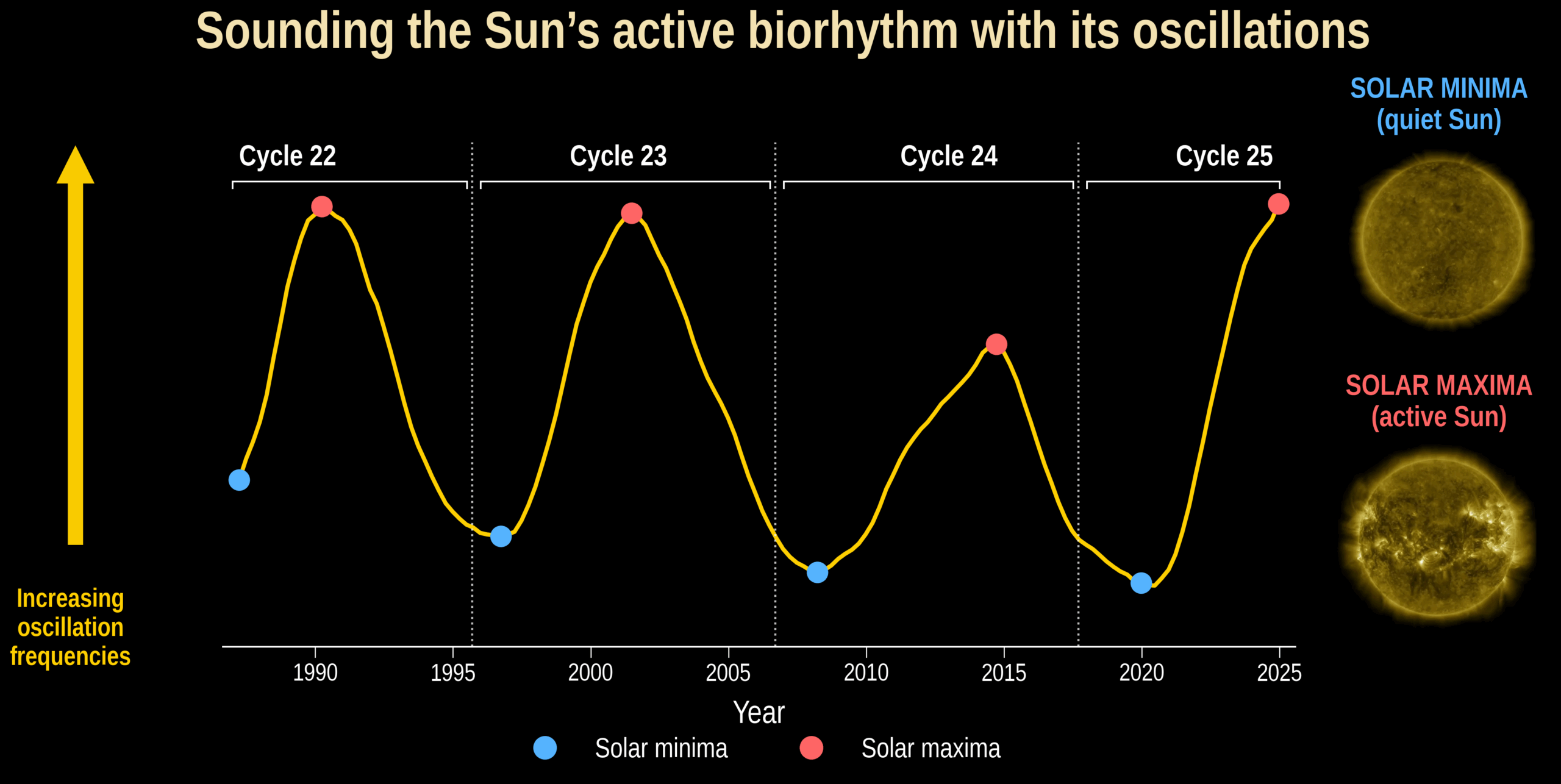
Solar activity is usually tracked through surface signs, including sunspot counts and the 10.7-centimeter radio flux. Those measures remain useful, but they do not show what is happening beneath the surface, where magnetic fields are regenerated and rearranged.
Helioseismology offers a way in. As sound waves move through the Sun, their frequencies shift in response to changing magnetic activity and changes in solar structure. By separating these oscillations into low-, mid-, and high-frequency bands, the researchers could probe different depths below the surface and compare those signals with traditional activity markers.
What emerged was not a simple confirmation of the familiar solar cycle. The relationship between those internal oscillations and the Sun’s surface activity has been changing over time.
The clearest long-running shift appeared in the low-frequency modes, which are sensitive to deeper layers. Earlier work had suggested that something changed during the declining phase of cycle 23, and the new data show that pattern has continued into cycle 25. Since around 2005, those lower-frequency oscillations have drifted away from what traditional activity proxies would have predicted.
At the same time, the mid-frequency modes have shown consistently reduced sensitivity in cycles 23, 24, and 25 compared with cycle 22.
Then came the most striking result. In the high-frequency band, which is most sensitive to very shallow layers near the surface, cycle 25 looked much stronger than expected. In traditional surface indicators, cycle 25 remains weaker than cycle 22. But in the high-frequency seismic data, it appears comparable in strength.
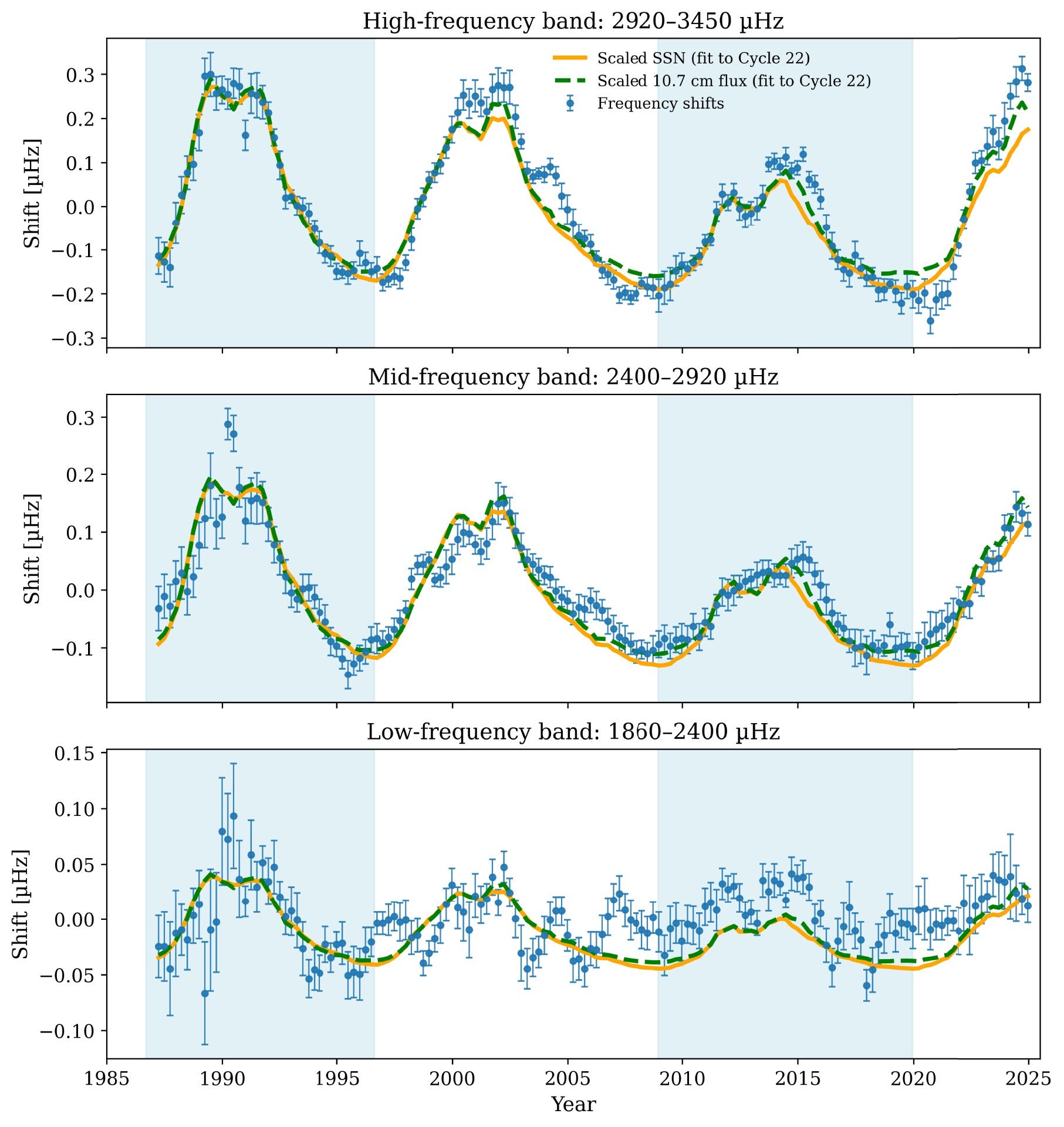
Taken together, those patterns point to a structural change in where solar-cycle effects are concentrated. The authors argue that the magnetic and structural changes associated with the cycle are becoming increasingly confined to a shallow zone near the Sun’s outer edge, within about 1,000 kilometers of the visible surface.
That is not the same as saying the Sun’s magnetic fields are simply weaker. The team explicitly argues that weaker fields alone cannot explain what they saw. A weaker field might change the absolute size of the frequency shifts, but it would not change the sensitivity pattern across the different oscillation bands in the way the data show.
Professor Sarbani Basu of Yale University said: “We discovered that the relationship between internal solar oscillations and surface activity has evolved over the past few cycles.”
She added: “This trend cannot be explained simply by weaker magnetic fields. Instead, it indicates a structural reorganisation of how the Sun’s magnetic activity is stored beneath the surface.”
In practical terms, the Sun’s cycle may still rise and fall on schedule, but the internal geometry driving that cycle could be changing. The researchers describe this as evidence that the Sun may be entering a different long-term mode of behavior.
The study relied on Doppler velocity data collected from 1987 to 2025. The researchers divided the record into overlapping one-year segments and extracted mode frequencies using a Bayesian fitting method. They then compared those shifts with two widely used measures of solar activity, the 10.7-centimeter radio flux and the revised Sunspot Number.
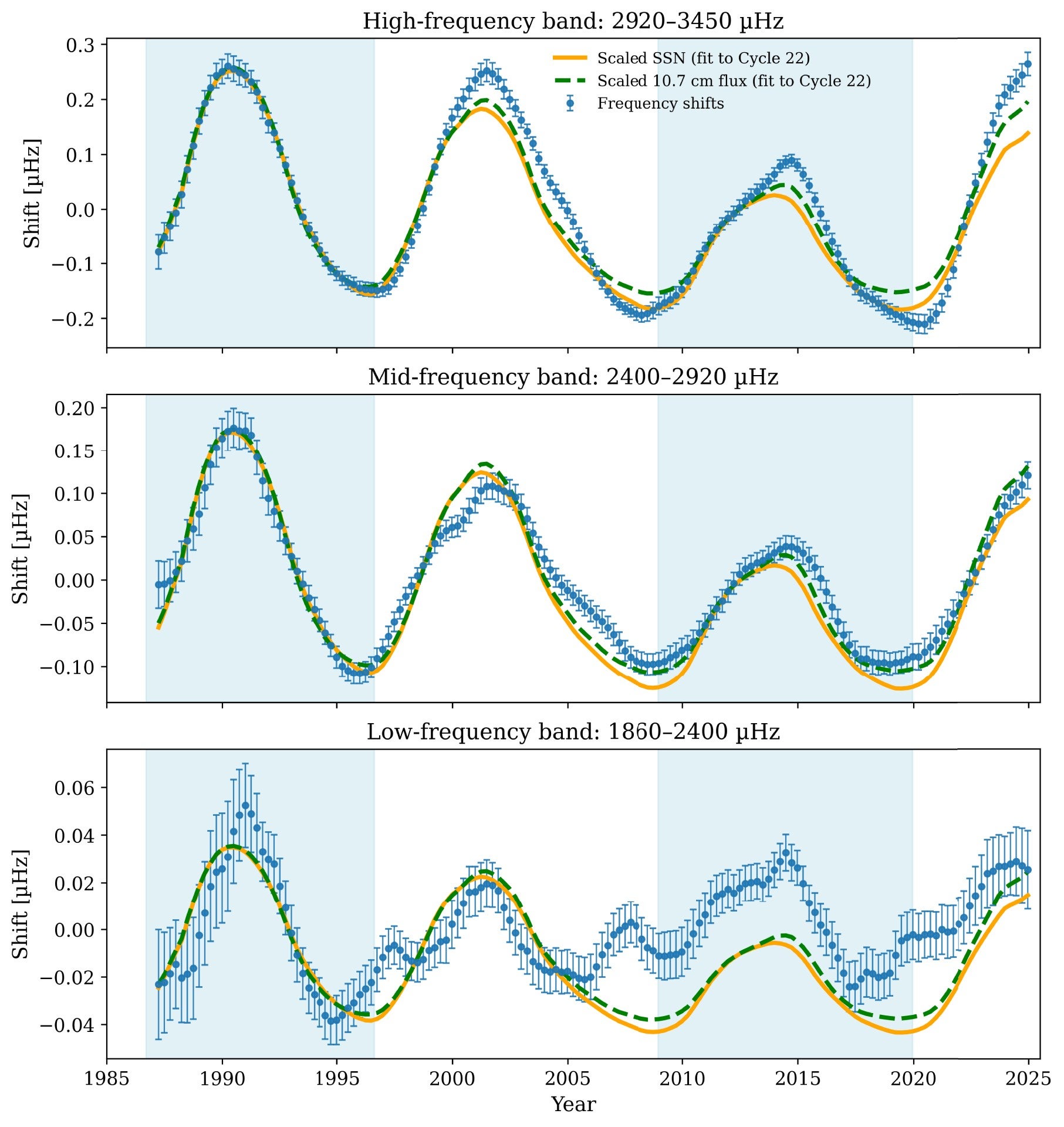
To sharpen the long-term pattern, they also smoothed over a shorter quasi-biennial variation, a roughly two-year signal layered on top of the main 11-year cycle. The broader trend remained.
That long view was crucial. A single cycle, or even two, might have looked like noise or a temporary irregularity. With nearly 40 years of data, the team could track changes across cycles 22, 23, 24, and 25 and see that the pattern was not going away.
Chaplin said: “We have uncovered evidence of systematic changes in the solar activity cycle. Crucially, magnetic activity is becoming more tightly confined near the surface with each cycle. This is the first such discovery and would have been impossible without the long BiSON observations.”
The findings also fit with other reports of multi-decade changes in solar behavior, including shifts in overall activity levels and changes in sunspot properties across recent cycles. Still, the authors are careful not to overstate the case. They say more observations through the rest of cycle 25 and into cycle 26 will be needed to determine whether this is a sustained long-term transition.
For now, the Sun’s familiar pulse remains in place. But the data suggest its internal beat is no longer quite the same.
This work could sharpen how scientists think about space weather forecasting. If the Sun’s magnetic activity is being reorganized closer to the surface, models based mainly on surface indicators may miss part of the picture.
Helioseismic monitoring may offer an earlier or more complete view of how a solar cycle is developing, especially when surface signals make a cycle look weaker than its internal structure suggests.
The study also points to the value of long, continuous observing networks, because slow changes in the Sun can take decades to become clear.
Research findings are available online in the journal Monthly Notices of the Royal Astronomical Society.
The original story “Forty years of solar data finds our Sun is changing from the inside out” is published in The Brighter Side of News.
Like these kind of feel good stories? Get The Brighter Side of News’ newsletter.
The post Forty years of solar data finds our Sun is changing from the inside out appeared first on The Brighter Side of News.

