A cloud of helium atoms split, scattered and fell under gravity, yet still behaved as if its parts were linked.
That is the heart of a new experiment from the Australian National University, where physicists directly observed a form of quantum entanglement in atoms moving through space. Similar tests have long been done with photons, or particles of light. Doing it with atoms is tougher. Atoms have mass. Gravity acts on them. Stray fields can disturb them. Even so, the team found strong evidence that these particles followed the same strange rules. Those rules make quantum physics so hard to square with everyday life.
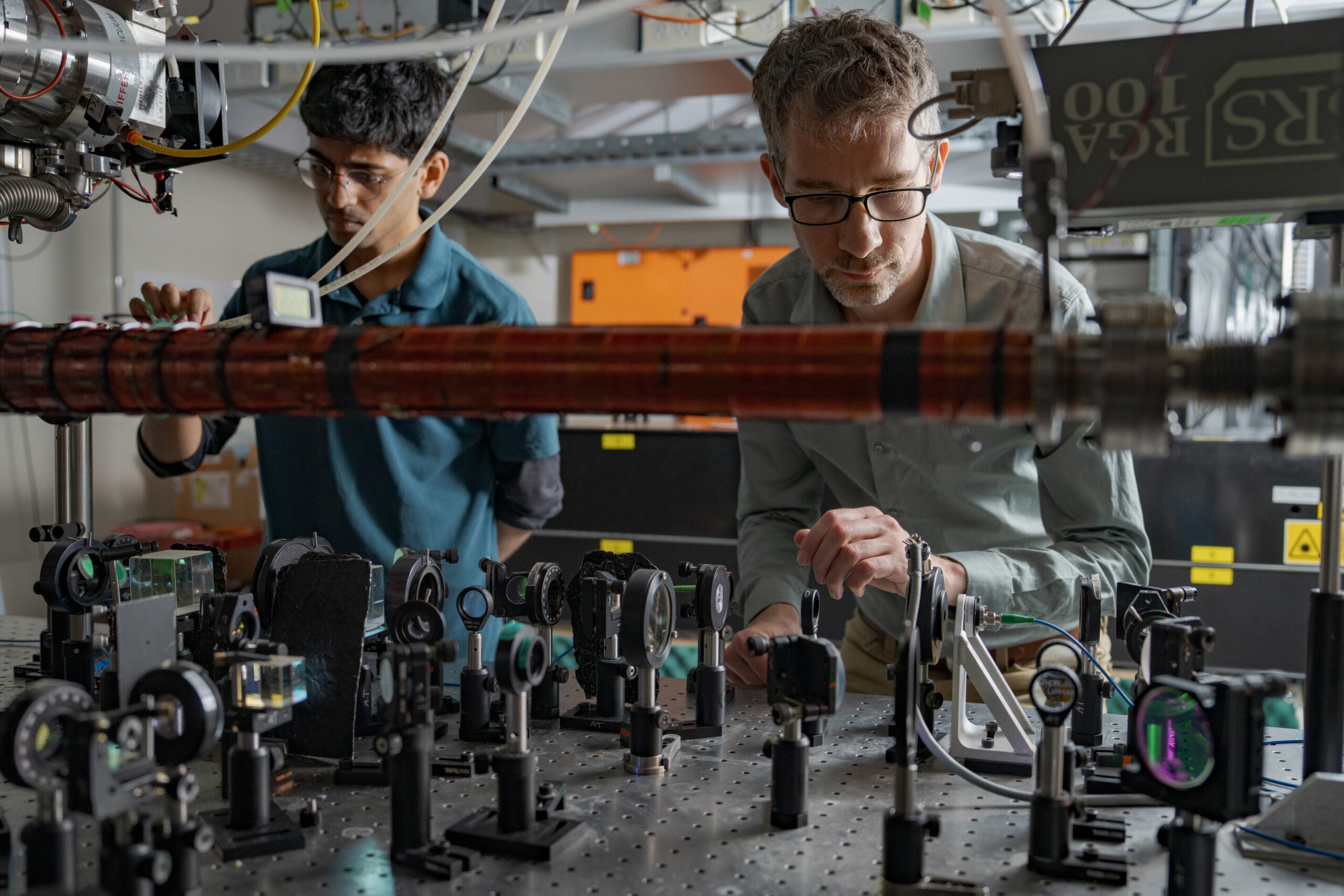
“It’s really weird for us to think that this is how the Universe works,” said Dr Sean Hodgman from the ANU Research School of Physics. “You can read about it in a textbook, but it’s really weird to think that a particle can be in two places at once.”
The result does not deliver a long-sought “theory of everything.” It does, however, push an important boundary. It suggests that the nonlocal behavior seen so clearly in light can also be tracked in matter. That makes atoms a more realistic testing ground for questions about how quantum mechanics might connect with gravity and general relativity.
Bell tests are among the clearest ways to probe whether the world works the way classical intuition says it should. In simple terms, they test whether particles carry fixed, local instructions that explain their behavior. Alternatively, they check whether quantum mechanics is right in predicting stronger-than-classical correlations.
Many experiments have already violated Bell’s inequality using internal properties such as photon polarization or atomic spin states. What has remained far harder is doing something similar with external motion, especially the momentum of massive particles.
That is the gap the ANU team set out to narrow.
“Experimentally, it’s extremely hard to demonstrate this,” said lead author and PhD researcher Yogesh Sridhar. “Several people have tried in the past to show these effects, and they have always come short.”
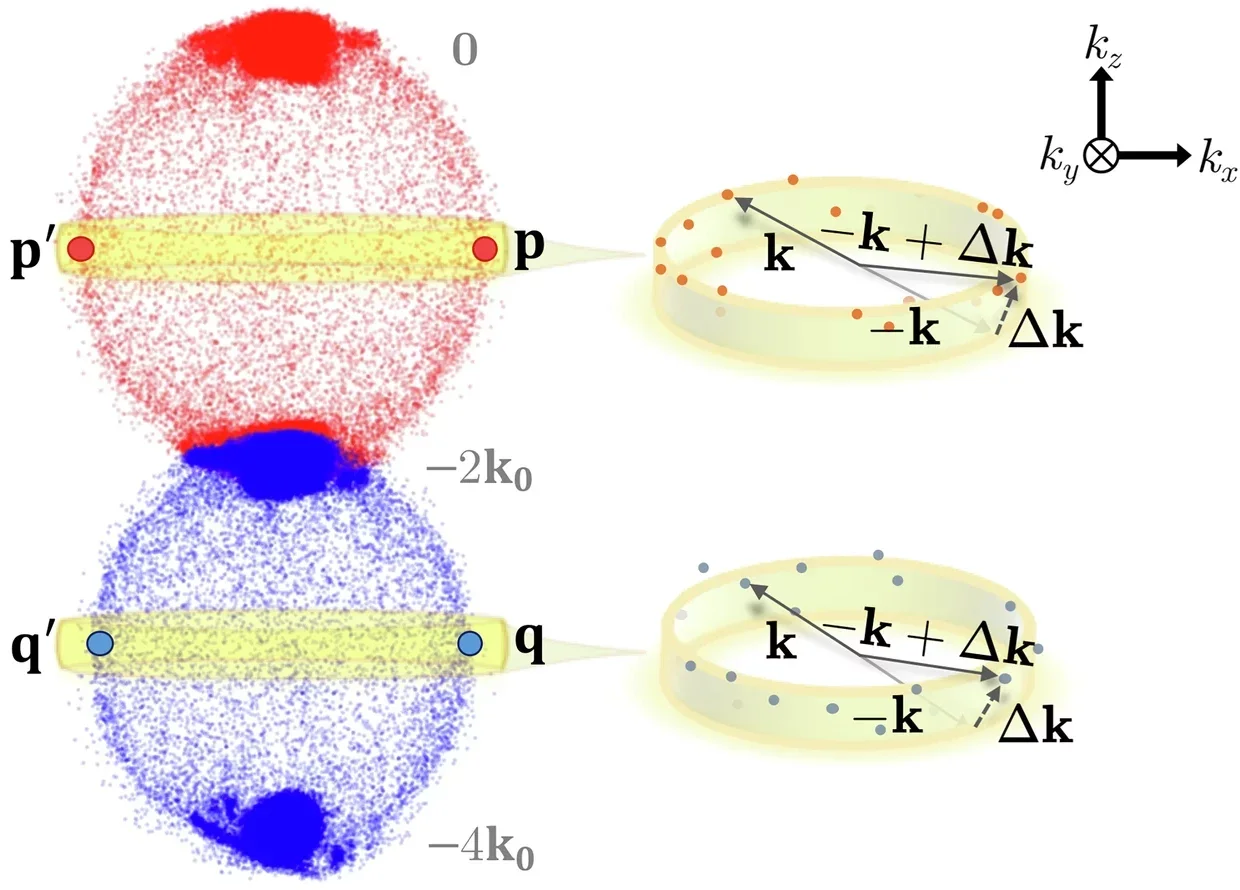
The group used ultracold metastable helium atoms, starting with a Bose-Einstein condensate, a state in which atoms act collectively in a highly ordered quantum way. After switching off the trap, the researchers used laser pulses to shift and split the condensate into different momentum states. As those parts separated, atoms collided and produced two spherical halos of scattered atom pairs.
Those pairs carried opposite momenta. That mattered because momentum conservation links the atoms. This made them candidates for a form of entanglement tied not to spin or polarization, but to motion itself.
The experiment borrowed the logic of a famous optical arrangement known as the Rarity-Tapster interferometer. However, it translated it into matter waves. The ANU team used Bragg pulses as mirrors and beam splitters to manipulate selected momentum modes. This brought the relevant atomic paths back into interference.
They then let the atoms fall about 848 millimeters onto a detector capable of recording single atoms in three dimensions. From that spatial and timing data, the researchers reconstructed the atoms’ momentum distribution. They looked for correlations between atoms emerging in opposite parts of the halos.
The numbers were striking. In measurements built from 1,000 shots, the team found strong pair correlations in both scattering halos. The amplitude was about 30 at zero momentum difference. That corresponded to average mode occupancies low enough to match the conditions expected for Bell-type tests.
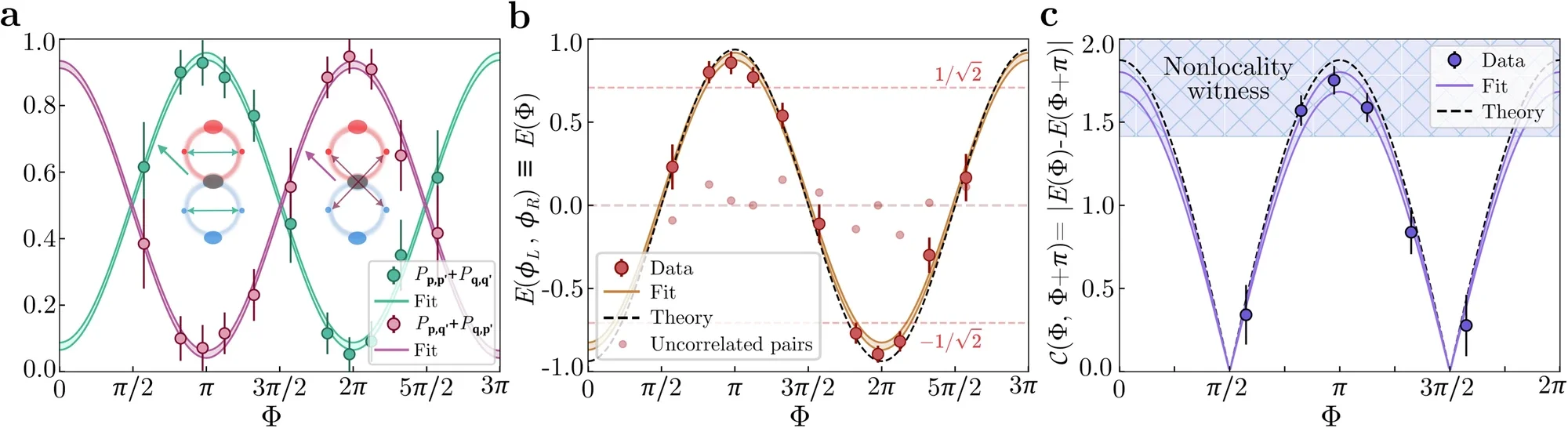
Then came the larger dataset, more than 35,000 shots. This was used to measure how the correlations changed as the experimenters varied a global phase in the interferometer.
The resulting pattern oscillated in a way quantum theory predicts for entangled states. The Bell correlation function had a fitted amplitude of 0.86(3), well above the threshold needed for the type of nonlocality witness the team used. From that, the researchers reported a maximum violation of their chosen inequality at about 3.9 standard deviations. This occurred when the global phase reached 3.062.
“This result confirms the predictions of over a century ago that matter can be in two locations at once, and it can interfere with itself even in those locations,” Hodgman said.
The experiment marks the first reported observation of the Bell correlations needed to demonstrate nonlocality in momentum-entangled pairs of atoms. That alone makes it a notable result.
Still, the work stops short of the strongest version of the claim. The current setup does not yet allow independent phase settings in the two spatially separated interferometer arms. Because of that, the team did not perform a full CHSH-Bell inequality test. This is the better-known and more stringent benchmark.
Instead, they used a steering inequality and a related nonlocality criterion. That was enough to rule out a broad class of hybrid local hidden variable and local hidden state models. However, not every loophole is closed.
The researchers are clear about that limitation. A future CHSH-style test would need independently controlled phase settings in separate regions. Also, it would need those settings applied only after the atom pairs were already space-like separated. Given the detector’s time resolution of about 1 nanosecond, that means the atoms would need to be at least 30 centimeters apart. The current detector is 8 centimeters across.
So this is not the end of the story. It is a serious step forward.
The team says it improved on earlier work by boosting correlation amplitudes and signal-to-noise ratio. Among the upgrades were higher-efficiency micro-channel plates, frequency-locking of the Bragg beams to reduce fluctuations, and tighter detection windows around the equator of the halos for better precision.
Photons have been the workhorse of entanglement experiments for decades. They are ideal in many ways, but they are also massless. Atoms open a different door because they move through gravitational fields as ordinary matter does.
That makes momentum-entangled atoms especially appealing for experiments that sit at the uncomfortable border between quantum mechanics and general relativity. The paper points to future possibilities involving helium isotopes with different masses. These could provide a basis for testing the weak equivalence principle with quantum test masses.
The platform could also help researchers probe decoherence theories in systems influenced by gravity. It could support quantum information techniques that use motional entanglement rather than internal atomic states.
This work gives physicists a new way to test quantum behavior in matter that has mass, motion and exposure to gravity. In the near term, that matters most for basic physics. Especially, it matters for efforts to understand whether the rules governing the very small can be reconciled with gravity.
It also points toward tools for quantum sensing and quantum imaging, where carefully controlled atom interference could improve precision beyond standard limits.
The experiment does not settle those questions yet, but it builds a platform that may let future studies ask them more directly.
Research findings are available online in the journal Nature Communications.
The original story “Historic discovery shows atoms can exist in two places at once” is published in The Brighter Side of News.
Like these kind of feel good stories? Get The Brighter Side of News’ newsletter.
The post Historic discovery shows atoms can exist in two places at once appeared first on The Brighter Side of News.


Leave a comment
You must be logged in to post a comment.