With James Webb Space Telescope (JWST), NASA has confirmed its sightings of the farthest known galaxy to date, providing an unprecedented look back into the early universe about 280 million years after the Big Bang. The discovery of MoM-z14 was accomplished by a joint effort of the Massachusetts Institute of Technology, the University of Geneva, and many others. The results were published in the Open Journal of Astrophysics and provide additional evidence supporting scientists’ previous beliefs that the early universe’s brightness and activity levels were higher than expected.
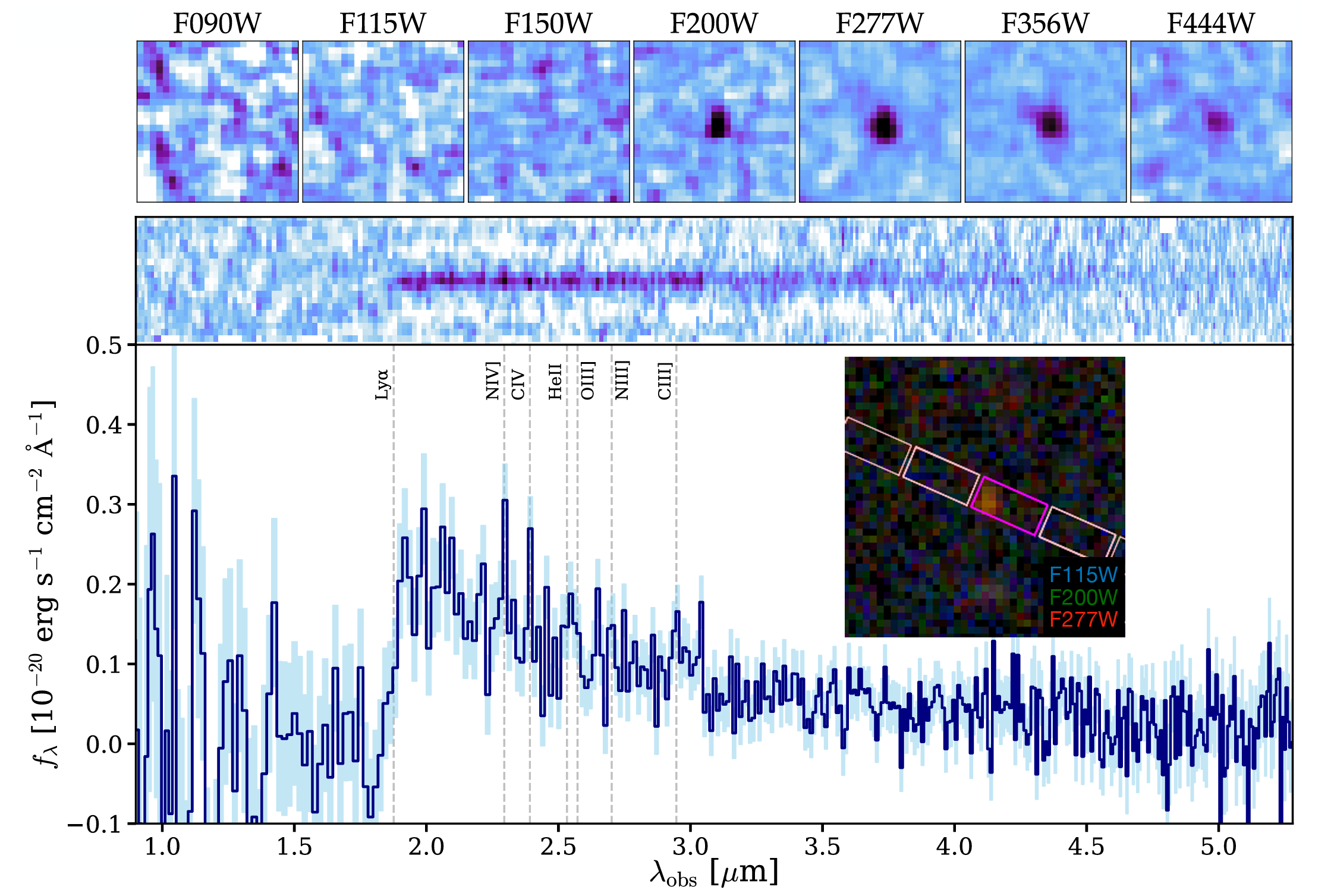
The team determined MoM-z14’s redshift of 14.44 using JWST’s Near Infrared Spectrography (NIRSpec). Light emitted from MoM-z14 has been travelling for nearly 13.5 billion years to reach Earth due to cosmic expansion. Therefore, MoM-z14 represents the closest object observed back to what is known as the cosmic dawn, when the universe began to form.
“Using JWST has enabled us to see much farther back into the ancient past than we are capable of doing here on Earth, and yet what we see does not correspond to anything we had anticipated. The data is both exciting and perplexing,” said Rohan Naidu from MIT’s Kavli Institute for Astrophysics and Space Research, lead author of this study.
There can be issues with estimating distance using only images at such great distances, and therefore spectroscopy was critical in validating what the team had observed. “Estimating distances from images is meaningful for galaxies, but there is a need to substantiate your findings with high-quality spectroscopic data before you can make total determinations about what you’re viewing, and how far away it may be,” said Pascal Oesch from the University of Geneva, co-principal investigator of the survey.
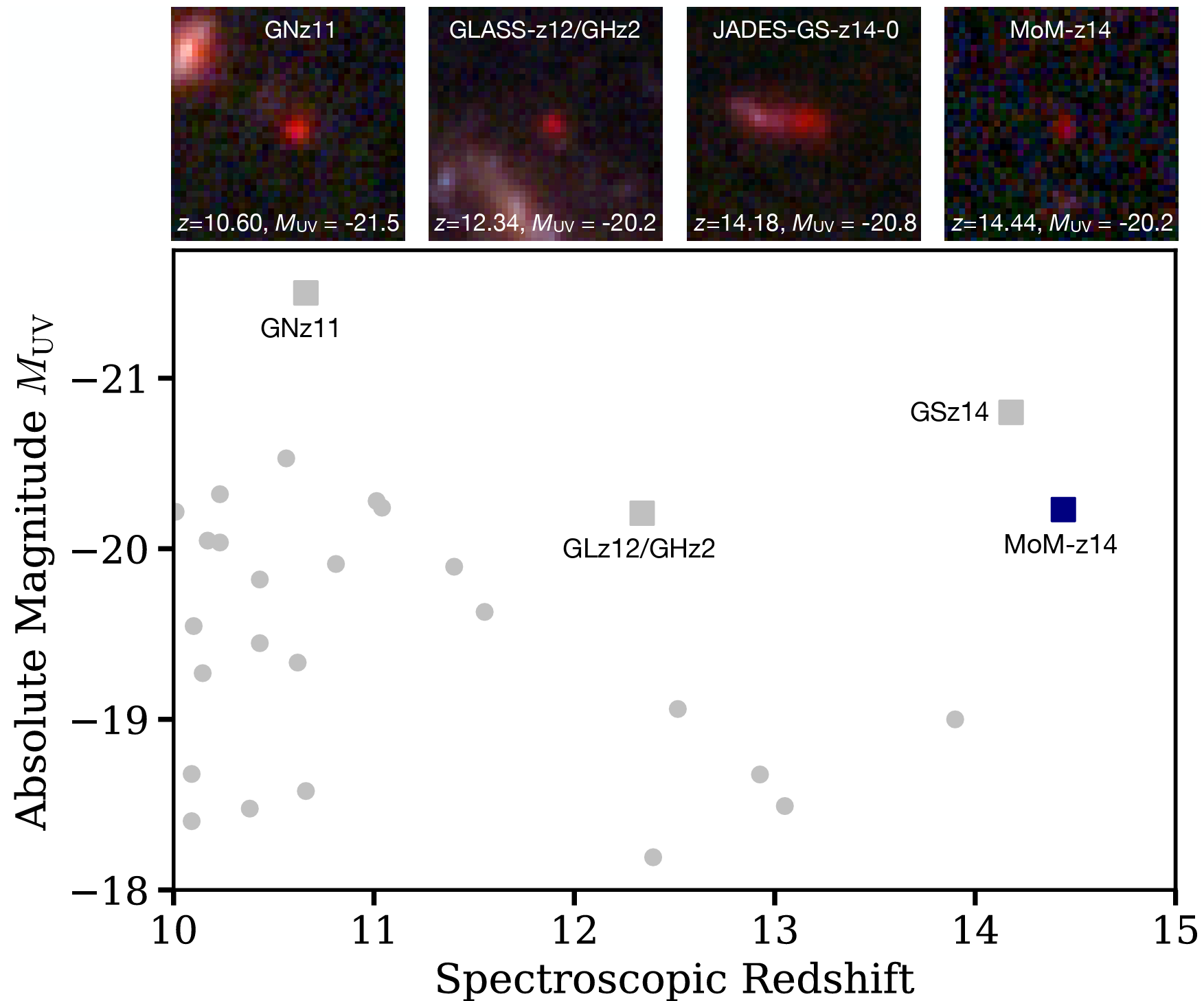
Not only is MoM-z14 a long way away, but it is also very bright. Prior to Webb being sent into space, most theorised that there would be very few faint or nonexistent galaxies that formed within the first 500 million years of the universe. Webb is finding many more bright, luminous galaxies than expected from this period. The researchers find that these bright galaxies are about 100 times more abundant than predicted.
“There is an increasingly large discrepancy between the predictions of the early universe and what we observe,” said Jacob Shen, a postdoc at MIT.
Even with all of its brightness, MoM-z14 is relatively small. The image shows it to be only about 74 parsecs in diameter, which is much smaller than predicted for a galaxy of this luminosity. Its morphology indicates that it has experienced recent star formation and does not have a lot of light from a central black hole.
The models suggest that MoM-z14 has about 100 million solar masses, similar to a current dwarf galaxy, but with a much higher star formation rate.
The composition of MoM-z14 is also very low in dust. This allows ultraviolet light to escape from the galaxy easily, which is why it appears so bright to Webb. Evidence suggests that there was a rapid increase in star formation in MoM-z14 over the past few million years.
The spectral data obtained from Webb indicate that MoM-z14’s chemical make-up is different from that of more recent stars. Naidu told The Brighter Side of News that the galaxy exhibits a significant nitrogen enrichment feature that is not often found in nearby galaxies and has been detected in only a few other early objects.
He added that researchers can learn from archeological approaches used to study these stars, as they serve as a fossil record of the early universe. In astronomy, Webb allows scientists to obtain direct evidence of galaxies from this time period. “In addition to the effects we can observe from the evolution of objects in our local universe, we are witnessing an abundance of features that are similar to those found within the early universe,” Naidu said.
The idea that the chemical composition of galaxies shortly following the Big Bang would vary compared with those seen today is puzzling. Approximately 280 million years after the Big Bang, there were only a limited number of stellar generations capable of producing significant amounts of nitrogen.
One explanation is that the early universe was forming supermassive or very massive stars, which would have facilitated large-scale nitrogen production on very short timescales. Another possibility is that the high density of star clusters during this period altered how elements formed and were released, creating a new chemical pattern.
The chemical constituents observed in some of the oldest stars of the Milky Way and in globular clusters share evidence of a common origin from the earliest stellar populations that ever existed in the universe.
Moreover, MoM-z14 offers a window into the eventual reionization of the universe. This defining moment occurred when turbulent conditions allowed starlight to dissipate the dense hydrogen cloud filling the cosmos. The galaxy’s spectrum shows very little absorption from surrounding neutral hydrogen, which is interpreted to mean that its immediate environment may have already been partially ionized.
Mapping when and how reionization occurred is one of the main goals of the Webb mission. Based on these observations, scientists conclude that the process of reionization likely started earlier or progressed faster in certain regions than originally believed.
Astronomers observed evidence of surprisingly high levels of activity in the early universe even before the launch of Webb. The Hubble Space Telescope identified the galaxy GN-z11 approximately 400 million years after the Big Bang. Webb later confirmed its distance and went on to detect even older galaxies such as MoM-z14.
As these observations build on one another, scientists are preparing to take the next step. The upcoming NASA Nancy Grace Roman Space Telescope will combine wide-field infrared imaging with high-resolution detail, enabling researchers to find thousands of similar galaxies from the early universe.
According to Yijia Li of Pennsylvania State University, “To better understand what was happening in the early universe, we need additional data, better observations with Webb, and a larger sample of galaxies to see where the common characteristics exist. Roman will provide that.”
The discovery of MoM-z14 is expected to reshape how astronomers understand the earliest galaxies. This galaxy shows that star formation began sooner than expected, progressed more rapidly, and emitted more light than previously thought. As a result, new models will be developed to explain galaxy formation, star formation, and chemical enrichment.
The findings also provide further insight into the timing of cosmic reionization, a key process in understanding how structure formed in the universe.
Over time, this research may offer a clearer picture of how the first stars created the conditions necessary for modern galaxies such as the Milky Way. It may also help explain how the universe became capable of supporting the first forms of life.
Research findings are available online in the journal arXiv.
Like these kind of feel good stories? Get The Brighter Side of News’ newsletter.
The post JWST confirmed the most distant galaxy ever observed at 13.5 billion light years away appeared first on The Brighter Side of News.

