The light from LHS 3844 b does not suggest oceans, clouds, or even air. What it points to instead is a dark, battered surface. This surface may have more in common with Mercury or the Moon than with anything you would recognize from Earth.
Using the Mid-Infrared Instrument, or MIRI, aboard the James Webb Space Telescope, a team led by Sebastian Zieba and Laura Kreidberg, from the Max Planck Institute for Astronomy and Center for Astrophysics | Harvard & Smithsonian, examined the rocky exoplanet’s dayside glow and used it to probe the planet’s surface. Their results, published in Nature Astronomy, suggest that LHS 3844 b is likely airless. They also found that it is coated either in fresh volcanic rock or in older material that has been darkened and ground down by space weathering over time.
That alone marks a shift in what astronomers can do. For years, much of exoplanet science focused on atmospheres. Here, the target was rock.
LHS 3844 b sits about 48.5 light-years away and is about 30 percent larger than Earth. It circles a cool red dwarf star in roughly 11 hours and hugs it so tightly that the same side always faces the star. Because of that proximity, the permanent dayside reaches about 1,000 Kelvin, hot enough to glow strongly in the infrared. However, it is apparently not hot enough to melt into a global lava surface.
“Thanks to the amazing sensitivity of JWST, we can detect light coming directly from the surface of this distant rocky planet,” Kreidberg said. “We see a dark, hot, barren rock, devoid of any atmosphere.”
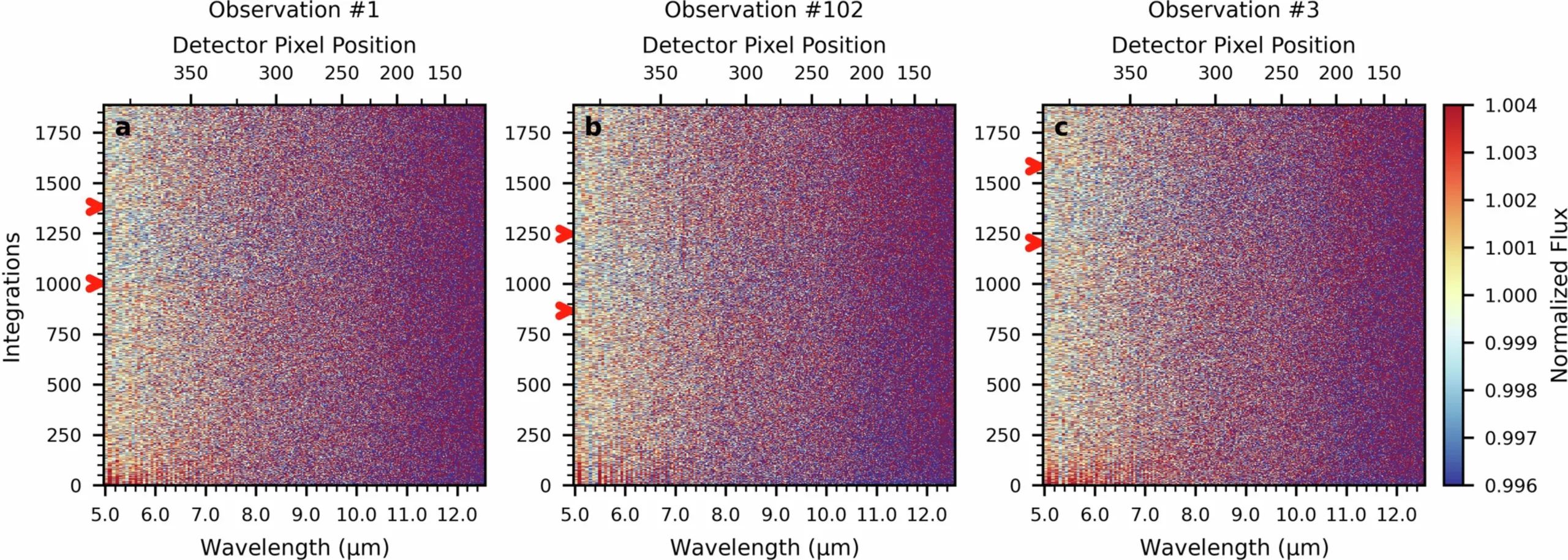
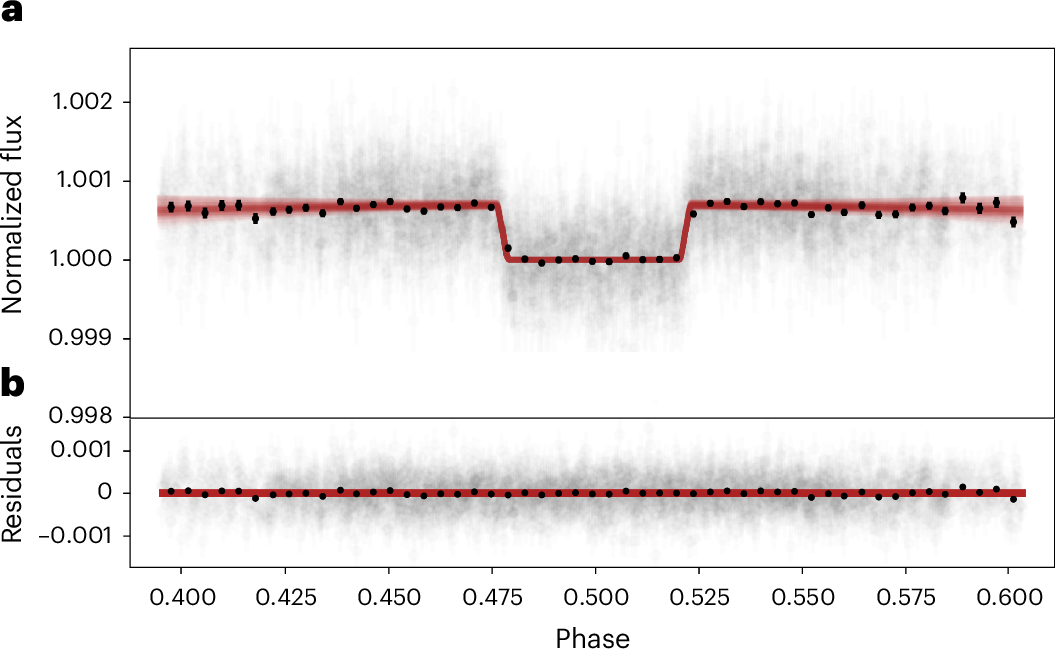
The team did not image the planet directly. Instead, they measured tiny changes in the total brightness of the star-planet system as the planet moved through its orbit and slipped behind its star. MIRI split the planet’s thermal emission between 5 and 12 micrometers into smaller wavelength bins. This process produced a spectrum that could be compared with models of known rocks and minerals.
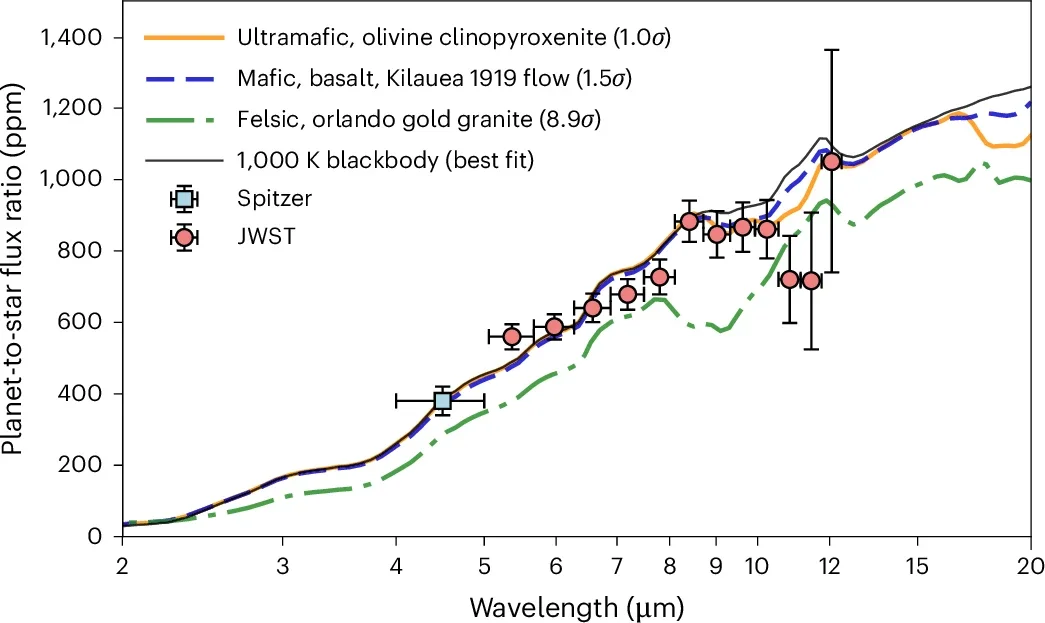
The researchers also added an earlier Spitzer Space Telescope measurement in the 4 to 5 micrometer range. Together, the data showed a planet with a dark, nearly featureless spectrum that matches a roughly 1,000-Kelvin blackbody fairly well.
That lack of strong features mattered.
The team compared the observations against libraries of rocks and minerals measured on Earth, the Moon, and Mars, including different surface textures such as solid slabs, coarse crushed material, and fine powders. Their analysis ruled out a surface like Earth’s granite-rich crust. They found a granite sample in the comparison set was rejected at about 8.9 sigma, and even severe space weathering could not rescue that fit.
That result carries geological weight. On Earth, granite-rich crust forms through long-term recycling and refinement of rock, processes tied to tectonic activity and often helped by water. However, LHS 3844 b does not seem to show signs of that kind of crust.
“Since LHS 3844 b lacks such a silicate crust, one may conclude that Earth-like plate tectonics does not apply to this planet, or it is ineffective,” Zieba said. “This planet likely only contains little water.”
What fit better were darker, magnesium- and iron-rich materials, especially basaltic or ultramafic rocks, and perhaps olivine-rich surfaces. Solid slab-like surfaces gave the best overall matches. Coarsely crushed surfaces also worked reasonably well. Fresh powders mostly did not, because they reflect more light and would appear cooler than what JWST saw.
But space can change that.
On airless worlds, micrometeorite strikes and intense radiation can gradually break down the surface into fine material called regolith while also darkening it. On the Moon and Mercury, some of that darkening comes from tiny iron particles created during space weathering. Carbon can darken a surface too.
“It turns out, these processes not only slowly dissolve hard rocks into regolith, a layer of fine grains or powder as found on the Moon,” Zieba said. “They also darken the layer by adding iron and carbon, making the regolith’s properties more consistent with the observations.”
That left the team with two broad scenarios.
One is a surface dominated by dark, solid rock, perhaps basaltic or magmatic, that formed recently enough to remain relatively fresh. In that case, the planet may have experienced recent geological resurfacing, such as widespread volcanism.
The other is almost the opposite: a much older surface blanketed by regolith that has been darkened over long periods by space weathering. That picture would make LHS 3844 b look more like Mercury or the Moon, geologically quiet for a long time.
At the moment, both explanations fit the data.
The team tried to break that tie by looking for gases linked to volcanic activity. MIRI is sensitive to sulfur dioxide, or SO2, which can show up strongly in the infrared and often signals active outgassing.
It found none.
Using atmospheric models, the researchers ruled out several thicker atmosphere scenarios and also placed upper limits on sulfur dioxide. They excluded CO2-dominated atmospheres with surface pressures of 100 millibars or more at 5 sigma. In addition, they ruled out SO2 partial pressures of 10 microbars or more at 3 sigma. Venus-like sulfur dioxide levels were excluded by more than 12 sigma.
That weakens the case for recent, large-scale volcanism, at least if it would have produced detectable gases in the atmosphere. For now, the team leans toward the older, weathered-surface interpretation.
There are caveats. The atmospheric modeling assumed radiative-convective equilibrium and no clouds, and the observations covered only part of the planet’s thermal emission. The phase curve amplitude also could not be tightly constrained from the JWST data alone. Therefore, the analysis fixed it using the earlier Spitzer result that suggested essentially no nightside heat redistribution. Uncertainties also grow at the red end of the spectrum, especially beyond 10 micrometers, where some potentially interesting mineral features remain tentative.
The study also notes that volcanic gases, if released, might quickly freeze out on the planet’s cold nightside. That means active resurfacing cannot be fully ruled out.
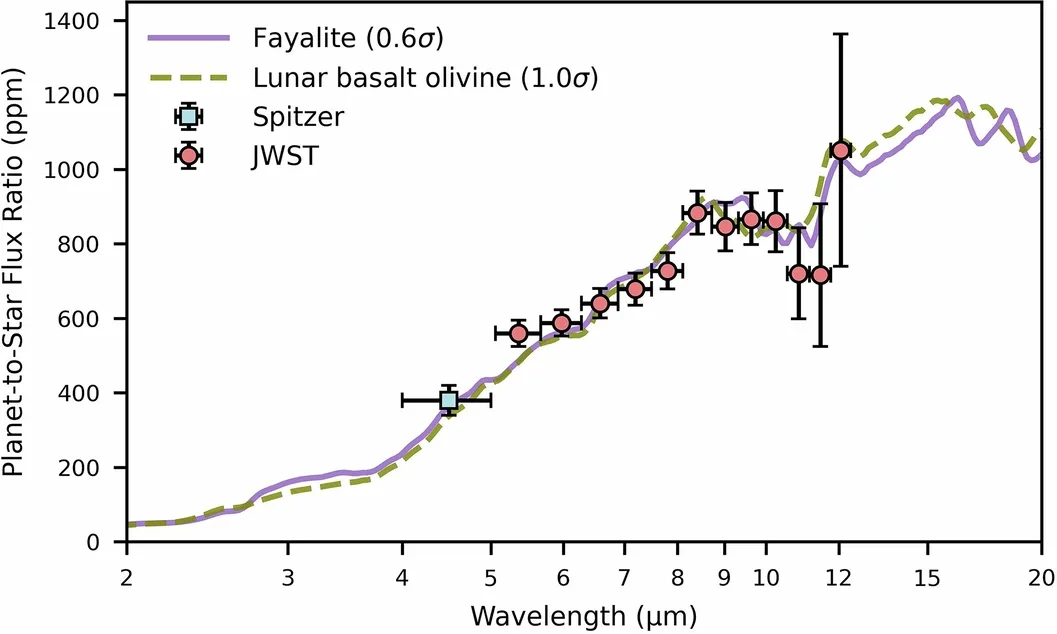
Even so, the picture is already striking. This is not a world with an Earth-like crust, and it does not look like one with a substantial atmosphere either. Its surface appears dark, poor in silica, and broadly consistent with mafic or ultramafic material rich in pyroxene and olivine.
The work shows that astronomers can now do more than hunt for exoplanet atmospheres. They can begin to read the geology of distant rocky worlds from thermal light alone.
That opens a new path for sorting rocky planets into types, not just by size and orbit, but by crust, surface history, and signs of activity. For LHS 3844 b, the result argues against an Earth-like, water-linked crust. Instead, it points to a harsher world shaped either by volcanism long ago or by relentless weathering in open space.
The team has already obtained additional JWST observations to test the difference between solid rock and powdery regolith by looking at how the surface emits light at different angles. If that works, the same approach could help decode the crusts of other rocky exoplanets. In other words, scientists could study them one scorched surface at a time.
Research findings are available online in the journal Nature Astronomy.
The original story “JWST finds a dark, airless exoplanet covered in rock like Mercury” is published in The Brighter Side of News.
Like these kind of feel good stories? Get The Brighter Side of News’ newsletter.
The post JWST finds a dark, airless exoplanet covered in rock like Mercury appeared first on The Brighter Side of News.

